Former OpenAI researcher changes his tune: Super AI researchers may arrive as early as next year
Our timeline has been moved forward!
On November 11, Daniel Kokotajlo, a former OpenAI researcher, shared the team's new prediction on X and said, "I feel scared, sad and angry."
He believes that the intelligence explosion will happen in 2027 after all: if METR's judgment holds, the AI-driven R&D acceleration will be about five months earlier than the original deduction in "AI 2027".
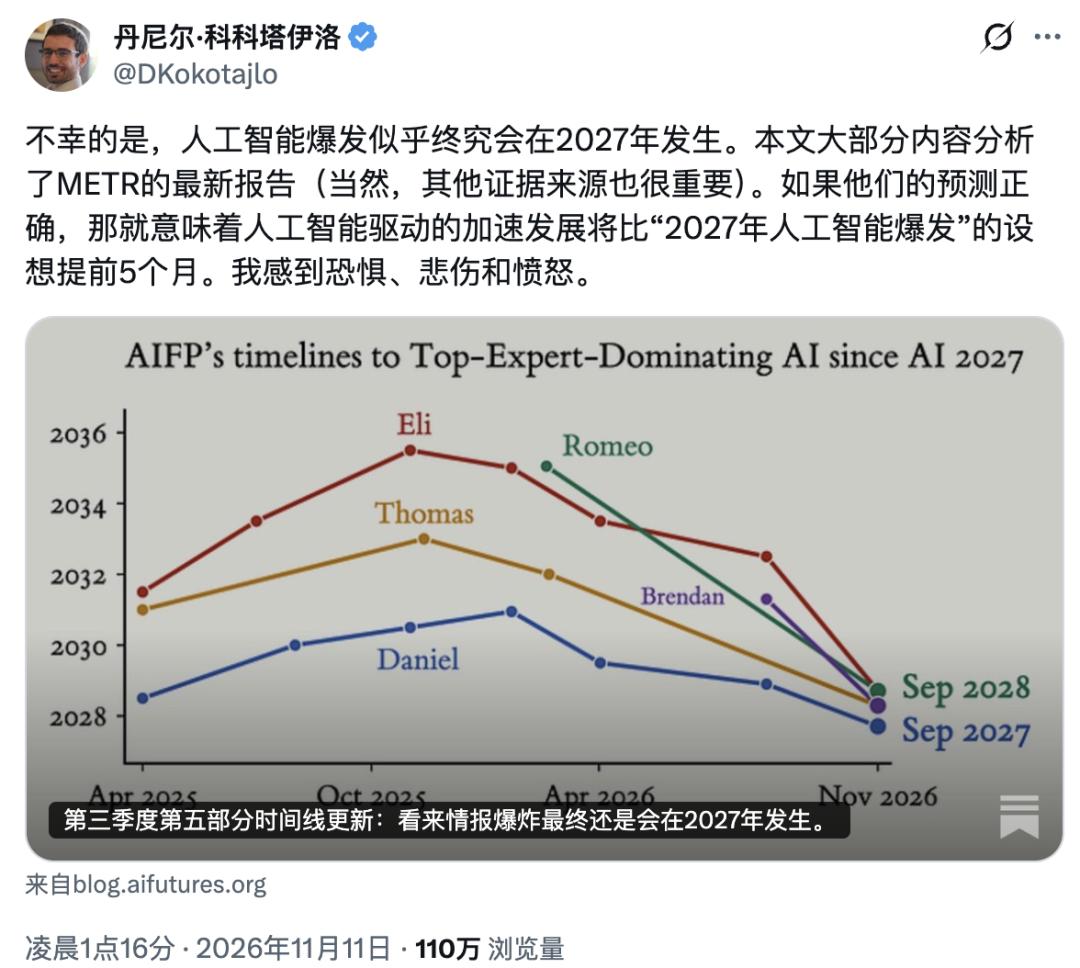
When AI starts to help humans develop the next generation of AI, even the most radical predictors may underestimate the speed of progress of AI models.
In less than three months, AI Futures Project, the prediction team behind "AI 2027", has moved the timeline for the arrival of Super AI Researcher (SAR) to next year.
Previously, Daniel Kokotajlo, the most optimistic member of the team, only gave a 50% probability when mentioning that "super AI researchers will emerge before 2029".
On November 10, AI Futures Project released a new round of forecasts (Q3.5).
The signed authors unanimously believe that if there is no significant and active slowdown in cutting-edge AI R&D, super AI researchers are very likely to emerge in 2027.
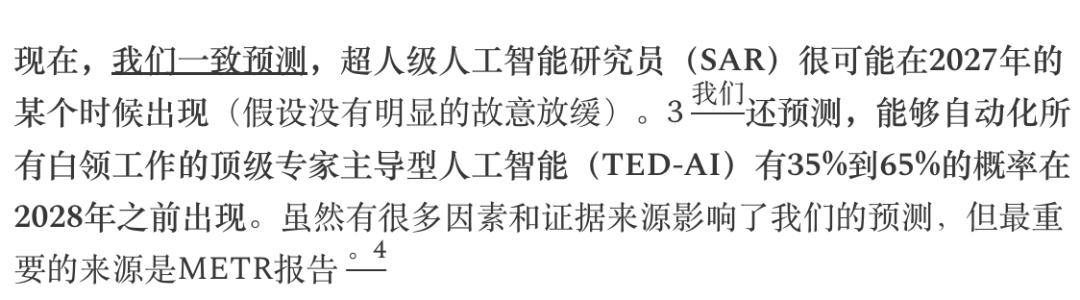
The most important basis that prompted them to change their judgment is a survey of Anthropic conducted by the independent assessment agency METR.
METR spent 11 weeks investigating Anthropic, reviewing internal data and interviewing employees, and finally estimated a number:
Since October 2025, the growth rate of the benchmark score of Anthropic's internal models has reached 1.9 times of the previous level.
According to this estimate, the one-year increase of Anthropic's models in this set of tests is equivalent to the growth of the past nearly two years.
Benchmark Score Growth Nearly Doubles, How Much Credit Goes to AI?
On November 5, METR released this report.
In order to see how fast Anthropic's models have improved, METR used an internal indicator called AECI.
It combines the scores of multiple tests into a total score. Most tests have clear goals, and the results can also be verified.
METR estimates that since October 2025, the growth rate of this total score is about 1.9 times of the previous level, with a 95% confidence interval of 1.5 to 2.8 times.
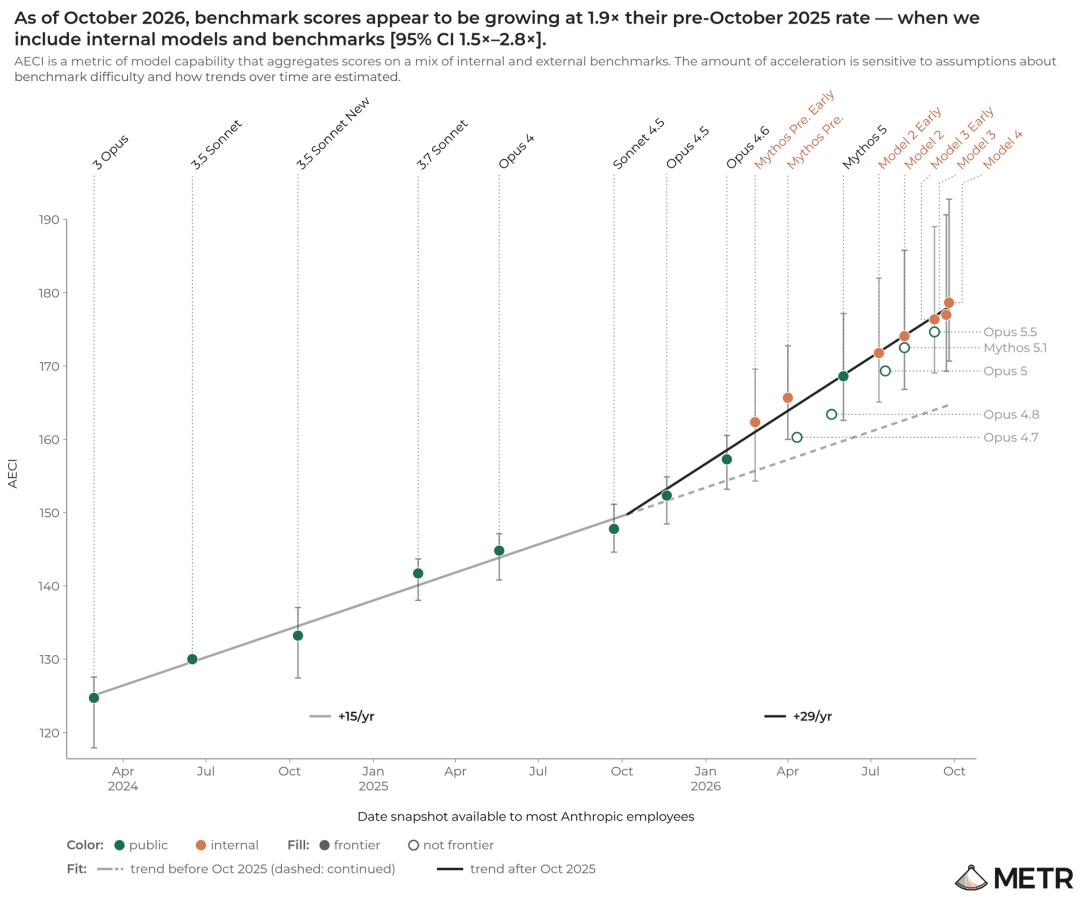
Around October 2025, the annual increase in the model's comprehensive score rose from about 15 points to about 29 points. (Source: METR)
How to estimate the difficulty of the questions will also affect the results.
METR recalculated with several different assumptions and found that the score growth rate after October 2025 is about 1.1 to 2.9 times of the previous level.
Several algorithms yield different growth rates, but the trend is obvious: the scores are rising faster.
Why are the scores rising faster?
METR examined the changes in training computing power, recruitment, data and algorithms, and believed that the change in the growth rate of training computing power cannot explain this acceleration.
However, the specific evidence supporting this judgment has been deleted in the public version of the report.
As for how much contribution AI has made, METR believes that this proportion is also changing over time.
When the acceleration just started at the end of 2025, factors other than AI most likely also played a role.
But by October 2026, METR estimates that about 80% of the extra speed gain compared to the past may come from AI.

Note that this "80%" is METR's subjective estimate. The report uses "We guess" and clearly points out that this judgment has great uncertainty.
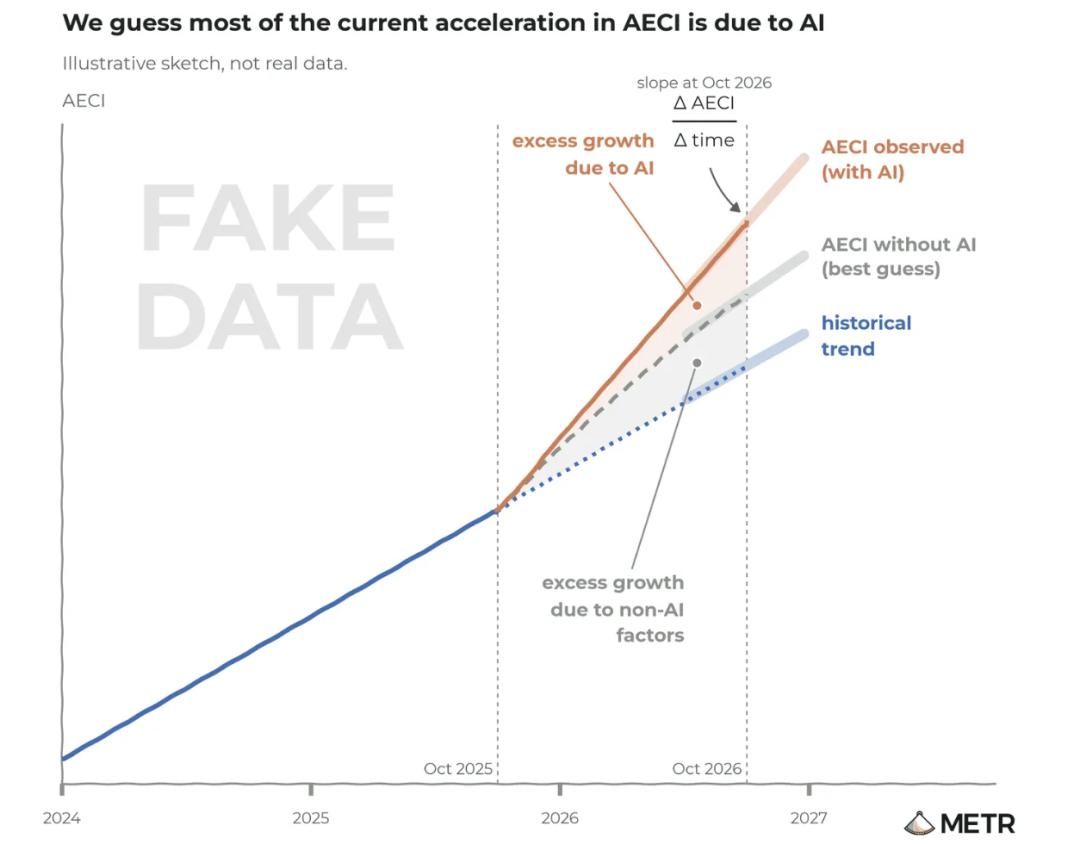
Schematic diagram of the contribution of AI and other factors to model acceleration. The orange area represents the extra acceleration brought by AI, and the gray represents the unsubdivided non-AI factors.
So what exactly does AI help with?
One interviewed researcher said that in the past, some ideas would take a day or two just to write code and run experiments.
With the help of AI, he is willing to try more ideas to see which ones work.
Other interviewed researchers also mentioned that AI helps write experimental code, monitor experiment operation, and complete some measurements that used to require a lot of extra effort.
Some people even give ten ideas to the agent at one time to let it help implement and test them.
From writing code to running experiments, AI is already helping to develop the next generation of AI.
According to the new estimate of AI Futures Project, this acceleration may come earlier than the original deduction in "AI 2027".
AI R&D Acceleration May Be 5 Months Faster Than the Deduction in "AI 2027"
The "AI 2027" released in April 2025 deduced how AI could help develop the next generation of models.
According to the setting at that time, the virtual company OpenBrain needed a week and a half to achieve the same amount of algorithm progress without AI, and only one week with AI.
But algorithm progress is only part of model progress.
An improvement that comes out of the experiment must be applied to the next round of training to be reflected in the capabilities of the new model.
This time, AI Futures Project calculated based on METR's estimate that by early November 2026, the acceleration brought by AI alone may make the overall model progress speed reach 1.7 times of the historical level.
In order to see when this speed would appear in the old scenario, the team used the model to reproduce the general trend of "AI 2027".
The results show that the same 1.7x speed will not be reached until around April 2027. If the estimate in early November holds, the time when the model progress speed reaches 1.7 times will be about five months earlier than the old scenario.
This result also exceeds the team's expectations less than three months ago.
Even according to the most optimistic prediction model at that time, the probability that AI would push the overall model progress speed to 1.7 times or higher of the historical level in November 2026 was less than 4%.
Super AI Researcher Will Decide What to Research on Its Own
METR's report also made AI Futures Project move the timeline for super AI researchers forward.
According to their definition, a super AI researcher must first be able to handle all the programming work of a cutting-edge AI project.
In terms of choosing research directions, designing experiments, interpreting results and other matters, it also needs to have the judgment of a top human research team.
After the code is written, which idea should be tried next? When an experiment fails, should we continue to investigate the cause or change direction... AI has to make these decisions without ready-made answers by itself.
So when will AI cross this threshold?
In the same report, the time calculated by the three methods differs by more than a year.
One method first assumes that AI has pushed the model progress speed to 1.7 times the historical level. Then it takes into account that AI may take over more R&D work in the future.
According to this model, the median forecast is February 2027, which means that the probability of a super AI researcher emerging before this point in time is about 50%.
Another method extrapolates backward according to the speed of the model's progress in the test to estimate when it can have the judgment of a top research team, and the calculated median is July 2027.
The third method uses the efficiency improvement reported by Anthropic's own employees to extrapolate, and the result reaches mid-2028.
What Key Evidence Did Anthropic Delete?
METR stated at the beginning of the report that they believed most of the evidence that is most helpful for judging the core conclusions has been deleted.
The report also lists a table that compares item by item what internal materials Anthropic provided to METR and which results were included in the public version.
The benchmark score trend of internal models is made public, but the estimation of algorithm progress and key R&D investment are not disclosed. As for AI's contribution to R&D acceleration, the public version only lists part of the evidence.
According to the prior agreement, Anthropic can redact non-public information, and METR can point out which conclusions rely on these materials.
Anthropic's reason is that publicizing this confidential information may help other developers accelerate AI R&D.
After the redaction, which conclusions can the outside world still verify?
AI Futures Project pointed out that the benchmark score growth rate is about 1.9 times the previous level, which is supported by the public curve.
As for the "about 80% of the extra acceleration may come from AI" and the 1.7x speed extrapolated based on it, there is far less public evidence.
To judge whether these two figures are reliable, the outside world relies more on METR's assessment of internal materials.
On November 5, METR also released a review of Anthropic's August risk report.
Both METR and Anthropic believe that the risk of directly causing a disaster by using the mid-July model to automatically conduct R&D is still relatively low. Both sides also tend to believe that the R&D acceleration at that time had not reached the warning line set by Anthropic.
However, METR believes that Anthropic's public report underestimated the magnitude of the acceleration at that time, and the actual acceleration may have already touched the warning line.
Next, we will first see whether AI helping researchers write code and run experiments faster can make the next generation of models delivered earlier. Then see whether after this stronger model is put into R&D, it can also shorten the R&D cycle of the next round.
If the acceleration can be accumulated generation by generation, Artificial Super Intelligence (ASI) may arrive earlier than expected.
References:
https://blog.aifutures.org/p/q35-timelines-update-looks-like-the
https://metr.org/blog/2026-11-05-anthropic-ai-rd-acceleration-assessment/
https://ai-2027.com/
This article is from the WeChat official account "AI Era" (ID: AI_era), written by Yuan Yu, and authorized for release by 36Kr.