Intense competition in the AI pharmaceutical sector has now shifted to laboratories.
AI can generate tens of thousands of molecules in an instant, but producing them still requires a large amount of time and experimental resources.
This is precisely the new problem that AI drug discovery is facing: molecular design and computational screening are continuously accelerating, yet experimental capabilities do not necessarily grow in sync.
As molecular design and computational screening keep accelerating, experimental capabilities are becoming a new competitive focus for AI drug discovery. Laboratories are no longer just places to verify model results; they also need to continuously produce high-quality data, so that experimental results can in turn drive model optimization.
In recent years, a number of AI pharmaceutical companies have started to build their own laboratories, integrating experimental capabilities into their technology platforms. Terray Therapeutics is one of such cases.
This AI pharmaceutical company founded in 2018 integrates high-throughput experimental equipment, automated experimental workflows and AI models into one single R&D system, trying to transform the laboratory from a verification link in the R&D process into a data source for continuous model learning.
In October 2026, Terray announced the progress of its cooperation with NVIDIA: the two parties fine-tuned the Nemotron series vision-language models to extract molecular structures, reactants and synthetic routes from chemical reaction diagrams in scientific papers. In the RxnCaption benchmark test, the model's HybridMatch F1 score increased from 59.8 to 63.4.
This progress does not mean that the synthesis efficiency of the laboratory has been improved. It reflects that the model's ability to identify and extract chemical reaction information has been enhanced, providing more available data for subsequent synthetic route planning.
From experimental data production to molecular prediction and synthesis planning, Terray is trying to connect AI and laboratories into a continuously operating R&D closed loop.
Making the Laboratory Part of AI R&D
Facing the problem of insufficient data, Terray chose to start with the laboratory, connecting experimental data production, model design and subsequent verification to form a continuously iterating R&D closed loop.
In November 2025, Terray named this system EMMI (Experimentation Meets Machine Intelligence). It is not a single model, but a small molecule R&D platform that connects experimental hardware, automated workflows and multiple AI modules.
The laboratory is first responsible for producing data.
Although public databases have accumulated a large number of molecular structures and experimental results, there are differences in detection methods, experimental conditions and data accuracy among different laboratories, and the coverage of non-hit molecules is also insufficient. For targets that lack known active molecules and have not been fully studied, it is often difficult to obtain sufficient training information only by relying on public data.
Therefore, Terray independently developed an ultra-high-density microarray chip to fix a large number of small molecules on the chip and measure their binding to target proteins in parallel. Its value is not only to improve the screening throughput, but also to continuously obtain quantitative experimental data suitable for model training. As a result, the laboratory is no longer just a verification department for model results, but a data entry point for the AI system.
As of June 2026, Terray disclosed that it has completed more than 420 billion individual measurements in total, involving more than 17 billion unique "target-molecule" interactions. These data provide new information for model training, and also help the company explore the chemical space that has not been fully covered in public databases.
With the data, different models participate in R&D decisions respectively:
COATI is a foundational chemistry model that maps molecular strings, 2D structures and 3D conformations to a unified mathematical representation space, providing a basis for subsequent molecular generation and property prediction;
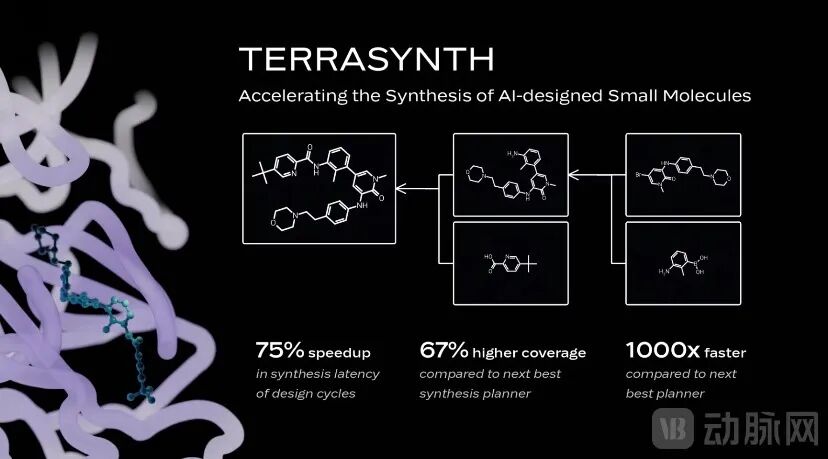
TerraSynth is a synthetic route planning model that proposes synthetic routes for candidate molecules, and considers whether the molecules can be actually synthesized in the design stage in advance;
TerraBind is a binding potency prediction model that evaluates how strong the possible binding ability of small molecules to target proteins is;
EMMI Select is an experimental selection module that combines model prediction results and uncertainty assessment to assist in deciding which batch of molecules to prioritize for synthesis and testing next.
These modules solve different problems in the same R&D process: from molecular characterization, synthesis planning and binding potency prediction, to selecting the set of candidates most worthy of verification. After all, models can propose tens of thousands of designs, but the number of molecules that laboratories can synthesize and test is limited, and the highest prediction score does not necessarily mean that the molecule is most worthy of investing experimental resources.
In terms of synthesis planning, Terray launched TerraSynth in June 2026. According to its disclosure, in 17 internal projects, the molecules proposed using this workflow are about 2 to 4 times faster in synthesis than the design schemes that do not consider synthesis constraints, and the synthesis delay is reduced by up to 75%.
Collaborating with NVIDIA to parse chemical reaction diagrams is also a data supplement for this link: through the vision-language model, the reaction diagrams in papers are converted into structured information, providing more data for the model to learn the laws of chemical reactions.
In terms of binding potency prediction, Terray also announced the test results of TerraBind-Struct. The company stated that on a single NVIDIA A6000 GPU, the end-to-end inference speed of TerraBind-Struct for a single protein-ligand complex is about 26 times that of Boltz-2; on the public CASP16 test set and the company's internal dataset, the Pearson correlation coefficient between its binding potency prediction and experimental data is about 16% to 20% higher than that of Boltz-2.
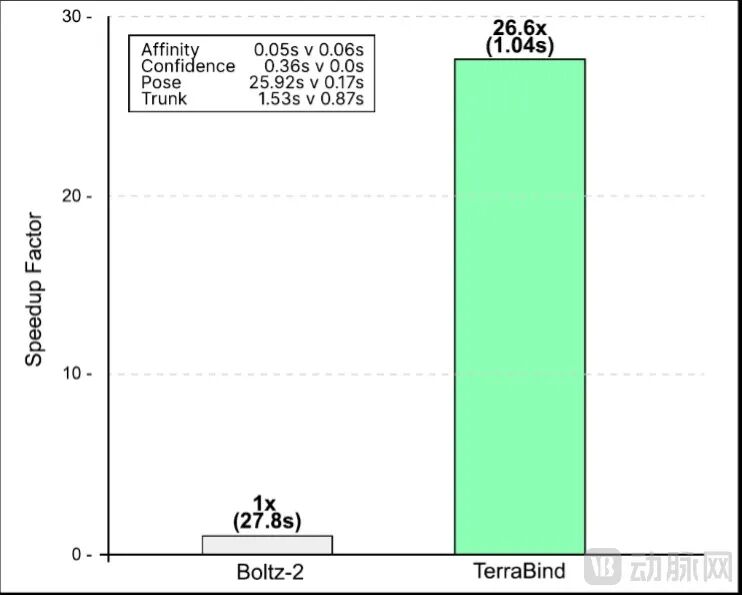
Compared with Boltz-2, the end-to-end inference time for each complex has been increased by 26 times (using 196 tokens, 10 samplings and NVIDIA's cuEquivariance kernel on a single A6000 GPU)
This means that Terray hopes to screen more candidate molecules under limited computing and experimental resources, and deliver the designs most worthy of verification to the laboratory.
What it solves is not "which molecule has the highest score", but "which set of experiments is most worthy of priority implementation".
Finally, let the experimental results flow back to the model.
Terray connects AI design and laboratory automation through customized software, linking molecular synthesis, experimental detection and model update. The new round of experiments is not only used to verify predictions, but also generates new training data that affects the next round of molecular design.
Therefore, what Terray hopes to establish is not a one-way process of "AI generation - manual verification", but:
Experiment produces data - model proposes designs - laboratory synthesizes and tests - results flow back to the model.
This closed loop is the core of EMMI. COATI, TerraBind, TerraSynth and EMMI Select are not isolated products, but undertake tasks such as molecular characterization, property prediction, synthesis planning and experimental selection respectively, and are embedded into the R&D process together.
Cooperation Comes First, Followed by Pipeline
Whether the technical system is effective ultimately needs to be answered by R&D projects.
At present, Terray has established cooperation with many pharmaceutical companies.
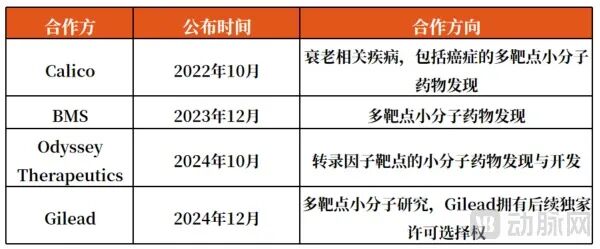
Overview of Terray's cooperation status
In these cooperations, pharmaceutical companies mainly provide target resources and related disease biology knowledge, while Terray relies on its own high-throughput experiments and AI platform to carry out small molecule drug discovery. According to the cooperation agreement, the two parties have different divisions of labor in subsequent R&D and commercialization links.
Take the cooperation with Gilead as an example, the two parties carry out small molecule drug discovery and development around multiple targets. If Gilead exercises its exclusive license option, it will be responsible for the subsequent development and commercialization of related compounds; Terray will be eligible to receive upfront payments, R&D and sales milestone payments, and sales royalties.
In December 2025, Terray announced that it had reached the first drug discovery milestone in its cooperation with BMS, saying that the relevant results involved challenging targets that previously lacked chemical starting points. However, the company did not disclose the specific target, candidate molecule, project stage or milestone amount.
Compared with the progress of cooperation, Terray's self-developed pipeline still needs time to verify.
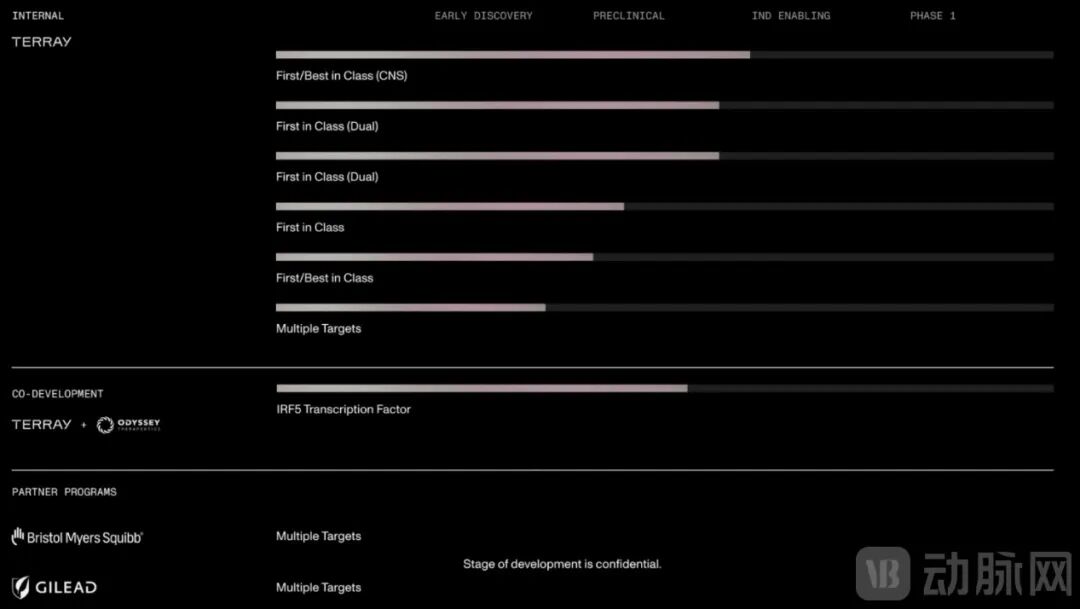
Overview of Terray's pipeline in development
In February 2026, CEO Jacob Berlin said in an interview with GEN that the company's fastest advancing self-developed project is a brain-penetrant inhibitor for multiple sclerosis, which is expected to enter the clinic in 2027. The interview did not disclose specific targets and preclinical data.
This schedule is delayed compared to the company's previous expectations. In 2024, Terray expected its first candidate drug to enter the clinic in 2026; by February 2026, this timeline was updated to 2027.
This also reflects the current development stage of Terray: the platform continues to expand, cooperations are continuously advancing, but the self-developed pipeline is still in the preclinical stage.
A one-year difference is hardly a breach of promise, but it shows that platform capabilities and clinical progress are two different curves. Phased milestones in pharmaceutical company cooperation can reflect the application value of the platform in specific projects, but self-developed drugs still have to go through links such as candidate identification, preclinical research and clinical trials.
Whether Terray's platform can be truly transformed into drug assets still needs more project results to answer.
AI Drug Discovery, Each Company Has Its Own Laboratory
Not all AI pharmaceutical companies take building their own laboratories as the core of platform construction. Even if they are all investing in experimental capabilities, the data produced by each company is different.
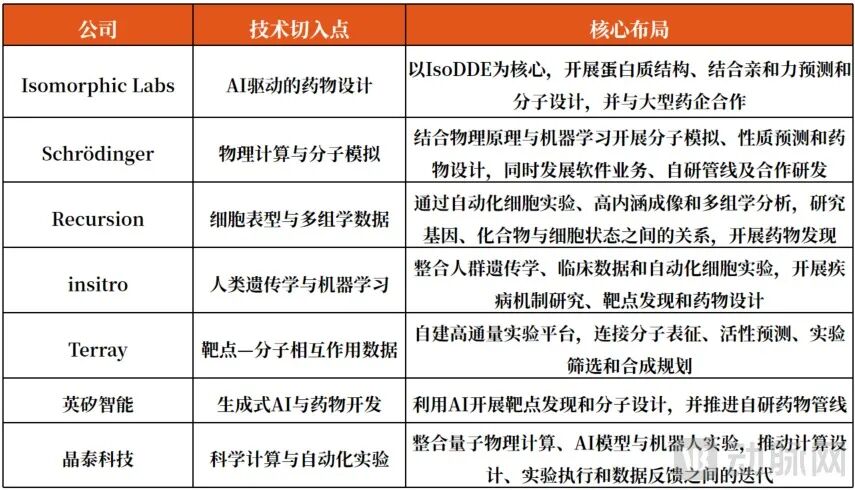
Technical entry points and platform layout of different AI pharmaceutical companies
A more fundamental question therefore emerges: who produces the data required by the model, in what way, and under what experimental conditions?
Terray's answer is small molecule-target interaction data. Through ultra-high-density microarray chips, it can perform parallel binding measurements of millions of small molecules with target proteins. These data are not only used to discover hit compounds, but also for subsequent lead compound optimization. The research objects are focused, and the measurement throughput is high.
Recursion takes cellular phenotypic data as an important entry point. Through automated cell experiments, high-content imaging and multi-omics analysis, it observes how cell states change after gene or compound perturbation, and finds disease-related biological laws from them.
insitro further combines cellular phenotypic data generated by the laboratory with population cohorts, clinical data and genetic information, hoping to identify intervention targets with more causal associations from the genetic and biological mechanisms of human diseases.
There are also enterprises whose platform construction does not take building their own high-throughput laboratories as the core. Schrödinger started with computational chemistry and molecular simulation software, and software products and services are still its main source of revenue, while also carrying out drug discovery business; Isomorphic Labs focuses on advancing AI drug design models, and the IsoDDE released in February 2026 covers capabilities such as protein structure prediction, binding pocket identification and binding affinity prediction. They show that building a self-owned laboratory is not the only development path for AI pharmaceutical platforms.
Chinese enterprises are also exploring different experimental paths.
Insilico Medicine combines AI platform construction with the advancement of self-developed pipelines. Generative AI is used for target discovery and molecular design, and candidate drugs are continuously advanced for clinical development by the company. Its independently developed Rentosertib entered Phase III clinical trials in 2026, and completed the first patient administration on September 9.
XtalPi combines quantum physics computing, AI models and robotic experiments, and orchestrates models and experimental equipment through agents to promote iteration between computational design, experimental execution and data feedback. Its experimental system not only undertakes the task of data production, but also tries to shorten the cycle from computational prediction to experimental verification.
When several paths are placed together, the difference does not lie in the area of the laboratory, but in two questions: what data does the experiment produce? Can this data continuously feed back to the model? The former affects the problems that the model can study, while the latter relates to whether the model can be continuously improved through experimental feedback.
In this industry map, Terray's position is clearer: it puts high-throughput small molecule-target interaction data production at the core of the platform, and then connects experimental data to subsequent molecular discovery and optimization through prediction, screening and synthesis planning.
The Laboratory Is the Entry Point, and the Drug Is the Answer
In the past, the competitive focus of AI drug discovery was mainly whether models could predict structures, discover targets and generate molecules.
As the efficiency of design and prediction improves, new bottlenecks gradually emerge: whether candidate molecules can be synthesized, whether experiments can be verified in a timely manner, and whether experimental results can continuously improve the model. The stronger AI is, the more it needs real experiments to provide constraints.
This explains why Terray invests in chips, automated experiments, data infrastructure and models at the same time. It hopes to transform the laboratory from a verification link in the R&D process into a source of continuous AI learning.
Of course, it is not that the larger the laboratory is, the better, nor the more data, the better.
Whether 420 billion measurements can be transformed into better candidate drugs, whether the efficiency improvement in internal projects can be replicated on more targets, and whether cooperation milestones can continue to advance to clinical projects, still need results to prove. In particular, repeated measurements, data coverage and experimental costs cannot be replaced by a single scale figure.
For Terray, the next tests are very specific: whether the first candidate drug can enter the clinic according to the new schedule, whether EMMI can continuously deliver R&D results for different targets, and whether the self-developed pipeline can produce publicly available clinical data.
Laboratories are becoming a new competition field for AI drug discovery, but laboratories are only the entry point, and drugs are the answer.
From generating a molecule, to synthesizing it, and then to proving that it is useful for patients, AI drug discovery still has a long way to go.
This article is from the WeChat official account "VCBeat" (ID: vcbeat), author: Huang Yurou, published with authorization from 36Kr.