From grading machines to teachers' workstations, what new AI products have been launched and put into use on campus in the past half year?
In the past six months, education enterprises have launched a batch of AI products targeting school teaching scenarios. From intelligent marking machines and AI learning situation analysis platforms to AI lesson preparation assistants and teacher agents, the teaching links covered by the products are constantly being enriched.
For example, iFlytek has launched the Spark Intelligent Marking Machine M50 and Starlight Teacher Agent, 7networks continues to update its intelligent marking and learning situation analysis functions, Zuoyebang has released the Yunsi AI Smart Teaching PAD, and Hailiang Technology has launched the teacher workstation HaiMate. At the same time, enterprises including Feixiang Planet and Seewo have also launched new products in scenarios such as AI lesson preparation and classroom interaction.
In terms of specific functions, these products are mainly focused on intelligent marking, learning situation analysis, AI lesson preparation, classroom teaching and teacher agents. From intelligent marking to teacher agents, what changes are taking place in AI education products?
PART.01 Intelligent Marking: From Homework Grading to Learning Situation Analysis
Homework grading is one of the earlier applications of AI entering school teaching scenarios. In the past six months, related products have continued to be updated in terms of question types for grading, error cause analysis and learning situation feedback, and their product forms are also different.
On September 1, iFlytek introduced the new generation of Spark Intelligent Marking Machine M50 on its official website. At the end of October, the product was exhibited at the Changsha Education Equipment Exhibition. The M50 generation integrates the scanning and printing ports. Even if the order of paper-and-pencil homework is disrupted, the device can print the marking traces on the corresponding original test paper. When marking geometric proof questions, the system supports step-by-step grading. If a student selects the correct theorem but misses a step in the reasoning process, the teacher can view the corresponding step in the marking result. For Chinese and English compositions, comments can be added next to the original text. iFlytek stated that the system classifies error causes by knowledge points, thinking methods and problem-solving habits, and generates learning situation reports and teaching review materials. The learning situation data platform displayed at the same time can also aggregate homework and exam data for teachers to view weak knowledge points and arrange error correction exercises.
7networks has previously provided intelligent marking and digital intelligent homework products for schools. The teacher app "7 Days Teaching Assistant" launched in September integrates lesson preparation, homework grading, learning situation feedback and collaborative proposition into one entry. Teachers can assemble test papers, take photos or upload homework, and check the weak points of the class and individual students after grading. When collaborating with colleagues to create test questions, the exercises can also be stored in the school-based resource library. According to the App Store version record, 7 Days Teaching Assistant was updated to iOS 1.0.0 on September 8. The update on October 15 added special dictation exercises, composition comments and learning situation analysis, and also supports teachers to handle abnormal test papers.
On October 30, Zuoyebang fully demonstrated its AI smart education solution for K12 schools for the first time at the Changsha Education Equipment Exhibition, and released the new teacher-end product Yunsi AI Smart Teaching PAD. The whole solution collaborates with smart terminals and education cloud, applies the self-developed large model and AI capabilities accumulated in the learning machine business to in-school teaching, and integrates the in-school service capabilities of Yunsi Smart Learning in teaching, research and evaluation. According to Zuoyebang's disclosure, this solution has covered more than 20 provinces and over 1,500 schools across China.
Yunsi AI Smart Teaching PAD supports multi-type homework grading and error cause analysis, and can call built-in teaching materials, auxiliary materials and question bank resources to assist test paper assembly and lesson preparation. During teaching, teachers can use the terminal to carry out classroom review, call up knowledge points and organize interactive exercises.
Seewo also organized campus observation during the same education equipment exhibition. There are already landing cases on the school side. Teachers at Changsha Lushan International Experimental Primary School use the Seewo Smart Homework Marking Machine to scan students' paper-and-pencil homework, and the answer data is imported into the Seewo Smart Homework System. Teachers then refer to the common error causes of the class aggregated by the system to determine the key points of the review. Students do their homework on paper as usual, and teachers have an additional summary of the whole class's answers when preparing for the review.
PART.02 AI Lesson Preparation and Classroom Teaching: From Courseware Generation to Classroom Interaction
In addition to homework grading, AI lesson preparation and classroom teaching are also the directions where enterprises have concentrated on product updates recently.
On August 24, Feixiang Planet under the Yuanli Technology Group launched the AI teaching tool for teachers "Feixiang Teacher 3.0". Previously, Feixiang Teacher already supported the generation of teaching animations and interactive courseware. The 3.0 version adds an educational application generation function. Teachers can describe teaching needs in natural language, and then create interactive applications that can be accessed through links and modified later.
These applications can call the capabilities of the Feixiang Education Large Model for subject explanation, personalized question generation and error cause diagnosis. Taking in-class exercises as an example, students can answer and view explanations in the application, and teachers can also adjust the activity content according to the recorded answer situation and task completion situation.
At the Service Trade Fair in September, Feixiang Planet demonstrated Feixiang Teacher 3.0 and the campus version of Feixiang Teacher for schools and regions. The new function of the 3.0 version allows teachers to turn teaching design into interactive applications that can be accessed through links. The campus version integrates Feixiang Planet's existing intelligent homework and composition tutoring products. Teachers can grade homework, view learning situations and prepare reviews in the campus version, and schools can also include the teaching materials made by teachers into the school-based resource library.
Seewo updated the classroom feedback system and Seewo Whiteboard two products at the same time. On August 31, Seewo announced the upgrade of the classroom feedback system, adding an AI assistant to the original classroom report. The report can present teaching links, teacher questions and teacher-student interactions. After the update, teachers can ask questions about a certain link, find corresponding records, and generate teaching reflections based on the report. According to Seewo's disclosure, Xiamen Jinlinwan Experimental School recorded a total of 2440 valid courses through the classroom feedback system in the 2026 spring semester, and used the classroom diagnosis report to carry out course evaluation and lesson case comparison discussions in teaching research.
On September 9, Seewo announced the update of the whiteboard version, announcing the access to Feixiang Teacher. Teachers can reference the interactive web pages generated by Feixiang Teacher into the Seewo Whiteboard courseware, and open them directly from the courseware during teaching. This update also involves AI lesson preparation and adaptation of old courseware. Teachers can modify existing courseware, and then insert the newly generated interactive activities into the corresponding pages.
PART.03 Teacher Agent and AI Workstation: Lesson Preparation, Teaching Research and Teaching Management
Lesson preparation and classroom review are also included in teacher agents and AI workstations, and enterprises have added functions such as learning situation analysis, grade analysis or class management to these products.
iFlytek released the teacher agent "Starlight" on April 24, and the product was officially launched on June 3. After teachers put forward lesson preparation requirements, the system can match lesson plans, teaching animations and exercise resources. When preparing review lessons, teachers can also specify knowledge points, question types and difficulty to generate exercises. According to iFlytek's exhibition materials, teachers can convert self-made or AI-generated interactive courseware into teaching applications, and collect students' answer records through the applications.
At the Changsha Education Equipment Exhibition in October, Starlight also demonstrated the functions of interactive courseware generation and class management. According to iFlytek's disclosure, some teachers from Haikou No.1 Middle School integrated the hydrological data of Yangpu Port into the trigonometric function exploration courseware, designed a dynamic modeling link, and allowed students to observe data changes in the courseware.
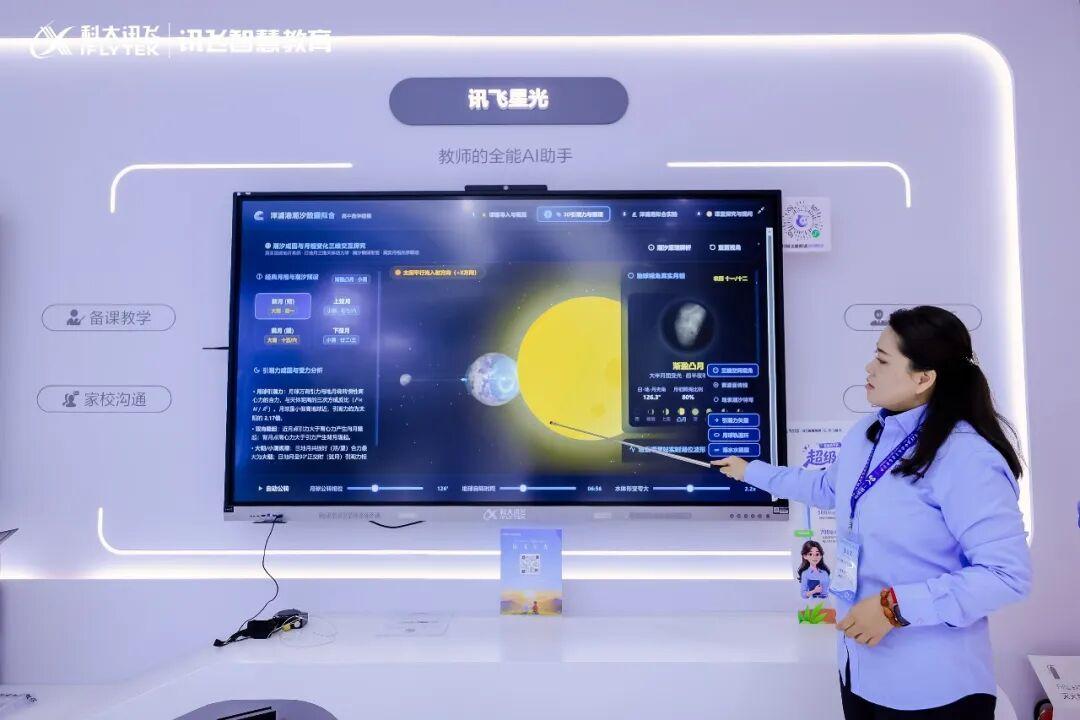
Starlight also handles teachers' daily class affairs. With the teacher's authorization, it can call the homework accuracy rate, weak knowledge points and correction status from Zhixue.com to generate student growth files or periodic learning situation reports. The supporting WeChat mini-program can publish homework, notices and forms, and summarize the list of unread, unsubmitted and unreceipted items.
Before launching HaiMate, Hailiang Technology already had the "Hongru Teaching Research" platform for schools, which is used for teachers' collective lesson preparation and school-based resource accumulation. At the same exhibition, Hailiang Technology under Hailiang Technology Service released the teacher workstation HaiMate on October 30, which integrates lesson preparation, grade analysis and classroom review. When preparing lessons, teachers can select the school stage, subject and lesson type, generate guided learning plans, lesson plans or teaching PPT, and then modify part of the content. At the press conference, Hailiang Technology took the 7th grade English textbook as an example to demonstrate how the system extracts knowledge points and maps the lesson preparation content to the textbook chapters.
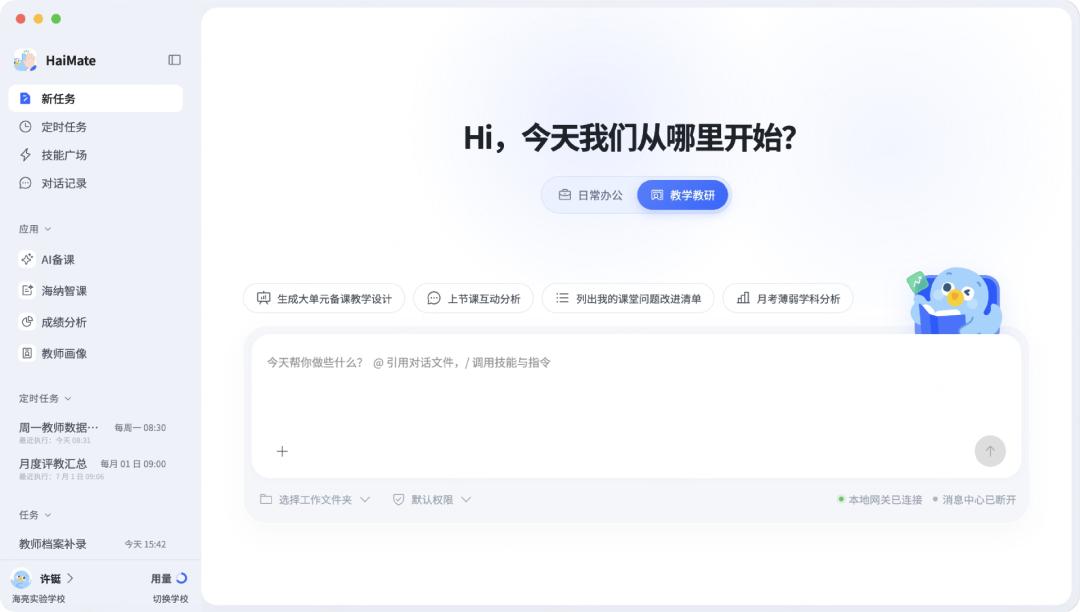
The other two functions of HaiMate are used after class. Teachers upload classroom recordings or transcription records, and the system will generate a review report from dimensions such as teaching methods and student interactions. After importing multiple periods of exam scores, HaiMate can generate the trend of previous scores, the comparison between classes and subjects, and the weak items that need attention. School administrators can continue to ask questions around the same report.
Starlight and HaiMate each combine several teacher tasks. The "AI Interdisciplinary Teaching Design Agent" jointly developed by the Primary School Affiliated to Renmin University of China and the Zhiqi team focuses on a specific lesson preparation task. This tool is developed on the "Zhiqi" platform operated by Zhiqi Wenhua. According to the report of Beijing Daily on September 10, this agent completed the key upgrade of the 3.0 version in the first half of 2026, and it has been iterated to 3.0. The first version generates teaching design according to the curriculum standard, the second version adds textbook resources, and the third version adds a knowledge graph to find the connections between knowledge points of different subjects.
Taking the fifth-grade Chinese text "Pyramid" as an example, when teachers prepare an interdisciplinary activity related to pyramid construction, they need to find the ramp in science class, the proportion in math class, and figure out which volume of the textbook these contents appear in. This agent puts the relevant knowledge points and textbook clues together for teachers to arrange activities.
From homework grading and learning situation analysis, to AI lesson preparation and classroom interaction, to teacher agents and workstations, the in-school AI products launched by education enterprises in the past six months have involved multiple links of teachers' daily work.
Products of different enterprises have different forms and functional focuses: some focus on a single teaching task, some integrate multiple teaching tools, and some develop agents around the textbook and teaching research needs of specific schools.
These products are currently in different landing stages, and they constitute a set of new samples for observing the in-school AI layout of education enterprises.
This article is from the WeChat official account "Duojing" (ID: DJEDUINNO), written by A Mei, and published with authorization from 36Kr.