Fable 5.2 text-to-video capability has also gone viral. It can generate 3D short clips with just one sentence, covering all the whole workflow including modeling, camera movement control and rendering.
Yesterday, Anthropic officially released Claude Fable 5.2 and Claude Mythos 5.2. Apart from its astonishing capabilities in programming, scientific research and robot operation, Claude's video generation ability is also worth discussing in depth on its own.
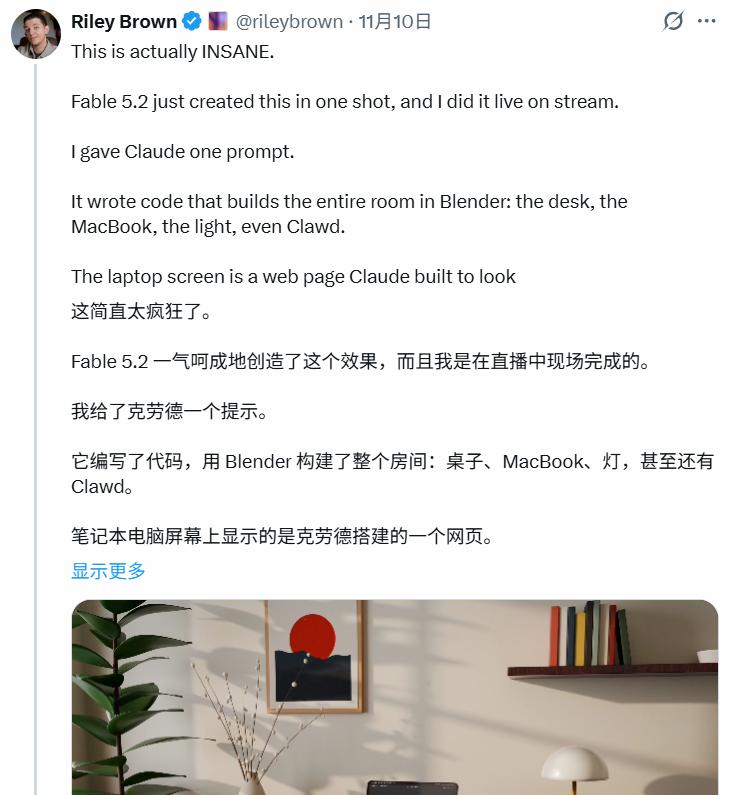
After the new model was released, developer Riley Brown posted a 3D short film titled "The Edge" on X.
https://x.com/rileybrown/status/2119902109709537708
The scene centers around a work desk. The MacBook on the desk lights up, Claude's lobster mascot Clawd moves around in the scene, with the keyboard keys, screen content and ambient light coordinating with each other. The camera keeps switching, the sky outside the window changes from dusk to night, and finally welcomes the sunrise.
This short film contains 13 shots and lasts about 59 seconds.
Riley stated that he only provided Fable 5.2 with a single prompt during the live stream. Afterwards, the model independently wrote Blender code, created models for the table, laptop, lamps and characters, arranged camera movements, and added animations to objects.
After completing modeling and animation, Fable called 10 GPUs on RunPod for 4K rendering, which took 52 minutes. The cloud rendering cost announced by Riley was 5.75 US dollars. The model also performed color grading for the footage, produced the title, and generated soundtrack and sound effects with the help of ElevenLabs.
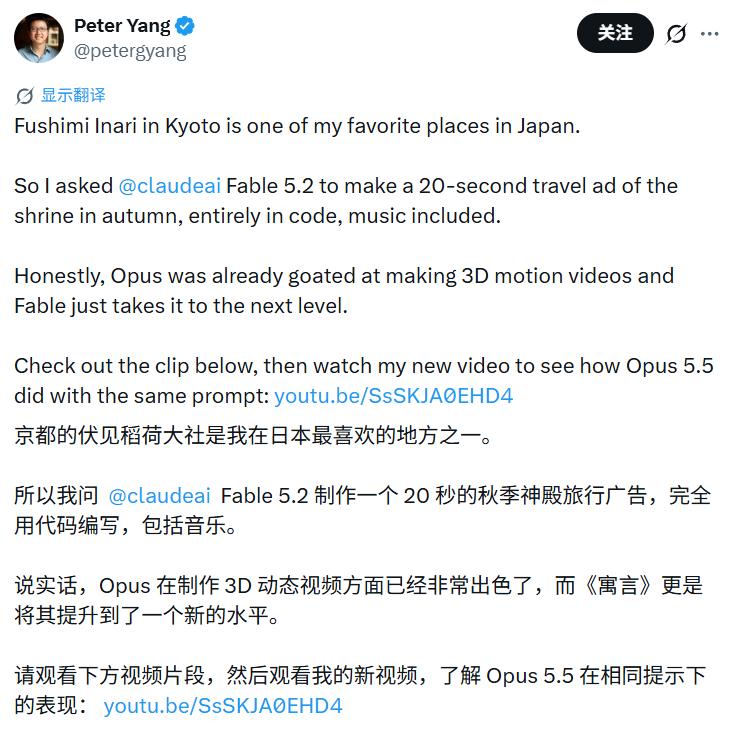
Another developer, Peter Yang, used Fable 5.2 to make a 20-second travel advertisement for the autumn trip to Fushimi Inari Taisha in Kyoto, Japan. The entire video is built through code and includes music.
https://x.com/petergyang/status/2119886560992854431
In fact, as early as September, Opus' video generation function had already become a hit
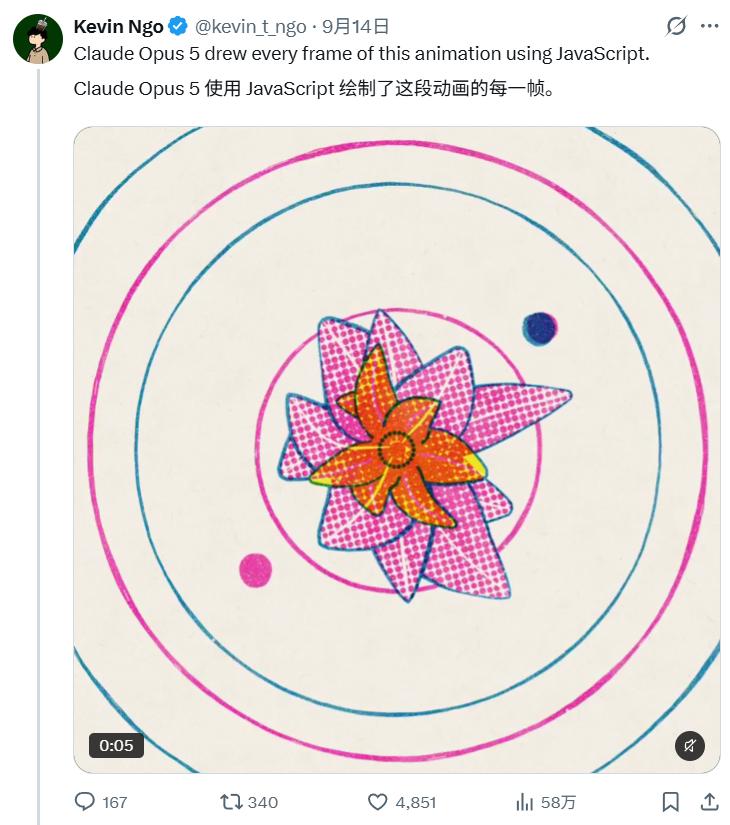
On September 14, developer Kevin Ngo demonstrated an animation drawn frame by frame by Claude Opus 5 via JavaScript.
https://x.com/kevin_t_ngo/status/2099477219877978289
After that, some developers used Claude Code to replicate this Risograph stencil printing style, generating about 3500 lines of Canvas 2D code, realizing 26 illustration scenes in a single HTML file, and using WebAudio to synthesize music.
On September 22, Anthropic released Opus 5.5, which further boosted this creative boom.
On the release day, Reddit user AzorAhai1TK shared a roughly one-minute surreal horror short film. The requirements he put forward to Claude were quite open: make a video about an ordinary workday with a weird atmosphere, with both footage and audio completed through programming, and the model can choose specific tools on its own.
According to the creator, Opus 5.5 spent 45 minutes completing the production including the final rendering under the Extra-High inference mode. The toolchain involved NumPy, SciPy, Cairo, Piper TTS and FFmpeg.
In the following days, more complex works emerged one after another.
On September 24, a Reddit user demonstrated a battle video in the style of retro SNES games. Opus 5.5 scheduled multiple Agents, which were responsible for characters, scenes, music and battle animations respectively. The creator stated that no ready-made materials were provided, but confirmed in the comments that two to three rounds of modifications were made during the production process.
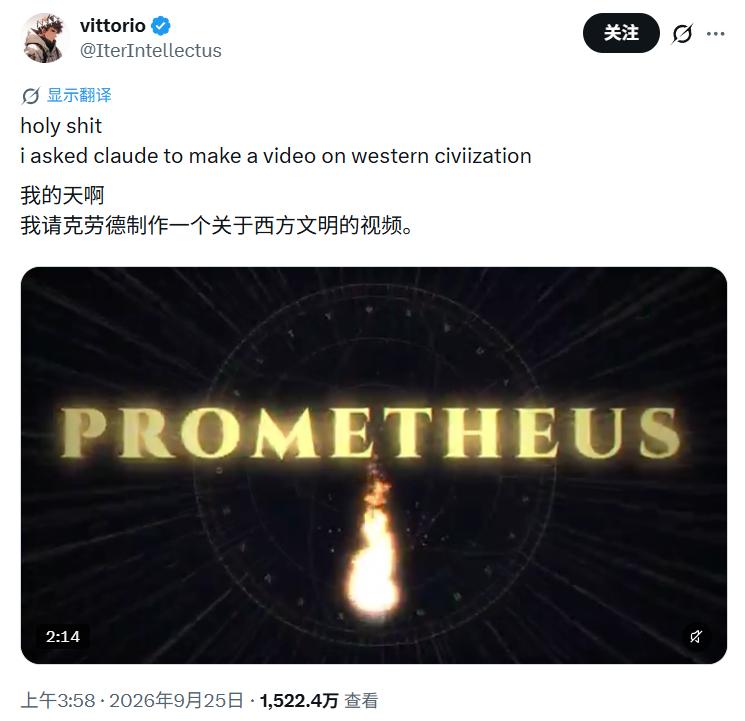
In the same period, X user @IterIntellectus released a 2-minute-16-second animation of the history of Western civilization, connecting historical stages including ancient Greece, Rome, the Renaissance, and the Industrial Revolution with black-gold lines and dynamic graphics.
https://x.com/IterIntellectus/status/2103212539895017864
This video got 5.8 million views about 24 hours after its release, and the total number of views later exceeded 15 million. The creator said that he only used one single prompt.
The scale of this boom is also quite considerable. The third-party work index Claude Video currently includes 1276 videos made by creators using Opus 5.5, involving 1007 authors, 457 of which are attached with public prompts. The total number of views on X counted by this website is about 78.9 million.
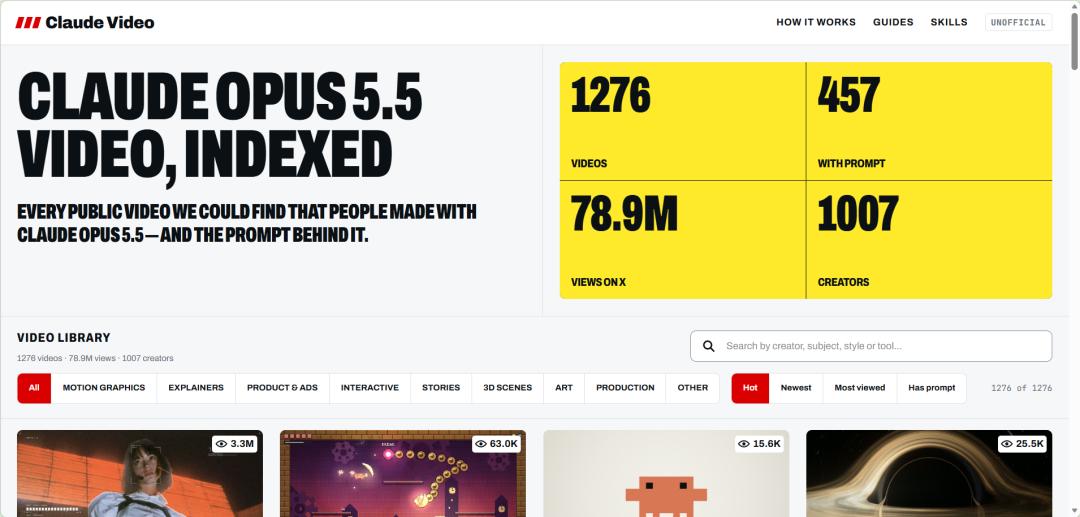
https://claudevideo.org/
How exactly does Claude generate videos?
Claude can write HTML, CSS, JavaScript, SVG or Canvas animations according to natural language requirements, build 3D scenes with Three.js, or call Blender for modeling and rendering.
For example, if a user requests to make a 15-second product promotional video, Claude can first plan the shots and timeline, then write code to control text, graphics, cameras and transition effects. The program calculates the frame of each picture according to time, and finally exports MP4 through browser recording, rendering engine or FFmpeg.
If a complex 3D scene is needed, Claude can also write Blender Python scripts to automatically create models, set materials, arrange lights and cameras, and then call the GPU to complete rendering.
This process mainly relies on the model's capabilities in programming, spatial reasoning, task planning and tool calling. The footage is generated through program calculation and rendering, which has obvious technical differences from the generation method adopted by video models such as Veo and Runway.
Code-generated videos also have their own advantages.
The positions of texts, numbers and graphics can be precisely controlled; the scene and animation timeline can be modified repeatedly; interface elements, technical diagrams and dynamic charts in product demonstrations can all be generated using structured code.
Previously, Remotion also launched the Claude Code plugin, allowing developers to create and edit video projects through natural language. On October 8, Anthropic also officially launched the Claude Motion beta version, which supports turning text, charts and graphics into animations and exporting MP4, and is open to Team and Enterprise users.

At present, the most mature applications of Claude's code-based video generation are concentrated in dynamic graphics, information visualization, product display, technical popularization and stylized 3D animation. For highly realistic characters, complex natural movements and continuous film and television shots, professional generative video models still have their own respective advantages.
After the release of Fable 5.2, its robot operation capability also triggered discussions among many researchers at Anthropic. They stated on social media that the "bitter lesson" in the robotics field may have arrived.
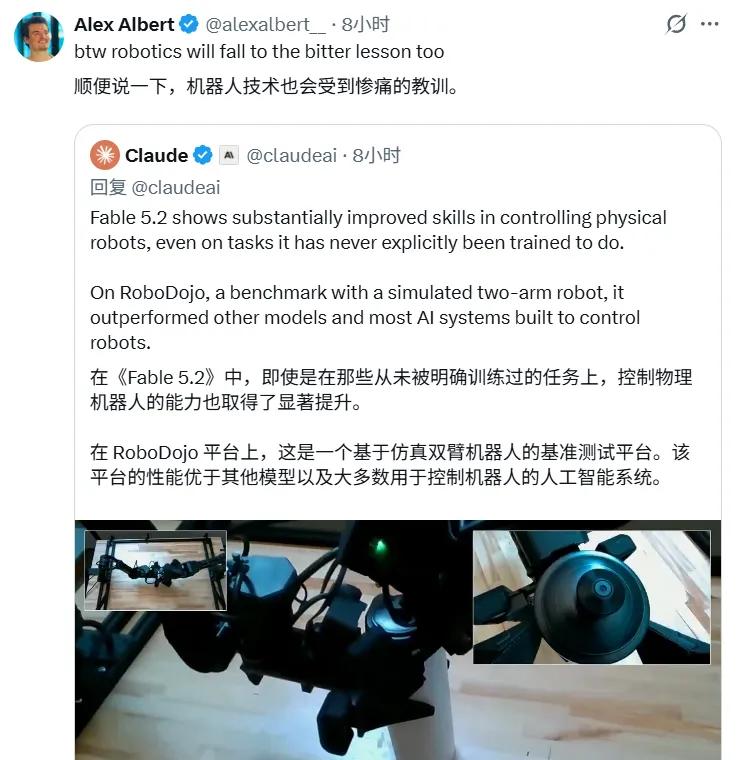
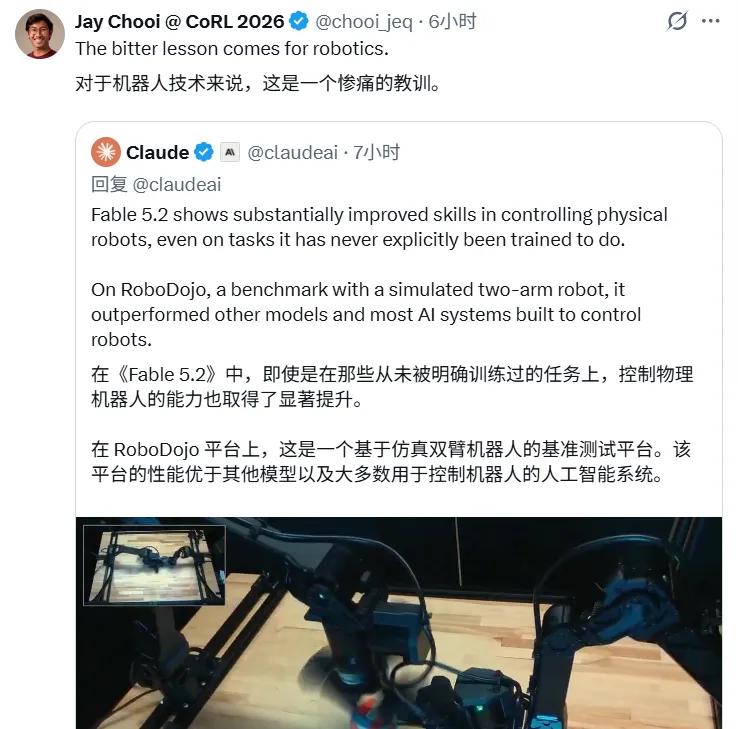
From Opus 5.5 in September to today's Fable 5.2, Claude's video generation has continued to attract attention. Will dedicated video generation models also usher in their own "bitter lessons" in the future? What's your opinion?
This article is from the WeChat official account "Machine Heart" (ID: almosthuman2014), the author is a practitioner focusing on video generation, and 36Kr publishes this content with authorization.