Let the dust-laden notes grow into full-fledged articles, and the AI Canvas bridges reading and creation.
I. Information Is Not Scarce; What Is Scarce Is Transforming Information Into Knowledge Production
In today's era where information access is increasingly easy, how to convert information into one's own knowledge remains a difficult task.
Many people are accustomed to using note-taking software to record reading excerpts, web materials, inspirations and daily thoughts. However, as the number of records continues to grow, new problems emerge: notes are scattered in different folders and pages, making it hard to rediscover the content recorded in the past; even after accumulating a large amount of materials, it is not easy to build new connections from them, let alone further transform them into valuable perspectives and creations.
Over the past decade, note-taking software has gone through evolutions at different stages, from simple text recording and folder classification to bidirectional links and knowledge graphs. Tools represented by Notion, Obsidian and others help users build personal knowledge bases from the directions of structured management and bidirectional links respectively. However, for people with long-term reading and writing habits, information management is not equal to knowledge creation.
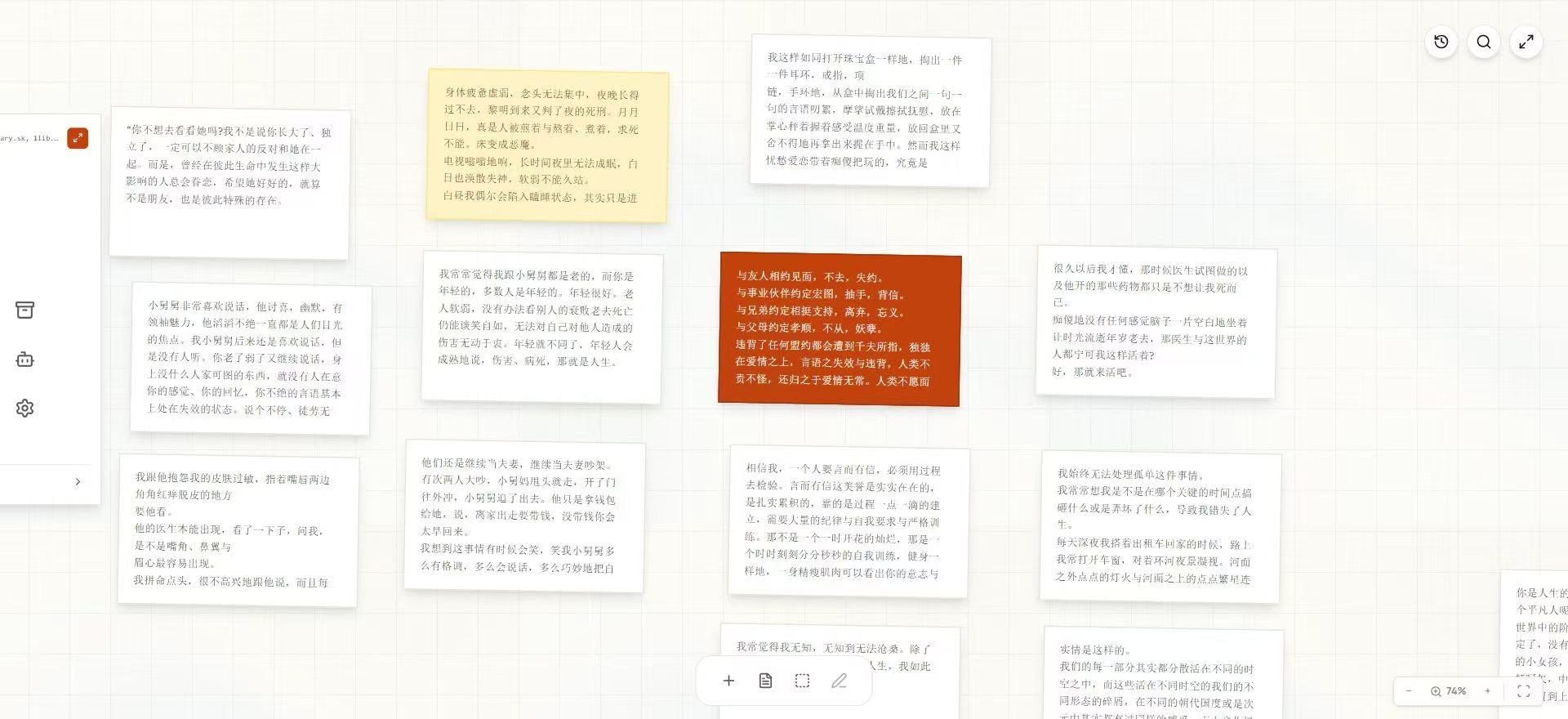
A person may record dozens of excerpts when reading a book, and collect a large number of web pages, articles and research materials at different times. However, these contents often stay in their respective independent pages. Users need to actively recall, search and organize to rediscover the connections between them.
The emergence of AI provides new possibilities for this problem, but many current AI note-taking tools still use traditional documents or chat windows as the main interaction interface. AI can help users summarize, refine and generate content, but it may not be able to integrate into users' original thinking process.
II. Taking Spatial Canvas As The Carrier To Enable AI To Participate In The Thinking Process
Therefore, Spoor was born. Different from traditional note-taking software which takes folders, documents or databases as the main organizational units, Spoor converts content such as texts, books, pictures, web materials, excerpts and AI conversations into independent cards. Users can freely drag, arrange and combine these cards according to their own thinking habits, and establish connections between information in the same canvas.
For example, when reading a book, users can excerpt the paragraphs they are interested in onto the canvas, and then launch discussions around a certain point of view among them; questions arising during the reading process can be directly handed over to AI for analysis; the answers, supplementary materials and new viewpoints generated by AI can also be re-saved as independent cards and placed together with the original content.
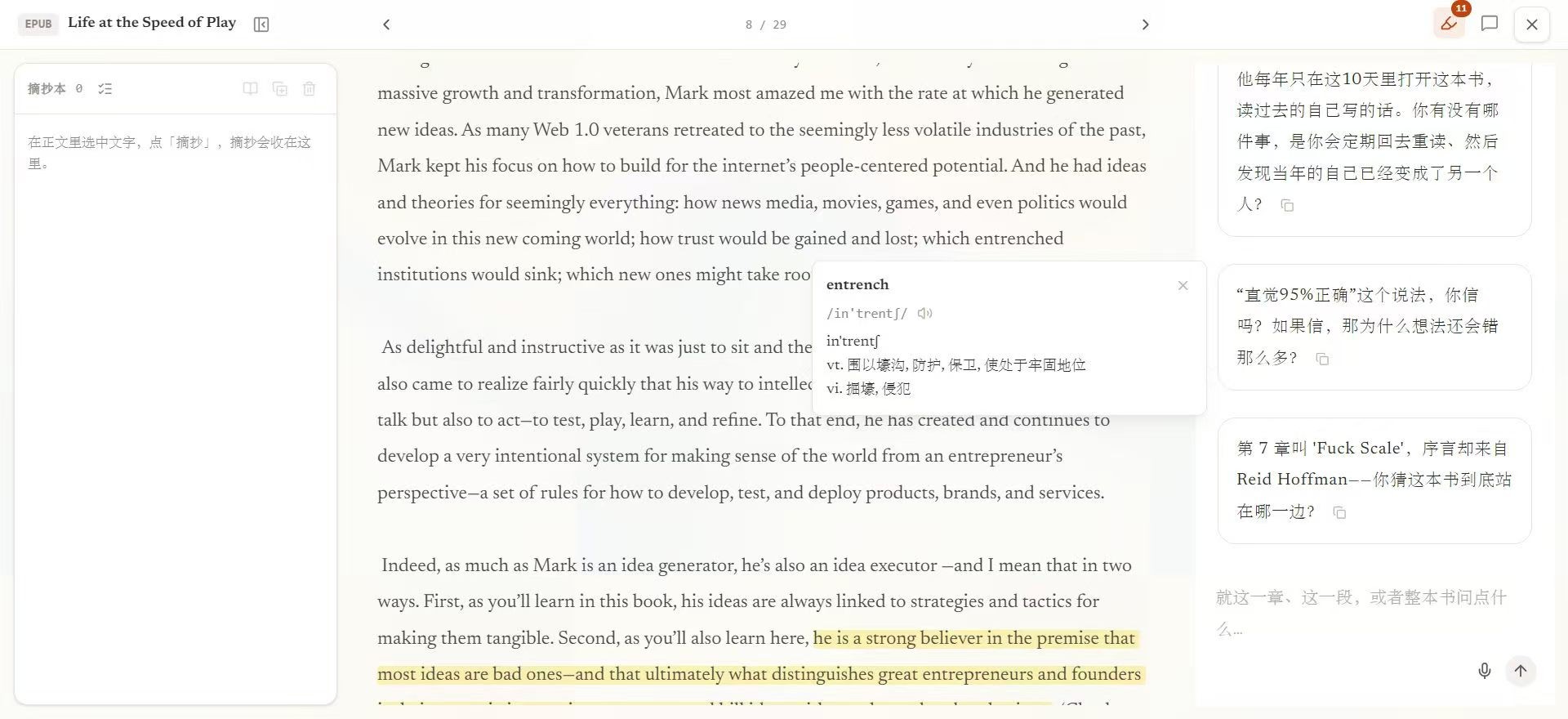
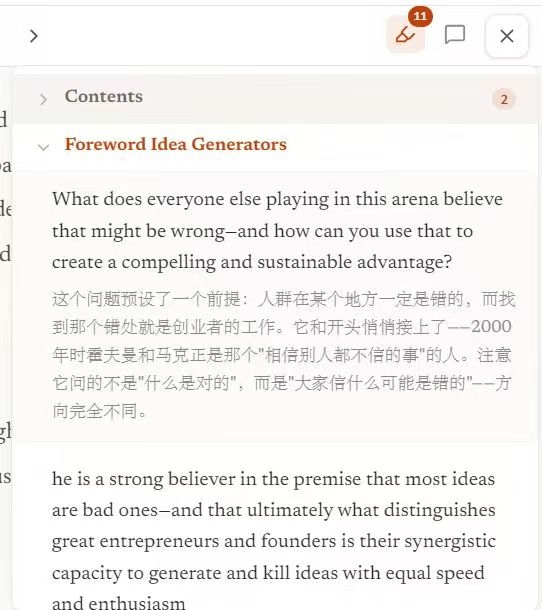
This interaction method is not simply embedding an AI chat window into note-taking software, but trying to make AI participate in the whole process of knowledge organization.
At present, Spoor has realized the AI conversation capability based on the canvas context. AI can answer questions by combining the existing relevant cards in the canvas, and users can also reorganize AI answers, thinking content and other materials into editable cards to continue processing on the canvas.
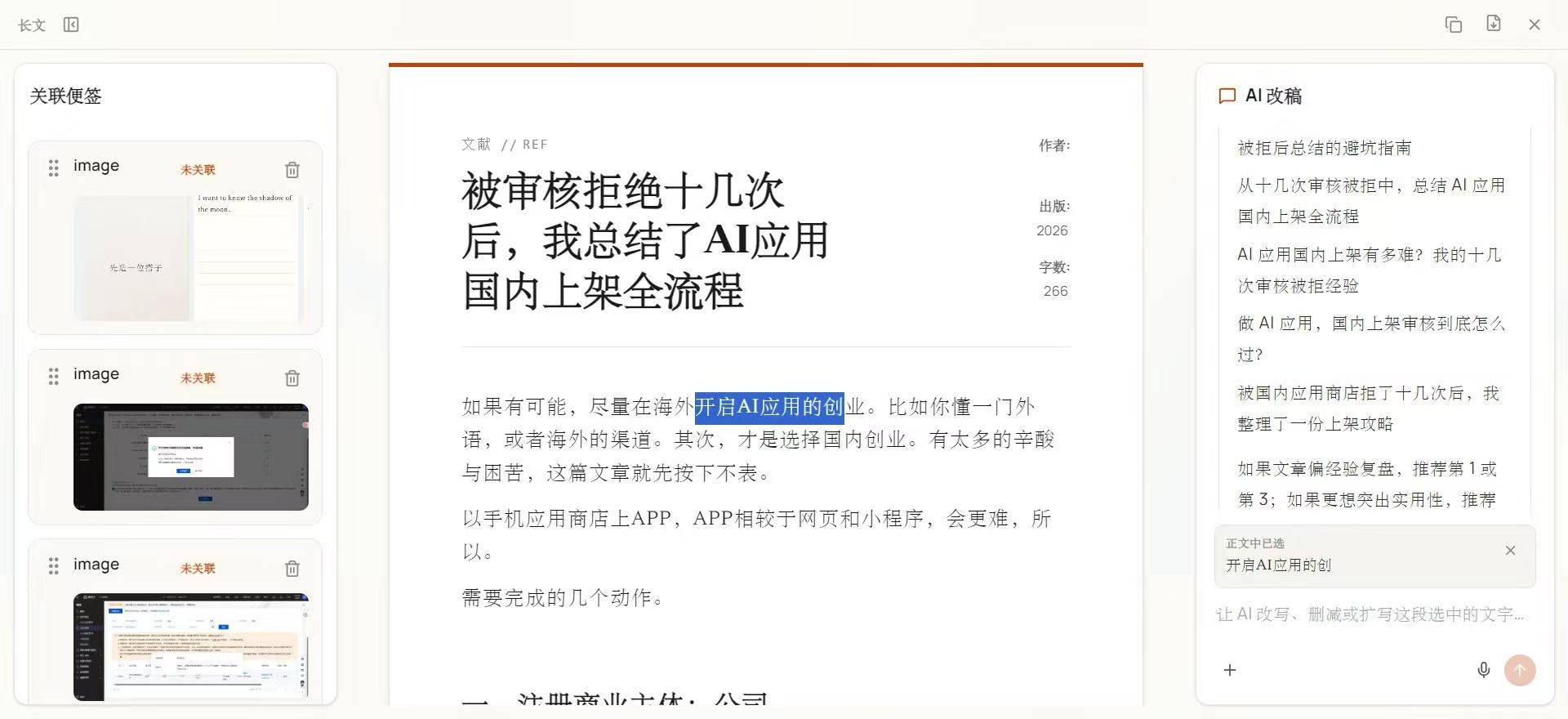
The product also provides functions such as long-form text editing and reading assistance, trying to connect the whole process from material collection, viewpoint formation to content output.
The origin of the project comes from the 13 years of modern poetry creation accumulation of founder Xie Jiawei and his experience in landing AI workflows in the legal field. As an AI product entrepreneur who transformed from a lawyer, Xie Jiawei once provided AI application training and business process optimization for law firms and enterprises. His 13 years of personal creation notes, coupled with his long-term experience of dealing with AI tools, made him deeply feel the core pain point of current mainstream AI products: large language models have entered the Agent task processing stage, but the vast majority of products still take the linear chat window as the core interaction. Users' inspirations, web materials, screenshots, AI answers and personal judgments are scattered in every corner of chat boxes, browsers and local documents. AI can generate hundreds of answers with one click, but it cannot help users filter and organize the truly valuable content to form their own complete works. Real thinking is never linear, and creators need a shared workspace that can accommodate diverse content and support repeated adjustments.
Since the project was officially launched in September this year, Xie Jiawei has completed all the work of product prototype development, design and interaction in the way of personal entrepreneurship. At present, the product has been launched on the official website of Spoor. In the promotion process, the biggest challenge the team encountered is customer acquisition and promotion. Currently, the team plans to open up the early user market by connecting with KOLs in the field of text creation.
(1) Target Users and Business Model
At present, Spoor is mainly targeted at individual users with long-term reading, research and writing habits, including deep readers, independent researchers, content creators and knowledge workers who need to process a large amount of information.
In terms of business model, it is dominated by a local free open-source project (that is, users do not need to upload data, the data is stored locally, they can even use it with a local model, and can also call their own APIKEY). The value-added service is personal subscription for cloud data synchronization.
Free users can use the basic unlimited canvas, basic AI capabilities and local storage, while Pro users can get higher AI quota, multi-device synchronization and other functions, with a monthly/annual subscription system.
(2) What Are The Differences Between Spoor And AI Automatic Article Writing Tools & AI Chat Tools?
Different from the existing AI chat tools and traditional knowledge management canvas products on the market, the core innovation of Spoor is the interactive logic of "AI + unlimited canvas", which breaks the linear limitation of chat windows. Users can freely place texts, pictures, web pages, AI answers and personal inspirations all in the same canvas space, supporting free dragging and associated annotation. On this basis, the product launches the multi-role AI collaboration function. Users can call different AI roles such as collaborator, questioner, association sorter and reader feedback to discuss together around the same theme, and always maintain the thinking context shared by humans and AI.
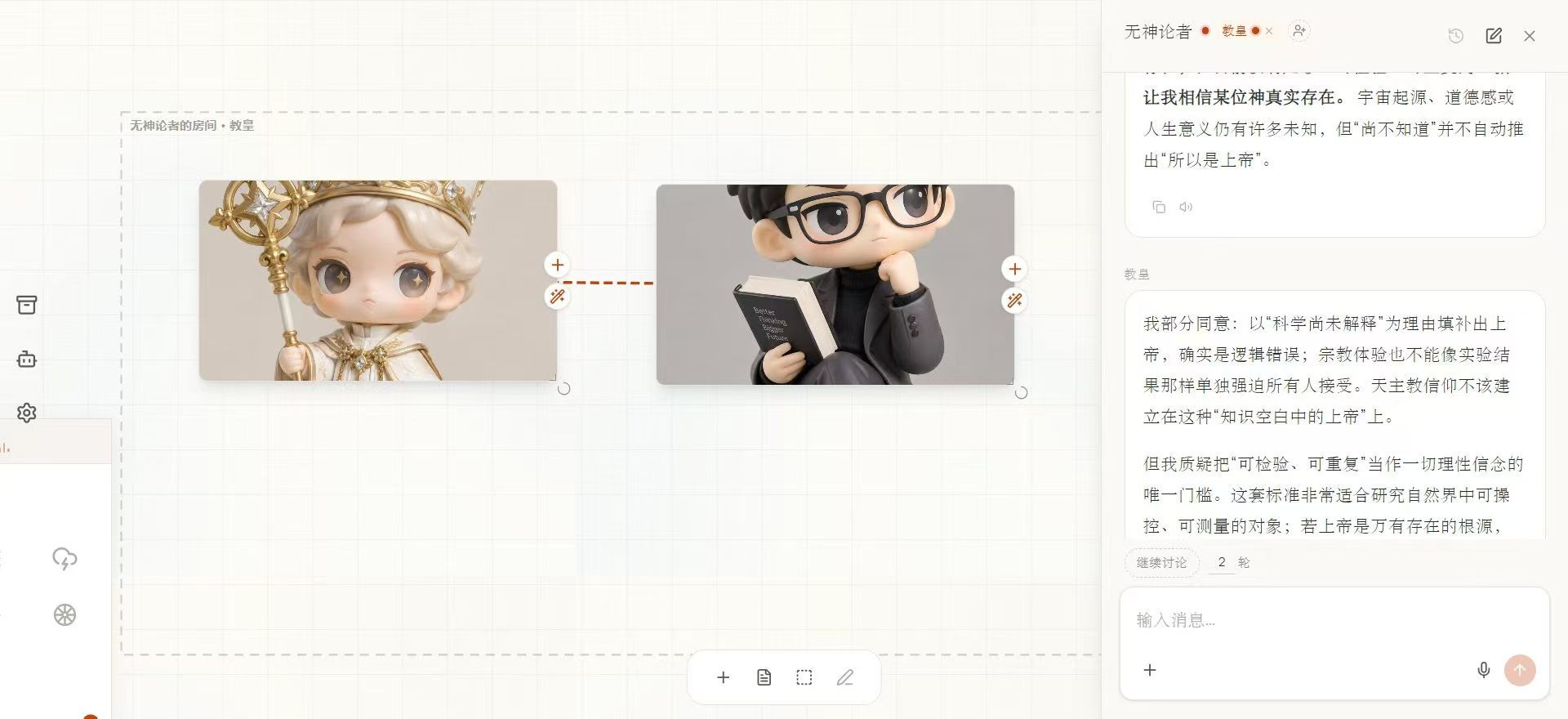
Different from the mainstream creation tools that "generate complete articles with one click", Spoor insists that humans make decisions and judgments. The process is designed as "AI diverges existing ideas → human filters → spatial organization → AI re-discusses → human filters again → finally forms the work". All AI outputs are retained on the canvas in the form of editable cards. Users always have the right to choose content, and finally gradually precipitate from scattered materials into a complete work, filling the gap between AI conversation and the final work.
From the market perspective, with the popularization of generative AI, the scale of domestic knowledge workers and creators who frequently use AI continues to grow. Such users generally face the problems of information overload and scattered content. In the first stage, Spoor prioritizes serving groups with high acceptance of new tools and easy to form word-of-mouth communication, such as content creators, researchers, product operation personnel, and heavy AI users. In the follow-up, it plans to launch standardized canvas templates around specific scenarios such as writing, research and product exploration to lower the user threshold. In the long run, it plans to connect multiple content entrances such as web page collection to build a personal thinking growth space covering the whole link of content collection, organization, collaboration and creation.
III. Early User Feedback
At present, many early test users have given feedback. A creator with a psychology background said that writing not only has the meaning of publishing to the outside world, but also the meaning of inward exploration. Therefore, she used narrative therapy to build a water world that allows crying and vulnerability. This world will not be as harsh as the real world, and creators can build their own roles, worldviews and images in it.
Regarding this entrepreneurial experience, Xie Jiawei said, "What will always be scarce in the future is not the content generated by AI, but users' own clear judgments and unique expressions. What we want to do is to help everyone retain and grow these truly valuable things."