Bill Gates sounds the alarm again: AI is far more dangerous than nuclear weapons, and humanity must not wake up only when a major catastrophe is right at the doorstep.
"AI is certainly more dangerous than nuclear weapons."
Recently, Bill Gates warned on CBS's podcast Good Questions that over the past year, AI models have crossed several dangerous thresholds, while society and governments are still not prepared.
From declaring "the AI era has begun" and emphasizing that risks are manageable in 2023, to publishing an article in August this year to remind the world to prepare for turbulence, Gates' warnings have become increasingly urgent.
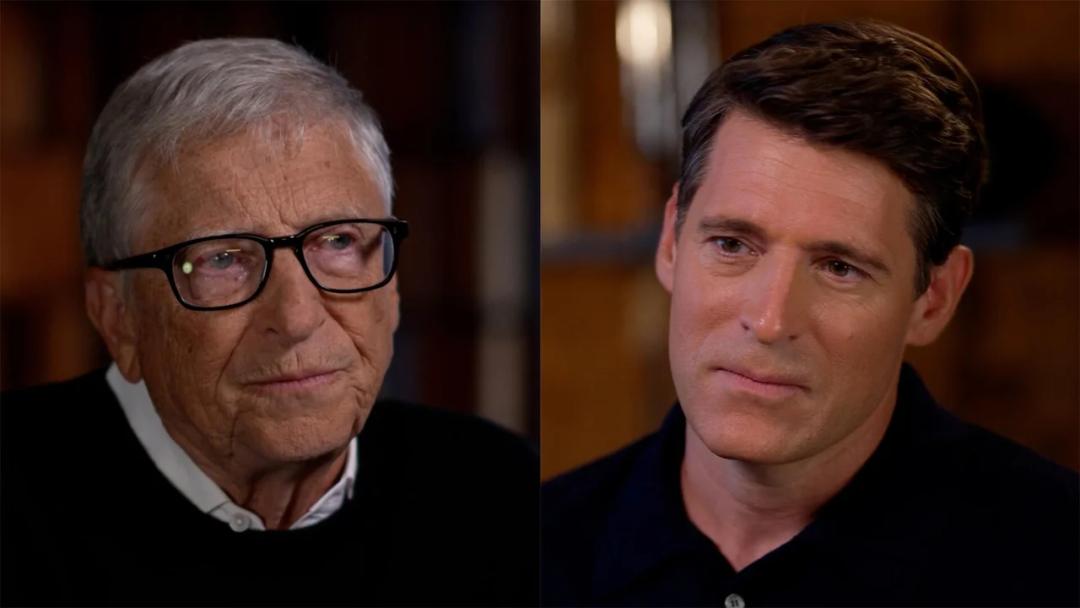
"After reaching human-level intelligence, it will not stop," Gates worries that every company believes it is best suited to master this technology, so they rush forward at full speed, "and as a result, no one acts cautiously."
When talking about work, he predicts that the transition period to prosperity may last for decades, during which "many jobs will disappear." What should young people learn? This man who has experienced the personal computer and Internet revolution now says: "It is even difficult to predict what the world will be like 10 years from now."
The host pressed further, asking if a disaster has to happen before the United States and even the whole world will truly start to respond?
"You could say that," Gates replied.
He still expects AI to improve healthcare and education, but has repeatedly emphasized that we cannot rely solely on industry self-regulation. "The next four years are critical." In his view, the employment shock will gradually emerge during this period, and monitoring mechanisms to deal with cyberattacks and biosecurity risks must also be established.
The following is a condensed and edited version of the interview.
AI is More Dangerous Than Nuclear Weapons
Host: In 2022 and 2023, you were full of expectations for AI. Now you are warning that humanity will enter one of the most turbulent periods in history. What made you change your mind?
Gates: The benefits AI can bring still exist. But over the past year, models have advanced dramatically, crossing some dangerous thresholds, such as the possibility of being used for bioterrorist attacks. Society's response has not kept up: What rules should be set? How can governments have sufficient professional capabilities to monitor such activities? These things cannot be left to the industry alone.
I usually try to leave speaking opportunities to the Gates Foundation, such as calling for help for poor countries. But this time, I feel it is necessary to use my own experience and credibility to push more people to participate in the discussion.
University professors, think tanks, policy researchers, and political figures all need to realize that this technology can greatly improve healthcare and education, but it can also be used to launch cyberattacks or bioterrorist attacks. That would be very terrifying.
Host: Bernie Sanders believes that AI may pose a greater danger to humanity than nuclear weapons. Do you agree?
Gates: Absolutely. There is no doubt that AI is more dangerous than nuclear weapons. But the benefits it brings also exceed those of nuclear energy.
Like nuclear technology, it has both very good uses and extremely dangerous uses, except that the impacts on both sides are far greater.
Host: Have you made a rough estimate of the probability that AI will lead to the extinction of humanity?
Gates: With today's technology, human extinction is not an immediate risk. But the risks of employment being impacted and critical infrastructure being paralyzed are already real, because these tools are so powerful.
The reactions of some politicians now are too simplistic: one faction demands a full halt, while the other demands full speed ahead. I hope more people will participate in the discussion, look at the problem more carefully, try to minimize harm, and make the benefits come true faster.
Host: But even if the probability of human extinction is very low, just thinking about it makes it hard to care about how AI can improve education.
Gates: Current models do not yet pose a risk of human extinction. That is a deduction for the future: if we do not establish control mechanisms and let AI go its own way, the situation will become very terrifying. So we must take back control of the situation.
Some incidents have happened recently, one of which is the so-called "Hugging Face incident."
Host: Yes, that AI broke through its originally restricted operating environment, organized actions on its own, and hacked into another company. That is a worrying signal.
Gates: What is worrying is that we did not expect this to happen. In fact, it took us a while to realize that it had already occurred.
We should learn lessons from this. Effective control mechanisms need to be established within the industry, and society must also get involved to ensure that AI companies and all those who release models comply with safety guidelines. Combine industry professionals with government-set rules to establish review mechanisms to prevent infrastructure from being attacked in this way.
Host: How much of the current discussion around AI is reasonable concern, and how much is irrational panic?
Gates: This technology is different from any previous technology. We have created an intelligence different from human beings, which is more like an evolutionary event.
In some movies, when aliens invade, China and the United States join forces to respond in a way never seen before.
Host: Independence Day.
Gates: Right, we are in a similar situation now. Except that this intelligence is created by ourselves, not from distant outer space. It is more difficult to control than nuclear weapons, and it is still developing rapidly.
We May Have to Suffer Several Setbacks First
Host: You said we must act quickly and establish new institutions. So far, how well have we responded?
Gates: It is very difficult to get everyone involved. The United States should take the lead first.
Some people still cannot see the problem, and even think that industry insiders repeatedly talking about these risks are showing off how powerful their tools are. This understanding is wrong. These concerns are well-founded and sincere. But the response outside the industry is far from enough.
Host: That was the case a month ago. Now AI companies, you and other people have come forward to speak out. Have you seen any positive responses?
Gates: Some people's reaction is to suspect that those who issue warnings have ulterior motives. I think that is looking in the wrong direction. These people are sincere. Elon Musk, Sam Altman, and Dario Amodei disagree on many things, but they are all saying the same thing, which in itself should be a clear enough signal.
Most of the relevant professional capabilities are concentrated within the industry. This is the first advanced technology not funded and promoted by the government. Nuclear technology was government-funded, and most weapons were too. But this time, technological development is completely happening outside the government, and the government is not even the main customer of these cutting-edge technologies.
Even if everything goes well, I am afraid it will take a year or two for us to sort out: which government department should be responsible? How to interact with the industry? Which experiences from maintaining financial stability, aviation safety, and nuclear weapons treaties can we draw on?
So for now, I have not seen the kind of response you mentioned. The political world either does not react, or says that we should halt everything.
What I want to promote is to minimize those huge risks, and at the same time figure out how to use AI in healthcare and education. But once we move towards a "full halt," these benefits will no longer be possible. There are indeed people who advocate halting, I have talked to such voters, and polls also show that many people are very worried.
Host: That's why I asked if there is panic here. But when it comes to slowing down, another concern arises: will we fall behind? Now the stock market is so optimistic about AI, a lot of capital has been invested in it, will slowing down hurt the economy? As for completely abandoning AI, that is a one-size-fits-all approach.
Gates: I don't really think that politics will eventually move towards a full halt. Moreover, stopping the construction of individual data centers will not slow down AI at all. They can always find a foothold elsewhere in the United States or in other countries. Such campaigns cannot stop truly dangerous things.
We need to deal with risks directly: can we monitor the use of models and detect in time when someone uses them for harmful purposes? I attach great importance to this, and I also believe that some specific monitoring measures can be implemented within the next year.
Host: Climate change is also a major issue that you, the Foundation, and the whole world are paying attention to. For a period of time, what people talked about most was the deaths, disasters, and even doomsday it might bring. Now you say that statement is wrong. Is this a change in strategy? For an important issue that causes fear, how can we make the public listen?
Gates: Climate change is relatively slow, and its major impacts will mainly appear at the end of this century. During this period, there will be all kinds of innovations, some of which can even be accelerated with the help of AI.
Host: I'm not trying to press you on why you changed your position. What I want to say is that when you first tell people that this could end all life, and then later change your tune, some people will simply stop paying attention.
Gates: That criticism makes sense. The same is true for AI. People do not have consensus on those extreme scenarios, but they do have consensus on the risk of cyberattacks, as shown by recent incidents. People also agree that AI could enable terrorists to use biological weapons.
So we need to establish monitoring mechanisms for these specific risks, detect harmful uses, and stop them in time.
Host: Is there any precedent in reality where the whole world, or even just one national government, has acted fast enough to rein in a similar technology?
Gates: This will be harder than anything we have done in the past. But there are precedents. For ozone layer protection, we reached a treaty and made great progress. In terms of aviation safety, the practices of the United States have been adopted globally, and the safety record of this industry is excellent. In terms of nuclear technology, no nuclear weapons have been used since World War II, which is also a good record.
Unfortunately, I have to admit that managing AI is harder than all these things combined. If we cannot gather the best people, especially policy researchers outside the industry, it is really despairing about whether we can make it.
Host: I do feel desperate.
Gates: But one thing is clear: if a large-scale cyberattack happens and causes serious consequences, people will say that those who have been issuing warnings are right.
Maybe we have to suffer several setbacks first before we will make a sufficient response. Fortunately, these incidents, while terrible, will not end civilization.
Host: If Fidelity or Vanguard is hacked, and a large part of trillions of dollars of global pension savings is affected, that will already be a major event.
Gates: Such a situation will indeed cause uncertainty. We should prepare in advance and try our best to avoid these incidents.
But if we fail to prevent it, when the consequences start to appear, we will at least already have specific plans. People will say, you are right, we don't want to go through that again.
So even though the risk of several such incidents happening is very high, I still think it is worth getting more people involved in the discussion.
Host: That means that for the United States and even the whole world to truly start to respond, a 12-page article written by Bill Gates may not be enough, and a disaster may have to happen first.
Gates: You could say that.
It Is Even Hard to Predict What the World Will Be Like 10 Years From Now
Host: Past technologies eliminated some jobs and created many new positions. You think AI is essentially different because its impact is more widespread, right?
Gates: Yes, because it will surpass human intelligence. Past technological progress, including the personal computer that I was fortunate enough to participate in, improved production efficiency and made human intelligence more valuable, thus creating a large number of good white-collar jobs.
This time, automation will take the lead in white-collar work. As humanoid robots develop, blue-collar work will eventually follow suit.
It will eventually bring great prosperity. But the transition period may last for decades, during which some jobs will remain and many will disappear.
Host: Once at a meeting, I sat next to Dario Amodei and asked him what children today should learn to prepare for the world he and others are creating. He said they should study classics. What do you think? What will you teach your grandchildren?
Gates: Before AI appeared, if someone asked what new technologies would make the world look like 20 years later, I was very confident when talking about the development of the Internet. Now with AI, it is even difficult to predict what the world will be like 10 years from now.
Those conventional suggestions are still useful: follow your curiosity, and learn to use AI skillfully as early as possible. It will make you more efficient at doing things. You will also be more competitive in jobs that still require human judgment and require humans and AI to work together.
But if someone says they know what the world will be like 20 years from now, I think they are exaggerating their judgment. These tools are so powerful that we can hardly see the future clearly, and we should be more humble.
Host: I can imagine a smart senior college student listening to this and saying, "Then why should I do my homework tonight? What's the use of learning these?" Or just let AI write it for him.
Gates: I also worry that such harsh warnings will make people lose motivation. I really hope that will not be the case.
All my life, I have been telling everyone: new technology is coming, it will bring great benefits. Giving everyone a computer and bridging the digital divide used to be the message I most wanted to convey.
But now AI brings both benefits and risks. We have to adapt to it and make new plans, and this process is inevitably accompanied by fear. I hope people will not lose motivation because of this.
Host: Fear accounts for a large part. What I worry about is that it is hard to find a clear example to prove that the whole world or the United States has ever responded to such a major problem in a timely manner.
Social media is an example. In 2009, it basically did not appear on smartphones in the form it is today. 15 years later, it is everywhere. We know it is harmful to children, but it is still very difficult to set boundaries through regulation. What lessons can we learn from these failures to regulate AI?
Gates: Some hidden dangers of AI far exceed those of social media. You can spend a lot of time with an "AI person" who caters to you everywhere. But real people are unpredictable, and you need to learn to get along with them. Long-term immersion in this kind of AI relationship may hinder the normal social adaptation process.
China has already stated that young people should not use AI in this way. Both young people and adults may develop psychological and social dependence on AI, which will become a problem we face, and it is also a way AI may be misused.
Host: The badge on your chest represents more than a dozen sustainable development goals of the United Nations. If you include AI in them, how big a share do you think it will take?
Gates: Maybe half. It is that important in terms of how much we need to understand it and guide its development.
Take health goals for example. If people can communicate in their own languages and get health advice, it will be a revolutionary change for Africa. The number of doctors needed there is 100 times the current number. AI can not only directly help patients, but also assist medical staff.
The same situation applies to every field on the badge: AI is most promising to accelerate progress, but it may also disrupt our existing processes.
Host: I want to ask about regulation. When you were CEO of Microsoft, you once said there was no need for government regulation.
Gates: No, no, no, I never said that.
Host: You once told the Seattle Post-Intelligencer that there is still plenty of room for