Over 13.2 billion yuan, increasing holdings in the semiconductor industry
On November 10, the A-share market opened higher and then fell back throughout the day, with all three major indices rising collectively. By the close, the Shanghai Composite Index rose 0.08%, the Shenzhen Component Index rose 0.86%, and the ChiNext Index rose 1.46%. On that day, AI manhua drama concept stocks strengthened again, AI glasses concept stocks rose in the afternoon, robot concept stocks performed actively, and oil and gas stocks fell collectively.
The overall capital flow of stock ETFs showed a net outflow trend. On November 10, the total net outflow of stock ETFs across the whole market reached 1.06 billion yuan, among which the net outflow of broad-based ETF capital was 4.112 billion yuan, and the industry-themed ETF recorded a single-day net inflow of 2.909 billion yuan.
The semiconductor ETF recorded a net capital inflow of 2.27 billion yuan on November 10
Wind data shows that as of November 10, the total size of 1,623 stock ETFs (including cross-border ETFs) in the whole market reached 3.67 trillion yuan.
From the perspective of major categories, industry-themed ETFs and strategy-style ETFs took the lead in net inflows, reaching 2.909 billion yuan and 377 million yuan respectively. In terms of size change, the size of industry-themed ETFs increased by 10.376 billion yuan.
The single-day net capital inflow of the semiconductor sector was the most obvious, reaching 2.27 billion yuan, followed by the gold industry with a single-day net inflow of 960 million yuan.
Some broad-based ETFs achieved net inflows, among which the Sci-Tech Innovation Board 50 Index recorded a net inflow of 720 million yuan, and the SSE 50 Index recorded a net inflow of 510 million yuan.
From a longer time dimension, observed from the perspective of the past 5 days, recent capital inflows into sci-tech innovation semiconductor materials and equipment have exceeded 13.2 billion yuan.
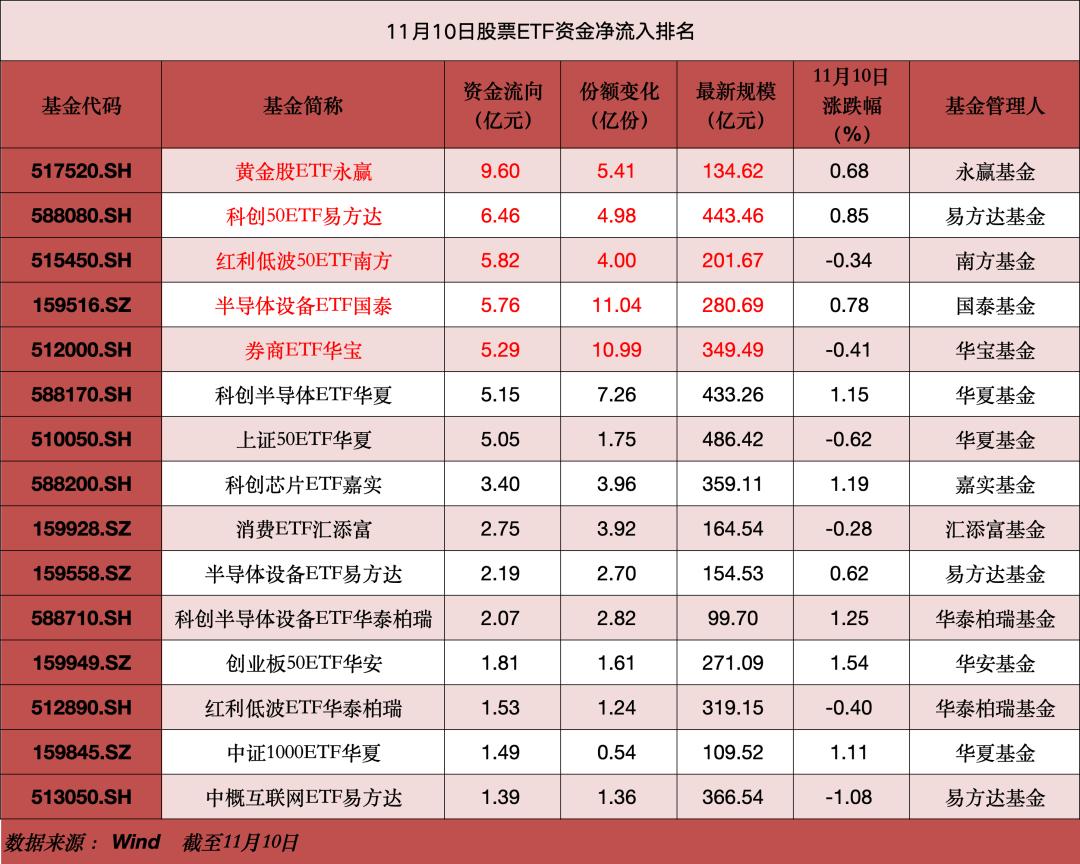
Among the leading public offering fund companies, the latest size of E Fund's ETFs is 740.44 billion yuan, with an increase of 3.64 billion yuan in size yesterday. The size of E Fund Sci-Tech Innovation 50 ETF is 44.346 billion yuan, with a net inflow of 646 million yuan; the size of E Fund Semiconductor Equipment ETF is 15.453 billion yuan, with a net inflow of 219 million yuan; the size of E Fund China Concept Internet ETF is 36.654 billion yuan, with a net inflow of 139 million yuan; the size of E Fund Dividend ETF is 19.098 billion yuan, with a net inflow of 119 million yuan; the size of E Fund Sci-Tech Innovation & Startup ETF is 15.054 billion yuan, with a net inflow of 118 million yuan.
In terms of China Asset Management's ETFs, ChinaAMC Sci-Tech Innovation Semiconductor ETF and ChinaAMC SSE 50 ETF took the lead in single-day net inflows, recording 512 million yuan and 505 million yuan respectively, with the latest sizes reaching 43.326 billion yuan and 48.642 billion yuan respectively, and the corresponding tracking indices have an average daily turnover of 6.004 billion yuan and 3.221 billion yuan respectively in the past month. The net inflow of ChinaAMC CSI 1000 ETF exceeded 100 million yuan.
In terms of Southern Asset Management's ETFs, Southern Dividend Low Volatility 50 ETF recorded a single-day net inflow of 582 million yuan. In the technology growth sector, the semiconductor ETF recorded a net inflow of 16 million yuan, the sci-tech innovation chip ETF recorded a net inflow of 12 million yuan, and the communication ETF recorded a net inflow of 7 million yuan; in the new energy sector, the new energy ETF recorded a net inflow of 20 million yuan, the battery ETF recorded a net inflow of 7 million yuan; in the robot sector, the robot ETF recorded a net inflow of 5 million yuan.
The net outflow size of some broad-based ETFs is prominent
In terms of net capital outflow, broad-based ETFs took the lead in net outflow in the previous trading day, reaching 4.112 billion yuan. Among them, the CSI 300 ETF recorded a net inflow of 1.97 billion yuan, the CSI 500 ETF recorded a net outflow of 920 million yuan, the CSI A500 ETF recorded a net outflow of 920 million yuan, and the ChiNext ETF recorded a net outflow of 900 million yuan.
Looking ahead to the market, Lin Weibin, General Manager of the Index Investment Department of E Fund, said that the profit improvement of listed companies in the first three quarters has further enhanced the market's attention to high-quality assets. After the relatively sufficient style adjustment in the early stage, the allocation value of core assets with stable earnings, reasonable valuation and industry competitive advantages has become more prominent. At the structural level, the long-term trend of the technology industry continues, but the market will pay more attention to profit realization, return on capital expenditure and valuation matching in the pricing of growth assets, and the market is expected to shift from the previously relatively concentrated thematic trading to more balanced fundamental screening. On the whole, the market is expected to gradually find a new balance after the early adjustment in November, and under the combined effect of profit improvement and valuation digestion, the medium-term allocation value of high-quality assets is worthy of attention.
In terms of allocation, Lin Weibin suggested continuing to strengthen the underlying position allocation value of large-cap core assets. After the early market adjustment, the advantages of core assets in terms of earnings stability, valuation rationality and industry leading position have been further highlighted, and they have good risk-return characteristics in a volatile environment. The broad-based indices represented by the CSI 300 Index and CSI A500 Index cover high-quality leading companies in various industries, which can not only participate in the overall profit recovery of enterprises, but also reduce the impact of fluctuations in a single track on the portfolio through a relatively balanced industry structure. On this basis, investors can appropriately participate in growth directions that have been verified by performance and supported by sustained industrial prosperity, so as to take into account both the stability and return flexibility of the portfolio.
This article is from the WeChat Official Account "China Fund News" (ID: chinafundnews), written by Wang Siwen, published with authorization from 36Kr.