People who chose to spend their retirement on luxury cruise ships were abandoned off the ship in Cambodia.
Sold their houses, bought cabins of a dozen square meters, and planned to spend the rest of their lives sailing around the world. More than 200 people lived on the Odyssey, which was supposed to be their final home.
One early morning in October, when the ship docked at Sihanoukville, Cambodia, all residents were ordered to disembark within seven hours, leaving them homeless in the blink of an eye.
Aging care is a global issue, and the collapse of the Odyssey is like a fable.
Seven Hours: Losing Their Home on the Sea
Toni originally planned to have her ashes scattered into the sea after her death.
She and her husband loved traveling, but their health no longer allowed long-haul flights. After reading about the Odyssey online, she excitedly sold their house. The couple moved into a 13-square-meter cabin and decided to spend the rest of their lives on a round-the-world voyage.
The room was not large, so she bought wallpaper, furniture and new floor tiles. "This is not a vacation," she said, "this is a way of life."
There are many retired seniors from the United States and Canada on the ship, the oldest of whom is 100 years old. Long-term residents usually pay hundreds of thousands to millions of US dollars to purchase the right to live in the cabin, and then pay monthly fees. The monthly fee covers meals, dinner drinks, Wi-Fi, cleaning, laundry and ship doctor consultations.
The cruise ship planned to sail around the earth in three and a half years, dock at 147 countries, and stay at each port for two to five days. Residents could get on and off the ship at will to arrange their own trips.
Randy started running the online newsletter *This is True* in 1994, which is dedicated to collecting real and bizarre news from around the world. He and his wife have no children, and worried that no one would take care of them when they got old, so they sold the house they had lived in for 20 years. Randy said: "I don't plan to get off this ship alive."
On the day the ship crossed the International Date Line, the date jumped directly from Tuesday to Thursday. Some residents could not wrap their heads around this, and the ship's solution was to throw a party: "When in doubt, bring out the wine." Randy titled the blog post: "Party like there's no tomorrow."
Jim is a long-time reader of Randy's. He and his wife Chris have traveled full-time in an RV for 14 years, and planned to live on the ship even longer. Chris runs the Geeks on Tour website, writes blogs, publishes newsletters, and makes videos. She calls life on board "a non-stop RV party", and she even wears earrings when going to breakfast.
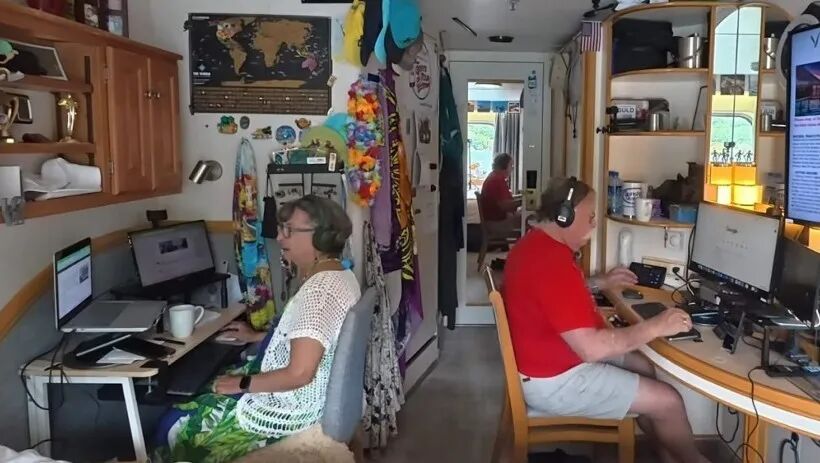
Photo | Chris and Jim working on the ship
57-year-old Joel was also impressed by the life on board shared on social media, so he boarded the ship specially for a four-day trial stay, asking each resident if they were satisfied, and everyone said it was great. He then disposed of all his property, drove across the United States to say goodbye to relatives and friends. He paid the final balance in May 2026, spending a total of 350,000 US dollars to buy the cabin.
In October, he officially boarded the ship in Bangkok, planning to live there for the next ten or twenty years. He said that five minutes after getting on the ship, he knew these people would be his new neighbors and this would be his future. Only 26 days later, he was asked to leave.
Around 7 a.m. on October 27, the ship docked at Sihanoukville Port, Cambodia. The operator Villa Vie Residences issued a notice to the entire ship, stating that due to the failure to obtain the fuel needed for continued operation, all residents were required to disembark before 2 p.m. that day.
Residents were only given about seven hours to pack up their home on the sea. They could only urgently stuff their personal belongings into suitcases and backpacks. Some were angry, some were at a loss, and some stayed where they were, repeatedly asking "What should I do next?"
The suspension of the Odyssey reflects the common dilemma under global aging: human lifespan continues to extend, the cost of elderly care keeps rising, but personal savings, family care and social security may not be able to support an equally long old age.
No matter whether they choose global nomadic life, invest in elderly care real estate, or move into elderly care institutions, even if the seniors spend all their savings, they may not be able to buy long-term stability, and they have to bear the operational risks that should not have fallen on them.
The long-term promise of the "elderly care utopia" is difficult to last until the last day of the seniors' lives.
The Loan Letter on the Cabin Door
On September 30, 2024, the Odyssey set sail from the Port of Belfast, Northern Ireland. For the next 757 days, residents shared the scenery along the way, on-board parties and festivals on social media, which looked like a utopia on the sea.
After Toni boarded the ship, she gradually found that there were three topics that neighbors seldom talked about: politics, religion and money. The residents on the cruise ship were not the rich as imagined. Many of them sold all their belongings to get on the ship and lived on social security benefits. The fact that operator Villa Vie was short of money gradually came to light.
To save fuel, the Odyssey slowed down its speed and stayed longer at ports. The original route was changed again and again, and the number of port calls was 28% less than originally planned. Some ports were visited not long ago, and then the ship went back again after a while, and the round-the-world voyage almost became a revisit to old places.
The network was intermittent, and shore activities kept shrinking. Starlink once suspended service due to unpaid fees, forcing residents to switch to international eSIM or go ashore to find hotels to work. Chris and Jim were very distressed about this. As digital nomads, disconnection from the Internet meant no source of income.
There was less and less food. Sometimes from the end of lunch to nearly 7 p.m. at night, only some biscuits were served. When the ship arrived in Vietnam, the supplier stopped delivery because the payment for goods was in arrears, and the crew had to go to local grocery stores to purchase supplies.
In April 2026, a letter asking for loans from the operator was posted on Toni's cabin door. The letter promised an annual interest rate of 12% to 24%. Toni took out 50,000 US dollars, but when the first interest payment date came, she did not receive any interest.
Randy was not interested in these high-interest loans. Some annual interest rates were as high as 20% to 40%, and Randy couldn't figure it out: "With such an interest rate, how can you climb out of the pit?" But the couple would raise money for the crew who were owed wages, "We can't make up for their unpaid wages, but at least let them know that we care about them very much."
According to the operator's estimate, after the Middle East conflict pushed up oil prices in 2026, the average monthly fuel expenditure allocated to each cabin on the ship rose from about 1,800 US dollars to 6,000 to 8,000 US dollars. Some packages promised to lock in monthly fees, so when the fuel bill rose, the fees could not be increased accordingly.
But the Odyssey's problems were not just fuel costs. Internal documents showed that 139 of the 490 cabins were still unsold. The average monthly operating cost of the Odyssey was listed as 3.1 million US dollars, while the monthly income from full occupancy and full payment of fees was only 2.5 million US dollars.
By August, when the Odyssey docked in Singapore, the company had a funding gap of millions of dollars, and faced the risk of detention at any time. Chris remembered that at that time, if they could not collect enough fuel and port fees, the ship could not leave. A group of residents raised 400,000 US dollars and remitted it directly to the fuel supplier.
Toni and her husband felt that staying longer was just throwing more money into bad debts. Before disembarking, she wanted to sell back the right to live in the cabin to the company at a discount according to the contract, but was told that the buyback plan had been suspended. In the end, the two left thousands of dollars worth of belongings behind and disembarked in Singapore.
In September, she sent an email to a journalist with the subject line "Villa Vie Odyssey is sinking".
On October 26, the night before disembarkation, some residents on the Odyssey were still discussing how to buy the ship. The hotel manager on board told residents that if no solution could be worked out the next day, everyone would have to disembark.
That night, the residents held an all-ship party, drank up all the wine in their wine cabinets, hugged and danced in the bars and restaurants.
In the early morning of November 4, the Odyssey left Cambodia. About 100 former residents were still stranded in Cambodia. On the morning of November 8, the Odyssey arrived in Singapore and was ordered to be detained by the local court.
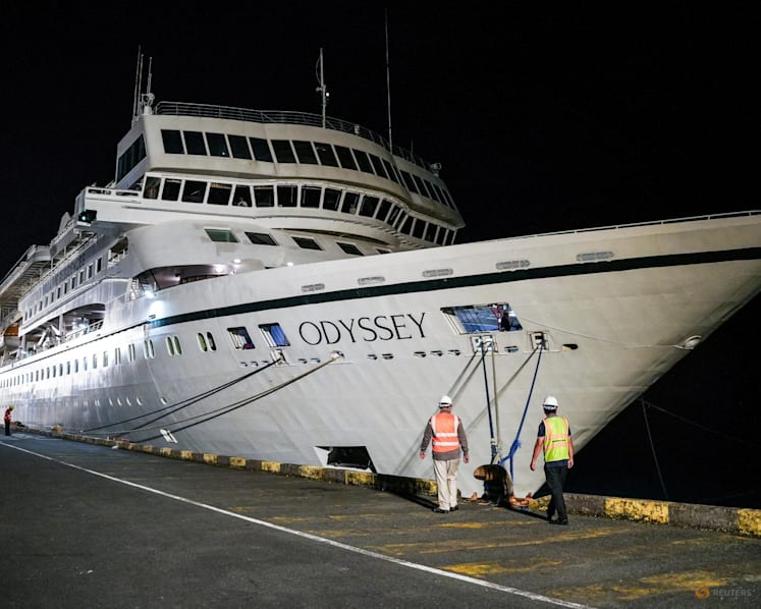
Photo | The Odyssey preparing to leave Cambodia
An Unbalanced Account
The Odyssey is not the first long-term global nomadic project to go wrong.
U.S.-based Storylines signed a construction contract for the MV Narrative with a Croatian shipyard as early as 2022, and planned delivery in 2025 at that time, but later the maiden voyage target was postponed to 2028. By May 2026, the operator was still pushing forward restructuring and seeking to secure the remaining financing.
Turkey's Life at Sea once promoted a three-year global voyage with a starting price of about 30,000 US dollars per person per year. Some guests sold their houses and rushed to Istanbul waiting for the ship, but the operator failed to buy the selected ship, and finally canceled the voyage before departure. They also had to chase refunds.
There are actually successful cases of such projects. The World, which set sail in 2002, is still in continuous operation, with only a 16-month suspension in the early stage of the pandemic. Its fees are much higher. The resale price of existing residences is about 2.5 million to 15 million US dollars, and the minimum annual maintenance fee set in 2023 is 200,000 US dollars. Residents jointly own the shipping company, share operating expenses, and pay for future maintenance reserves.
The Odyssey tried to lower the threshold to allow ordinary retirees to spend their old age at sea, but they failed. The cabins were sold out at one time, and the monthly fees were locked, so the income could not keep up with the rise in costs. A few weeks before the suspension of operations, co-founder Villalba admitted in a letter: "Looking back, we made it too cheap."
The acquisition planned by the Odyssey residents has fallen through. The old debts are more than expected, and they cannot reach an agreement with the lenders. Even if they bought the ship, they could not work out a monthly fee that could support the operation of the ship and be affordable for the residents.
The nomadic activities for middle-aged and elderly people on online travel platforms mainly combine accommodation and travel services for about a week or a month, which is essentially a longer short-term rental plus travel, and does not provide long-term elderly care guarantees.
Many seniors on the Odyssey, however, regarded the ship as their home for old age. The accounting problem that supports this home also appears repeatedly in the elderly care industry: increasing investment, continuous inflation, and lower-than-expected occupancy rates are squeezing operating profits, and it is difficult to digest the rising costs by raising prices.
According to data from the OECD, among its member states, there are only 5 long-term care workers for every 100 people aged 65 and over on average, and this number has not changed for ten years. The nursing industry has long faced the problems of low salary, heavy workload and difficulty in recruiting workers.
Another 2024 OECD study shows that in 16 countries, seniors with median income who need heavy care still have to pay more than half of their income out of pocket for home care even with public support. Institutions want to retain nursing staff and maintain service standards, but it is difficult to pass all the increased costs on to the seniors.
Mature large elderly care groups have not avoided the capital crisis either. French elderly care group Orpea (later renamed emeis) was caught in a nursing scandal in 2022, and then embarked on a debt restructuring path involving about 9.5 billion euros of debt.
Dilemmas similar to the Odyssey have also occurred in China.
In April 2025, the Shanghai Pujin Hotel under "Changsong Home" was shut down. A senior spent 200,000 yuan to buy a three-year bed card, and was forced to move out after living for 15 months. Later, she moved to another hotel in Fengxian, where there was no wireless network, the room had to be cleaned by herself, and the sheets could be changed for free only once every half a month.
In addition to operational risks, seniors may also encounter scams in the name of elderly care. Changsha Aizhixin Senior Apartment absorbed funds by pre-selling beds and elderly care services, promising to give bed subsidy vouchers that could be repurchased in cash. The total bed capacity of the apartment was about 600, but it developed more than 5,700 customers and absorbed 811 million yuan in funds. Operating income was not enough to pay high marketing commissions and repurchase fees, so it could only rely on newly received funds to maintain operations, and eventually failed to make payments on schedule.
By 2030, 1 in 6 people in the world will be aged 60 or over; by 2050, the number of people aged 80 and over will increase to about 426 million. More and more people will have to answer the same question after retirement: with limited money and a declining body, where will they live in their old age, and who will take care of them.
The residents on the Odyssey once thought they had found the answer. Now, they can only look for it again on their own.
Joel rented a riverside apartment in Cambodia for 200 US dollars a month. He had only been on the ship for 26 days, and had not yet developed a deep affection for this home, so it only took him an hour to pack his luggage. He said he had no resentment, "I just think they have no idea how to do business, maybe they should consider never doing it again in their lives."
Toni and her husband bought a new house and car in Las Vegas, living near their family. She still feels lucky to be able to afford this new settlement. "Many retired women put all their old-age savings into this ship," she said. "They not only have nowhere to go, but also have no money. The ship took everything away."
Randy said this is the first time he has been involved in a news story so bizarre that it can be featured in *This is True*. While living on the ship, he was diagnosed with cancer, and had disembarked twice to go to Thailand for treatment. The medication plus radiotherapy almost exhausted his physical strength. Now he plans to go back to Thailand, stay close to his doctors, and recover his health first.
"We are practically homeless." Staying in a five-star hotel in Southeast Asia is cheaper than staying on a ship, "but living in a hotel forever is not a home." Randy said. His wife Kit looked at the unfinished buildings in Sihanoukville and said that this is what her new life looks like, "an empty shell, and I will build it into something new."
