Let Robots Step into IFM: Shanghai Rimin Launches Multi-task Robot Tina
How many tasks can a service robot perform at most in one day? Rimin's answer is four: floor cleaning, night patrol, visitor guidance, and material delivery, with a maximum daily operation time of 18 hours.
Shanghai Rimin is a company with 10 years of experience in IFM (Integrated Facility Management), which has integrated its self-developed Tina robot into its existing contracts: 100% of its clients are foreign-funded or joint ventures, most of which are Fortune Global 500 companies. At present, Tina has entered the preparation stage for small-batch production, and the first batch of products will be prioritized for delivery to these cooperating clients.
Product Differentiation: Not Adding Extra Functions, But Multi-Task Scheduling
Single-function devices will return to the charging dock and stand by after completing cleaning, patrol or guidance tasks. However, the work in the building never stops: meeting materials need to be delivered, visitors need to be guided, and public areas need to be inspected. These tasks take place in the same space, but are undertaken by personnel in different positions, different devices and different systems respectively.
Huang Taibang, founder of Rimin, pointed out: "Every hour the device is on standby is an underutilized service cost, and clients will calculate this account." This is also the starting point for Rimin to develop Tina: to let the same robot undertake a variety of tasks in one day, and incorporate them into a schedulable, recordable and verifiable service process.
Value Proposition: 10 Years of On-site Service Experience in IFM (Integrated Facility Management) Defines What Tina Should Do
Huang Taibang founded Rimin in 2016 and has been engaged in IFM on-site services for 10 years. He was selected into the Forbes China 100 Elite Young Returnees list in 2025, and put forward the Tina concept in the same year, taking charge of product definition and R&D coordination —
His judgment criteria are: Which on-site problems are worth solving by machines, and which must be left to humans?
What drives Rimin to develop Tina comes from the pressure on both ends: on one hand, clients have increasingly higher requirements for service quality and data transparency; on the other hand, front-line posts are facing aging and recruitment difficulties, and young people are generally unwilling to enter this industry. In 2026, more than 70% of the top 50 domestic property enterprises explicitly require the deployment of robots in cleaning bidding documents, while the proportion was less than 30% three years ago. This trend is also rising significantly abroad.
It is the promotion of clients and the market that forces Rimin to push technological innovation to the final link — the labor execution link. From the UniLink IoT platform and service management system to industry AI capabilities, and then to the Tina robot, what Rimin wants to connect is a closed service loop covering facility status, task arrangement and actual operation.
The task processes, service standards and exception handling experience accumulated by Rimin over the past ten years determine the capability boundary of Tina: which tasks are suitable for automatic completion, which must be completed by personnel, and how to conduct acceptance after completion.
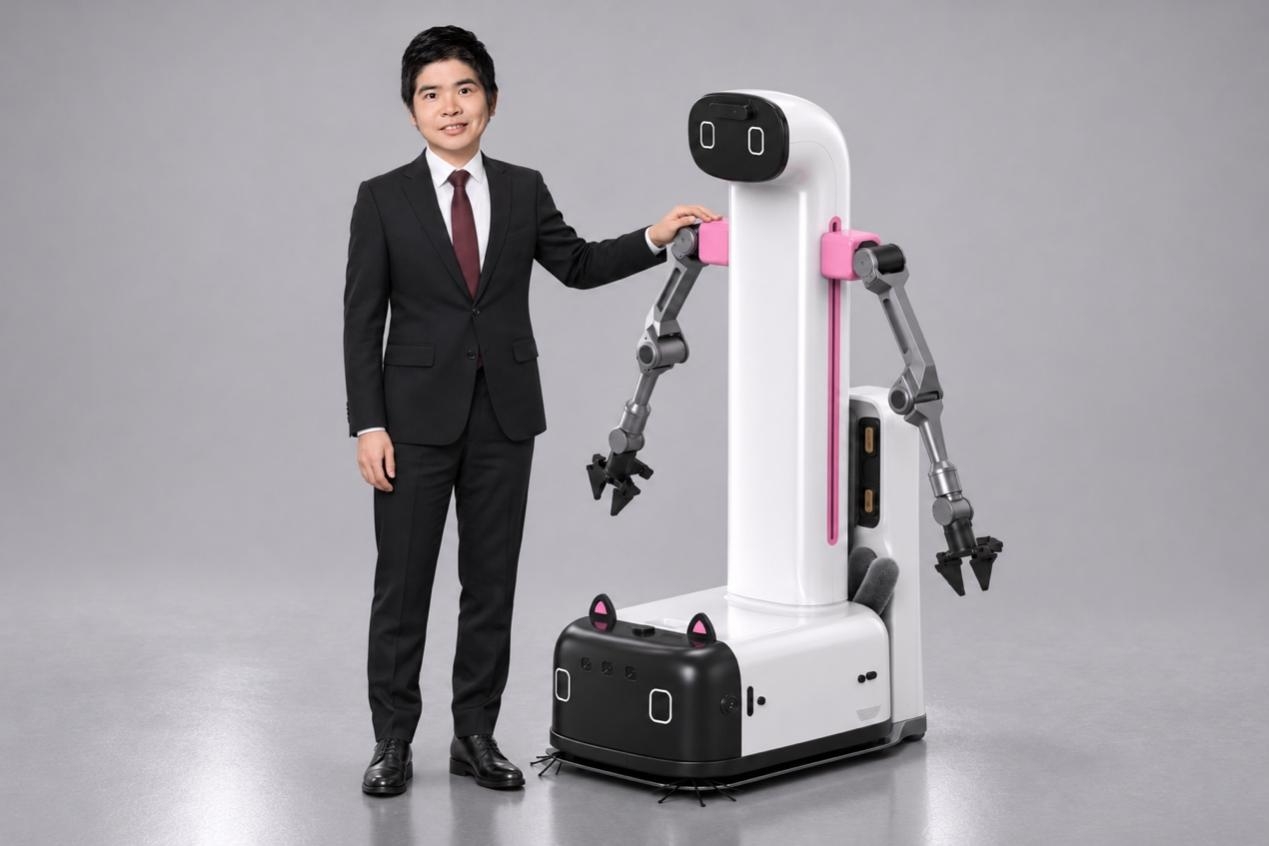
[Figure 1: Group photo of the founder and Tina]
Competitive Barrier: Not the Machine Itself, But Turning Service Processes Into Schedulable and Verifiable Tasks
Compared with single-function cleaning robots, the difference of Tina lies in task orchestration rather than hardware parameters.
When serving office buildings, Tina undertakes tasks such as floor cleaning, patrol, visitor guidance and material delivery through time-sharing scheduling. What clients really care about is: How much effective work can the device complete in a day? Will new tasks crowd out existing operations? Is the on-site personnel easy to manage? Who will take overall responsibility if problems occur?
These questions are answered by Tina OS. It consists of three parts: scheduling, perception and execution, which uniformly manages task priority, maps, access permissions, execution records and exception handling, and connects robot actions with service processes. After obtaining authorization and completing adaptation, Tina can also interact with building facilities and work order systems.
For example: when Tina finds an abnormality during patrol, the system will automatically leave a record, notify the responsible person and track the processing result; when encountering a task that cannot be completed independently, Tina will hand it over to the on-site personnel immediately to prevent the task from getting stuck at the device end.
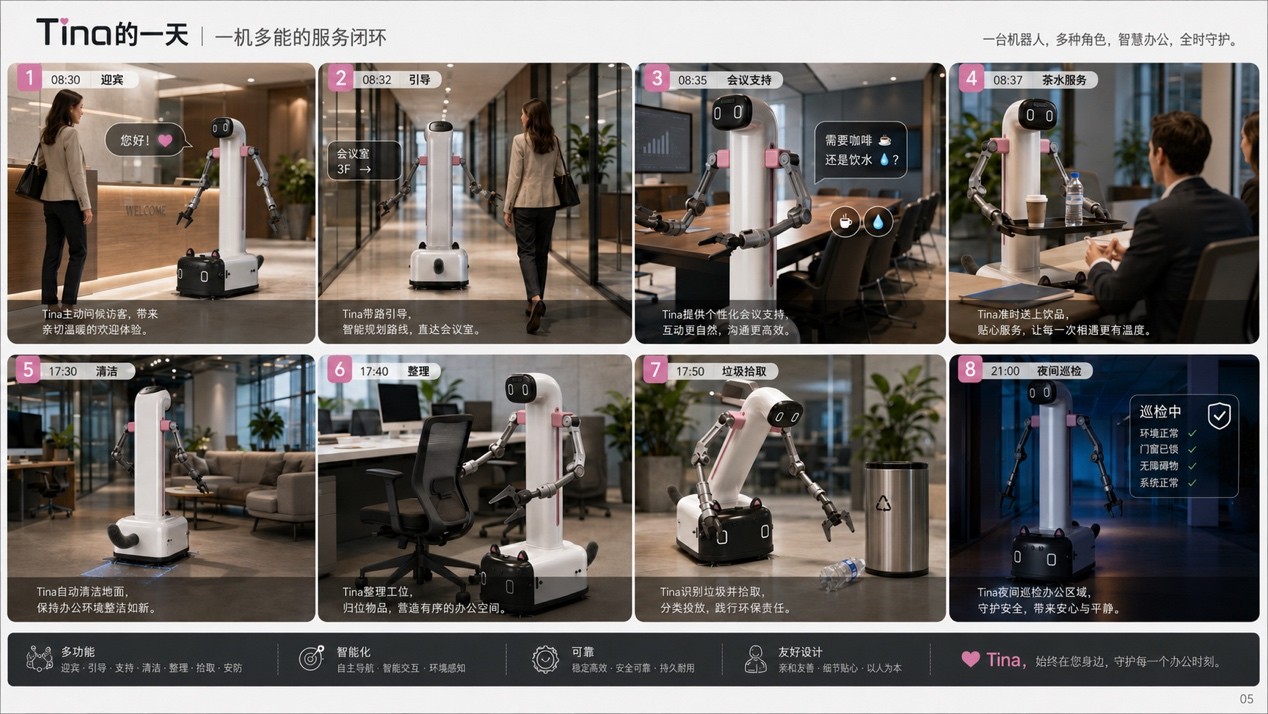
[Figure 2: A day of Tina — task timeline showing the time-sharing arrangement of cleaning, delivery and patrol]
Tina's core technology accumulation is reflected in three interconnected layers:
First, the collaborative architecture of the body brain, on-site brain and cloud brain. The body brain processes perception, navigation and action execution; the on-site brain organizes work by combining spatial maps, client rules, task priorities and device permissions; the cloud brain supports the update of knowledge, skills and versions. Different layers collaborate through clear interfaces, so that the robot can not only perform on-site tasks, but also handle tasks according to rules when the network changes, permissions are limited or tasks are abnormal.
This architecture needs to solve practical system problems: which decisions must be completed locally, how to coordinate multiple tasks, how to recover from execution failures, and when to transfer tasks to personnel. Its replication difficulty comes from the accumulation of cross-module collaboration and on-site verification.
Second, convert facility service SOPs into executable and verifiable task processes. Traditional SOPs describe how personnel should work, while robots also need to understand task trigger conditions, execution sequences, action parameters, completion standards and exception branches. For example, meeting room services need to arrange operations according to the usage status, enter the corresponding processing process when leftover items are found, and leave execution records after completion.
Rimin hopes to precipitate these processes into task templates, skill libraries and on-site configurations. With the increase of verification, new projects can reuse mature capabilities and then adjust according to site differences. This accumulation is related to deployment speed, operation stability and delivery cost, and is an important foundation for the large-scale implementation of multi-task services.
Third, connect mobile perception, service execution and building control. Centering on the technical concept put forward by Huang Taibang, Tina's R&D route further covers the authorized linkage between robot patrol and facilities such as lighting and air conditioning: combining spatial usage status and environmental information, triggering control according to on-site strategies, and then reading device feedback to confirm the results, forming a "perception-judgment-execution-feedback" process.
This requires both robot technology and facility control to have adaptation capabilities, and it is necessary to process different device protocols, client permissions, comfort requirements and safety boundaries. The energy-saving effect needs to be verified through the baseline and operation data of specific projects.
Rimin has obtained 37 software copyrights and 2 patents, and has submitted a number of invention patent applications for current related technologies which are under review. It is gradually accumulating technical assets through software, task rules and engineering implementation. Patent applications and actual operation verification are promoted simultaneously to gradually form product protection and replication thresholds.
Sales Strategy: From Selling Devices to Delivering Continuous Services
For example, taking the existing IFM project as an example, the total monthly salary of the three positions of cleaning, security and administration is 18,300 yuan, with an annual expenditure of 219,600 yuan. Tina does not replace all personnel in one post, but undertakes the standardized parts of the three positions respectively — floor cleaning, night patrol, material delivery and visitor guidance, accounting for about 35.3% of the total working hours. Calculated based on a single unit price of 125,000 yuan and an annual operation and maintenance cost of 15,000 yuan, the annual net saving is 62,500 yuan, and the investment can be recovered in two years. Clients can calculate this account by themselves. Only when the company can retain profits can this business be sustainable.
Tina's target clients include the administrative and logistics departments of Fortune Global 500 enterprises, property and integrated facility management companies, and park operators. Considering the different procurement and capital arrangement habits of different clients, Rimin has planned three different methods:
(1) Device sales: Clients with operation teams purchase devices, software and maintenance support.
(2) Leasing: Reduce one-time investment, which is convenient for trial and expansion.
(3) Comprehensive service: For clients who want to directly purchase IFM service results, Rimin will configure robots, personnel and management systems, and take delivery responsibilities according to the contract.
The revenue structure unfolds accordingly: device sales or leasing is the entry, software subscription, skill expansion, maintenance and spare parts constitute subsequent revenue, and comprehensive service contracts correspond to the long-term operation needs of clients.
Future Outlook: Stabilize Production Capacity, Expand Spatial Applications and Expand Overseas Markets
According to Huang Taibang, the founder, the company's domestic business alone has maintained an annual operating revenue of tens of millions of yuan in the past five years, with a peak employment scale of about 3,800 people. Tina has been running on a pilot basis in existing projects for more than 3 months, which is sufficient to support the current small-batch production and delivery.
Market expansion starts from office buildings. The planned Tina 2.0 is oriented to large public spaces such as airports and hospitals, and needs to complete corresponding industry access; Tina 3.0 will explore household scenarios in the long term, and each version is developed for the task and safety requirements of different environments.
In terms of overseas sales, Rimin plans to prioritize expansion in Singapore, Japan and Europe. The company will rely on its sales and support layout in Singapore, the planned Irish marketing center (covering Europe) and local partners to establish delivery capabilities.
If the financing goes smoothly, Rimin will push the already developed products to the replicable mass delivery stage. The funds are planned to be used for production preparation, reliability and core technology improvement, iteration of Tina OS and skill system, as well as channel and after-sales construction. Rimin is expected to achieve the business goal of delivering 300 units in 2027 ahead of schedule, and the specific pace will be advanced in combination with order conversion, production preparation and capital arrangement.
Whether the 10 years of accumulated industry experience of Rimin can be transformed into replicable robot products and form software and service revenue through continuous use will be further tested in the subsequent delivery.