In the AI era, when it becomes possible for people to live up to 150 years old, what will become of our wealth and careers?
Jeff Bezos bet 3 billion US dollars on cellular reprogramming, while Sam Altman wagered 180 million US dollars of his personal wealth on extending human lifespan by 10 more years — the world's top capitals are pouring into the "longevity" track at the same time. This is no longer just a scientific issue, but an ongoing economic earthquake.
In March 2026, the first human anti-aging gene therapy has been initiated for injection, and investment banks have listed longevity as one of the certain investment themes in Asia. When living to 150 years old is no longer a fantasy, a practical problem is already imminent: do you have enough money to spend? How long can you keep working in your career? Can you still keep writing the script of your life?
The concept of "retirement" was only invented in the 20th century — before that, humans never needed to make special financial plans for "living too long", because that scenario barely happened. Now, history is accelerating. When "somatic engineering" moves from concept to reality, we are not only faced with the biological problem of how to live longer, but also an urgent practical problem: for a person who may live up to 150 years old, how should they earn money, spend money, and plan their career?
Longevity is not only an extension of life, but also a complete rewrite of all our existing wealth logic and career models.
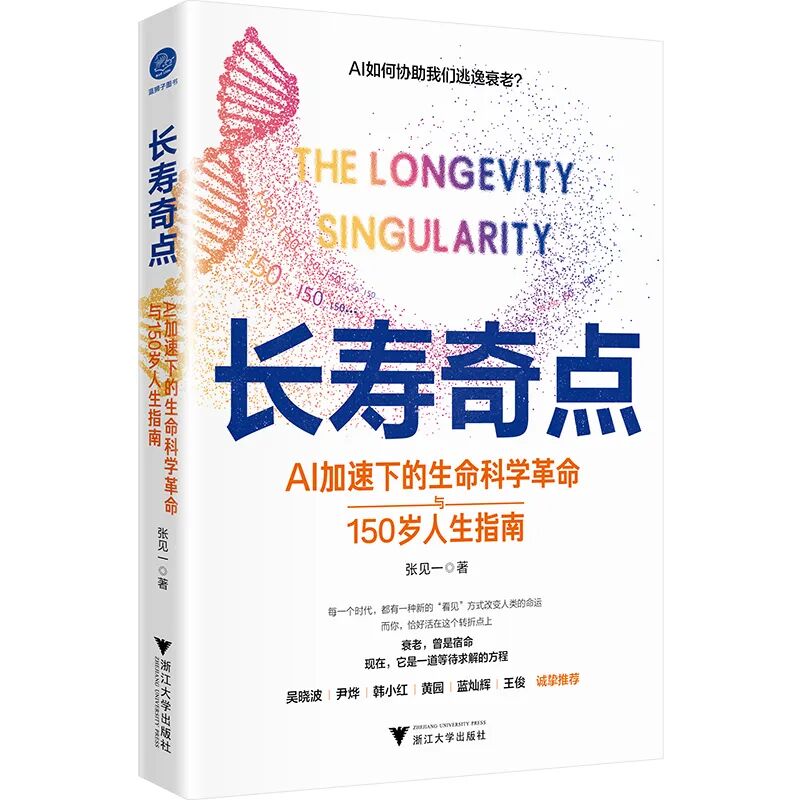
This book is selected from *The Longevity Singularity: The Life Science Revolution Accelerated by AI and the Guide to 150-Year Lifespan* by Zhang Jianyi, specially appointed researcher at the University of Cambridge and operator of the multi-million-fan blog "Uncle Cambridge".
I. Paradigm Shift and Cognitive Immunity:
Premise of Reconstructing the View of Wealth
From "Silver Economy" to "Longevity Economy"
When you hear the term "aging society", what comes to your mind? Staggering elderly people, full nursing homes, and rising medical insurance deficits? In traditional economic narratives, this is called the "silver economy", whose underlying logic is "recession management" — paying for disability, illness and end-of-life care. In this model, the elderly are defined as a burden on society, a group of pure resource consumers.
But this model is about to become invalid. With the popularization of "somatic engineering" and the intervention of AI health management, we are welcoming a brand new economic form: the "longevity economy". There are essential differences between the two: The silver economy is a stock-based defense, with capital flowing to crutches, wheelchairs, adult diapers and nursing beds; the longevity economy is an increment-based offensive, with capital flowing to anti-aging interventions, lifelong learning platforms, adventure tourism for 80-year-olds, and even geriatric medical aesthetics and dating markets.
Just imagine: if an 80-year-old is no longer a disabled person who needs to be fed, but a super individual with the heart function of a 30-year-old, the muscle strength of a 40-year-old, and 60 years of accumulated wisdom — this is not an elderly person, but a young person with 60 more years of life experience. What they need is no longer elderly care, but enjoying their old age, and even starting a new business. This will be an unprecedented incremental market. In the past, we believed that the peak of life output was between 30 and 50 years old, followed by a long downhill path. But in the longevity economy model, the life value curve will be redrawn as a "plateau curve" — after reaching the peak, it will maintain a high-level operation for decades through technical means. When the new generation armed with new technologies becomes the mainstream of society, that will be the real gold mine of the longevity economy.
Building a "Cognitive Immune System"
We are in a period of drastic transformation where old and new paradigms collide violently, and the information market presents an extremely high-entropy state. Open your mobile phone, and you will be bombarded by countless contradictory headlines: one day it says "coffee lengthens telomeres", the next day it says "coffee causes cortisol to rise"; in the morning an expert suggests "eating less carbohydrates to resist glycation", in the afternoon a blogger warns "ketogenic diet damages the heart". For the public who do not understand the underlying logic, this is a disaster. They are like duckweed, living in the anxiety of "chasing news" instead of the certainty of "seeking truth".
In the era of longevity singularity, the most valuable ability is not the ability to acquire information — information is already overflowing — but the ability to filter information. You need to build a set of "cognitive immune system" based on first principles. Once you master the underlying logic such as "SIRT protein pathway", "mTOR signaling" and "autophagy mechanism", you will have the "X-ray eyes" to penetrate the fog. You will understand why cold water baths and fasting are isomorphic in the underlying logic, and you can see through pseudoscience in high-tech clothing at a glance. Don't be an "information scavenger" chasing the latest news, be a "long-termist" who sticks to the underlying logic. When you have this cognitive immunity, anxiety will disappear.
II. Wealth and Career:
Two Major Survival Tracks in the Longevity Era
Three Tides and Hierarchical Strategy
On the journey towards crossing the longevity singularity, trillions of dollars of wealth will erupt sequentially along three tides.
The First Tide (Present — Next 10 Years): AI Infrastructure and Proximal Data Mining.
The core task is efficiency revolution — using silicon-based computing power to solve the complexity of carbon-based data. Representative tracks include AI drug discovery: whoever can use AlphaFold to reduce the cost of new drug R&D by 90% will be the winner; hardware vendors with high-precision sensors that can continuously capture data such as blood glucose and brain waves are the "data oil drilling platforms" in the longevity era.
The Second Tide (Next 10 Years — 20 Years): Life Repair and "Somatic Engineering" Tools.
The core tasks are "hardware wear repair" and "system reinstallation". Representative tracks include targeted drugs such as Senolytics that precisely eliminate "zombie cells", synthetic biology and organ regeneration technologies, and epigenetic reprogramming based on Yamanaka factors.
The Third Tide (Next 20 Years —): Post-human Infrastructure.
The core tasks are "consciousness expansion" and "energy supply", and representative tracks include brain-computer interfaces and controlled nuclear fusion.
However, investment in the life science field is extremely difficult. A gene sequencing company that is thriving today may lose its moat instantly due to the emergence of new algorithms; the "star molecule" of this second may plummet by 90% in stock price the next second due to a clinical side effect report. Without professional literacy, even if you invest in the right track, you may fall before dawn.
Recommended hierarchical strategy: If you are a young person, go all in (plunge into the field) — the best investment is not buying stocks, but devoting your career to it. Choose a cutting-edge company to work and learn at the same time. Even if the company goes bankrupt, the "bilingual ability" you accumulate — understanding both biology and AI — is still the scarcest asset. If you are a non-professional, stay put (stay steady and down-to-earth), do your job well, accumulate steadily, stay away from individual stocks and fancy unlisted shares. Lifespan extension itself is the greatest wealth leverage. In a life that exceeds 100 years old, the compound interest effect is extremely amazing. There is no need to rush, time is on your side.
Life Science: A Career Safe Haven in the AI Era
Since the end of 2022, AI anxiety has shrouded white-collar workers — what kind of work can't be done by silicon-based beings? But life science presents a peculiar "anti-fragility", and it is very likely to be one of the few fields that can increase employment in the AI era.
The logic is: AI's strength is calculation, while human's strength is connection. The diagnostic accuracy of junior doctors will soon be surpassed by AI, but the essence of life science is not only processing data, but also dealing with human pain and hope. The human body is still a complex system full of "black boxes", and AI cannot capture unstructured distant data through a glance or a sigh. The more sophisticated medical technology is, the stronger human demand for warm comfort will be. The formula will change from "Doctor > AI" to "Human + AI > Pure AI".
What positions will disappear? Junior laboratory technicians and radiologists — AI's eyesight is 10,000 times better than human eyes; junior health customer service staff — those who only reply with standard scripts will be eliminated; repetitive experimental operators — automated laboratories will make pipette operators a thing of the past. What positions are emerging? Biological data analysts — "bilinguals" who understand both biology and algorithms; longevity planners — external think tanks for the "CEO of the somatic company"; somatic engineering consultants — high-end roles that combine doctors, coaches and psychological counselors, who do not treat diseases, but manage the life cycle.
Jensen Huang has predicted many times: "Life science will be the greatest engineering discipline in the future." Demis Hassabis is using AI to exhaust protein structures, and Sam Altman has invested huge wealth in the longevity field. AI is transforming biology from an experimental science to an engineering science, and the threshold for entrepreneurship is plummeting. In the future, three to five young people who understand biological algorithms can use cloud computing power in the garage to design therapies for rare diseases. This will be a Cambrian explosion belonging to "carbon-based developers".
More importantly, you don't have to switch careers to become a full-time biologist. Understanding somatic engineering will become the underlying general knowledge for all pan-health practitioners. In the future, fitness coaches must understand CGM data, and future psychological counselors must understand the brain-gut axis. Life science will become the new "foreign language" in the AI era — no longer a vertical industry, but a survival skill and career value-added package for a 100-year lifespan.
III. Lifestyle Revolution:
Maintain Iteration in an Extra-long Lifespan
From "Three-stage Life" to "Multi-stage Life"
Industrial society has compiled a standardized "three-stage life" script: store knowledge during the education period, convert knowledge into money during the working period, and wait for the end during the retirement period. This script is designed based on the assumption that "humans can only live to 70 years old". But in the era of longevity singularity, if you can live to 150 years old, you will face a 90-year long blank after retiring at 60, which will not only lead to depletion of money, but also depletion of spirit.
We must switch to the new paradigm of "multi-stage life". Life is no longer a one-way straight line, but a series of iterative cycles: study — work — rest/reshape — new job — re-study — new track. You will experience 3 to 5 completely different careers: you are a programmer at 30, become a biological data analyst through re-learning at 50, and reshape yourself into a space travel guide at 80. The concept of retirement will disappear, replaced by "sabbatical years", when you press the pause button at the age of 40, 60, and 80 to recharge for the next journey.
Credit Compound Interest: One Person Is a "Century-old Shop"
In the past, credit was often regarded as a consumable for one-time realization. In a short cycle, a person overdrafts his credit to "make a big profit" at the age of 40, and only needs to change his social circle and survive for two or three decades — physical death is the most thorough means to write off bad bills, and the cost of breach of contract has an upper limit. But longevity has welded this shortcut shut. When life expectancy is extended to 150 years old, credit bankruptcy at the age of 40 means you have to endure social exclusion for more than a century. Any short-sighted behavior of overdrawing credit has become an extremely stupid transaction.
On the other side of the coin, longevity gives amazing "time compound interest" to positive credit. In the past, a "century-old shop" required several generations to pass the baton, full of fragility of intergenerational inheritance. But in the longevity era, you can do one thing for a hundred years all by yourself. The reputation accumulated at the age of 30, the contract fulfilled at the age of 50, and the industry trust precipitated at the age of 80 will continue to generate dividends at the age of 120. In the infinite game of ultra-long cycle, personal credit is the hardest moat.
Curiosity: The Nuclear Power to Fight Against Mental Entropy Increase
In a multi-stage life, you might as well regard the brain as a continuously iterating "large language model". As the life cycle lengthens, a lot of knowledge and old experience will expire in the technological iteration. Daring to forget is not only fine, but also necessary — to make room for the upgrade of the cognitive framework. Constantly crossing boundaries, reshaping careers, and learning new knowledge is essentially not to stuff in more data, but to continuously upgrade the underlying parameters of the brain.
What drives us to "clear the cache" again and again and "train the model" from scratch for hundreds of years? There is only one answer: curiosity. In the short three-stage life, you can tolerate a job you don't like for 30 years for survival. But in the longevity era, no utilitarian endurance can last for 80 years. Only curiosity and thirst for knowledge are the nuclear power to keep the "human brain large model" never down — it activates the brain's reward circuit, maintains neuroplasticity, fights against "mental entropy increase", and keeps the internal model always full of endless desire for the latest parameters of the world.
We already have a clear roadmap for wealth and career, and for how to win chips in the longevity game. But having chips does not mean having the feeling of "winning". In the era of longevity singularity, the biggest worry may be the depletion of meaning.
We have discussed the technical problem of "how to survive". Now, we have to face the ultimate interrogation of "why to live". This is not an easy question to answer, but it is worth our while to use the long years ahead to seriously find the answer.
This article is from the WeChat official account "Blue Lion Books", Author: Uncle Cambridge, published with authorization from 36Kr.