One-stop learning, training and trading system, Smart K-Line is seeking angel round financing
Smart K-Line Practice is an application designed to help stock traders quickly build and verify their trading systems and risk awareness. It compresses the process of gaining trading capabilities that would otherwise take several years or even decades into just a few months, using real market data and a systematic training matrix. The project was launched in April 2026 and officially went online in September. It is now available on four Android app stores: Xiaomi, OPPO, Honor and vivo, with listings on Yingyongbao, Huawei HarmonyOS AppGallery and Apple App Store underway, and its official website has completed EOS\GOS optimization. No promotion has been carried out yet, and there are more than 200 registered users from natural traffic of app stores and the official website, with a daily growth of 8-14 users, user retention rate > 20%, and average single-session user stay time of 5 minutes and 27 seconds. Commercialization has been fully implemented and closed-loop, with real payment orders on WeChat Pay. The project is seeking 2 million yuan in Angel round financing, offering 20% equity for a post-money valuation of 10 million yuan. It strives to become a must-install learning and training tool for stock traders within 3 years, with a target of over 1 million retained installed users.
Retail Investors Should Pay Far Less Unnecessary Tuition
By the end of 2025, there were 250.6729 million A-share investors, 99.76% of whom were natural persons; 13.8695 million new investors were added in 2025, and the annual new increment has exceeded 10 million in the past decade. New investors keep entering the market, but almost everyone's trading ability is bought with real money — every loss is not only a loss, but also tuition fees.
This tuition could have been avoided in real trading accounts. Books and courses can teach people to recognize chart patterns, but being able to identify a pattern is completely different from daring to place an order amid uncertainty; simulated stock trading platforms offer virtual capital, but the market moves in real time and stock names are publicly visible, so users can just glance at the real market to get the answer, and they can restart even if they lose money. After market close, most software only shows a profit and loss number, without telling users what type of decision is causing losses. Existing products on the market only cover half of the needs: simulated trading platforms solve the problem of "not using real money", but fail to prevent users from seeing the real market answer; investor education courses and stock trader communities solve the "knowledge" part, but lack the "practice" module, and some of them even push stock recommendations and trading point hints under the pressure of paid conversion, violating regulatory license rules. Quantitative backtesting platforms such as JoinQuant and RiceQuant have complete functions, but they assume users can write code, serving strategy researchers rather than retail traders who want to practice trading intuition. There is a clear unmet gap: a practice field that requires no real money, hides real market answers, and tells users exactly where their losses come from after practice.
The founder of Smart K-Line Practice has 18 years of real trading experience, used to be a journalist at a provincial mainstream media outlet, and was an officially certified top influencer on stock trading communities. He put it plainly: "Ordinary retail traders enter the market without enough practice, and the tuition they pay is too high. I want people to spend that money on the training ground, not in real trading accounts."
Unfalsifiable Performance Records
Different from most similar products that only have a simulated trading button, Smart K-Line Practice splits "practice" into a complete matrix: daily K-line training is divided into three styles: trend swing trading, pattern breakout trading, and bottom-fishing low-absorption trading, each with two modes: open card and hidden card; time-sharing training runs on a self-built 1-minute market database; K-line confrontation has three play modes: 2-player duel, multiplayer free-for-all, and arena match; pattern recognition converts 20 textbook patterns into executable rules, and extracts real cases from real market data for users to practice identification. Matching with this matrix is a course system consisting of 160 formal lessons plus 4 learning maps, totaling 1.02 million characters, covering 4 stages from beginner to hot money-level trader, with 3 style tracks, which is unmatched by similar investor education products. The three-volume book *Stock Market Practical Trading* derived from the courses has been serialized on major platforms, forming a closed loop that integrates reading, learning and practice.
The core of the matrix is the hidden card mode. The system randomly intercepts a segment of real historical K-lines, hides the name, code, time coordinate and all subsequent trends. Users receive the K-lines one by one and make decisions for each, with four buttons for buy, sell, hold and wait, and the answer is only revealed when the round ends.
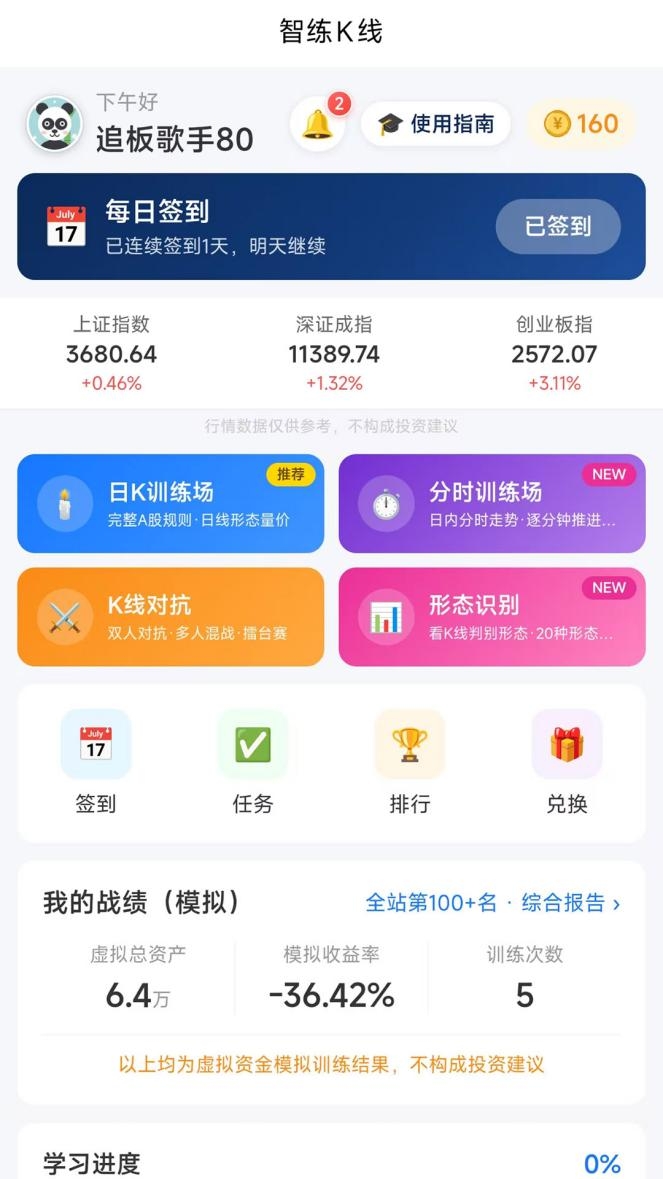
The time-sharing training uses a self-built database. The team collects and stores 1-minute level A-share market data on its own. At present, there are more than 5.38 million time-sharing K-lines covering more than 1,000 underlying assets, which are incrementally updated after each trading day's close, and the data coverage is aligned with the latest trading day — users do not practice on outdated samples from several years ago, but on market data that matches the latest market rhythm. Common game scenarios such as limit-up and limit-up breakdown are all included in the practice pool.
The three play modes of K-line confrontation share one rule: all players in the same round get exactly the same set of K-lines, and winning or losing only depends on decision-making, not luck.
Pattern recognition is built as a "textbook laboratory". 20 classic patterns including W bottom, head and shoulders bottom, arc bottom, morning star, bullish engulfing, three white soldiers, head and shoulders top, evening star, three black crows, dark cloud cover, flag consolidation, triangle consolidation are all converted into executable judgment rules according to textbook definitions — the calculation of neckline, the proportion of entity, the position of confirmation line are all clearly defined without any ambiguity. The system automatically extracts cases that meet the definitions from real market data for users to practice identification, and the case library has accumulated nearly 20,000 entries. The patterns in textbooks are artificially drawn, but every pattern here has actually happened in the real market.
After practice, users do not only get a yield number. The 9-dimensional scoring system splits profit, risk control, win rate, stability and other indicators for separate calculation, and weights them into a growth score corresponding to 6 ranks. There are two strict calibration rules: scores are not counted for less than 5 rounds of practice, to avoid luck from small samples being counted as capability; the profitability indicator uses the 95% confidence lower limit instead of the average value — an average return of +8% over 11 rounds may just be good luck, and the system only counts the part that is statistically proven to have positive expectation into the user's capability. Each round can generate a playback, allowing users to compare their decisions with the corresponding K-lines at that time; the AI interpretation goes one step further, generating a readable attribution report that explains details such as "the maximum number of trading days of empty position" and "which type of pattern leads to concentrated losses".
The course system matching this matrix consists of 160 formal lessons plus 4 learning maps, totaling 1.02 million characters. Every pattern explained in the lessons can be verified with one click in the corresponding training scenario, so users can practice immediately after learning, and courses are unlocked according to membership level. This content system is still expanding: the three-volume *Stock Market Practical Trading* book derived from the courses has started serialization on major platforms, and the methods learned from the book can be practiced in the App — the book is not only an output of content, but also a customer acquisition entry with zero promotion cost.
Compliance is the prerequisite rather than an additional item of this design: no stock recommendation, no trading point hint, no return commitment, no connection to real trading, all underlying assets are anonymous during the decision-making stage, all return displays are marked with "simulated" label, and the four qualifications including ICP filing, public security network filing, App filing and software copyright registration are all complete. This boundary has been a hard constraint since the first line of code: "We would rather reduce features than engage in behaviors that require investment advisory licenses".
Three Steps for Future Development
The development adopts the model of small team plus AI assistance, with key foundations such as fund settlement, data security and compliance internal control built by professional personnel. The output speed of this model is very solid: since the launch in April, more than 40 official versions have been iterated in over 7 months, with about 53,000 lines of core code and 194 back-end interfaces. The time-sharing data layer reconstruction, pattern laboratory and AI interpretation are all developed at this pace. The same methodology has also produced a second product — the self-developed AI customer acquisition assistant "QueLang", with more than 46,000 lines of back-end code, which has been launched online.
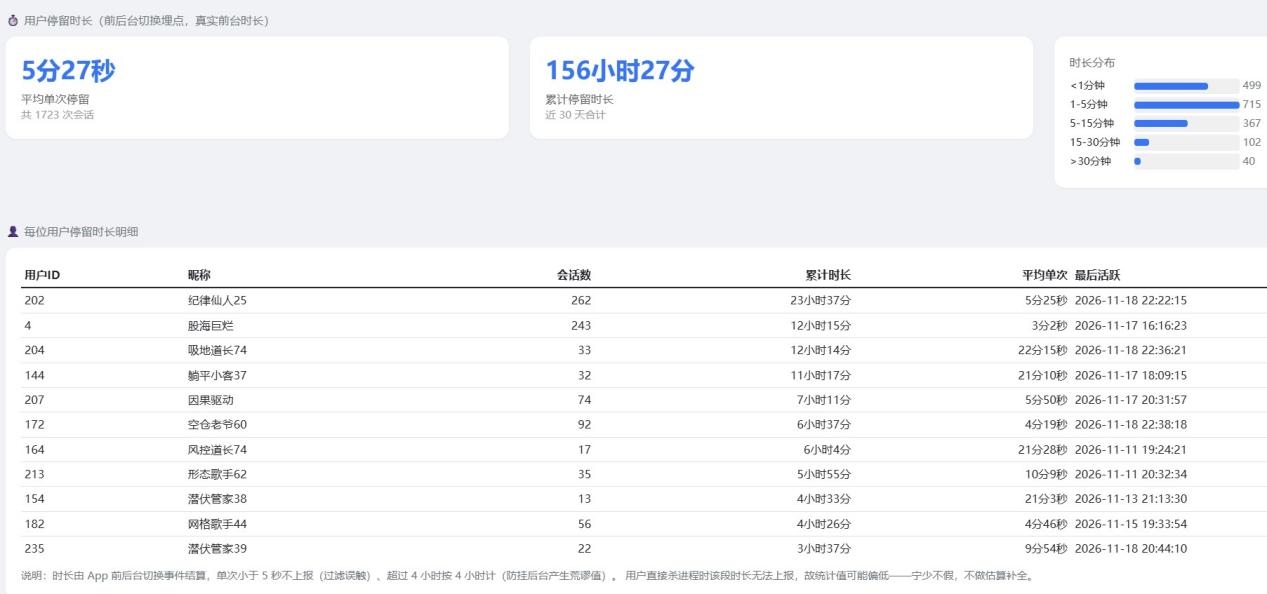
User stay time displayed on the backend
Up to now, the platform has not spent a penny on promotion. After the official launch in September, 72 new users were added in October, and 127 new users have been added in November before the end of the month, with the natural growth rate climbing. What can better reflect the product quality than the number of registered users is the usage depth: there are 141 active users in the past 30 days, with a total of more than 3700 training rounds, and more than 1800 rounds in the past 7 days; in the backend data, 21 users have completed a single training session of more than 20 minutes, and the most active user has accumulated nearly 300 training rounds — in a tool product without heavy gamification design, such high stay time proves that users take the training very seriously. The payment data is small for now: 8 orders, totaling 88.75 yuan, with zero refund. But the order composition is more meaningful than the amount — membership subscription, asset reset card, and AI interpretation are all purchased by users. The willingness to pay comes from the depth of training, not from sales pitches.
Customer acquisition will not only rely on paid promotion, and four independent channels have been built inside and outside the product. The first one is two-level invitation rebate: 10% for the first level and 3% for the second level, permanently locked, no third level, no team remuneration, and rebate is only counted after the invited user completes 3 rounds of practice, which avoids pyramid scheme risks from the rule level. The second one is the contracted promoter system: 27% for the first level, 9% for the second level plus CPA, with monthly cash settlement, supported by server-side authoritative ledger and monthly settlement engine, no manual reconciliation needed. The third one is the serialized three-volume book, which realizes the linkage of reading, learning and practice, and the content spreads by itself. The fourth one is the self-developed AI customer acquisition assistant "QueLang" by the same team: merchants answer 15 questions to extract product DNA, the system then generates a compliant content matrix in batches (Douyin scripts, copywriting, landing pages, with double compliance recheck at rule level and AI semantic level, financial red line content will be directly blocked), assembles landing pages and release packages, then tracks which channel and which content brings leads and transactions, calculates ROI — promotion no longer relies on intuition, and can stop loss in real time.
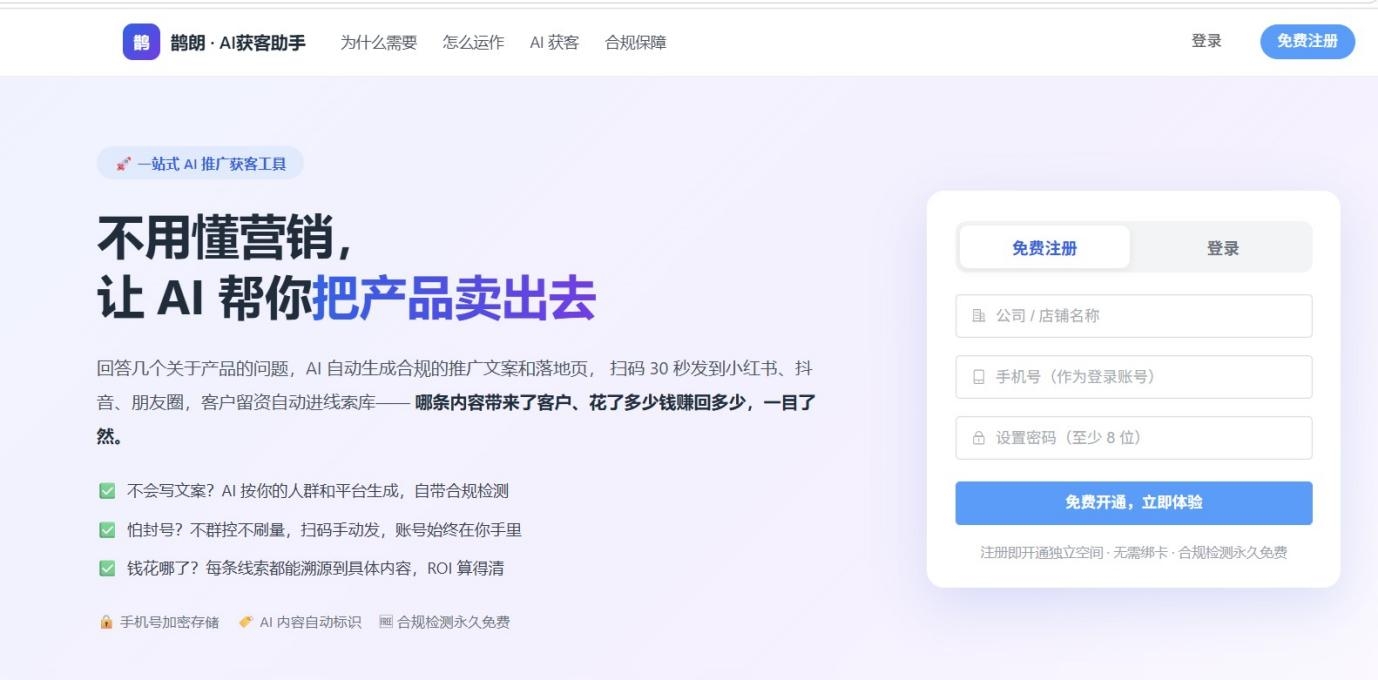
Figure: The self-developed AI customer acquisition assistant "QueLang" by the team
The 2 million yuan raised in this round will be allocated as follows: 50% for market promotion, 30% for team expansion, 10% for server upgrade and operation maintenance, 10% for office space.
The first thing after the fund is in place is not to pursue rapid user growth. The project team splits the next three years into three verifiable milestones: first, within 12 months after financing, verify that the business model is valid by getting clear data of customer acquisition cost, retention rate and paid conversion rate under the scale of 10,000 registered users; second, launch the season pass, start pilot cooperation with brokerages' investor education departments and university financial training programs, so that B-side revenue can offset C-side revenue fluctuations; third, achieve annual revenue of 4.905 million yuan, net profit of 1.729 million yuan, and positive operating cash flow (these are the project team's planning targets, not performance commitments), so that the next round of financing will be for expansion instead of survival. Looking further ahead, what we want is not a bigger application, but a specific scenario: when retail traders want to "practice first before entering the real market", the first thing they open is Smart K-Line Practice, not their real trading account; books, courses and training ground are integrated together, becoming the default entry for this behavior. In recent years, regulators have been continuously promoting practical investor education, and the practice module is exactly the missing part in the current investor education supply.
Most retail traders have not realized that trading ability requires deliberate practice. What this round of financing buys is the time to let more people recognize this concept.