After serving 540,000 merchants, AINU AI aims to turn viral hit videos into a standardized production pipeline.
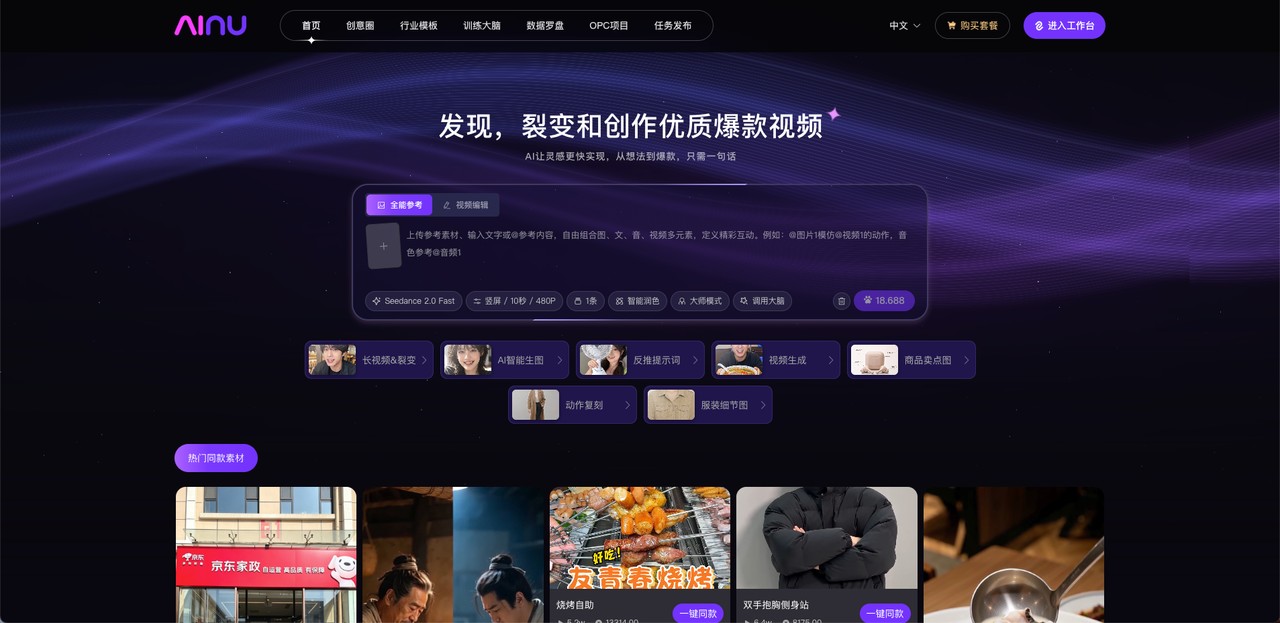
AINU AI Homepage Workbench
Over the past two years, the "model" has been the core protagonist of the AI video track. Kling, Jimeng and Runway have successively refreshed the records of generation quality, and industry discussions have always focused on whether the picture is realistic enough and whether the movements are natural.
However, in real creator scenarios, another problem is emerging — after you "can generate the content", how do you make it go viral.
A short video that can achieve excellent performance on TikTok or Douyin cannot rely only on a generated clip. It also requires scripts, topic selection directions, viral templates, shot structures, dubbing and background music, and even the awareness of what themes perform well on which platforms recently. In this entire workflow, model generation is only the last step at the very end.
Officially launched in September 2026, AINU AI tries to cut into this earlier part of the workflow. It does not position itself as another "entry for generation models", but a one-stop AI creation platform for short video creators and e-commerce marketing — integrating the entire workflow from topic selection, script writing, generation to final video production into one single interface.
Reverse design the workflow from viral content, instead of expanding functions forward from the model
The homepage slogan of AINU AI is "Discover, iterate and create high-quality viral videos". From the perspective of product structure, this slogan corresponds to a complete assembly line:
"Data" comes before "creation". At the top of the left navigation bar of the platform is Global Viral Data Dashboard — it aggregates popular videos from TikTok, Douyin and Xiaohongshu in real time, supports filtering by dimensions such as influencers, products, trends, hot tags, etc. The data sources cover TikTok influencers like ash tervino vs bri, popular Douyin food accounts, Xiaohongshu nail art category and more. The entry of this module is placed before all creation tools, which conveys a clear product logic: first figure out what can go viral, then decide what to create.
The next part is Script Master — when users input requirements like "30-second Xiaohongshu product promotion video, product is an air fryer", the AI can generate short video scripts, rewrite existing scripts, produce storyboard schemes or optimize titles and covers. The Script Master also supports Skill Market — the platform has 8 built-in official preset skills (Douyin voiceover, promotional segmented clips, etc.), and users can also upload their own skills for modular calling. This is a rather special design: Skills turn "how AI works" from a black box into reusable configuration blocks, which reduces the cost for ordinary users to describe demands from scratch every time.
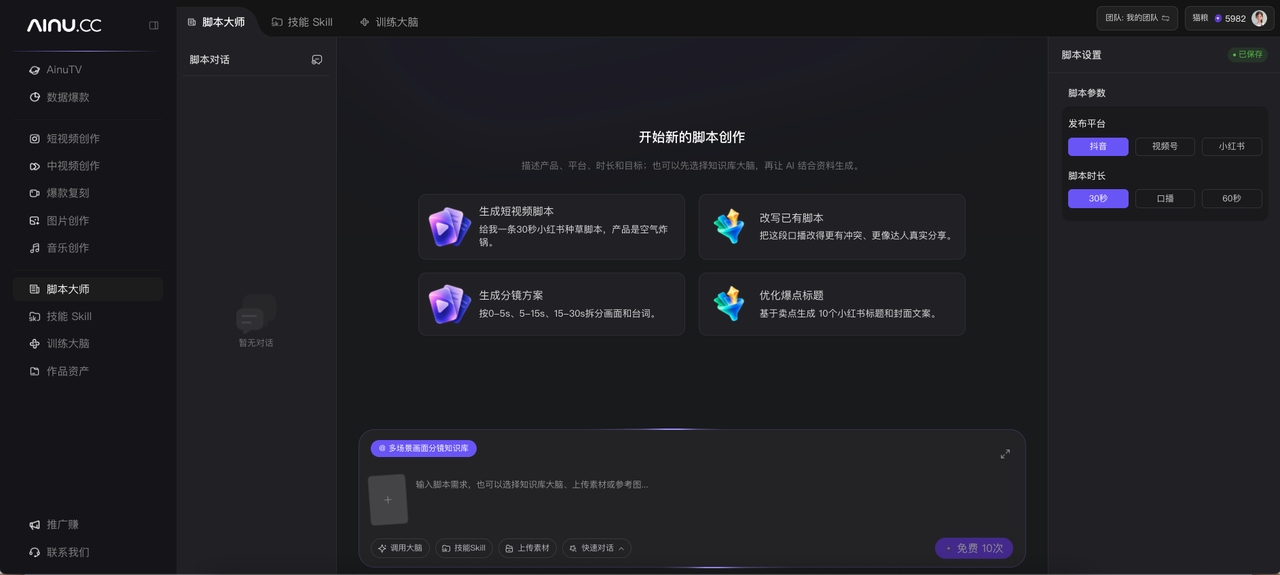
Script Master supports multiple input modes including short video script generation and storyboard scheme output
Then comes the Video Generation part. AINU AI is connected to multiple video models including Wan 3.0, Seedance 2.0, Seedance 2.5 and more. Users can upload reference images or input text to directly generate materials under the two modes of "All-round Reference" and "Video Editing". Different from pure generation tools, it does not require users to choose between "which model is better" and "which model has this capability", but schedules models uniformly according to specific scenarios.
Images and music are also independent modules. AI Image Generation has built-in e-commerce scenario templates such as clothing detail images and product selling point images, while Music Creation supports both instrumental music and lyric modes, which can directly generate matching soundtracks for videos — this is not common among current AI video tools, as most platforms only cover the "visual content" layer.
There are two more industry-oriented modules in the function list worth mentioning: Viral Content Replication and Knowledge Base Brain. The Viral Content Replication function allows users to upload a video, and the AI will analyze the shot structure and prompt logic to generate replication prompts, which essentially reversely disassembles the creation ideas of viral content. The Knowledge Base Brain allows teams to upload industry materials (such as product manuals and brand tonality documents) to train an exclusive "brain", and all subsequent creations will call the knowledge of this brain. For teams with brand consistency requirements, its output is more controllable than that of general models.
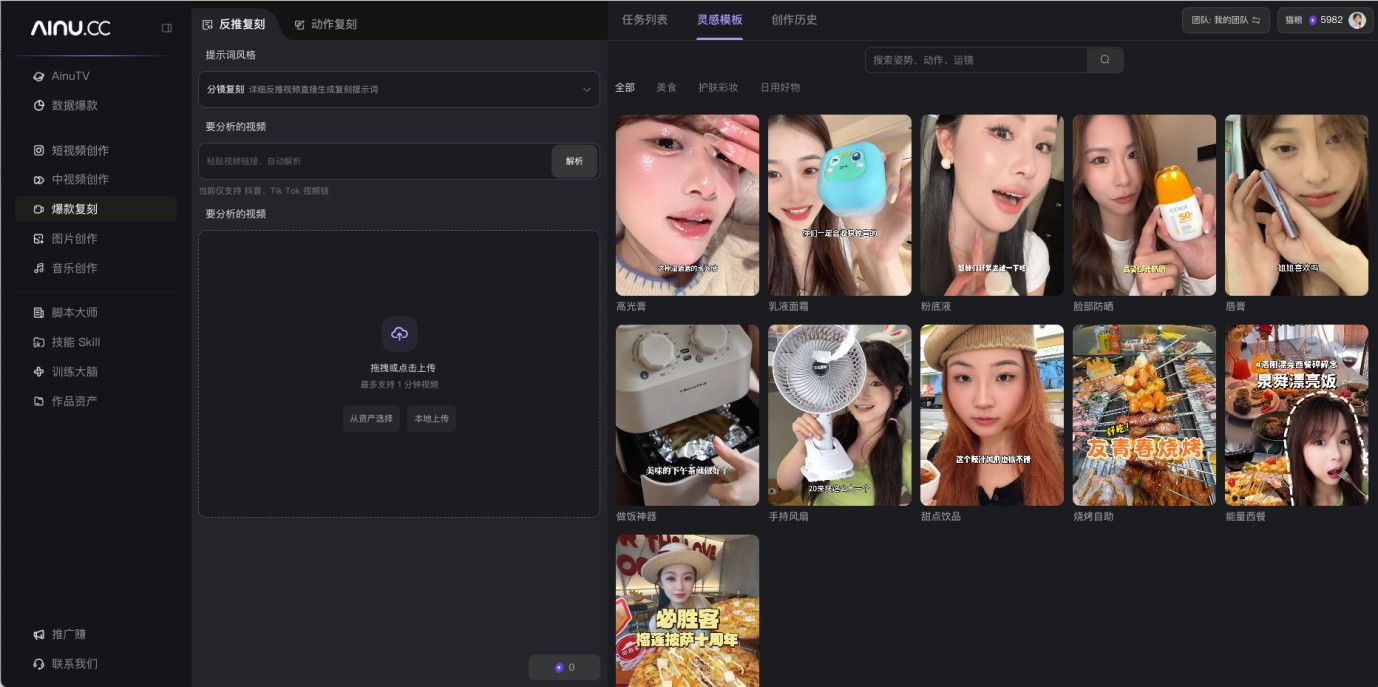
Viral Content Replication function: upload a video to disassemble its structure and generate replication prompts
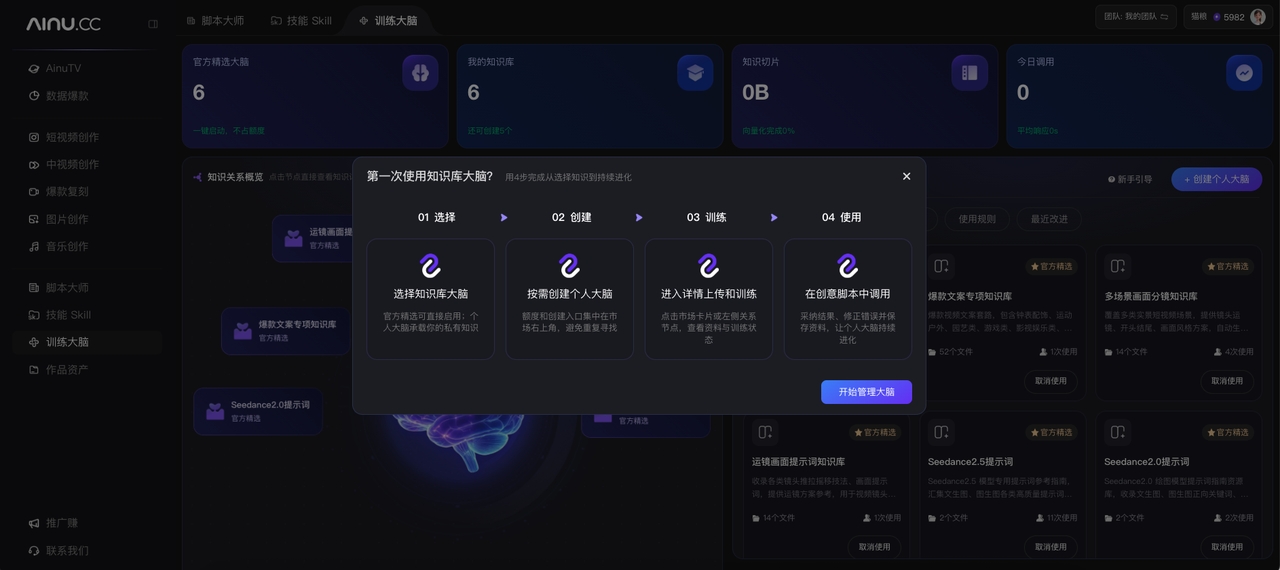
Knowledge Base Brain training process: upload domain-specific materials to train an exclusive AI brain
The last part is Creative Community AINU TV — similar to an open work square, users can publish their generated works to the community, and visitors can directly create secondary works based on others' content. The platform currently also provides an "Inspiration Template" category, covering vertical scenarios such as catering and entertainment, daily life convenience, store materials, tourism and accommodation, domestic services, etc., which can be directly applied by industry users.
Differentiation from Kling, Jimeng and Runway: shifting competition from "model" to "workflow"
It should be noted that AINU AI does not compete at the exact same level as Kling, Jimeng and Runway.
The core advantage of Kling lies in its model capability and in-depth exploration of vertical scenarios — Kuaishou has deeply integrated it with short dramas, e-commerce live streaming and film and television production, and the Kling series has reached the first echelon in performance of character movement and physical interaction. The advantage of Jimeng lies in ecological collaboration, generated materials can be seamlessly imported into Jianying for fine editing, and functions such as digital human and lip-syncing are very friendly to short video creators, with direct domestic access and low usage threshold. Runway has long been oriented to professional creation and post-production for film and television, its flagship model has been iterated to Gen-4.5 with a mature tool chain, but localized support for Chinese users is not its priority.
In contrast, AINU AI has three major differentiation points:
First, full process coverage rather than single-point capability. It does not take "model" as its product selling point, but packages the model as one node in the workflow — data-based topic selection → script generation → visual content production → music creation → final video output → community publishing. The direct benefit of model aggregation is that users do not need to switch between multiple platforms for different effects, and do not need to pay for the capability upper limit of a single model.
Second, industry-specific templates rather than general output. The existence of modules such as clothing detail images, product selling point images and catering store videos shows that the product is designed by reversely deducing functions from "what people who sell goods on e-commerce platforms need", instead of expanding functions forward from "what the model can generate". The vertical industry templates in the creative community (catering and entertainment, domestic services, tourism and accommodation) further strengthen this positioning.
Third, data accumulation rather than simple user volume growth. Up to now, the publicly disclosed data of AINU AI includes: it has served 540,000 merchants and 2.2 million influencers, with a total accumulated content play volume of over 500 million. It relies on an annual AI content production capacity of nearly 2 million hours and a self-built computing power server room to support large-scale delivery. The significance of these figures is that it does not build tools from scratch, but builds the AI workflow on the basis of existing industry content production experience and computing power infrastructure. The team has nearly 100 members, and core R&D, model iteration and computing power operation and maintenance are all independently controllable, instead of relying on the black box capability of upstream suppliers.
What are the difficulties of this business
Objectively speaking, the AI video tool market is already quite crowded. Model manufacturers are expanding downwards to make consumer-facing products, and editing software developers are expanding upwards to add generation functions, both sides are squeezing the middle layer at the same time.
The current strategy of AINU AI is to bet on the workflow — when generation capability gradually becomes public infrastructure, the next stage of competition will most likely not lie in the model, but in "whether you can connect the whole process from start to finish, and enable one person to complete the work that used to require three people".
This development strategy also has clear challenges. Model aggregation means that the underlying capability is restricted by upstream suppliers. Once a certain model provider tightens authorization or raises prices significantly, the product strategy needs to be adjusted quickly. At the same time, the other side of "full process coverage" is that it is difficult to achieve the deepest industry-leading performance in every single link — for professional creators, single-point depth is still the first standard for tool selection.
But for groups such as e-commerce practitioners, individual merchants and small teams, what they want is not "the best model", but "the assembly line that can produce a useful video as quickly as possible". AINU AI is exactly targeting this demand track.