Attractive female companions play LOL with gamers, Tencent steps into the AI gaming companionship sector! Will it follow the old path of miHoYo?
On October 21, Tencent officially announced the recruitment and test launch of its AI game companion Agent, E Yuan Ci, across all platforms.

Recently, E Yuan Ci kicked off its "Vitality First Test". DataEye Research Institute conducted an in-depth analysis on the details of this test, as well as the reasons why Tencent chose to enter the AI companion track.
What is E Yuan Ci
E Yuan Ci is Tencent's first AI game companion Agent targeted at the PC gaming market. Its name is a homophone for "two-dimensional" in Chinese, and it is positioned to fully understand games and better understand users. It runs on Windows platform as an independent client, and relies on screen recognition, multi-modal dialogue and character memory system to realize real-time companion interaction in game scenarios.
The current "Vitality First Test" version provides 4 characters for players to choose from: Xia Xia, Shen Lubai, Gu Yu and Bella (Bella is not open for access for the time being). The four characters have differentiated positioning, and are distinguished from dimensions such as personality, character setting, timbre, background story and behavior preference to avoid homogenization. Each character is equipped with an independent memory base, which can remember the player's past matches, preferences and chat content, forming a continuous companion narrative, instead of being a tool-based Q&A that resets after a single dialogue.

In terms of interaction, the virtual companion digital human of E Yuan Ci supports text messages, asynchronous voice messages and real-time voice calls, and the dialogue link covers multi-modal content of images, texts and voices. In addition to dialogue interaction, the product also comes with lightweight companion functions such as desktop pet, desktop wallpaper and AI image generation. When not playing games, the digital human can also stay on the desktop to chat and interact with players, extending users' online duration.
Given its positioning as a game companion Agent, the capability in game scenarios is its core barrier. The current first test version already supports 4 PC games, including League of Legends, Valorant, CS2 and the recently released Phantom Blade Zero. The official also revealed that more games will be continuously connected, maintaining a rhythm of weekly iteration and new experience launch.

During matches or level progression, the AI partner can understand the current situation relying on screen recognition capability: in MOBA and FPS matches, it can identify the laning phase and give suggestions at appropriate time; when playing single-player adventure games, it will give hints for puzzle-solving difficulties, and adjust the speech style according to the character setting, rather than giving rigid strategy broadcasts. The AI will judge the timing independently and intervene in the dialogue at the right node, which will neither over-screen to interfere with the game, nor remain silent throughout the whole process, taking into account both tool value and sense of companionship.
miHoYo has suffered setbacks, why does Tencent choose to enter this track?
On August 11, miHoYo released the shutdown announcement of BSide: Olivia Lin on the Steam platform. The product landed on Steam and launched early access on July 13, 2026, and officially announced its shutdown on August 11. Its overall online operation duration was less than one month, which broke the public's positive expectation of miHoYo entering the AI companion track.
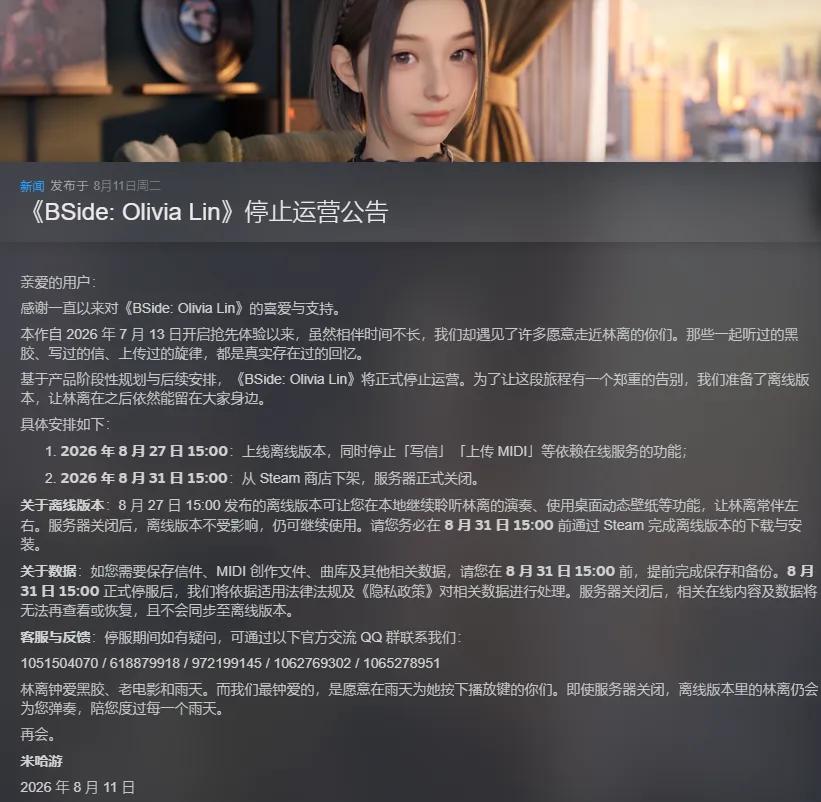
From the perspective of the underlying product logic, there are obvious differences between BSide: Olivia Lin and E Yuan Ci. BSide: Olivia Lin is an independent desktop companion application that is not bound to game scenarios. Its core is centered on character settings, focusing on healing chat, letter writing and music interaction, belonging to the pure emotional companion Agent.
Although the product's reputation is not bad, after players' sense of novelty fades, there is a lack of scenarios that continuously trigger interactions, leading to pressure on long-term retention. At the same time, continuous dialogue brings high computing power costs, and it is ultimately difficult to form a positive commercial closed loop.
However, miHoYo's trial and error does not mean that there is no opportunity for the AI companion track itself. On the contrary, it has helped the industry clarify the boundary: companionship that only provides emotional value without scenario anchor points may be a false proposition, and only companion Agents bound to high-frequency rigid scenarios have living space, which is also the underlying logic for Tencent to choose to enter the market at this time.
First, Tencent has a large-scale PC game product matrix in China. Games such as League of Legends and Valorant are long-term products with high DAU and long match duration. E Yuan Ci can be used as a universal AI plug-in across games to serve existing game users, improve players' stay duration and activity in Tencent's game ecosystem, and it is a value-added tool for existing users, rather than an independent companion product that attracts new users from scratch.
Second, the AI game companion Agent is a lightweight alternative to real human playmates. It is not only for chatting, but also can understand game screens and provide tactical assistance, with the dual value of "playmate + strategy assistant", covering the demand of single players for scattered late-night matches that real human playmates can hardly cover.
Third, AI Agent is a long-term technical layout, and E Yuan Ci is a scenario-based implementation test. Tencent has accumulated years of technical experience in game AI and multi-modal visual recognition. E Yuan Ci can be used as an external test carrier to precipitate general Agent capabilities. More importantly, through this test, the Agent can collect more user demands, which can be used to improve the official version of E Yuan Ci.
Fourth, the track competition is still in the early window period, and user demands are diversifying. Some players reject the pure AI girlfriend-style companionship, but have the rigid demand of "lacking a playmate when playing games". E Yuan Ci targets this segmented demand, adopts the differentiated positioning of "game priority", avoids the verified trap of pure emotional companionship, takes the mixed route of tool + companionship, and explores new commercialization paths.
Three Judgments: Which Direction Will Game Companion Agents Move Towards?
Based on the trends of game companion Agents at home and abroad, DataEye Research Institute puts forward the following judgments.
Judgment 1: It May Shift from "Pure Emotional Companionship" to "Scenario Rigid Demand Priority"
The case of miHoYo's BSide: Olivia Lin has proved that independent companion products that only rely on character settings, dialogue and emotional comfort have a very low ceiling. In the future, surviving independent cross-game Agents may, like E Yuan Ci, put game assistance capability in the first place, and companionship is an additional experience rather than the whole.
Players' interaction motivation changes from "I want to chat with AI" to "I need a game-savvy playmate when playing games", forming a natural interaction loop. The emotional relationship is built on shared game experiences, rather than empty conversations.
Judgment 2: Two Routes Diverge: External Cross-Game Agent and Game-Native Embedded AI NPC
One route is the external independent Agent like E Yuan Ci. As a plug-in client, it relies on screen recognition to realize cross-game adaptation. Its advantage is strong universality, which can serve multiple games at the same time, and is suitable for players who use multiple devices and play multiple games; its shortcoming is that screen recognition has delay and upper limit of recognition accuracy, it cannot read the underlying game data in depth, and advanced tactics and deep game interaction will be restricted.
The other route is that game manufacturers deeply embed AI Agent into the game body. For example, the recent release of No Mortal's Land by Nuverse, as a native NPC, can directly read the internal data of the game, have full authority over the world view, with more accurate interaction and stronger immersion.
Of course, the two will not replace each other: native AI is part of the game content, serving the long-term experience of a single game; external cross-game Agent is an ecological tool, serving the overall game habits of players, which is suitable for platform-based manufacturers.
Judgment 3: The Commercialization Route Remains to Be Verified
On October 12 this year, Character.AI released an announcement: it voluntarily filed for Chapter 11 proceedings of the U.S. Bankruptcy Code in the Delaware Court of the United States, and started the asset auction process under the supervision of the court, which is expected to be completed at the end of November or early December.
It should be noted that as a pioneer of AI chat applications, Character.AI has gathered 163 million users in 5 years, and its monthly active users have reached the order of 20 million. The reason for its bankruptcy announcement is that the number of users is too large. According to statistics, under the high AI computing power cost structure in 2024, the monthly operating cost of Character.AI was estimated to be about 30 million US dollars, while its revenue only came from the subscription fee of 9.99 US dollars per user per month, but the number of paid subscription users was only 139,000 by the end of 2024 — which is equivalent to burning more than 400 million US dollars a year, making losses in exchange for popularity.
The excessive number of users and low number of paying users led to the bankruptcy of Character.AI, and the payment capacity of E Yuan Ci is also worthy of attention. If it adopts the subscription system, non-stop AI dialogue of multiple users 24 hours a day will also generate considerable Token overhead for Tencent.
From the long-term trend of the industry, the AI companion track has bid farewell to the early fantasy that "as long as you have a good-looking digital human that can chat, you can attract users". The debut of E Yuan Ci represents the shift of leading manufacturers' thinking: AI Agent is no longer a separate emotional entertainment product, but an intelligent assistant embedded in players' existing entertainment behaviors.
The core of future competition is not whether the character setting is good-looking or whether the dialogue is sweet, but whether it can understand games, provide effective value at the right time, and naturally develop a credible and continuous companion relationship on the basis of tool value.
This article is from the WeChat Official Account "DataEye" (ID: DataEye), written by Yj, and authorized for release by 36Kr.