Bezos: Life is always Day 1.
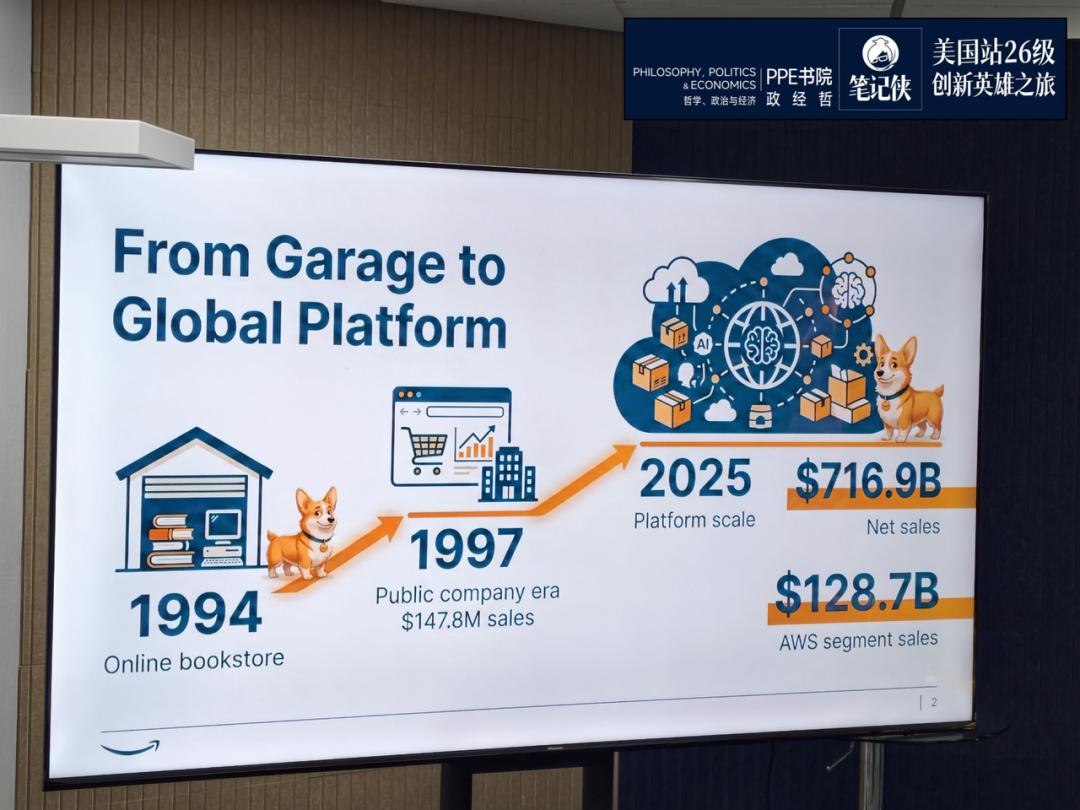
In 1994, Amazon was nothing more than an online bookstore operating out of a Seattle garage; today, it has grown into a behemoth spanning global retail and cloud computing.
In the AI wave sweeping across the globe, why can it still hold its ground steadily? Many people only notice its computing power and capital, but seasoned entrepreneurs see its hidden secret weapon under the surface: strategic layout that outruns trends and its corporate culture.
This article is compiled from the on-site sharing at the "Innovation Heroes" session of the 26th US Station of the PPE (Politics, Economics, Philosophy) course from Notesman.
The speaker is a former founding team member of Rufus, Amazon's AI shopping assistant. From the first-person perspective of a witness, he fully dissects the true hidden cards of this giant in AI strategy and organizational management for us.
We hope today's sharing will bring you inspiration.
I. The First Iron Law of AI Implementation: Restraint is More Important Than Showing Off Skills
1. Don't Build a "All-Purpose Agent" Right From the Start, First Find a Niche to Break Through
Nowadays, many business owners, when talking about AI, will say the very first sentence: "Should we develop an Agent?"
The so-called Agent refers to an AI system that can not only chat with you, but also understand your goals, break down tasks, call tools, and help you complete the whole process from searching, price comparison, form filling to placing orders.
It sounds really exciting, but the vast majority of enterprises' AI projects die exactly on this impulse of "seeking grandeur and completeness": they don't even figure out what the real pain point of customers is, but rush to build an omnipotent framework.
The process of Amazon internally incubating its AI shopping assistant Rufus went in the completely opposite direction.
When the project just started in 2023, the team had only 7 or 8 people in total, and no more than 20 people at its peak. It only took about two months to roll out a small Demo.
It was not until this small model passed internal verification and was recognized that the team gradually expanded to hundreds of people and evolved towards a mature product form.
Why could it move so fast? Because the problem they focused on at that time was extremely specific, with no empty and meaningless stuff at all:
There are too many products on the platform. When a user searches for a random item, hundreds or thousands of results pop up, which are impossible to go through completely;
The comment section is full of mixed true and false information, with a large number of fake reviews everywhere, and users don't know who to trust;
When there are too many options, people are prone to choice paralysis, and simply choose not to buy.
After figuring this out, Rufus decisively gave up unrealistic fantasies, and positioned itself as a "knowledgeable shopping guide" down-to-earth: understand what you want, explain complex product parameters clearly, compare the advantages and disadvantages, and finally only present you with two or three most reliable options.
If you break down the complex shopping scenario to the core, it only gets stuck in two things: difficulty in making choices, and lack of trust.

The smart part of Amazon is: it doesn't ask "how powerful current AI is", but directly digs into "what is the most headache problem for customers right now".
The biggest taboo in developing Agents is no clear boundary. The stronger the model and the larger the scope you expand, the more the permission management, data cleaning and fault tolerance mechanism behind it will explode exponentially. Instead of spreading out your business with several cool demos, it is better to narrow down the entry first, and dig a well until you get water.
2. The Essence of the Computing Power Battle is Still the Core Competitiveness of Supply Chain
If you still regard Amazon as a pure product-selling platform, you cannot understand its terrifying potential in the AI era at all.
From selling books in the early days, to entering full-category e-commerce, smart hardware, and offline supermarkets later, to AWS (Amazon Web Services) which now holds half of its business, Amazon has long built its foundation into an impregnable fortress.
Competition in the AI era still falls on infrastructure and supply chain.
One of Amazon's layouts is quite admirable. When I worked at Amazon, GPU (Graphics Processing Unit) resources were very sufficient, and we never worried about GPUs, no one would have trouble getting computing power. Amazon laid out GPU computing power in advance, starting from H100, H200, B200 at the very beginning, to B300 and GB300 now, so internal teams have relatively sufficient computing power to use.
Amazon is truly a company born with supply chain genes. Computing power is essentially a supply chain product, which requires CPUs, networks, optical fibers, and data center construction. All these processes heavily rely on supply chain capabilities.
When I worked at Microsoft and Google, on the contrary, we often encountered the problem of queuing for computing power.
Laymen only watch the excitement, always thinking that whoever shouts louder wins; insiders see the essence, computing power is ultimately a real heavy-asset supply chain business. Amazon may not be the first company in the world to shout the AI slogan, but it is the one that has stockpiled the most sufficient supplies.
In the past, it bought GPUs all over the world, laid optical fibers, and built data centers, which might originally be only intended to support its own search, recommendation and cloud business. As a result, the generative AI wave broke out suddenly, this "down-to-earth effort" invested many years in advance instantly turned into strategic mobility that others can't envy. While others are still queuing for GPU allocation, Amazon's teams can already run at full capacity at any time.
3. Hardware, Model and Scenario Coordination to Form a Combined Punch
Amazon Echo smart speaker follows the same logic.
This is the smart speaker launched by Amazon. This type of hardware does not necessarily take hardware profit as its main goal, but is mainly designed to improve shopping experience. Its more important function is to connect voice interaction to the shopping scenario.
You can say to Amazon's mall through the hardware: "Our laundry detergent is used up today, add some laundry detergent for me". Users can directly tell the device that the laundry detergent at home is out of stock, and let the system help restock.
When conversational AI capabilities were not mature, Echo was more like a smart home device; after the model capabilities improved, AI suddenly became able to hold conversations, chat more and more smoothly, and it may become a shopping entry.
In the past, when people wanted to develop such a function, AI was not as powerful as it is now. Later, people suddenly found that AI could hold conversations and chat better and better. Amazon then invested in Anthropic, whose model is currently top-tier, making Echo the best-selling product now.
In this way, several capabilities of Amazon are connected:
AWS provides computing power, the supply chain is responsible for preparing infrastructure in advance, the e-commerce platform provides real transaction scenarios, Echo provides the entry, user behaviors are precipitated into data, and the model is responsible for understanding and execution.
Now Amazon is an important investor of Anthropic, even the largest investor, which makes Echo the best-selling product on the market.
Amazon is a resource-based enterprise, it can do things well after investing sufficient resources, but when it comes to pure innovation capabilities, Amazon's innovation over the years is definitely not as good as startups. The same logic applies in China, the best models are not developed by large companies.
Recognizing who you are is far more important than blindly following trends.
Startups compete for the aura of breakthrough at a single point, while the truly terrifying part of giants is that they tightly combine computing power, hardware, data and transaction scenarios into an ecological chassis. Once it runs, it will generate crushing momentum.
II. How Does Amazon Resist "Big Company Disease"?
1. Corporate Culture is Not a Slogan on the Wall
Computing power and ecology are Amazon's muscles, and its corporate culture is the nervous system that drives this huge body to punch flexibly.
Many business owners envy the corporate culture of large factories, but what they develop themselves always ends up as slogans on the wall. Why? Because they do not turn the culture into a hard mechanism that determines employees' career success and failure.
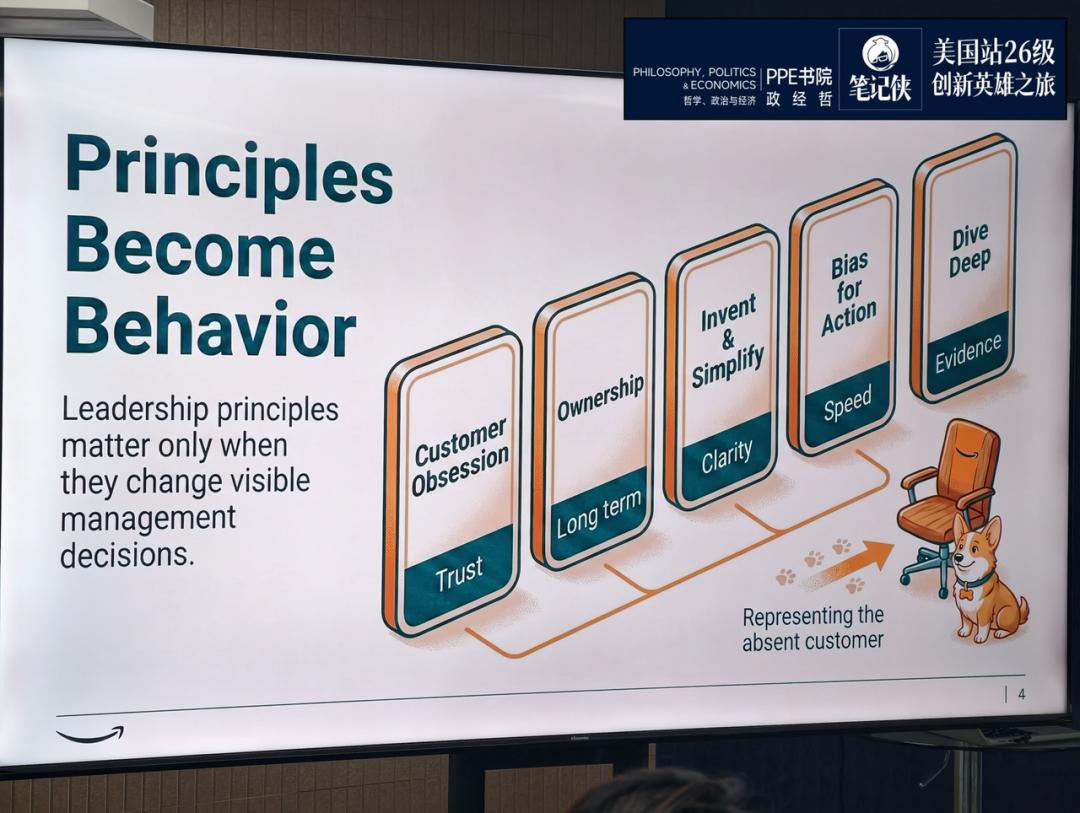
At Amazon, the famous "Leadership Principles" are not for recitation, it has become the underlying operating system of the entire company, directly determining who can be hired, who can get resources, and who can get promotion and salary raise.
When Amazon recruits people, more candidates are eliminated in the cultural interview than in the technical interview.
In order to prevent the hiring department from lowering standards because of the urgent need to recruit people to work, Amazon even has a famous internal "Bar Raiser" mechanism: in every final interview, there must be a senior certified examiner from another department, who has the one-vote veto power, and his only task is to strictly verify whether the candidate's inherent traits conform to Amazon's principles.
Excellent technical skills are only an admission ticket, candidates must use real things they have done to prove one by one that they can meet the following hard requirements.
Customer Obsession: Firmly focus on the real needs of customers. Amazon even has a tradition in meetings: they will deliberately leave an empty chair in the meeting room, representing the absent customer, to remind everyone: don't focus on the boss's face, make decisions for that chair.
Ownership: Take full responsibility for the final result, and never pass the buck by saying "this is not my job".
Invent and Simplify: Dare to overthrow cumbersome bad processes, and make things simpler.
Bias for Action: Don't wait until everything is ready, act as soon as you see the right direction.
Dive Deep: Refuse to be a hands-off manager, you must dig the problem all the way to the root.
Long-Term Thinking: Don't sacrifice long-term interests for the sake of good-looking short-term figures.
In this set of standards, "Customer Obsession" and "Ownership" are only the passing line; if you want to get promoted, you must present solid delivery results to prove that you have the tough capabilities of "Invent and Simplify, act quickly, and Dive Deep".
So what exactly is real corporate culture?
Real culture is not that everyone sits in the meeting room and shouts slogans together in good times, but what standard the company uses to judge employees when they face choices and make improper moves.
Even if you are just a team that makes data tools for other departments in the back office, the department that uses your tools is your customer. If you can make them work faster, more accurately, and reduce rework, that is your solid performance.
2. The Larger the Company, the More It Needs to Maintain the "Day One" Hunger
Inside Amazon, there is an unshakable creed called "Day One". According to founder Jeff Bezos, once any company steps into "Day 2", it will begin to rigidify and become mediocre. No matter how large its size is, it is already heading for chronic death.
Recall what state a new employee is in on his first day at the company? His eyes are full of light, full of curiosity and sense of urgency, he can't help but ask: "Where is the customer stuck? Why is this process so complicated? Can we modify it to make it more smooth?"
But once the company grows bigger and exists for a long time, the atmosphere changes: everyone no longer thinks about how to solve problems for customers, but is busy maintaining existing processes; no longer focuses on how to get results, but calculates how to sign and leave traces so as not to take responsibility; no longer takes the initiative to move forward, but sits at the workstation waiting for leadership approval.
The "Day One" concept is used to cut this deep-rooted organizational inertia.
If a company shouts every day that it encourages innovation, but in the end, all the people who get promoted and pay raise at the end of the year are those good old guys who follow the principle of "more work, more mistakes; less work, less mistakes; no work, no mistakes", then even the smartest people will become timid; if you shout customer first, but spend three hours in meetings debating whether the process is compliant, and no one cares whether the customer finally gets the result, then the values will completely become a joke.
The larger the company is, the more you need to pay attention not to regard completing the process as finishing the work, and not to regard internal routine work as creating value for customers.
3. One-way Door and Two-way Door
In Amazon's management toolbox, there is a set of decision-making mindsets particularly suitable for Chinese entrepreneurs - One-way Door and Two-way Door.
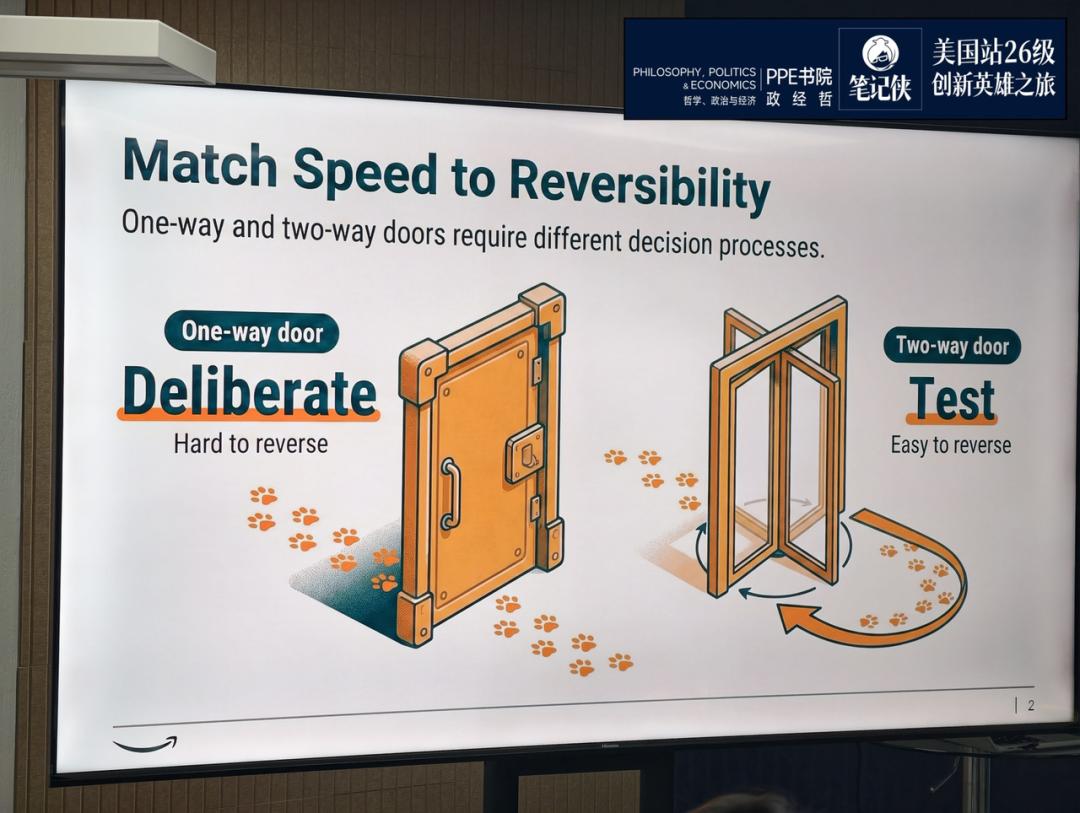
One-way Door Decision: After you push the door and walk in, the door clicks and locks, and you can never come back. For example, a universal large pay rise for all employees (the salary can never be reduced after being raised), the company completely changes its track, and invests all the working capital on the account to one supplier. One wrong step will lead to total failure, this kind of decision must be made slowly and cautiously.
Two-way Door Decision: It's like a revolving door in a shopping mall. After you push the door and take a look, if you feel it's not right