From "Gigabit to the Home" to "Token to the Home": The BRAS that was neglected for 20 years has made a huge comeback.
"Token Operation" has been the core focus of operators and even the entire communications industry in 2026.
However, public doubts about Token-based business operations have never ceased: their models are no match for dedicated vendors, their computing power supply looks like that of a reseller, and everyone is well aware of the product capability level of telecom operators. Is developing Token-based business operations really reliable?
Recently, I learned that a provincial-level operator tried out an interesting initiative.
They directly integrated the differentiated Token operation capability (essentially an AI gateway) into BRAS, the key access device for home broadband. On the computing power board of BRAS, they built a four-in-one Token operation system covering "authentication, billing, QoS, and security".
According to the verification results from the live network, for the same query, the model routing mechanism automatically selects the model with better cost performance, cutting the response time from about 35 seconds to around 16 seconds. In addition, future broadband subscriptions may come with built-in Token rights, with no need for registration or key configuration. Furthermore, operators can also provide uplink bandwidth acceleration services for specific services.
Operators call this operation model: shifting from "Gigabit Home Access" to "Token Home Access".
As a veteran in the communications industry, I find this model quite innovative. Operators may have truly found the right path for Token business operations, because it does not rely on self-developed models or exclusive computing power, but on the basic network-related capabilities that only operators can hold firmly and that no other party can take away.
Scarce resources are valuable, and only controllable assets can support revenue sharing. As an old device that has been sitting in the corner of equipment rooms for over 20 years and never made headlines in tech news, can BRAS really become the breakthrough entry point for operators' Token business operations?
How to Implement Token Business Operations on BRAS?
BRAS, whose full English name is Broadband Remote Access Server, later evolved into new forms including BNG and iBNG. Despite the name changes, its position in the network architecture has never shifted.
Where is the BRAS device located? You can figure it out by following the home broadband access path: AI devices, mobile phones, and computers at home → Optical Network Terminal (ONT) → Optical Line Terminal (OLT) → BRAS → Metropolitan Area Network → Backbone Network → Cloud (Internet services).

Home Broadband Networking Link
Simply put, BRAS is the "gateway" for home broadband to connect to the Internet. After passing through BRAS, your internet access data will flow to the public network.
For analogy, it is like the security guard of your residential community, plus the property management charging office. It performs three core tasks: verifying your identity (authentication), recording your usage volume (billing), and determining how much network resources you can occupy (speed limiting, for example, distinguishing between a 1000Mbps broadband subscription and a 500Mbps one).
The "broadband account" configured by on-site installation and maintenance personnel is authenticated right here on BRAS. Please note the three tasks mentioned above, as these are exactly the three missing capabilities that Token business operations lack the most.
That said, BRAS is an IP device, while Token management and control capabilities look more like IT services. So how does BRAS achieve this?
Modern BRAS devices are far from outdated legacy equipment. They support the addition of computing power boards and containerized deployment, and the common P2P CDN (PCDN) management and control used by operators today is also implemented via this type of board.
Two collaborative containers can run on the same intelligent board: the AI gateway container, which manages account mapping, Token metering and billing, multi-model routing, and AI safety fence functions; and the broadband differentiated guarantee container, which manages Token identification, QoS mapping, and uplink acceleration based on application scenarios.
According to the architecture disclosed in reports related to this case, the AI gateway identifies Token traffic, notifies the guarantee container to invoke BRAS capabilities, and creates an independent guarantee channel for the traffic that is physically separated from regular internet access traffic (on different boards of BRAS), without occupying the bandwidth for your normal internet usage.
What Are the Advantages of Developing Token Business Operations on BRAS?
First let's look at the difficulties operators face when carrying out Token business operations. I have summarized four major challenges.
Challenge 1: High entry threshold that blocks ordinary users.
To use AI services, users need to register accounts, complete real-name authentication, apply for and configure API Keys, bind payment cards for top-up, and then write these configurations into relevant files. The active users who purchase such packages are mostly heavy users who use PCs with broadband. To put it plainly, the mass consumer audience of operators' to-C products cannot understand these complicated processes at all, and users who do have relevant basic knowledge will not choose operator products under the same conditions (let me put it this way quietly).
The high usage threshold of Token packages does not match the direct customer group served by front-line operator business halls, making it impossible to develop effective front-line marketing scripts.
When promoting Token packages, you also need to consider all smart devices at home — cameras, speakers, smart locks, do you need to configure a separate Key for each of them? The home broadband and end-side ecosystem, which is the largest access entry point, is left completely untapped.
Challenge 2: Inconsistent billing systems.
Currently, Token services use independent billing systems that are not integrated into the core BOSS system, cannot be distributed along with broadband packages, and cannot be consolidated into the monthly broadband bill.
This means that operators' strongest billing capabilities, including automatic monthly deductions and the established payment habits of hundreds of millions of users, cannot be leveraged at all in this new business line.
Of course some people will object: operators' massive existing user base is not an advantage, since WeChat has far more users and higher user stickiness. I partially agree with this statement — WeChat does have a large user base, but WeChat cannot collect your broadband fee. You can survive without WeChat, but you definitely cannot survive without internet access.
Challenge 3: Networks and services operate independently of each other.
After you purchase Token services, the network cannot recognize your identity. After the network is accelerated, the AI service cannot perceive the change. The most typical example is uplink bandwidth.
Currently, most home broadband packages advertised as gigabit-level only provide 50Mbps uplink bandwidth, with a downlink-to-uplink ratio of 20:1. However, the core demand in the AI era is concentrated on uplink bandwidth: game streaming requires more than 50Mbps uplink, the AI comic and animation market is growing rapidly, and video upload also has clear uplink bandwidth requirements.

The Bottlenecked Uplink Bandwidth
The 50Mbps uplink bandwidth is completely unable to keep up with the development of AI and the current era.
Challenge 4: Why should users choose operators' Token packages?
Are operators' computing power cheaper than that of other vendors? Are operators' models more advanced than those of dedicated AI vendors? Are they self-producing and self-selling, or just reselling services from other parties?
Frankly speaking, operators do not have advantages in purely selling models or bare computing power. If they only position themselves as "model resellers and bare computing power wholesalers", they will eventually be completely bypassed by the market.
What about cloud-based AI gateways? They cannot reach your access network, do not know your home broadband account identity, and have no authority to implement differentiated acceleration combined with network capabilities. In addition, developing cloud-based gateways has no technical barriers, any vendor can do it, and many vendors are already offering such services.
These four challenges, when compared with the core functions that BRAS is originally designed for, show an interesting phenomenon: they correspond to each other almost one by one.
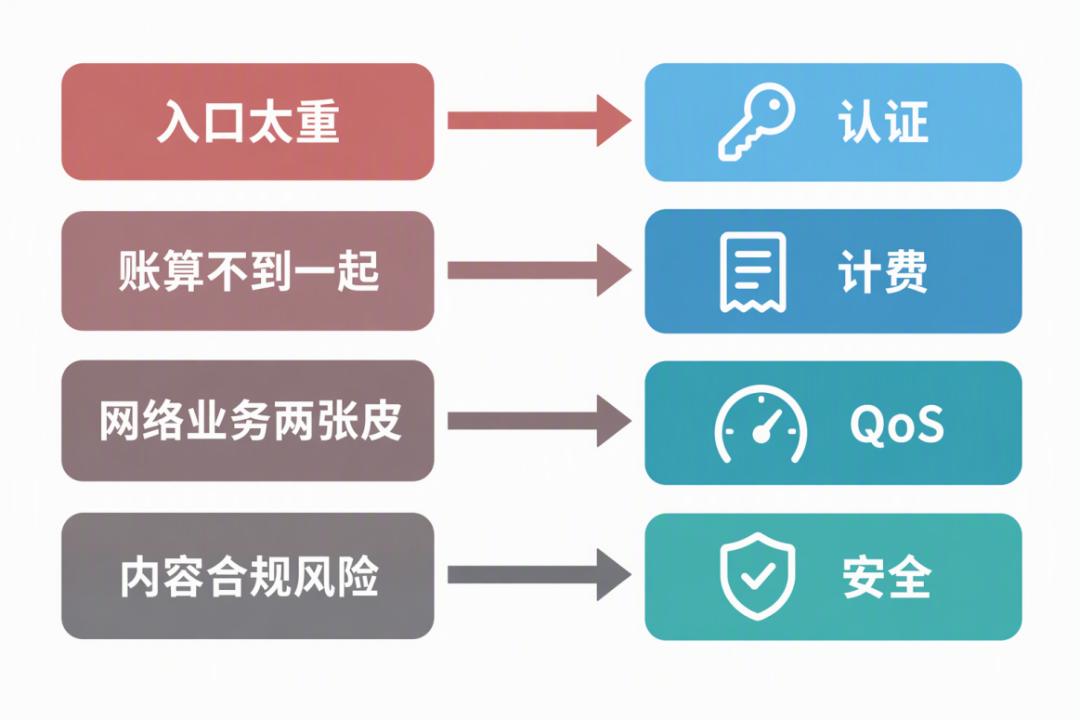
Four Challenges Matching Four Capabilities of BRAS
Challenge 1: "Overly heavy access entry" corresponds to the authentication function. Two-way mapping between broadband accounts and API Keys enables usage right after dial-up access, and access to computing power as soon as the device connects to the network.
Challenge 2: "Unable to consolidate all bills into one account" corresponds to the billing function. Token consumption data is directly imported into the BOSS billing system, supporting pay-as-you-go settlement, queryable detailed bills, and consolidated billing with broadband service charges.
Challenge 3: Services and networks are "two separate systems" corresponds to the QoS function. It performs intelligent routing between self-owned computing power pools and third-party models based on task complexity, and opens independent dedicated channels for video, voice, and text services.
Challenge 4: "Why should users choose operators" corresponds to the security function. As introduced earlier when we talked about BRAS, user data will only enter the public network after passing through BRAS. Adding an "AI safety fence" on BRAS can intercept sensitive information such as ID numbers and bank card numbers before the data leaves the local network, with full traceability and auditability throughout the whole process. This level of security defense cannot be provided by cloud-based gateways.
To sum it up in one sentence:
By building Token business operations on top of BRAS, operators may be able to convert the "network access entry" into a "Token access entry", which can not only sell AI models, but also leverage operators' unique superimposed network advantages.
Where Is the Feasibility of This Solution?
Using BRAS as the entry point for operators' Token business operations sounds very reasonable. But can BRAS really be competent for this role?
At present, the practice seems to be feasible, with three supporting reasons.
First, this is not a theoretical PPT solution (people in the industry all know what this refers to), it has already been fully tested and put into operation on the live network. This operator's practice has been selected as a typical case in the "Intelligent IP Wide Area Network (AI WAN) Research Report (2026)" released by the China Academy of Information and Communications Technology.
Verification by one operator alone may be an isolated case, so let's look at the second reason.
Second, all three major Chinese telecom operators have converged on the same technical architecture.
China Unicom released the "Intelligent Broadband Network Evolution White Paper" in September 2026, which covers token-based non-inductive authentication, token metering, collaboration between tokens and network resources, and collaboration between tokens and computing power resources. There is a sentence in the white paper that left a deep impression on me: "Authentication completes right after dial-up, access to computing power activates right after network access."
China Telecom is the furthest ahead in this field: Token packages have been officially launched for commercial use, priced from 9.9 yuan for 10 million tokens to 49.9 yuan for 80 million tokens, with matching uplink acceleration add-on packages for broadband.
Different operators starting from different points have converged on the same technical anchor point at almost the same time. This is definitely not a simple coincidence, which shows that all operators have completed feasibility analysis for Token business operations on BRAS. When all market players choose the same path, that path is very likely to be the correct one.
Third, the network link information cannot be tampered with.
The access line identifiers of home broadband are physically solidified: ONT serial number, PON port, and VLAN are all bound during on-site installation by maintenance personnel. Users cannot modify them, nor can they forge them.
This level of certainty is far more reliable than mobile phone numbers and emails: mobile phone numbers can be changed, accounts can be registered in batches, but every home optical fiber line must be installed with real-name registration, has a fixed physical location, and has complete installation records.
The internet industry has spent 20 years trying to solve the problem of "how to prove you are a real human", while home broadband has solved this problem from the very first day of installation.
Will Users Accept This Model?
The technology is basically feasible. Next, let's objectively discuss how to get users to accept operators' Token packages.
There are two benefits that users can perceive directly: no need to register accounts or configure keys, they can use AI services as soon as they connect to the internet; Token charges are consolidated into the broadband bill, and can be paid via phone balance which is eligible for corporate expense reimbursement.
For operators, the benefits are even more tangible: the customer acquisition cost is almost zero. Only operators can convert massive existing broadband users into computing power users in a large-scale, low-cost manner.
Here I would like to reference a segment of broadband development history.
In the era when mobile data traffic was very expensive, how did people use their mobile phones? They looked for Wi-Fi everywhere, and connected to any available Wi-Fi they found.
What if computing power capabilities are also integrated into broadband services? The moment you connect to your home Wi-Fi, you are already connected to the operator's computing power pool.
The basic tier can be designed as follows: operators provide low-cost models such as flash, with speed limiting (for example 1000 tokens per second) but no usage cap, directly included in the broadband rights package, ready to use as soon as connected. High-end models and acceleration rights can be provided as value-added services for users to choose from. In the future, a 1000Mbps broadband package with built-in 1000tps Token capability will become the final form of computing power-enabled broadband.
Cooperation with vendor ecosystems will also be smoother: Agents such as WorkBuddy can automatically access the broadband computing power under operator broadband networks, with no perception required from users, and vendors get their agreed revenue share. This model already has existing precedents: logging into WorkBuddy with a China Mobile mobile number will automatically redirect you to the China Mobile co-branded version of the service.
Of course some people will ask: what about privacy and security? This is exactly the core capability of operators — the AI safety fence deployed on BRAS is originally built for this purpose.
Besides, there were no lack of security news back in the era when people connected to public Wi-Fi everywhere. Did that stop Wi-Fi from becoming widely popular?
Also, users should not perceive the unit price of individual Tokens, but perceive the services as "rights packages, credit limits, and memberships". Tokens are only used as the backend settlement unit.
History has already given us the answer: telegraph services were billed by the word, telephone services were billed by the minute, internet services were billed by data volume, and eventually all evolved into unlimited usage packages.
Therefore, the question is never "are users willing to pay for Tokens", but "are users willing to pay an extra cost equivalent to the price of a cup of milk tea every month, to enable out-of-the-box AI usage for all devices at home".
BRAS Identity Upgrade: From "Security Guard" to "Residential Committee"
All the scenarios mentioned above are things that can be implemented right now. In the future, BRAS may be further upgraded: evolving from a "device that manages internet access" to a "device that manages all intelligent agents in your home".
The unalterable optical fiber access information provides a underlying trusted foundation for Agent-to-Agent network connections, which creates a mutual trust basis for intelligent agents belonging to neighboring households.
Imagine this scenario: during evening peak hours, your home Agent needs to generate a video, but the cloud service is queuing for resources. A neighbor under the same BRAS node just has idle computing power. The two Agents establish a direct connection to complete