Xuzhou is basically certain to achieve the target, who else is still sprinting to hit the trillion-yuan GDP mark?
There are only the last two months left in 2026, the competition among "near-trillion-yuan" cities has entered a critical stage.
A GDP of one trillion yuan means not only that a city's total economic volume has climbed to a new level, but also that the city's industrial scale, resource agglomeration capacity and regional influence have entered a new development stage. In recent years, the number of trillion-yuan GDP cities in China has continued to expand, reaching 29 by the end of 2025, and which city will become the next trillion-yuan city has attracted widespread attention.
Judging from the 2025 GDP data, both Xuzhou and Shenyang exceeded 900 billion yuan, forming the first echelon currently sprinting toward the trillion-yuan threshold. Cities including Xiamen, Shaoxing and Kunming are following closely, also moving closer to the trillion-yuan mark.
Looking at the economic performance in the first three quarters of this year, Xuzhou, which was only one final step away from the trillion-yuan GDP city threshold last year, is expected to take the lead in making a breakthrough.
In the first three quarters, Xuzhou realized a regional GDP of 759.145 billion yuan, a year-on-year increase of 5.1%. Calculated on this basis, there is a high probability that Xuzhou will break through the trillion-yuan threshold this year. Shenyang, whose GDP ranked right after Xuzhou in 2025, recorded a GDP of 680.41 billion yuan in the first three quarters, a year-on-year increase of 1.8%, with its growth rate significantly lagging behind that of Xuzhou.
Apart from Xuzhou, Shaoxing is also worthy of attention. In 2025, Shaoxing's GDP reached 893.213 billion yuan. In the first three quarters of this year, Shaoxing's GDP reached 694.353 billion yuan, a year-on-year increase of 6.4%, and its growth rate ranks among the top of cities nationwide. According to the set target, Shaoxing will become a trillion-yuan city in 2027.
From the perspective of regional distribution, the Yangtze River Delta is already the region with the most concentrated trillion-yuan cities in China, hosting 10 trillion-yuan cities. As cities including Xuzhou, Shaoxing and Jiaxing continue to move toward the trillion-yuan threshold, the advantage of the Yangtze River Delta's trillion-yuan city cluster is expected to be further consolidated.
Xuzhou Sprinting to Become the 30th Trillion-Yuan City
Among the near-trillion-yuan cities, Xuzhou is the city closest to the trillion-yuan threshold.
In 2025, Xuzhou's GDP reached 995.722 billion yuan . Judging from the current total economic volume and growth performance, Xuzhou is expected to become the 30th trillion-yuan GDP city in China this year.
Behind the figure close to one trillion yuan, industry remains a core support for Xuzhou's economy.
In 2025, the added value of industries above designated size in Xuzhou increased by 6.8% year on year, among which the added value of the equipment manufacturing industry increased by 16.5%, accounting for 39.6% of the added value of industries above designated size, driving the growth of industries above designated size by 6 percentage points. As a key hub of the construction machinery industry, Xuzhou's equipment manufacturing industry has reached a certain scale, which also provides important support for industrial growth.
In the first three quarters of this year, the added value of industries above designated size in Xuzhou increased by 5.8% year on year, slowing down from the 7.0% growth in the same period of last year. However, key industries still delivered outstanding performance, with general equipment manufacturing, special equipment manufacturing, automobile manufacturing and other industries registering relatively fast growth.
At the same time, emerging industries are also accelerating their development. In 2025, the output value of Xuzhou's "343" innovative industrial clusters (excluding the digital economy) increased by 5.5% year on year. The three emerging industrial clusters recorded a total growth of 3.8%, among which the integrated circuit and ICT cluster, and the safety and emergency response cluster increased by 7.2% and 2.1% respectively.
In May this year, Xuzhou optimized and adjusted the original "343" innovative industrial clusters into a "535" modern industrial system, proposing to consolidate and upgrade 5 advantageous industries including construction machinery, green and low-carbon energy, new materials, modern food, and high-end textiles; nurture and expand 3 emerging industries including new-generation information technology, pharmaceutical and healthcare, and safety and emergency response; and make forward-looking arrangements for 5 future industries including embodied intelligence, cutting-edge new materials, biomanufacturing, deep-earth industry, and hydrogen energy.
Behind this adjustment is Xuzhou's expectation to find more new growth points while strengthening its existing industries.
At present, Xuzhou's equipment manufacturing industry has formed a relatively large scale, but its growth is also vulnerable to the impact of cyclical changes in the industry. At the same time, although emerging industries are under development, judging from the current output value growth rate, they have not yet formed a growth force sufficient to drive the overall acceleration of the industry.
The pressure on the investment side is more obvious. In 2025, Xuzhou's fixed asset investment decreased by 11.9% year on year, among which manufacturing investment decreased by 11.7%, real estate development investment decreased by 21.7%, and infrastructure investment decreased by 6.1%. The decline in investment is not a problem in a single field, but a contraction faced by multiple fields.
In the first three quarters of this year, the pressure on the investment side has not eased. Xuzhou's fixed asset investment decreased by 30.4% year on year, with the decline further expanding, significantly higher than the 12.0% decline across Jiangsu province. The continued weakening of investment also means that the growth momentum in fields such as manufacturing capacity expansion and infrastructure construction has weakened.
To maintain the growth of urban economy, industries and investment are important supports, and population is also a factor that cannot be ignored. In 2023, the permanent resident population of Xuzhou once stopped falling and rebounded to 9.02 million, but it fell back for two consecutive years in 2024 and 2025, dropping to 9.01 million and 8.9671 million respectively.
For Xuzhou, after moving toward the trillion-yuan GDP mark, how to enhance the city's attractiveness, retain local residents, attract non-local people, and form better mutual support between population scale and industrial development is also a problem that needs to be addressed next.
The Yangtze River Delta Will Usher in an Expansion Wave of Trillion-Yuan Cities
Xuzhou is only one step away from being a trillion-yuan GDP city, and behind it, a group of cities are launching a sprint toward this threshold.
Reporters from Time Weekly sorted out the "15th Five-Year Plan" development targets of various regions and found that it is expected that 14 cities will cross the trillion-yuan threshold by the end of the "15th Five-Year Plan" period. If these targets are realized one after another, the number of trillion-yuan cities nationwide will increase from 29 in 2025 to 43 by then.
From the perspective of the geographical distribution of cities, the Yangtze River Delta is the most noteworthy region in this round of trillion-yuan city expansion. By 2025, the Yangtze River Delta already has 10 trillion-yuan GDP cities, accounting for more than one third of the 29 trillion-yuan cities across the country.
Apart from the existing 10 trillion-yuan cities, cities also located in the Yangtze River Delta including Xuzhou, Shaoxing, Yangzhou, Jiaxing, Yancheng and Jinhua have also entered the near-trillion-yuan echelon, or have written the sprint for the trillion-yuan mark into their "15th Five-Year Plan" development targets. According to the plans of various regions, by 2030, the number of trillion-yuan GDP cities in the Yangtze River Delta is expected to reach 16.
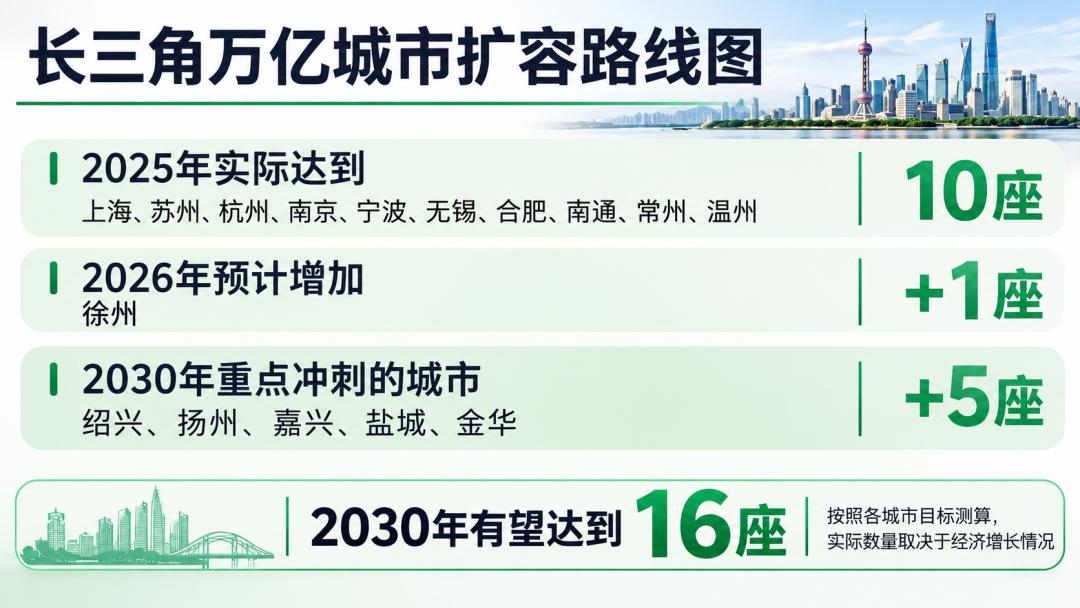
Source: Produced by Li Hang, Reporter of Time Weekly
Among this batch of near-trillion-yuan cities, apart from Xuzhou, Shaoxing has the clearest sprint schedule. In 2025, Shaoxing's GDP reached 893.2 billion yuan, a year-on-year increase of 6.5%, leaving a gap of about 106.8 billion yuan to the trillion-yuan threshold. The gap of 100 billion yuan is not small, but Shaoxing has clearly proposed that it will strive to make its GDP exceed one trillion yuan in 2027, and reach around 1.25 trillion yuan by 2030.
Shaoxing's confidence in sprinting toward the trillion-yuan mark comes from the support of its solid manufacturing foundation, as well as the continuous upgrading of its traditional industries.
For example, two out of every three ties in the world are produced in Shengzhou, Shaoxing, which fully demonstrates the strong manufacturing foundation of this city. At present, both the modern textile industry and new materials industry in Shaoxing have exceeded 200 billion yuan in scale, and the green chemical industry and high-end equipment industry have also formed a 100-billion-yuan industrial scale.
While strengthening these advantageous industries, Shaoxing is also promoting industries to extend to higher value-added links.
Taking the textile industry as an example, the local government continues to promote the digital, intelligent and green transformation of links such as printing and dyeing, and chemical fiber; industries including integrated circuits, biomedicine and intelligent vision are also growing at an accelerated pace.
In the first three quarters of this year, the added value of the high-tech industry, the core industry of the digital economy, and the equipment manufacturing industry in Shaoxing increased by 18.8%, 18.6% and 16.6% respectively, all significantly faster than the overall growth rate of industries above designated size. The upgrading of traditional industries and the growth of emerging industries are opening up new growth space for Shaoxing.
Following Shaoxing, Yangzhou, Yancheng and Jiaxing are also accelerating their catch-up. In 2025, the GDP of the three cities reached 805.675 billion yuan, 804.53 billion yuan and 785.106 billion yuan respectively, and all of them have included the trillion-yuan target in their future development plans.
With the same target, the industrial support of these cities is not the same.
Yangzhou's ship and offshore engineering equipment industry delivers outstanding performance, in the first three quarters of this year, 89 shipbuilding enterprises in the city achieved invoiced sales of 43.46 billion yuan, a year-on-year increase of 30.2%, and the volume of new shipbuilding orders received increased by 112.4%.
Yancheng continues to make efforts in the new energy industry, and the output value of energy storage and power battery industry increased by 46.5% in the first three quarters.
Jiaxing's growth momentum comes more from advanced manufacturing and the digital economy. Its GDP grew by 6.8% in the first three quarters of this year, ranking first in Zhejiang for three consecutive quarters, and the revenue of the core artificial intelligence industry is expected to increase by 26%.
The leading number of trillion-yuan cities in the Yangtze River Delta is backed by the support of the regional industrial system.
Different from the growth driven by a small number of core cities, the economic growth of the Yangtze River Delta features strong multi-point support. Central cities including Shanghai, Nanjing, Hangzhou and Hefei gather R&D, talent and capital resources, while surrounding cities rely on their respective manufacturing foundations to form competitive advantages in different links of the industrial chain.
This kind of industrial connection enables cities not only to compete for projects and investments, but also to obtain development opportunities through industrial chain collaboration. The landing of one industrial project can often drive upstream and downstream enterprises to set up layouts in surrounding cities, forming a cross-city production supporting network.
The deepening regional industrial division of labor also provides support for the growth of more cities. Relying on the sound manufacturing system and industrial chain collaboration of the Yangtze River Delta, whether Shaoxing can break through the trillion-yuan mark as scheduled in 2027, and which of Yangzhou, Yancheng and Jiaxing will take the lead in making a breakthrough, will become an important highlight of the expansion of trillion-yuan cities in the Yangtze River Delta during the "15th Five-Year Plan" period.
This article is from the WeChat official account "City Reading Studio", written by Li Hang, and published with authorization from 36Kr.