Why haven't 16-bit MCUs been phased out yet?
Recently, the release of a 16-bit microcontroller has once again demonstrated the vitality of this type of MCU.
On October 28, Renesas Electronics officially launched the RL78/G21 series 16-bit MCUs, which are mainly designed for system control of smart home appliances such as air conditioners, refrigerators, washing machines, and microwave ovens. A few days before this product launch, Renesas also released a flagship 32-bit MCU adopting 22nm process and embedded MRAM. While Renesas is pushing 32-bit MCUs toward more advanced manufacturing processes and higher computing performance, it is still updating its 16-bit product line.
In the inherent cognition of many people, the evolution of chip architecture has been moving forward steadily: 8-bit MCUs are responsible for extreme cost control, while 32-bit MCUs (especially the Arm Cortex-M series and open-source RISC-V) carry complex computing and high throughput requirements. According to this "polarization" logic, the 16-bit MCUs caught in the middle seem to have long been eliminated by history.
From the perspective of market size, 16-bit MCUs are not in a continuously growing track. According to the CIC research cited in the 2026 March Hong Kong stock prospectus of Nations Technologies, from 2019 to 2024, the global 16-bit MCU market size dropped from 6.5 billion US dollars to 4.5 billion US dollars, while the 32-bit MCU market grew from 10 billion US dollars to 20 billion US dollars in the same period.
Therefore, the author can't help wondering a question: when 32-bit MCUs are getting more and more powerful and their costs are getting lower and lower, why have 16-bit chips still not withdrawn from the market? For the home appliance, automotive electronics and industrial control industries that widely use MCUs, does higher operation bit width really mean a better choice?
16-bit chips have not stopped evolving
If we only look at the history of technological development, 16-bit MCUs are easily regarded as products of the transition stage from 8-bit to 32-bit. However, observing product releases in the past two years, we will find that such chips do not only rely on historical stock to survive, and some enterprises are still continuously updating their products focusing on low power consumption, real-time control and dedicated functions.
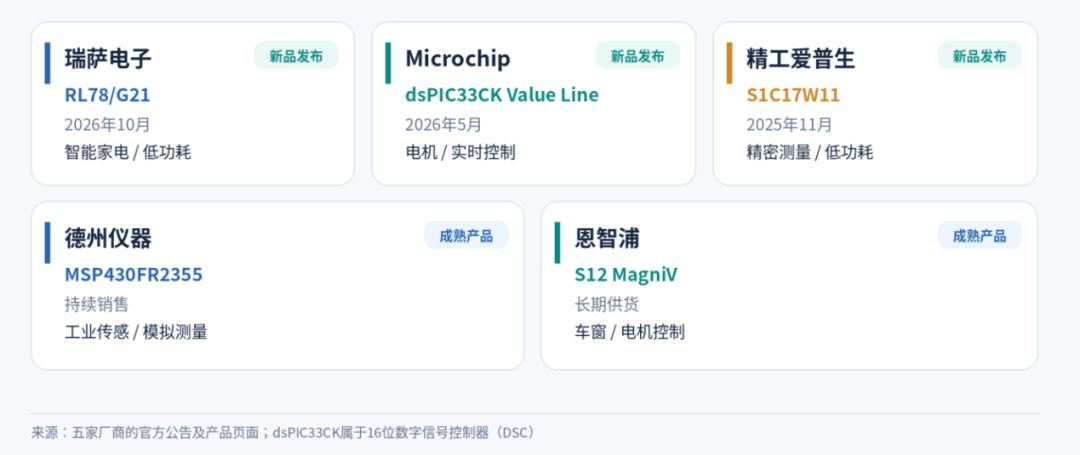
The RL78/G21 released by Renesas this time is a typical example.
Compared with simply increasing the main frequency of the processor, Renesas has put more energy on power consumption, peripheral circuit simplification and the continuation of existing software assets. The RL78/G21 integrates a high-speed on-chip oscillator with an accuracy of ±1% and 4KB data Flash, which can reduce the use of external crystal oscillators and EEPROM when meeting application requirements, thus lowering the material cost of the entire control board. At the same time, the new product maintains pin and functional compatibility with the existing RL78/G13 and RL78/G23 series, enabling customers who have already adopted the Renesas platform to complete product upgrades with minor design modifications.
For home appliance manufacturers, this compatibility has direct commercial value. For a refrigerator or washing machine that has been sold in the market for many years, its control program, PCB design, test process and production process are often quite mature. If the new generation of chips can reduce power consumption and cost on the basis of continuing the original architecture, customers do not need to redevelop the entire control system just to adopt a 32-bit core.
A similar idea also appears in the products launched by Microchip this year.
On May 28, 2026, Microchip released the dsPIC33CK Value Line series digital signal controllers (DSC). This is a controller based on the 16-bit dsPIC33C core, with a maximum operating frequency of 100MHz, integrating peripherals such as high-resolution PWM and 12-bit ADC, which is mainly used in scenarios such as motor field-oriented control (FOC), capacitive touch and precision sensing.
Strictly speaking, dsPIC33CK belongs to digital signal controllers, which has a different positioning from ordinary general-purpose MCUs. But it is exactly this difference that reflects that the 16-bit architecture still has certain technical scalability.
In the motor control system, the processor needs to collect current and position data periodically, execute control algorithms, and update the PWM output in time. Different from complex operating systems or graphical interfaces, such tasks often pay more attention to deterministic operation timing and the cooperation ability between ADC, PWM and the processor.
Therefore, Microchip does not simply enhance product competitiveness by increasing general computing power, but combines limited computing resources with real-time control peripherals to meet the actual needs of applications such as motors, power supplies and industrial control.
Seiko Epson also provides another direction.
On November 19, 2025, Epson announced that it would start to provide samples of the S1C17W11 series 16-bit MCUs, which are mainly targeted at thermometers, water quality measuring instruments and other portable testing equipment. This product adopts a self-developed 16-bit RISC core, integrates a resistance measurement circuit based on RC oscillator, LCD drive, and part of the functions required for buzzer and LED drive, with a typical sleep mode current of only 109nA.
For a battery-powered portable measuring instrument, the work that the processor needs to complete is not complicated, but measurement accuracy, battery life and volume are very important. If a general-purpose MCU is used, additional analog measurement and display driving devices may be required. Epson integrates these functions directly into the 16-bit chip, the purpose of which is precisely to reduce peripheral circuits and lower the overall design complexity.
In addition to the continuous launch of new products, some mature 16-bit platforms still have a long commercial life cycle.
Texas Instruments is still selling the MSP430FR2355. This 16-bit MCU has a maximum operating frequency of 24MHz, integrates 32KB FRAM, ADC, operational amplifier and programmable gain amplifier, and can be used in industrial sensing, analog measurement and other applications.
NXP also retains the S12 series 16-bit products, especially the S12 MagniV family for automotive electronics. For example, S12ZVMB integrates LIN communication interface, voltage regulator and H-bridge gate driver, which can be used for automotive window lifting, sunroof and other actuator controls. According to NXP's public long-term product supply plan, the supply commitment of the S12ZVMB series is extended to March 2033, and some other S12 MagniV products are extended to 2038.
From Renesas to Microchip, and then to Epson, Texas Instruments and NXP, the strategies adopted by these enterprises are not exactly the same: some keep launching new products, some strengthen integration capabilities around specific applications, and some mainly ensure the long-term supply of mature products. These facts clearly show that 16-bit MCUs have not stayed in the past, and they are still evolving together with modern semiconductor processes.
What exactly keeps 16-bit MCUs in the market?
The key reason why 16-bit MCUs can hold their ground is that they have found a "golden balance point" between performance, power consumption, code density, determinism and cost that neither 32-bit nor 8-bit MCUs can perfectly replace.
The first is the cost issue.
For a washing machine, replacing the main control MCU from 16-bit to 32-bit will not automatically make the clothes cleaner; for a set of automotive window control system, a more powerful processor will not directly improve the window lifting experience. This is not to deny the technical value of the 32-bit architecture, but to illustrate that performance is not the only indicator in many embedded applications. What really determines the chip selection is the overall system cost required to complete specific tasks.
The cost of an MCU includes not only the chip procurement price, but also peripheral components, PCB area, power supply design, software development, verification testing and subsequent maintenance costs. Taking Renesas RL78/G21 as an example, the significance of integrating high-precision oscillators and data Flash is to reduce external components and related design work. If customers already use the RL78 platform, the pin compatibility and software reusability of the new product may further reduce the upgrade cost.
Secondly, after long-term development, 16-bit products have formed a mature software and hardware ecosystem in some applications.
In the consumer electronics and home appliance industries, product upgrades usually need to take into account cost, reliability and development cycle. For a control system that has been stably mass-produced, replacing the processor architecture may involve rewriting underlying drivers, porting control algorithms, adapting peripheral interfaces and re-testing; in automotive and industrial applications, the situation may be more complicated. Chip replacement may also involve requirements such as environmental reliability, functional safety, long-term supply and customer certification.
This means that for existing 16-bit platform users, whether to upgrade to 32-bit not only depends on whether the new chip has better performance, but also considers whether the migration cost can be compensated by new functions or cost reduction.
Furthermore, the 16-bit architecture can still form a competitive combination with dedicated hardware peripherals. In many control systems, ADC is responsible for sampling, timer is responsible for timing, PWM is responsible for outputting control signals, and the CPU does not need to complete all operations alone. Through reasonable configuration of peripherals, hardware triggers and interrupt mechanisms, an MCU with unremarkable computing performance can also meet specific real-time control requirements.
In fact, 32-bit products are constantly invading the traditional market of 16-bit MCUs.
A very representative example comes from Texas Instruments. On the official product page of the 16-bit MCU MSP430FR2355, TI has recommended the 32-bit MSPM0L1305 based on Arm Cortex-M0+ as an alternative, and clearly described it as an alternative with lower cost, better functions and better performance. This shows that with the large-scale production and cost reduction of low-end 32-bit MCUs, some tasks that were previously undertaken by 16-bit chips are indeed being replaced by 32-bit products.
As 32-bit microcontroller technology matures, the traditional advantages of 16-bit MCUs are facing increasing challenges. The aforementioned CIC research data shows that the global MCU market size was about 29.9 billion US dollars in 2024, of which 32-bit MCUs accounted for about 20 billion US dollars, 16-bit MCUs about 4.5 billion US dollars, and 4/8-bit MCUs totaled about 5.4 billion US dollars. Compared with 2019, the 32-bit MCU market size has doubled, while the 16-bit market has shrunk by about 31% cumulatively, with a compound annual growth rate of about -7.1% from 2019 to 2024. This set of data clearly shows that 32-bit has become the dominant architecture in the MCU market, and the market space of 16-bit MCUs is being squeezed. Some research institutions predict that the 16-bit market may grow moderately in the future with the recovery of industry demand, but its growth rate will still significantly lag behind that of 32-bit MCUs.
From the current application distribution, 8-bit, 16-bit and 32-bit MCUs have gradually formed different competition patterns.
8-bit MCUs are still widely used in large-volume applications with cost sensitivity and relatively simple control logic. Mature manufacturing processes, low storage resource requirements and highly optimized product designs make them still competitive in some consumer electronics and small home appliance markets.
16-bit MCUs rely more on the existing architecture ecosystem, dedicated peripherals and long-term customer needs to maintain their market position, and continue to play a role in home appliance main control, motor control, industrial measurement and some automotive electronics applications.
32-bit MCUs have the widest coverage. On the one hand, low-end platforms such as Arm Cortex-M0+ continue to penetrate into cost-sensitive applications; on the other hand, Cortex-M4, M7 and other high-performance architectures can meet the needs of complex algorithms, network communication, industrial automation and automotive electronics.
From this perspective, the pressure faced by 16-bit MCUs actually comes from two directions: in the low-end market, they need to compete with 8-bit chips with extremely competitive costs; in the markets with continuously upgraded functions, they have to cope with the continuous replacement from 32-bit MCUs.
The position it occupies is no longer the natural middle performance layer it used to be.
But this does not mean that 16-bit MCUs will disappear quickly. As long as some mature products can meet customer needs at a reasonable cost, and there is not enough economic benefit to migrate to 32-bit, 16-bit MCUs still have reasons to continue to exist.
Why do Chinese MCU manufacturers prefer 8-bit and 32-bit products?
Compared with overseas manufacturers that still maintain relatively complete 16-bit product families, China's MCU market presents a more obvious two-end development feature: one end is 8-bit products with huge shipments, and the other end is 32-bit products that are continuously penetrating into high-performance applications.
The operating data of China Micro Semiconductor provides an intuitive case. According to the company's 2025 annual report, the annual chip shipment is close to 4 billion pieces, of which more than 3.3 billion are 8-bit MCUs, about 300 million are 32-bit MCUs, and about 400 million are ASICs. In terms of quantity alone, 8-bit products still account for the vast majority of the company's MCU shipments. This seems to be somewhat contrary to the 32-bit upgrade trend that the industry has been widely discussing in recent years. In fact, China Micro Semiconductor has not abandoned 8-bit products, but has clearly proposed to continue process improvement and product iteration for the 8-bit product line to maintain market competitiveness.
At the same time, the company is accelerating the serialized development of 32-bit products, extending the products to industrial control, automotive electronics, IoT and other applications. Its 2025 annual report shows that both the shipment and revenue proportion of 32-bit MCUs have achieved growth, and the company plans to continue to promote products with higher performance and larger storage resources.
This reflects a realistic choice of domestic MCU enterprises: use 8-bit products to meet the huge mature market demand, and at the same time develop to higher value-added fields through 32-bit products.
Such a layout is not difficult to understand. In small home appliances, consumer electronics and a large number of simple control scenarios, after years of development, 8-bit MCUs have formed a relatively mature manufacturing and application foundation. For terminal manufacturers with fierce price competition, as long as a controller can meet the functional and reliability requirements, there is no need to increase the cost just to increase the bit width.
However, in new energy vehicles, industrial automation, complex motor control and smart device markets, MCUs need to process more and more data, and communication protocols, security requirements and software complexity are also increasing, so 32-bit architecture is often easier to meet system expansion requirements.
The 16-bit MCU is in a relatively awkward position: if extreme low cost is required, 8-bit products may be sufficient; if complex functions need to be added, 32-bit MCUs have a wider software ecosystem and more upgrade space.
This pattern can also be partially confirmed by the domestic market scale.
The CIC data cited in Nations Technologies' 2026 March Hong Kong stock prospectus shows that in 2024, China's 4/8-bit MCU market size was about 28.3 billion yuan, 32-bit about 31.9 billion yuan, while 16-bit was only about 3.1 billion yuan. Compared with 2019, China's 4/8-bit MCU market grew from 16.2 billion yuan to 28.3 billion yuan, the 32-bit market grew from 16.6 billion yuan to 31.9 billion yuan, and the 16-bit market dropped from 4 billion yuan to 3.1 billion yuan. From this set of data, the market space of 16-bit MCUs in China is significantly smaller than that of 8-bit and 32-bit products.
For new entrants who need to invest a lot of R&D resources, it is commercially reasonable to give priority to markets with larger demand scale and wider customer coverage.
However, this does not mean that there is no value in the 16-bit market, nor does it mean that Chinese enterprises are not involved at all.
The home appliance MCU business of Sinonex Electronics reflects another layer of competition reality faced by domestic enterprises.
In its 2025 annual report, Sinonex Electronics pointed out that the white goods MCU market is still led by Renesas, with Sinonex Electronics and other overseas manufacturers participating in the competition