Looking at the collaboration between large and small models from Apple's AI practices: How can physical AI be implemented more efficiently?
Recently, Apple's practices around AI model capabilities and deployment methods have once again drawn industry attention.
As AI evolves from technical exploration to practical application, a thought-provoking question arises: With model capabilities getting increasingly powerful, does that mean all tasks should be handed over to large models for processing?
The answer is obviously no.
For AI systems that truly need to be deployed at business sites, model capability is undoubtedly important, but response speed, computing resources, operation costs and actual task requirements also determine whether the technology can be implemented on a large scale.
Apple's publicly released third-generation foundational model system covers different models on the end side and server side, and adapts computing resources to tasks of varying complexity through model architecture and parameter activation mechanisms. Its specific implementation method is not exactly the same as the model collaboration solutions of other enterprises, but it reflects a noteworthy industry trend: AI applications are shifting from simply pursuing model scale to placing greater emphasis on matching model capabilities with actual tasks.
This line of thinking also applies to the computer vision AI scenarios in offline retail.
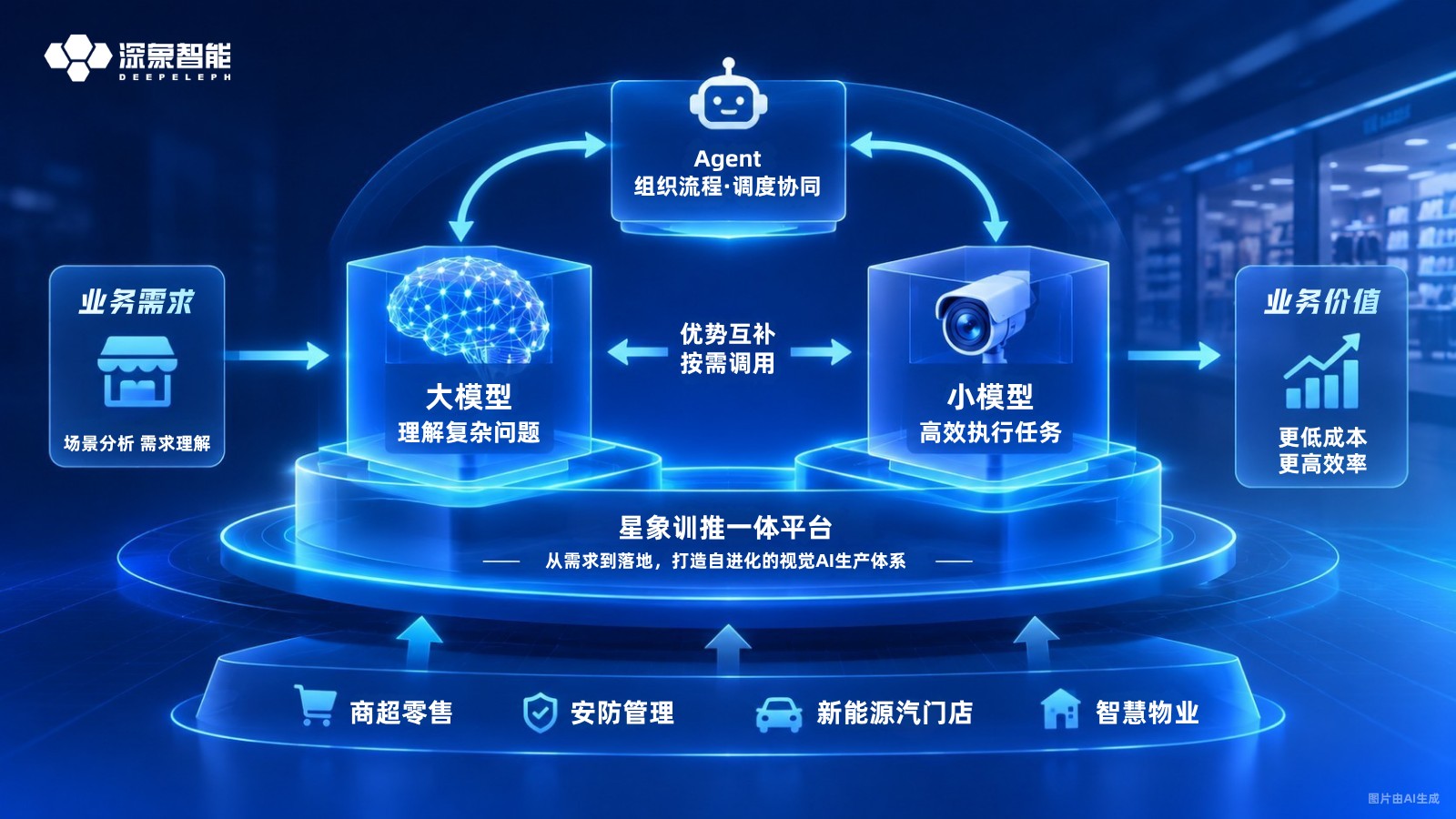
The Xingxiang training and inference integrated platform launched by DeepVision Intelligence is exactly the exploration centered on this issue: through the collaboration of large models, small models and Agents, it makes model production, scenario verification and business application more efficient.
I. Why is it unnecessary to use large models for everything in AI implementation?
For offline retail enterprises, computer vision AI does not face a single problem, but a large number of ongoing business tasks with varying degrees of complexity.
For example, brick-and-mortar stores need to continuously analyze camera footage to identify specific targets, detect abnormal behaviors and assist in daily patrol inspections. These tasks require not only the model to accurately understand the footage, but also the system to process a large number of video streams in real time.
If all footage and all tasks are handed over to large models for processing, there will be considerable resource pressure.
Large models have strong generalization capabilities and context understanding capabilities, and can process complex information, but they usually require more computing resources, and may not be the most cost-effective choice in high-frequency, real-time video processing scenarios.
Small models are different. They are usually trained for a specific type of clear task, such as identifying specific products, detecting abnormal behaviors or judging a certain scene state. After targeted training, small models can complete high-frequency and repetitive recognition tasks with low computing resources, and are more suitable for continuous operation on edge devices with limited computing power.
The two have their own advantages:
Large models: Good at understanding complex requirements, analyzing context, and assisting in solving new problems.
Small models: Good at performing tasks with clear boundaries, and suitable for high-frequency, real-time recognition demands.
This is just like the operation and management of a chain of stores: complex problems require experienced management personnel to analyze and make judgments, while a large number of standardized and repetitive work can be continuously completed by positions with clear division of labor.
A truly efficient AI system does not let a single model take on all the work, but allows different capabilities to perform their respective duties.
II. From model production to continuous optimization: How do large models and Agents collaborate?
After understanding the respective advantages of large and small models, we still need to solve a more practical problem: how to quickly produce small models suitable for different business scenarios?
Traditional computer vision AI projects often go through links such as demand analysis, data collection, data labeling, model training, effect testing and continuous optimization. Every time a new scenario is added, a lot of repetitive work may be involved. This is also a common difficulty that many enterprises encounter when promoting AI applications: technical feasibility needs to be verified, but the verification itself requires investment of time, manpower and costs.
The Xingxiang training and inference integrated platform of DeepVision Intelligence hopes to make this process more efficient through the collaboration of large models and Agents.
Step 1: Large models understand business requirements and assist model production.
Faced with a new computer vision AI demand, large models can assist in analyzing business objectives, sorting out scenario differences, determining which targets the model needs to identify, and what deficiencies exist in the existing data.
In the data preparation phase, it can also participate in sample screening, data generation, automatic labeling, error analysis and other work. For example, if a customer wants to identify a certain type of abnormal behavior in stores, the platform can assist in analyzing what kind of data needs to be prepared for this demand, whether the existing samples cover typical situations, and where the errors occurring in model testing are mainly concentrated. Part of the work that used to be handled item by item by engineers can now be completed with the assistance of large models, reducing repetitive labor.
Step 2: Agents organize task processes and promote continuous model optimization.
After data preparation is completed, it is also necessary to train the model, test the effect, and make continuous adjustments according to the results.
Agents can be understood as intelligent agents with capabilities of task planning, tool invocation and process organization.
In the Xingxiang training and inference integrated platform, Agents can organize processes such as data processing, model training, test evaluation and result comparison according to task objectives. For example, when model testing finds that the recognition effect of a certain type of abnormality is not ideal, the system can combine error samples and historical experiments to assist in analyzing whether supplementary data, label correction or training parameter adjustment is needed, and then organize a new round of experiments.
Large models assist in analyzing problems and proposing optimization directions, while Agents organize these directions into executable processes to promote continuous model iteration. When data processing, training evaluation and optimization processes are gradually standardized, mature production processes can be reused for subsequent similar scenarios, reducing the workload of developing from scratch.
III. After the model is actually launched, learn to call it on demand
The completion of model training does not mean that the implementation of computer vision AI is finished.
In the real store environment, cameras need to run continuously, and the situations in the footage are constantly changing. How to balance recognition effect, response speed and computing cost is a problem to be solved in the model deployment phase. The idea adopted by the Xingxiang training and inference integrated platform is to assign different models to take on corresponding work according to the complexity of specific tasks.
Take store abnormality recognition as an example: under normal circumstances, small models can continuously process video footage to complete clear target recognition and anomaly detection. When suspected anomalies appear in the footage, or more context information needs to be combined for judgment, large models are called according to preset rules for further analysis. If corresponding processing steps need to be taken afterwards, the relevant processes can be coordinated through Agents.
In this process, small models undertake high-frequency, clear perception tasks, large models are responsible for more complex understanding and analysis, and Agents organize collaboration between different capabilities.
Not every frame of footage needs to call a large model, and not every problem requires starting a full set of development processes from scratch.
Through application orchestration, the Xingxiang training and inference integrated platform organizes different models and intelligent agent capabilities into configurable and reusable business processes, enabling the AI system to flexibly combine capabilities according to scenario needs, and seek a balance between recognition effect, response speed and operation cost.
IV. From single-point model development to reusable computer vision AI production system
From Apple's AI practices to offline retail scenarios, we can see a common noteworthy direction: the competition of AI applications lies not only in how powerful the model itself is, but also in whether different capabilities can be organized to make them play a role in appropriate links.
This is particularly important for chain retail enterprises.
Making a certain AI scenario work in one store is only the beginning of business verification. When the application needs to be expanded to more stores, more cameras and more business demands, model production efficiency, deployment cost and continuous optimization capability truly determine whether AI can be applied on a large scale.
The Xingxiang training and inference integrated platform of DeepVision Intelligence, through large models assisting demand understanding and model production, small models executing specific computer vision tasks, Agents organizing training and optimization processes, and combining application orchestration to realize capability scheduling and reuse, explores transforming computer vision AI from single project development to a more standardized and configurable production method.
For enterprises, this means that when verifying new scenarios, there is an opportunity to reduce repeated development, shorten the cycle of part of the model production and iteration links, and make verified models and processes more conveniently applied to similar scenarios.
Of course, the business environment, data quality, equipment conditions and scenario complexity of different enterprises vary, and the actual deployment cost and effect still need to be evaluated in combination with specific demands.
The value of AI is not only to have more powerful models, but also to let the right capabilities solve real business problems at the right time.
From model capabilities to business value, DeepVision Intelligence hopes to make computer vision AI scenario verification more efficient, model production more flexible and large-scale application more sustainable through the Xingxiang training and inference integrated platform.
Let configuration replace repetitive development, and let computer vision AI enter real business sites faster.