Are we learning with AI, or using AI to bypass learning?
The biggest advantage of AI is speed: it solves problems instantly and generates solutions in seconds. But once AI is not available, how many things can we still accomplish independently? In 2026, three new studies conducted experiments from three perspectives: independent answering, long-term practice, and usage sequence. Let's take a look.
Suppose you are invited to solve 15 fraction operation problems. For the first 12 problems, there is an AI assistant on the side of the screen, available whenever you need it. When you get to the 13th problem, the assistant disappears without any prompts.
Can you still work out the remaining three problems?
Liu and his collaborators conducted exactly this set of randomized experiments. A total of 1,222 participants were recruited for the three experiments: the first two focused on fraction problems, and the third adopted SAT-style reading comprehension, with the same design: during practice, one group could ask AI for help while the other could not. During the test, all participants could only answer independently.
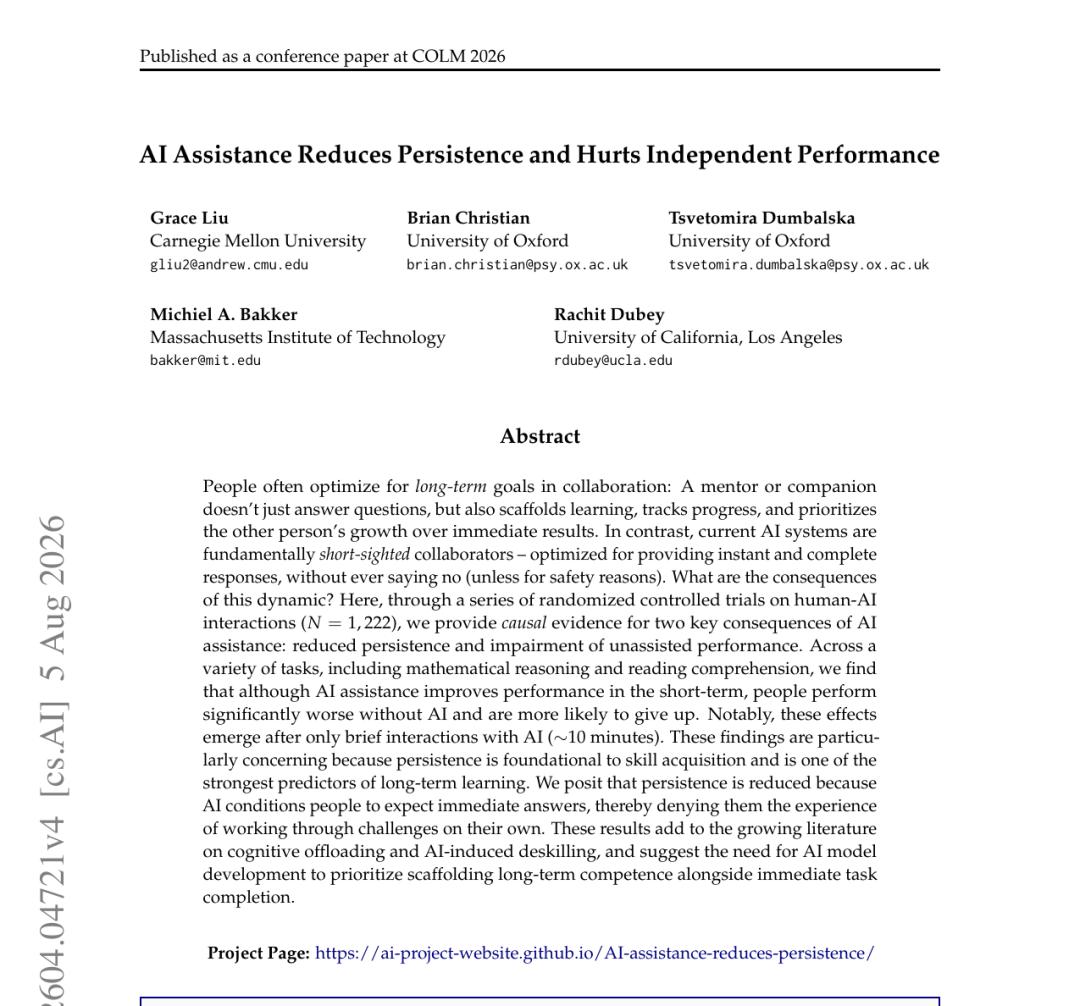
Homepage of the paper (arXiv version). Source: arXiv:2604.04721; accepted by COLM 2026
The results are clear: in the first experiment, for participants who could use AI during practice, the average correct answer rate was only 0.57 after the assistant was removed, while the rate for those who worked on the problems entirely on their own was 0.73. The number of problems they skipped was nearly twice as high.
There was a flaw in the sample screening process of the first experiment, which the researchers corrected in the second experiment, yet the gap still existed. The same pattern emerged when the task was changed to reading comprehension. The gap appeared even after only about ten minutes of practice.
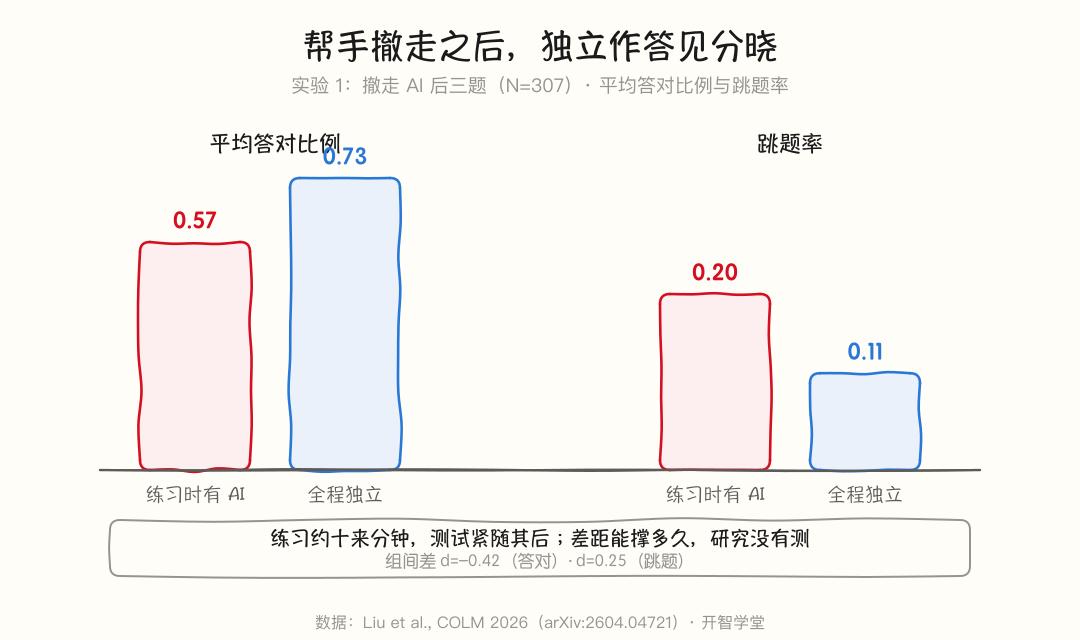
Data from Liu et al. Experiment 1 (average correct answer rate and problem skipping rate for the last three problems after AI removal); COLM 2026
Why did this gap emerge so quickly? Liu's team proposed two explanations. First, AI's instant responses change people's expectation of "how long a problem should take to solve", making independent thinking feel particularly laborious, and the more laborious it feels, the more people want to delegate the task to AI. Second, what AI saves is exactly the beneficial struggle in the learning process. Without this struggle, people cannot figure out how far they can go, and the self-awareness that supports persistence will also be inaccurate. The existing experiments have not yet distinguished which of the two explanations is the main factor.
The second experiment also recorded how people used AI. More than 60% of people directly asked AI for answers, and one real input recorded in the paper was only one word: "answer?". About a quarter of people mainly asked for prompts. After AI was removed, the average correct answer rate for people who asked for answers was 0.65, while the rate for those who asked for prompts was 0.76. Since the usage pattern was not randomly assigned, this can only be regarded as a correlational clue, but it shifts the question from "whether to use AI" to "how to use AI".

One of the paper's authors, Brian Christian (University of Oxford), author of *Algorithms to Live By*. Source: Official website of the Department of Experimental Psychology, University of Oxford
The same bottleneck observed in ten years of data
Will the ten-minute effect observed in the laboratory accumulate in real learning scenarios?
Another group of researchers retrieved approximately 3.2 million learning records from the mathematics practice platform ALEKS spanning from 2015 to 2025. The problems were divided into two categories: word problems, which can be copied in full to chatbots to get answers, are classified as "AI-easy"; problems that require dragging and dropping charts on the platform to answer are classified as "AI-hard".
The researchers estimated that after the launch of ChatGPT, college students spent 26.9% less time on AI-easy problems than on AI-hard problems (cumulative over 11 quarters). High school students spent 31.3% less time, junior high school students spent 9% less time, and fifth-grade students showed no change.
Are students just becoming more efficient? To rule out this possibility, the researchers compared two scenarios: proctored and unproctored. In the unproctored scenario, the time spent on AI-easy problems continued to decrease, while this trend almost disappeared in the proctored scenario. If students had generally become more efficient, the answering speed should have increased in both scenarios. The platform also inserted problems covering previously learned content under proctored conditions at regular intervals to test whether students still remembered the knowledge. For these problems, the odds of answering AI-easy problems correctly were also lower than those of AI-hard problems.
This set of results can only be used as circumstantial evidence: the paper has not yet been peer-reviewed, and the data does not directly record who used AI. However, it points to the same direction as the laboratory results: the time saved may have come at the cost of part of the learning process.
Does that mean AI is harmful to learning? The answer is no. A 2026 meta-analysis that aggregated 35 experiments involving 4,193 participants found that properly designed ChatGPT-assisted teaching can indeed improve measured learning outcomes. The two types of studies measure different things: the meta-analysis focuses on performance when learning with AI, while the previous studies focus on how much people can accomplish independently after AI is removed.
Change the usage sequence
Is there a usage pattern that can save time while ensuring effective learning?
A randomized experiment published by Singaporean researchers Sarah Shi Hui Wong and Sophia Xuefei Qiu in *Educational Psychology Review* proposed a preliminary solution.
196 college students were divided into three groups to develop improvement plans for a plush toy: the first group did not use AI, the second group used ChatGPT freely, and the third group followed a fixed sequence: spend 3 minutes independently brainstorming their own ideas, then spend 6 minutes asking ChatGPT to help revise, and finally spend 3 minutes finalizing the plan on their own. The third group was also provided with a question template, where each question started with their own idea: "My idea is XX, how can I improve it?" "What other ways can make it more original?"
In the first round, the group that used ChatGPT freely took a clear lead, with an originality score of 4.08, while the group that did not use AI scored only 3.06, and the group that brainstormed first before asking scored 3.30. The lower score of the "think first, ask later" group in the first round was the cost of changing the sequence.
In the second round, a more complex new task was assigned: to independently design a game that helps adults learn foreign language vocabulary, and no one was allowed to use AI. This time, the results were different. The score of the free-use group dropped to 2.69, which was almost the same as that of the no-AI group (2.63), and none of their advantages from the first round were retained. The "think first, ask later" group scored 3.42, outperforming the other two groups.
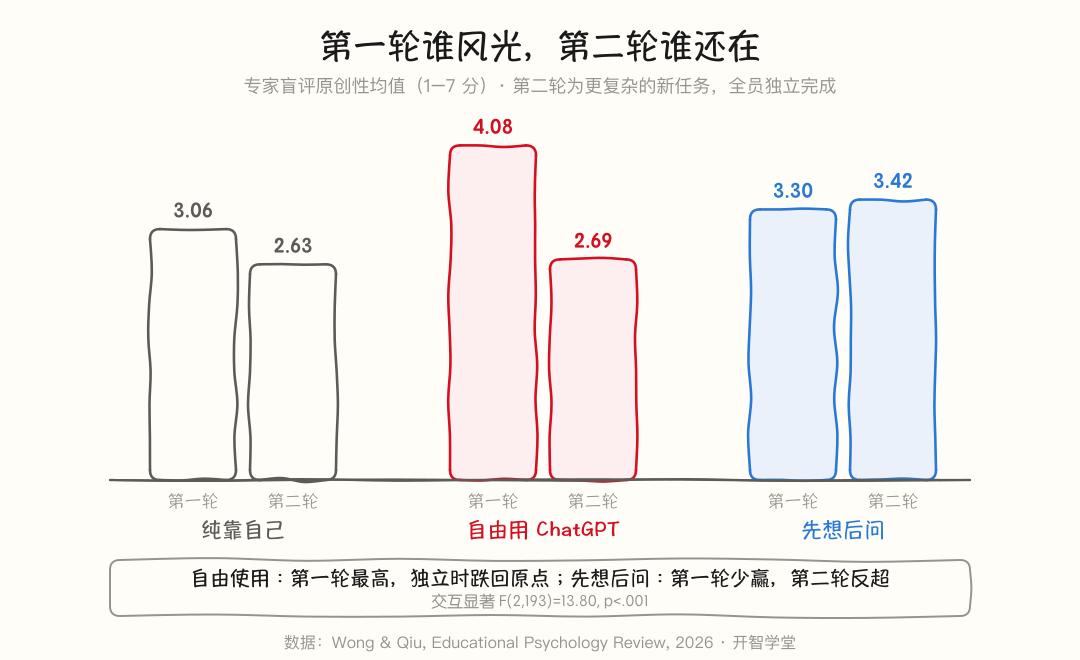
Data from Wong & Qiu 2026 (mean originality score from blind expert review, 1–7 scale); the second round is a more complex new task different from the first round problem
Where does the difference come from? The two groups asked ChatGPT roughly the same number of questions, and the difference lay in whether they put forward their own ideas before asking. In the free-use group, 70.9% of the questions were one-way requests, nearly 60% of which did not provide their own ideas before directly asking ChatGPT to generate creative content. In the "think first, ask later" group, 88.6% of the questions were used to polish their own ideas back and forth with AI.
However, the "think first, ask later" approach has only been directly tested in this one experiment so far, and it includes multiple links: independent thinking first, time limit, and question template, so it is not yet clear which link plays the leading role.
Think first, then ask
The "think first, ask later" approach is consistent with two principles in cognitive science: the generation effect and desirable difficulty.
The first principle is the generation effect. In 1978, psychologists Norman Slamecka and Peter Graf found that content generated by people themselves is better remembered than content directly presented to them.
The second principle is desirable difficulty. Psychologist Robert Bjork proposed this concept in 1994. After years of research with Elizabeth Bjork, they found that under many conditions, the extra effort spent during practice leads to better retention and application of knowledge in the future.
It's just like working out: if someone else lifts the barbell for you, the barbell goes up, but your muscles won't grow.
Therefore, when using AI, it is worth asking yourself one more question: if AI is removed, can I still complete the task independently? A simple method is: before the final answer takes shape, come up with your own solution first, even if it is rough; then ask AI to point out flaws, provide counterexamples, and help revise it.
AI will only become more and more capable of saving time. Whether the saved time is used to eliminate unnecessary waiting, or to skip the essential struggle that cannot be omitted, is entirely up to you.
References
Liu, G., Christian, B., Dumbalska, T., Bakker, M. A., & Dubey, R. (2026). AI assistance reduces persistence and hurts independent performance. In Proceedings of the Conference on Language Modeling (COLM 2026). arXiv:2604.04721.
Wong, S. S. H., & Qiu, S. X. (2026). Think first, ChatGPT later: Guiding human–AI collaboration for learning gains in independent human creativity. Educational Psychology Review, 38, Article 45. https://doi.org/10.1007/s10648-026-10118-7
Rismanchian, S., Uzun, H., Matayoshi, J., Cosyn, E., & Kurd-Misto, E. (2026). Faster completion, less learning: Generative AI reduced study time on math problems and the knowledge they build (arXiv:2605.21629) [Preprint]. arXiv. (Not peer-reviewed)
Wu, X., Zhu, P., Zhang, J., Yin, M., & Wang, Y. (2026). ChatGPT's impact on student learning outcomes: A meta-analysis of 35 experimental studies. Humanities and Social Sciences Communications, 13, Article 684. https://doi.org/10.1057/s41599-026-07019-z
Slamecka, N. J., & Graf, P. (1978). The generation effect: Delineation of a phenomenon. Journal of Experimental Psychology: Human Learning and Memory, 4(6), 592–604.
This article is from the WeChat official account "OpenMind Club" (ID: openmindclub), written by an advocate of meta-learning education, and authorized for release by 36Kr.