Now that AI is so capable, why are we still so tired from work?
AI can already do most of the work, but why are companies still operating the old way?
In recent years, a large number of companies have been pushing for AI transformation.
They purchase AI tools for employees, organize AI training, encourage everyone to use AI Coding, and even include AI usage in performance assessments.
After going through all these efforts, what is the actual result?
Employees can write weekly reports faster, operation teams can produce posters faster, and R&D staff can write code faster. But when it comes to actual work, requests still need to be approved layer by layer, cross-departmental communication remains difficult, and a project still requires more than a dozen meetings from initiation to launch.
The few hours saved by using AI with great difficulty end up being spent on meetings and reporting.
This is rather awkward.
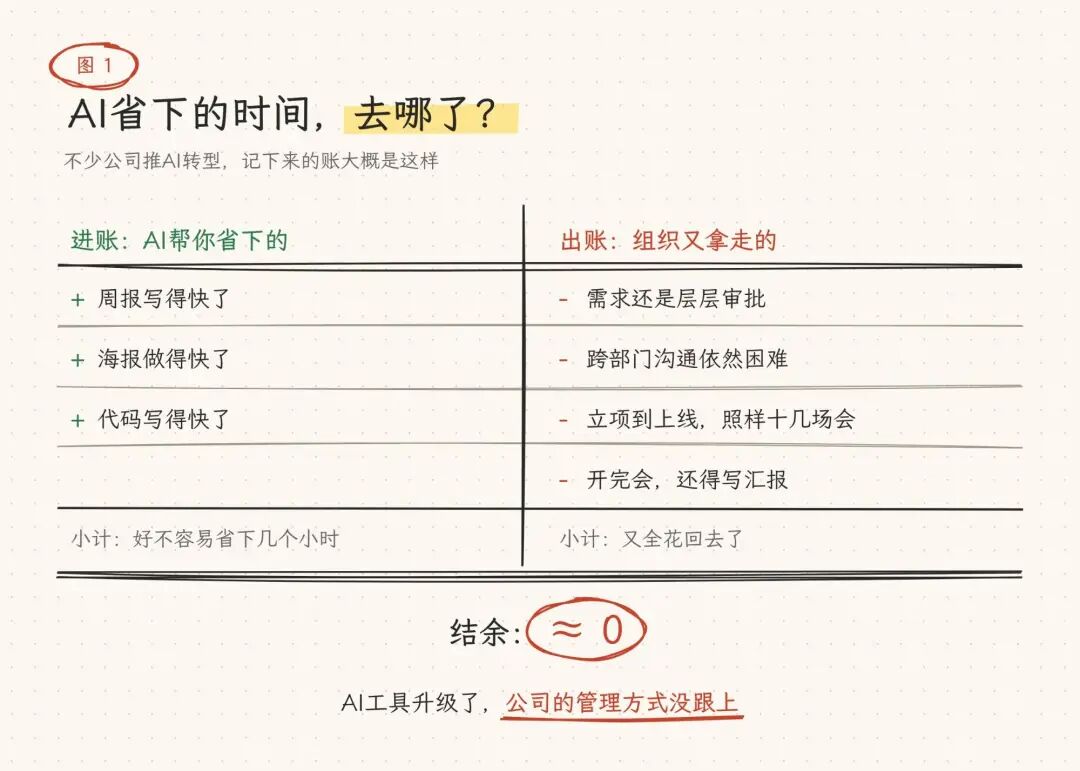
AI tools have been upgraded, but the company's management methods have not kept pace.
This is probably the most headache problem for many enterprises when promoting AI transformation.
01.Shopify Has Started to Rethink Its Hiring Strategy
An internal email from Shopify, the world-renowned e-commerce platform, has sparked extensive discussions in the tech industry.
CEO Tobi Lütke put forward a requirement to employees: before a team applies for additional staff and resources, it needs to first prove why the existing work cannot be completed by AI.
The company also plans to include AI usage in performance and peer reviews.
This policy is of course controversial. After all, no employee would like their boss to constantly ponder whether their job can be handed over to AI.
But from the perspective of business operation, this issue is indeed worth studying.
If a project that originally required 10 people to complete can be finished by 5 people with AI assistance, do enterprises still need to recruit, divide work and manage in the original way?
If product managers can already develop prototypes with the help of AI Coding, designers can generate visual solutions in batches, and operation staff can use Agents to complete a large number of repetitive tasks, is there still room for adjustment for the traditional team configuration?
Many enterprises probably have to recalculate this account.
However, there is a noteworthy point in Shopify's approach: it requires teams to consider AI capabilities before applying for resources, which actually involves how work is redistributed.
After all, the fact that AI can complete a piece of work does not mean that enterprises can directly lay off the corresponding position. Existing business, customer relationship, system maintenance and risk management still require dedicated personnel to take charge.
Moreover, for enterprises that have been developing for more than ten or even decades, adjusting the organization is far more difficult than purchasing a few AI tools.
02.AI-Native Organizations, the Hardest Part Is Dealing With Legacy Organizations
When many people discuss AI-native organizations, they like to take some AI startups as examples.
A small team of several people, cooperating with a large number of AI Agents, can complete product R&D, marketing promotion, customer service and other work.
This sounds very promising.
But the vast majority of enterprises do not have the opportunity to start from scratch.
Companies already have hundreds or thousands of employees, existing products are still generating profits, business systems have been running for many years, and organizational structures, reporting lines and performance assessment rules have long been formed.
When the boss suddenly announces the plan to build an AI-native organization, problems will emerge.
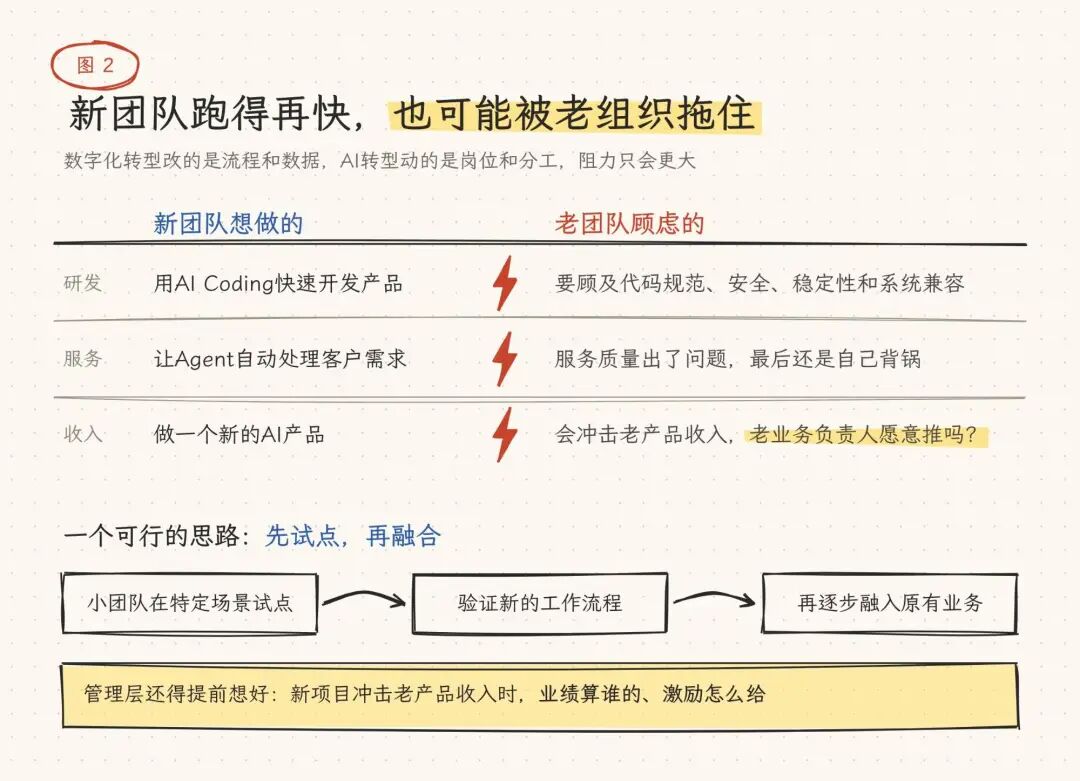
New teams can use AI Coding to develop products quickly, while legacy R&D teams have to consider code specifications, security, stability and system compatibility.
New teams hope to use Agents to automatically process customer demands, while legacy business teams worry that they will be held responsible for any service quality issues in the end.
What is more realistic is that the new team may be developing an AI product that will very likely affect the revenue of legacy products.
Will the head of the legacy business be willing to take the initiative to promote this change?
The situation will become even more complicated when the performance indicators of the two sides conflict.
This reminds me of the digital transformation experiences of many enterprises in previous years.
At that time, people were also discussing organizational reform, data-driven operation and agile collaboration. Enterprises set up digital departments and introduced various systems, hoping to change the original business processes.
However, in the implementation process, many projects were still dragged down by the original organizational structure and working habits.
New departments wanted to promote changes, while legacy departments were busy meeting their own performance indicators. Everyone agreed that digitalization was very important, but once it involved budgets, personnel, decision-making power and benefit distribution, things were far from easy.
AI transformation may be even more complicated.
Digital transformation mainly focuses on business processes and data, while AI has the opportunity to directly participate in or even complete specific work, affecting the division of existing positions and organizational configuration.
If AI can really automate half of the work of a certain department, who will be willing to stand up and take the initiative to promote this matter?
Such problems cannot be solved by technology alone.
I think when enterprises build AI-native organizations, they may need to find a sustainable cooperation mode between new and legacy organizations.
For example, let small teams carry out pilots in specific business scenarios first, verify new work processes, and then gradually integrate them into the original business. For innovative projects that may affect the revenue of legacy products, the management also needs to reconsider the performance attribution and incentive mechanism.
Otherwise, no matter how fast the new team runs, it may be dragged down by the legacy organization.
03. Without Breaking Down Department Silos, Even the Most Powerful AI Is Useless
There is another very realistic problem: department silos.
The business processes of many enterprises are originally divided into independent departments.
The product team is responsible for demands, the R&D team is responsible for development, the operation team is responsible for growth, the sales team is responsible for customers, and the customer service team is responsible for after-sales support.
Each department has its own head, budget and performance indicators.
After AI comes along, every department starts to improve its own efficiency.
The R&D department introduces AI Coding, the marketing department introduces AI content tools, the customer service department deploys intelligent customer service, and the sales department also has its own AI assistant.
Looking at each department individually, the efficiency may have improved.
But a complex business usually requires the collaboration of multiple departments to complete.
For example, an enterprise hopes to use AI to automatically process customer inquiries and drive customers to complete purchases.
The marketing department is responsible for customer acquisition, the sales department is responsible for follow-up, the product department is responsible for system capabilities, and the customer service department is responsible for subsequent services.
To make the AI Agent complete the whole process smoothly, it is necessary to access the data, systems and business rules of multiple departments.
The marketing department is unwilling to share its data, the sales department worries that AI will affect its own customer resources, the customer service department requires additional manual review, and the R&D department still needs to arrange the schedule to connect the systems.
After months of effort, AI may only realize the function of automatically replying to customer messages.
Each department has achieved its own AI efficiency improvement goal, but the overall business efficiency of the company has not changed much.
A global AI survey by McKinsey also reflects similar problems: nearly 90% of respondents said their organizations have used AI in at least one business link, but only 39% of respondents reported that AI has had an impact on the overall EBIT of the enterprise.
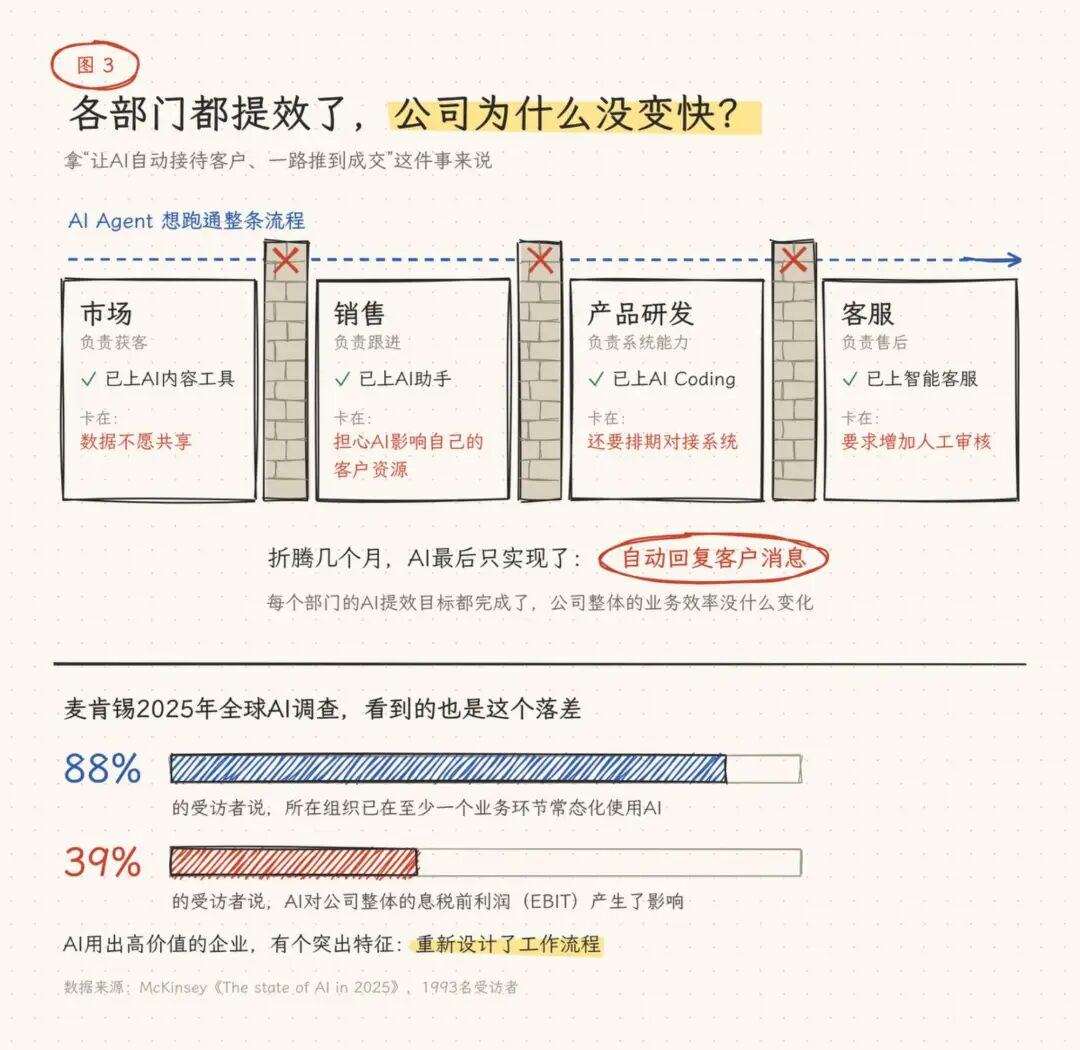
Among enterprises that have achieved high value from AI applications, redesigning work processes is a prominent feature.
This set of data is worth pondering for enterprise managers.
The efficiency of a complex business usually depends on whether the whole process can run smoothly. If a certain link improves efficiency by ten times, while other links still need to wait for approval, manual entry and repeated communication, the final effect will be greatly reduced.
To make AI truly participate in cross-departmental business, someone needs to be responsible for the complete business results, rather than only managing the several indicators of their own department.
For example, focusing on the whole process of customer transaction, let the product, R&D, sales and operation teams be jointly responsible for the conversion rate and customer experience.
The configuration of AI tools, data flow, and which links need manual review are all designed around the same business goal.
Of course, such adjustments will also touch the original power and responsibility relationship.
Are department heads willing to share resources? Who will be held responsible if something goes wrong? Who will own the performance created by AI? To whom will the new team report?
Each of these points may become a resistance to reform.
The hardest thing for enterprises to break may be the organizational inertia that has been running for many years.
04. AI-Native Organizations May Redefine Many Positions
As AI capabilities become stronger and stronger, the division of positions within enterprises may also change.
The work that product managers, designers, R&D engineers and test engineers originally performed separately is beginning to have more and more overlaps.
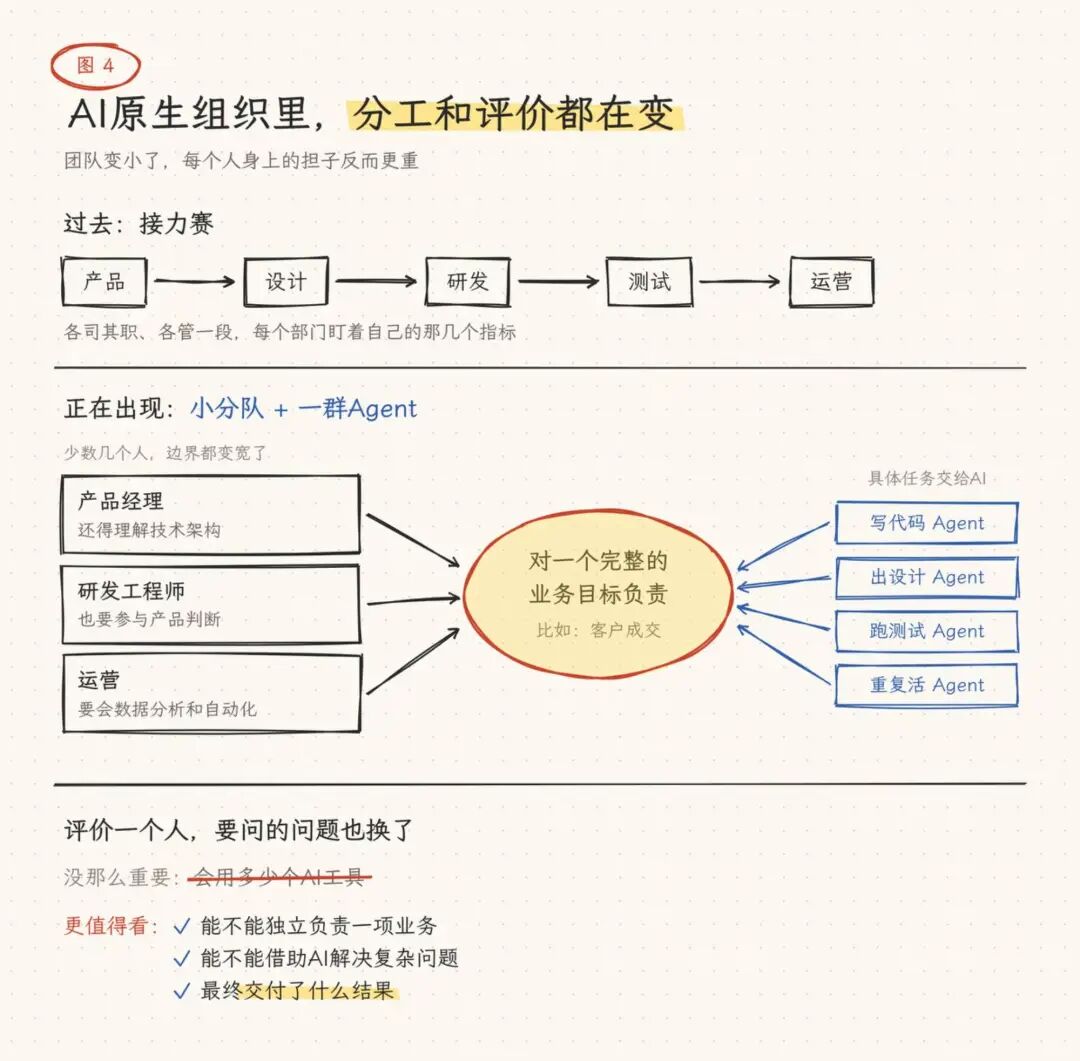
AI Coding enables product managers to independently implement some simple functions, AI design tools improve the efficiency of design output, and automated testing is also changing the traditional R&D process.
More small teams with high autonomy may gradually emerge in enterprises.
A small number of people are responsible for the complete business goals, and cooperate with multiple AI Agents to complete specific tasks.
But organizational adjustment will hardly be plain sailing.
On the one hand, AI improves individual work capabilities, and enterprises do have the opportunity to reduce repetitive work.
On the other hand, after the team size shrinks, each person may need to take on more responsibilities instead.
Product managers may need to understand technical architecture, R&D engineers need to participate in product judgment, and operation personnel also need to have certain data analysis and automation capabilities.
For enterprises, the evaluation criteria for talents will also change.
How many AI tools an employee can use is not that important. What is more worthy of attention is whether he can be independently responsible for a business, whether he can use AI to solve complex problems, and what kind of results he can deliver in the end.
For managers, the challenge is even greater.
This article is from the WeChat official account "Everyone is a Product Manager" (ID: woshipm), written by Guai Ge, published with authorization from 36Kr.