After GPT-6, embodied large models are trapped in a self-imposed predicament, and the in-house R&D budget for next year is highly unlikely to be approved.
GPT-6 Astra was released just two months ago, and GPT-6.2 Astra is right around the corner.
However, the embodied intelligence industry has not yet recovered from the last round of setbacks.
Everything came completely out of the blue.
You may still remember that when GPT-6 Astra first came out, a large number of practitioners in the embodied intelligence field were caught off guard. Especially front-line engineers engaged in pre-training, all felt their jobs were at risk.
Recently, there have been industry rumors that some embodied intelligence companies have started to cut algorithm positions.
Capabilities that used to require massive amounts of data, computing power and algorithm engineers to work on bit by bit, can now be demonstrated by GPT-6 Astra in some tests without additional post-training for specific tasks.
How can people keep up with this pace of competition???

An engineer working on model development at a robotics company told QbitAI:
Compared with the long-overdue new paradigm-breaking breakthroughs in embodied intelligence, general large models represented by Astra are delivering a vertical blow to the embodied industry through coding capabilities, which is the real impact.
The pressure brought by this impact does not only come from Silicon Valley.
Compared with the technological progress of overseas large model companies such as OpenAI, domestic embodied companies are more sensitive to the next moves of local large model players.
Kimi, DeepSeek, Zhipu AI... these names are becoming variables that the embodied industry has to pay close attention to.
In the recently popular RoboDojo benchmark, more and more teams have begun to try to integrate general large models (such as GPT-6 Astra) into their own robot systems, which show extremely strong generalization ability and astonishing performance.
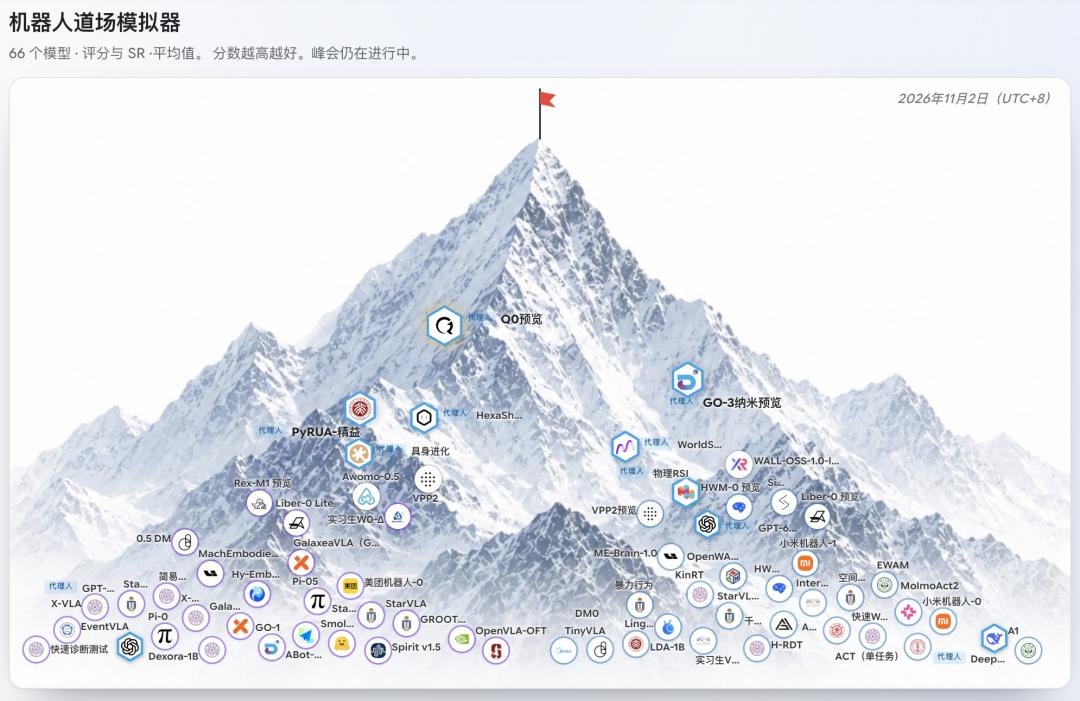
According to Tianxing Chen, the first author of the RoboTwin/RoboDojo benchmark, some teams that originally insisted on training native embodied foundation models have now begun to submit solutions combined with technologies such as Robot-Use-Agent (RUA), to leverage general large models to complete robotic tasks.
The effect is quite straightforward. Models that originally only scored 20 or 30 points can see their evaluation scores rise to 50 or 60 points after integrating Astra-related solutions.
While the scores on the leaderboard have gone up, the only thought lingering in the minds of embodied company teams is:
Is there still a need to develop models in-house...(cry)

Tianxing Chen, a PhD student majoring in embodied intelligence at the MMLab of the University of Hong Kong, participated in the evaluation of GPT-6 Astra and the writing of the RoboDojo assessment report (hereinafter referred to as the "Report").
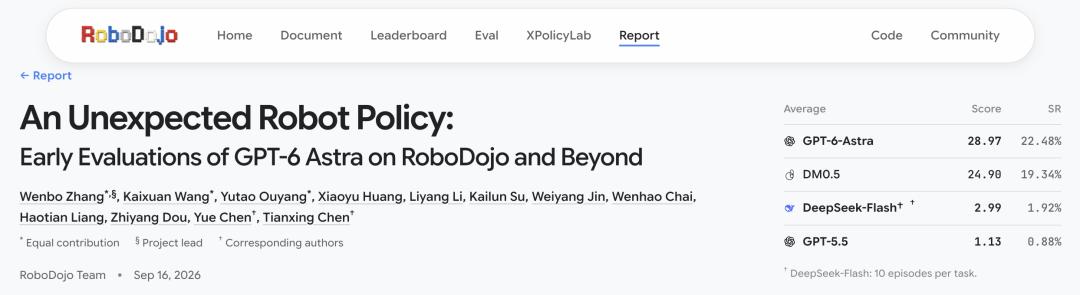
△ The early assessment report on GPT-6 Astra by the RoboDojo team
Recalling one day in mid-September, Tianxing Chen told QbitAI that when his teammates brought the test results one after another, he froze for several seconds:
You can see that its impact on 3D reconstruction, mathematics and various other fields is unprecedented.
It's scary, really quite scary.
Everyone was caught off guard by GPT-6
"While self-developed embodied models are still incrementing their scores by 0.1 or 0.2 points at the 80-point level, GPT-6 Astra has already jumped directly from 80 points to 90 points in one go."
This is a vivid metaphor Tianxing Chen used when reviewing this evaluation.
What's more striking is that in some tests, Astra did not even carry out additional post-training for specific tasks, nor did it use task demonstrations, and could complete many robotic operation tasks only through language instructions.
What surprised him most was that Astra immediately demonstrated three capabilities that embodied models used to focus heavily on developing in the past.
The first one is ICL (In-Context Learning).
Simply put, it means enabling robots to quickly learn a new task through a small amount of context information.
For example, if a human shoots a video of their own operation with text descriptions, the robot can understand how the human did it, and try to make the robotic arm reproduce the operation.
In July this year, ICL was still a very popular research direction in the embodied intelligence circle. The common paradigm was to demonstrate human operations and let the robot imitate to acquire new skills — the so-called one-shot in-context learning.
But the community found that providing image or text demonstrations to Astra can lead to higher success rates than not providing demonstrations.
What's more surprising is its online adaptation capability. Researchers deliberately changed the camera view and motion coordinate system, and Astra could adjust its strategy after several attempts based on the actual execution results, and successfully complete the task.
That is to say, it can not only understand the context, but also correct itself while executing tasks.
In Tianxing Chen's view, general models themselves have strong context understanding capabilities. When chatting normally, they can remember previous conversation history, and when given a video, they can also understand the relationship between video content and text.
When these capabilities are migrated to robot operations, the ICL problem that used to require dedicated research suddenly has a ready-made solution.
The second one is OOD (Out-of-Distribution generalization) and Correction capability.
Robots in the real environment are very likely to encounter situations outside the training data.
For example, when the robotic arm is about to grab a cup, the cup is suddenly bumped and its position changes.
A model that relies too much on training data may still follow the original trajectory to execute, and end up grabbing nothing.
But Astra can re-adjust its movements according to the changed visual information, and try to grab the object.
Sounds like just a tiny movement, but behind it is the core problem of whether robots can adapt to the real world.
After all, no one in the real world is responsible for putting every cup back to the position it was in during training.
The third one is Open-Vocabulary Manipulation.
This capability involves the alignment between language and actions.
For example, if the user puts forward operation requirements in different ways, the robot can still understand and execute them.
In the past, there was often a gap between language understanding and action execution, and embodied models needed post-training for specific tasks to achieve better alignment.
But Astra shows stronger capabilities in this regard. In some tests, even without additional post-training and demonstrations for specific tasks, it can complete many robotic operations only through language instructions.
In Tianxing Chen's view, the above three used to be very important technical propositions in the embodied intelligence field, and all of them were enough to be taken out separately as a complete entrepreneurial story in the past.
Now Astra has solved all three problems at once, which is an almost explosive impact on the original R&D route of embodied models.
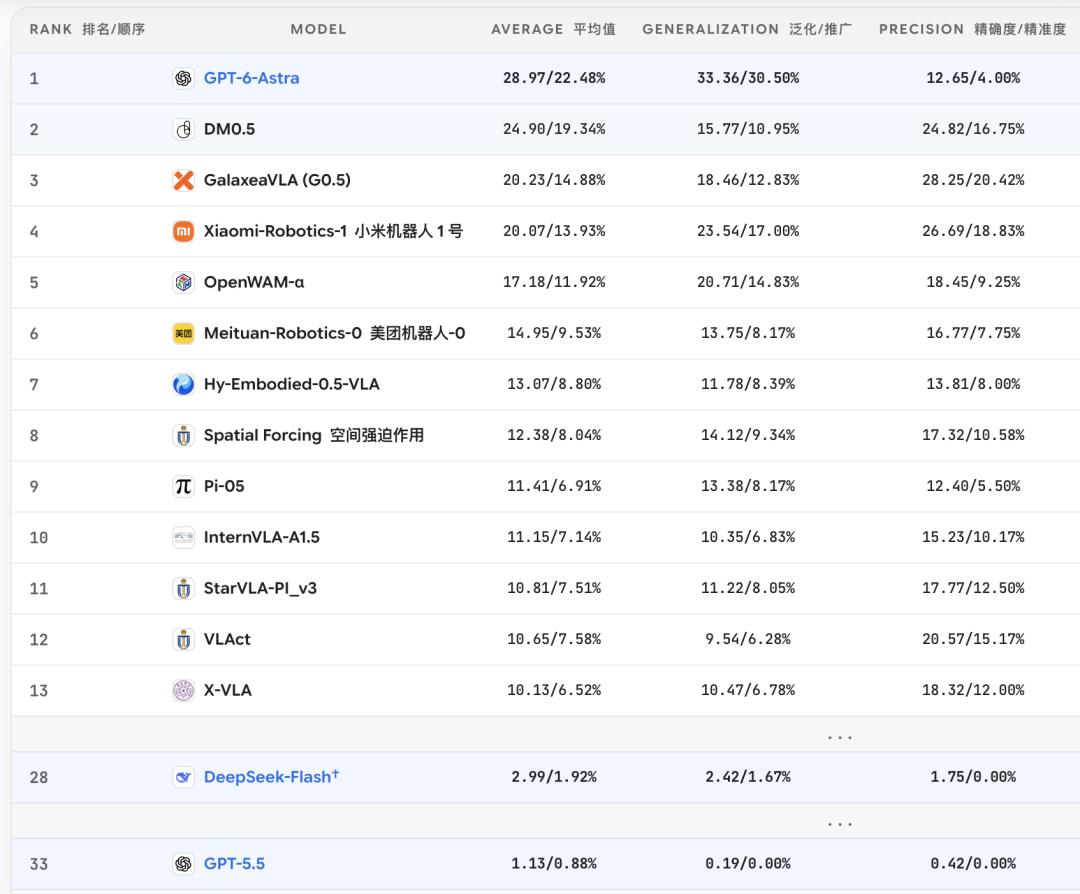
△ The zero-shot test results in the RoboDojo-Sim benchmark do not mean that Astra can already stably complete these tasks on real robots.
In the report, the RoboDojo team noted that Astra's real machine test was once suspended due to safety issues.
High scores on the simulation leaderboard cannot be directly equated to productivity in the real world.
But it is enough to make embodied companies re-examine their past R&D investments.
Why can a general large model that was not originally built for robotic operations quickly approach the capabilities that embodied companies have accumulated for many years?
It's a bit of a happy accident.
Although general large models do not learn robotics from scratch, they enter the robotics field with a series of capabilities accumulated from large-scale pre-training, including language, vision, reasoning, and coding.
These capabilities originally had their own use cases, and no one expected that they could be directly applied to robots.
In contrast, many embodied companies train robot brains from scratch, and the data they have is mainly from robotic operations themselves.

For models to understand the environment, follow instructions and learn movements, many capabilities have to be polished little by little from limited data.
One side comes to the robotics field with a full set of general capabilities, while the other side is still investing separate data, computing power and manpower for each individual capability.
The starting line of this competition is never the same.
Is in-house model development still necessary?
GPT-6 Astra is indeed very powerful, but it is not strong enough to make embodied companies surrender directly.
At least in the real physical world, there are still many tough challenges waiting to be solved.
Huazhe Xu, founder of Pebble Robotics, breaks down the capabilities of embodied intelligence into three levels: semantics, space and physical generalization.
He believes that Astra performs outstandingly in the first two levels, but still faces challenges when it comes to complex physical contact, force change, object deformation and high-precision operation.
For example, letting a robot know where a cup is and that it should reach for it, is completely different from letting it grab the cup steadily.
Is the cup soft or hard? How much force should be applied when grasping? What changes will happen to the object after it is squeezed or collided?
These problems cannot be solved only by recognizing images and understanding instructions.

△ Screenshot of the report
The RoboDojo team also found in the evaluation that Astra does not have advantages in all tasks.
Geometric alignment and language instruction understanding are its strengths, but when it comes to continuous contact and multi-step physical operations, existing VLAs still have many opportunities.
Qian Wang, founder of Zili, holds the view that for general large models to enter the embodied field, they still have to face infrastructure problems such as robot data, real-world evaluation, hardware, simulation and deployment.
These difficulties will not disappear automatically just because you have a stronger language model.
The question is, will the things that Astra cannot do well today be suddenly accomplished by it tomorrow?
At present, another widely criticized problem of Astra in the industry is its extremely slow inference speed.

Tianxing Chen also noticed that the cloud API of GPT-6 Astra has high inference latency, which is a real obstacle to the real-time closed-loop control of robots.
Just imagine, if the robot has to wait for the large model to think for a long time every time it takes an action, it will be difficult to meet the requirements of real scenarios.
But Tianxing Chen believes that this problem is not a fundamental barrier. There are already many existing edge-side deployment solutions for LLMs, including technologies such as model quantization, distillation, and edge-side inference engines. As long as large model companies regard robotics as an important business scenario, they can use the existing technology stack to complete latency optimization.
Behind this problem is a very easily confused concept: "Model inference frequency" and "Robot control frequency" are not the same thing.
An unnamed embodied model engineer told QbitAI:
Slow inference can still match fast control, and what is sacrificed is only the reaction speed. For assembly line tasks that are highly time-sensitive, this is not a critical problem at all.
For example, in express sorting, robots need to grasp and place items continuously and stably. The high-level model is responsible for understanding tasks and planning movements, while the underlying control system executes control instructions at a much higher frequency.
As long as the task allows pre-planning, or has a certain tolerance for reaction latency, the large model does not necessarily need to participate in every underlying control cycle.
Of course, for tasks with high-speed dynamic changes and complex contact, reaction speed is still very important.
But at least, slow inference does not necessarily mean that the robot's control is slow.

All the shortcomings exposed by general large models today cannot be directly taken as the moat that embodied companies can rely on for survival in the future.
For embodied companies, this hard truth is more or less distressing.
But