While the two leading platforms are locked in cutthroat competition, mid-tier short drama apps are fighting for survival in the narrow market crevice between them.
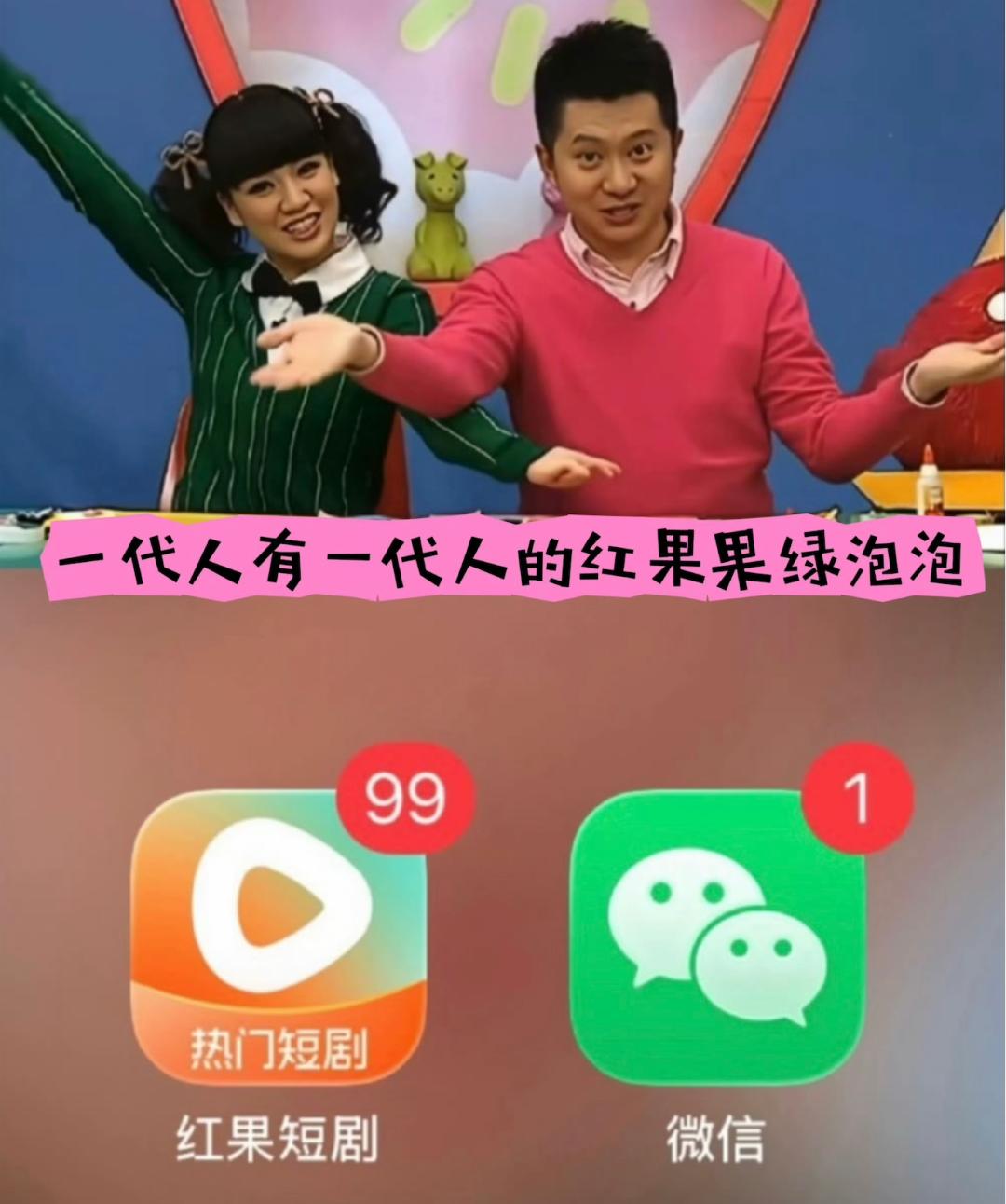
The "one red and one green" pair in China's domestic short drama market not only leads the overall user base, but also draws almost all public attention. From third-party data rankings to media reports, and even platform spokespersons' posts on Weibo, Hongguo and Lvpaopao are undoubtedly the absolute protagonists. In sharp contrast, a large number of mid-tier short drama APPs are gradually fading out of users' field of vision.
Recently, a ranking released by QuestMobile intuitively shows the survival status of mid-tier short drama APPs: their monthly active user (MAU) scale is crushed by the head players in a fault-like manner, and the MAU of a single month is even lower than that of short drama mini-programs. They cannot compete with the algorithm ecosystem of Hongguo, nor can they beat Lvpaopao's zero download cost advantage.
The reason why we still need to pay attention to mid-tier platforms at present is not to predict who has the strength to join the competition between Hongguo and Lvpaopao, but to take them as samples to observe the evolution of the entire short drama industry ecosystem.
What is worth further exploring is: What kind of impact has the rapid rise of Lvpaopao brought to mid-tier short drama APPs? In the market pattern where head players take all the profits, how do they retain their existing users and survive in the cracks? As the industry pattern is reshaped, what changes have taken place in their role positioning?
Mid-tier Short Drama APPs Are Caught Between Two Sides
On November 3, QuestMobile released the *2026 Autumn Report on China's Mobile Internet*. Its TOP10 ranking of short drama applications by MAU is somewhat different from previous ones: it splits and counts the short drama market into independent APPs, WeChat mini-programs, and Douyin mini-programs for parallel comparison, presenting the real entry structure of the short drama market.
In September 2026, among independent short drama APPs, Hongguo Free Short Drama recorded an MAU of 430 million, up 81.8% year on year, still maintaining a fault-like lead; Hongguo Free Manhua Drama had an MAU of 78.83 million, surging 26870.2% year on year, ranking second; Hippo Theater had an MAU of 30.8 million, down 40.3% year on year; Huolong Manhua Drama ranked fourth with an MAU of 11.13 million. Following them are three million-level platforms: Xifan Free Short Drama, Fanhua Theater, and Weiguan Short Drama, as well as three lower-tier platforms: Watch Short Drama to Earn Money, Xingya Free Short Drama, and Xiangguo Free Manhua Drama.
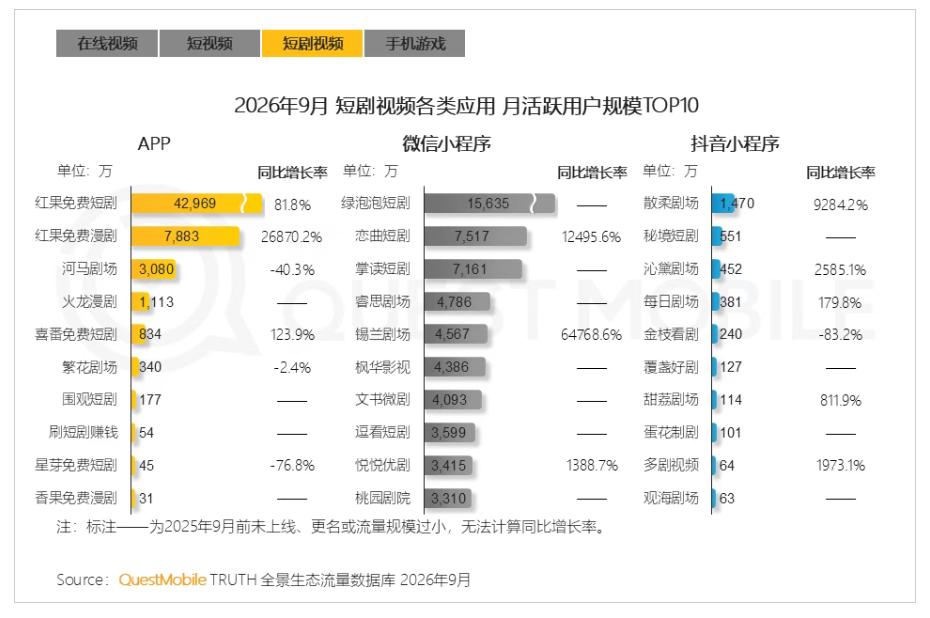
Among WeChat mini-programs, Lvpaopao Short Drama ranks first with an MAU of 156 million, which is also the second largest MAU in the entire short drama industry. Lianqu Short Drama and Zhangdu Short Drama both fall into the 70 million MAU tier. The MAU gap between the last seven platforms on the list narrows, with no fault-like disparity anymore.
In comparison, the overall MAU scale of Douyin mini-programs is significantly lower. The top player Sanrou Theater barely reaches the 10 million MAU tier, while the rest are hovering at the million level or even lower.
From the perspective of MAU scale, the short drama market cannot be simply regarded as competition among independent APPs. Instead, three types of entrances — APPs, WeChat mini-programs, and Douyin mini-programs — are all competing for users' time.
Lvpaopao Short Drama, which was officially renamed in July, is the biggest variable in the industry at present. Its MAU reached 143 million in August and rose to 156 million in September; its weekly active users (WAU) in the first week of October hit 89.68 million, up 44.1% year on year. It is not hard to understand why Lvpaopao can achieve rapid user growth: it relies on the WeChat ecosystem to keep user acquisition cost low, aggregates third-party content supply with an asset-light model, and replaces part of paid traffic investment with social fission distribution. Not everyone will download a separate independent APP just for short dramas, but people who watch short dramas are already using WeChat. Therefore, the users Lvpaopao gains are not necessarily heavy short drama users, but light users in WeChat's massive user base who have watched short drama clips on WeChat Channels.
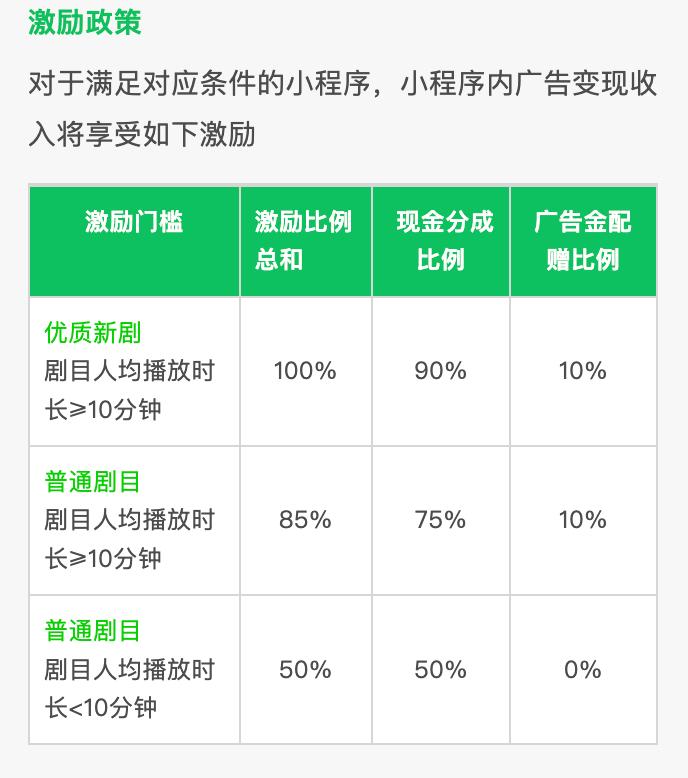
Another notable point is Lvpaopao's incentive policy: for high-quality dramas with per capita viewing duration exceeding 10 minutes, the incentive ratio can reach 100%. This means Lvpaopao has redrawn the rules for the content side through revenue sharing: clicks attracted by the 3-second opening hook are not valuable, and only content that can retain users can get full incentives.
The short drama Douyin mini-program channel is characterized by high volatility and low retention. In May this year, the unique users of short drama Douyin mini-programs only reached 14 million, down 83.3% year on year from 83 million a year ago. By September this year, Sanrou Theater broke into the top of Douyin mini-programs with an MAU of 14.7 million. It seems that the market is picking up, but in fact, the surge in MAU is driven by paid traffic investment for a single hit drama. Once the paid traffic stops, the user entry will collapse immediately.
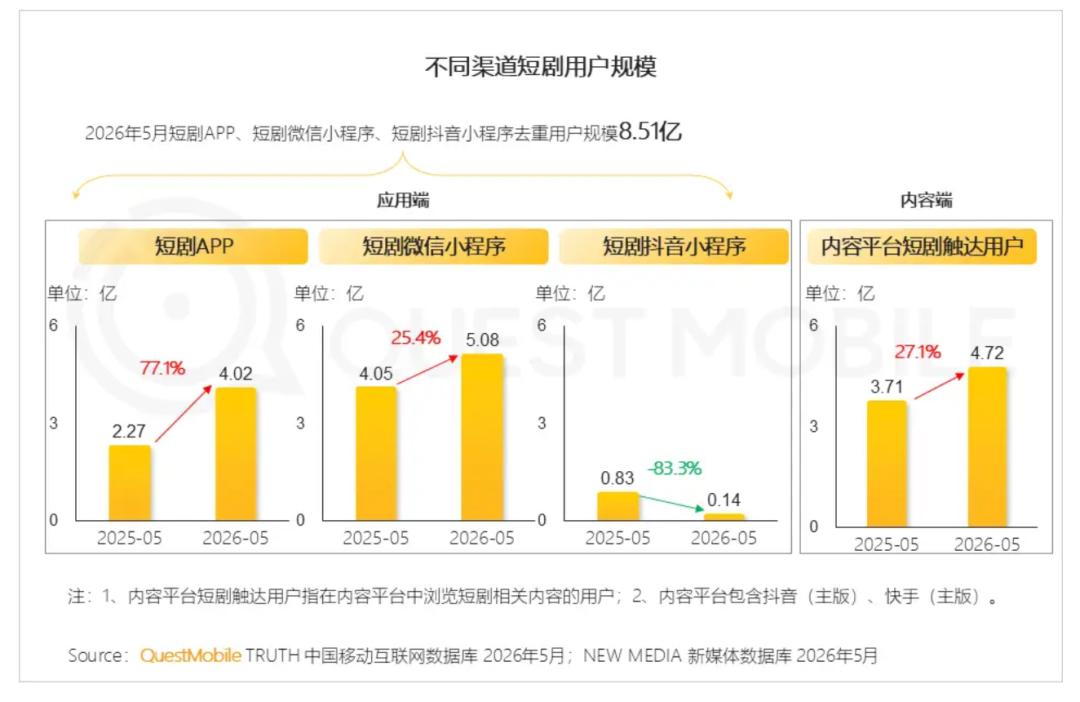
Overall, the top APP Hongguo attracts the "users who watch short dramas the longest", WeChat mini-programs attract "users who are unwilling to download a separate APP and prefer to open short dramas with one click", and mid-tier short drama APPs are stuck in the middle, facing pressure from both sides.
Behind the Monthly Rotation of Mid-tier Short Drama APPs
It is not difficult to find by sorting out QuestMobile's short drama MAU data that, except for the stable performance of head platforms, the rankings of mid-tier platforms rotate on a monthly basis. Most platforms have large MAU fluctuations and divergent growth rates, and the overall industry update frequency is very high.
Take Hippo Theater as an example. After its MAU reached 51.58 million in September last year, its growth stalled, and its decline accelerated after free manhua drama platforms started to grow. In February 2026, it still ranked second with an MAU of 39.283 million (down 1.5% year on year); by May, it was overtaken by Hongguo Free Manhua Drama and ranked third; according to the data in September, its MAU was 30.8 million (down 40.3% year on year), ranking third in the APP ranking, and its MAU was lower than the MAU of the 10th place on the WeChat short drama mini-program list.
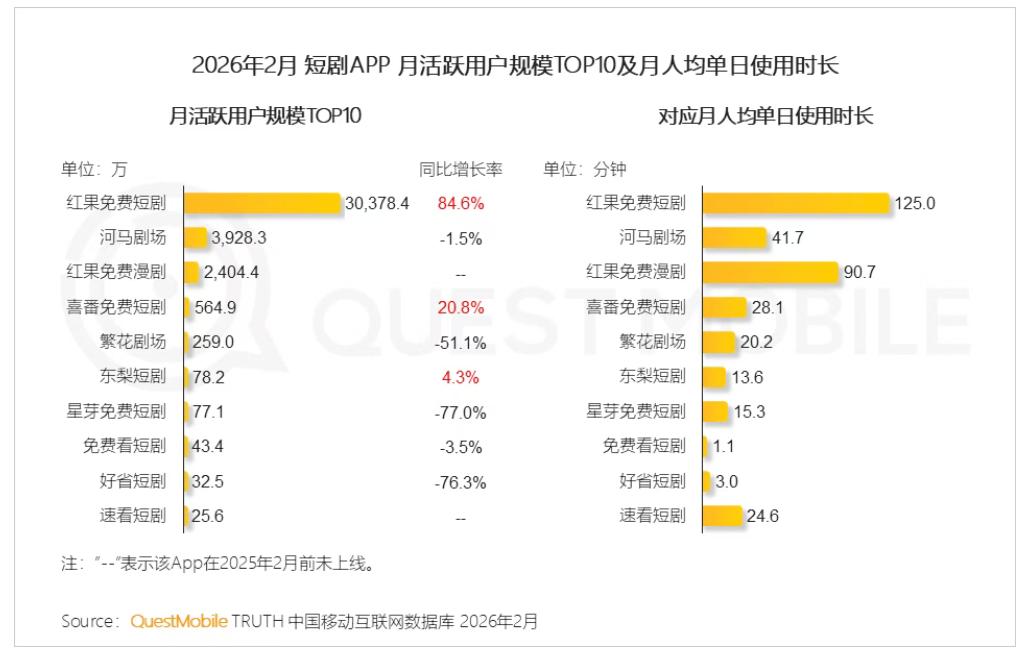
Take Xifan Free Short Drama as another example. In February 2026, its MAU reached 5.649 million (up 20.8% year on year), ranking fourth; by May, its MAU rose to 11.018 million (up 152.9% year on year), remaining in the same position; by September, its MAU dropped to 8.34 million (up 123.9% year on year), falling to fifth place.
Dongli Short Drama under Jiuzhou Group is in a more difficult situation. In February 2026, its MAU was only 782,000, ranking seventh; in May, its MAU rose to 8.89 million (up 6509.8% year on year), ranking sixth; by September, it had dropped out of the TOP10 list.
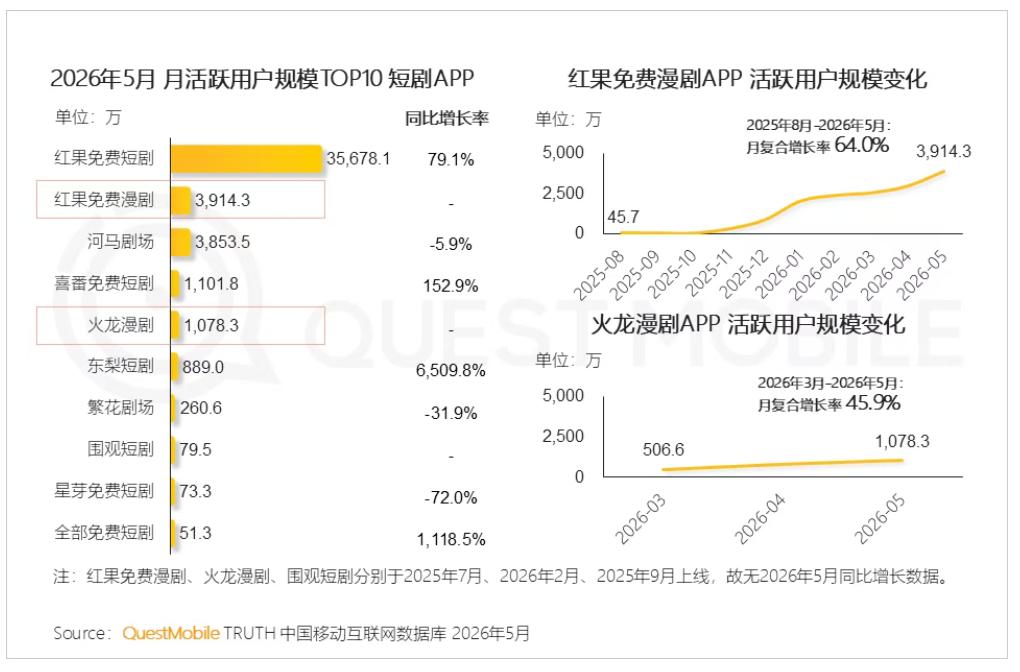
The monthly rotation of MAU rankings of mid-tier APPs seemingly reflects fierce industry competition where players are catching up with each other, but the deeper reason is that all platforms lack their own independent traffic pools and differentiated competitive barriers. They are all competing for users from the same user pool, relying on paid traffic investment or a single hit drama to attract users. When they increase investment in that month or bet on a hit work, their MAU will surge in the short term and their ranking will rise; once the investment is reduced and the popularity of the hit drama fades, the data will fall back immediately.
If MAU scale measures the coverage breadth of a platform, the average daily usage duration per user reflects user stickiness. Data shows that in February this year, the average daily usage duration per user of Hippo Theater was about 41.7 minutes, only about one third of that of Hongguo Free Short Drama (125 minutes) in the same period, and also significantly lower than the 90.7 minutes of Hongguo Free Manhua Drama. Head platforms retain users through their content libraries and algorithm ecosystems, and while the user scale of mid-tier platforms is crushed, their user stickiness is also left far behind with a huge gap.
In addition, APPs with MAU of only hundreds of thousands in the September list are in a more awkward situation. For example, Xingya Free Short Drama under the Jiuzhou system has faced rising compliance costs after rectification, with both content supply and growth pace restricted. At the same time, Jiuzhou has focused heavily on overseas expansion and shifted its incremental growth narrative overseas, so Xingya has transformed from a volume-pursuing APP to an existing user pool in the domestic matrix. As for Xiangguo Free Manhua Drama, it has no ecological system support behind it, nor has it found a differentiated positioning. It is more like a "follower" of the Hongguo model. In the current context where the siphoning effect of head players is intensifying, its living space will only become smaller and smaller.
How Can Mid-tier APPs Save Themselves?
The focus of paying attention to mid-tier short drama APPs is not to predict who will become the third strongest player, but to observe the changes of their roles in the industrial pattern.
Mid-tier platforms often act as test fields for vertical themes and emerging content. By observing which vertical content performs well on mid-tier platforms, we can identify which demands have not been fully covered by head players. At the same time, when the rules and preferences of head platforms are transmitted downward, the content selection and business strategies of mid-tier platforms also become a window to observe the changes on the content side.
For example, sweet romance dramas targeting middle-aged and elderly people became a hit in 2024. Hit Douyin works such as *Flash Marriage at 50* and *My Flash Marriage Partner is a Tycoon* targeted the emotional needs of the silver-haired group that had long been ignored by the mainstream market, driving a boom in related content.
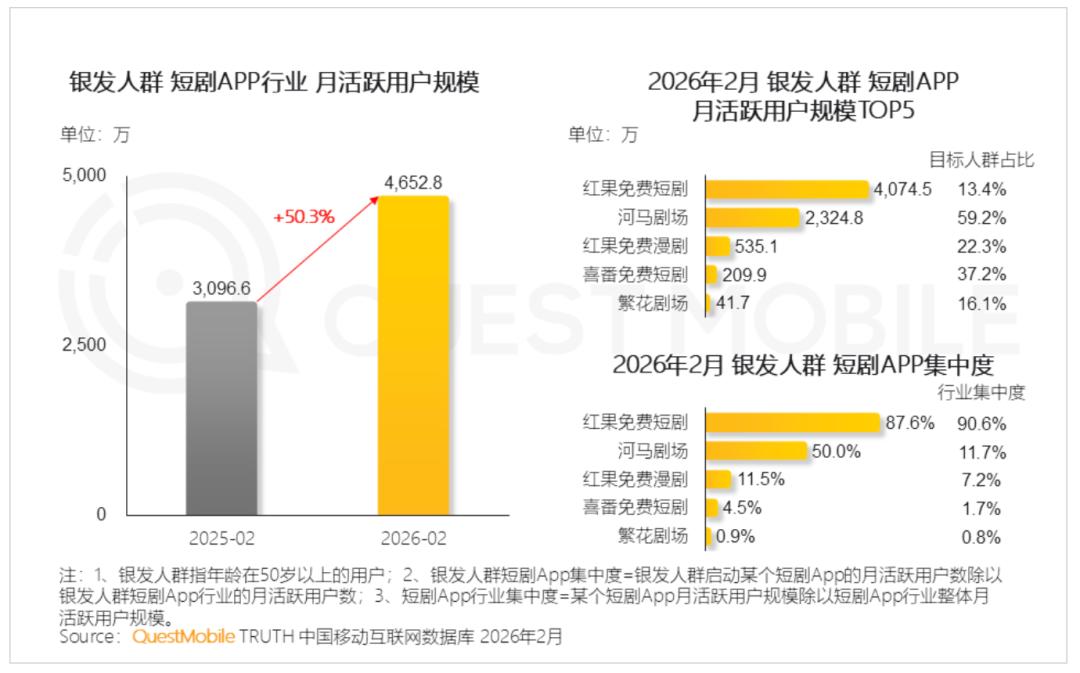
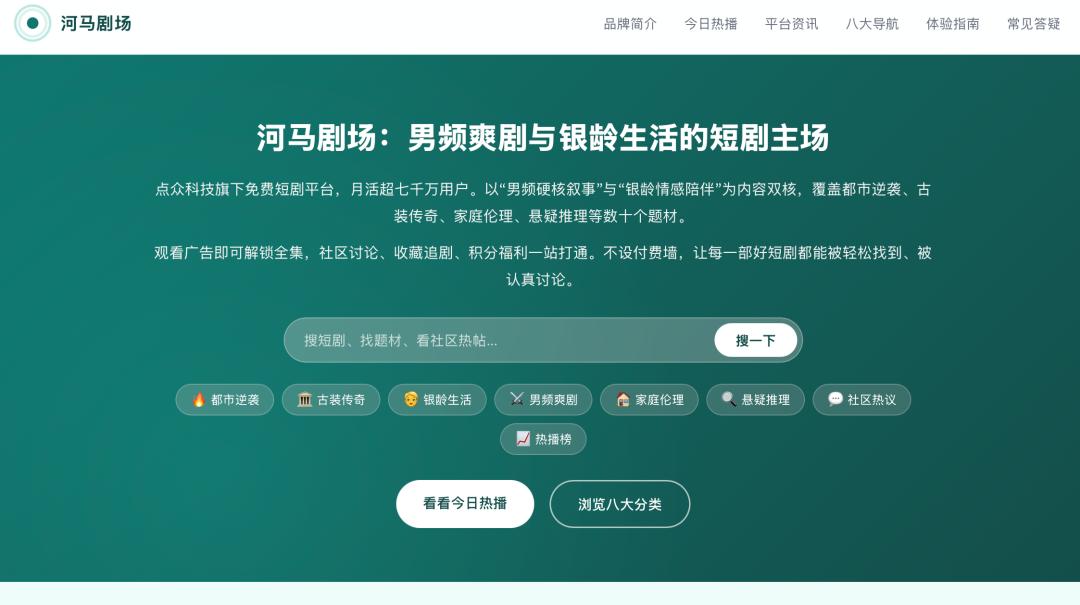
In August 2023, Dianzhong Technology launched Hippo Theater, adopting a free + advertisement business model, with content focusing on male-oriented themes and silver-haired group-oriented themes. According to data, Hippo Theater did seize the silver-haired content boom and retain users. In February 2026, the MAU of short drama APPs among the silver-haired group reached 46.528 million, among which the penetration rate of Hippo Theater among silver-haired short drama users was close to 60%, ranking second in the MAU scale of short drama APPs among the silver-haired group.
Hippo Theater reaped the benefits of themed content, and continuously launched diverse silver-haired works covering retirement life, intergenerational communication and other themes. But unfortunately, compared with ByteDance and Kuaishou systems, it lacks well-known IPs and distribution barriers. The high production and paid traffic costs erode its revenue, making it difficult to support long-term layout. In addition, the usage behaviors of the middle-aged and elderly group on short drama APPs are scattered, leading to a decline in MAU, and the gap between it and Hongguo is getting wider and wider.
In April this year, Dianzhong Technology, together with Hippo Theater and DramaBox, launched the "Double 1 Billion" AIGC Global Co-creation Project, investing 2 billion yuan in three links: script creation, copyright procurement, and production, opening authorization for 80,000 existing novel IPs, and holding the "Hippo Cup" College Student Micro Short Drama Competition to reserve talents. In August, Dianzhong announced that 4 of its AI partners had their revenue sharing exceeding 1 million yuan.
Fanhua Theater, which also belongs to Dianzhong, its controversies reflect the collective dilemma of mid-tier paid APPs. In October this year, Fanhua Theater was exposed to using a 6-yuan trial package to attract users, then automatically deducting 29 yuan per week without users' knowledge, and was accused of "exploiting elderly users".
When Hongguo reshapes users' consumption habits with the free model, the living space of paid APPs is sharply compressed. They face two choices: either transform to the free model, but bear the cost of restructuring the revenue structure; or focus on monetizing existing users, on the premise of upgrading content to maintain users' willingness to pay. The controversy of Fanhua Theater is a proof that the latter strategy went astray.
Huolong Manhua Drama and Hongguo Manhua Drama are in the same track, so it is inevitable to compare them. It was launched only in February this year, and its Android version was renamed "Huolong Free