Getting a head start over DeepSeek, have Chinese talents in Silicon Valley developed the next-generation Agent Harness?
No path is solitary.
The DeepSeek team's newly proposed Super-agent and its underlying philosophy have sparked widespread heated discussions immediately after release.
Amid this widespread buzz, the earlier achievements of a Silicon Valley Chinese team have finally begun to be truly understood by the public.
This cross-ocean technical resonance essentially points to the same underlying dilemma of human-machine collaboration —
At present, human beings are becoming the bottleneck of AI.
Just imagine: AI can simultaneously push forward 1000, 10000, even 100000 tasks, far exceeding the number that humans can track. What form should the Agent evolve into under such circumstances?
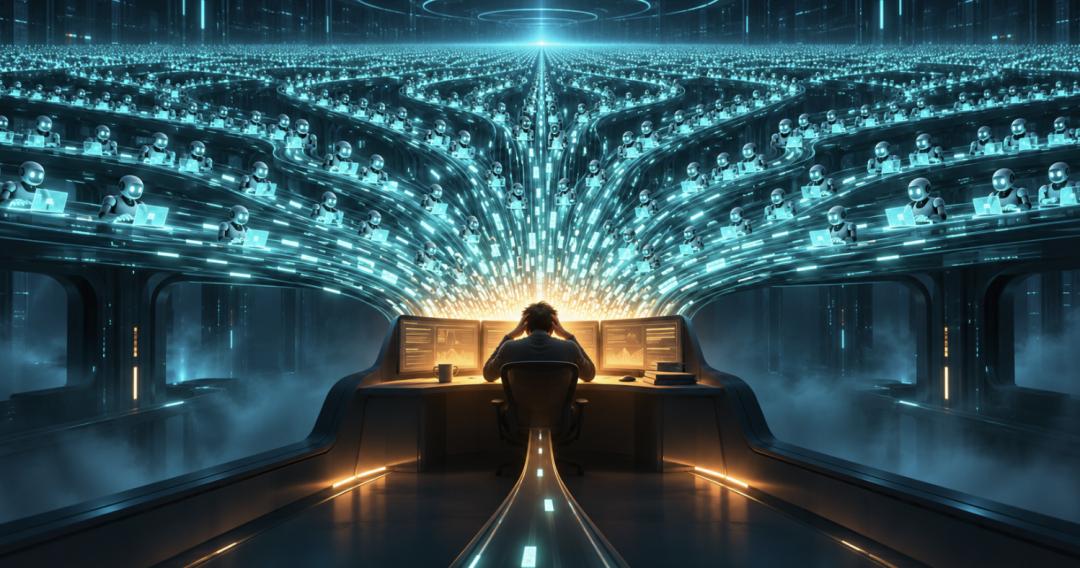
Generated by AI
A few days ago, the DeepSeek Harness team released a landmark paper, putting forward the architecture vision of the next-generation Super-agent to solve this exact pain point:
A super intelligent agent with continuous context, capable of independently scheduling multiple Agents to work in parallel, and even staying online 7×24 hours.
It liberates humans' limited attention, lets Agents take over massive tasks and manage themselves autonomously.
The reality is so surprisingly magical that many people don't know: on the other side of the ocean, a Silicon Valley Chinese team named AFK AI —
As early as the beginning of this year, they had already implemented the underlying Super-agent architecture of "single Router + multiple Workers" and its four core features into their own product Comma.
They even went a step further, directly tackling the context curse after a single Session takes over all operations, enabling the Agent to have long-term memory, continuous learning capability and stay online all the time:
What is more worth mentioning is that this system is already publicly available, and even the code is open source.
In this era where everyone is shouting for Personal Agent, a Silicon Valley Chinese team has brought the "Jarvis" from sci-fi movies into reality ahead of time.
Long plagued by single Session limitations, two Agent players reached a consensus by coincidence
I believe everyone is familiar with these dramatic and headache-inducing learning and work scenarios —
You are asking AI to modify a piece of code, and the test will take more than ten minutes to finish, what a bummer...
At this moment, the client suddenly puts forward a new requirement, urging you to produce a project plan as soon as possible. You open another AI session window and start assigning tasks again.
Unfortunately, your boss makes a surprise check and asks about yesterday's project progress in the work group, you are totally in a rush!
So you keep switching windows frantically, rummaging through historical conversations, and when you look back, there are full-screen Agent sessions and countless pending tasks, you are really overwhelmed.

This awkward scenario points exactly to the core pain point mentioned by the DeepSeek Harness team in their Super-agent paper —
According to the team's observation, the attention of ordinary people can usually only track 3 to 5 active Sessions at the same time.
It is not that the Agent does not have enough capabilities, the key reason is that the concurrency capability of Agents can expand infinitely, but human attention has a hard "upper limit".
The breakthrough idea of Super-agent is very straightforward: simply outsource human attention directly, and let Agents manage other Agents.
In this regard, they also put forward four standards for Super-agent — continuous, efficient, proactive, and persistent.
Continuity means the connection of memory and context, efficiency comes from the parallel collaboration of multiple Workers, proactivity represents autonomous task advancement, and persistence supports long-term online operation and autonomous repair.
Users only need one conversation entry, let the main Agent schedule multiple Agents to process massive amounts of information in parallel and track tasks across scenarios, and humans are only responsible for top-level decision-making:
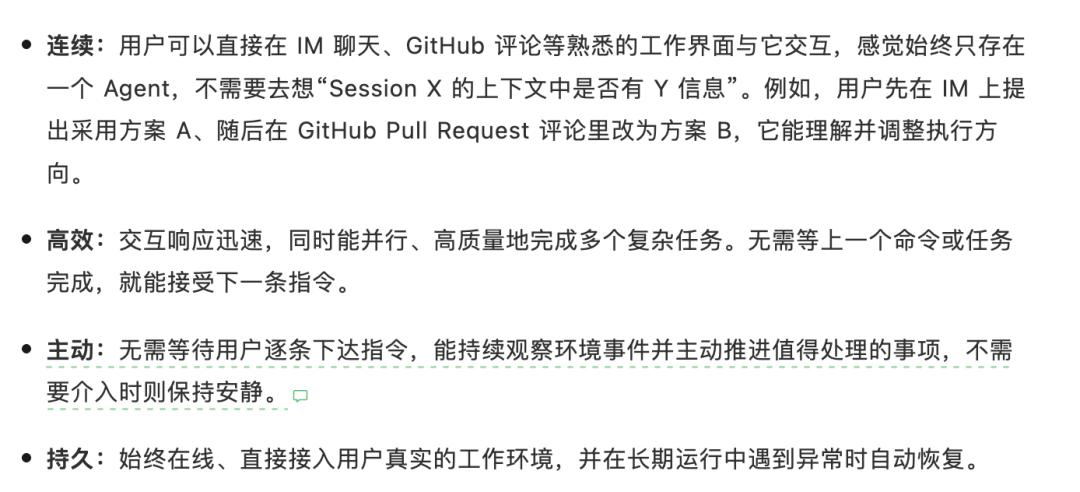
The judgment put forward by DeepSeek Harness a few days ago shocked the whole industry, but what is even more exciting is —
The next-generation Agent blueprint depicted by DeepSeek has already been implemented by the Silicon Valley Chinese team AFK AI half a year ago, in the form of Comma.
The team even put forward a very forward-looking concept: One team, one conversation.
Users only need to face one long-existing main conversation, where the Router coordinates tasks and schedules Workers with independent contexts to execute in parallel.
In terms of underlying architecture, the two Agent players have reached a very tacit consensus: single Session + Router (main brain) + multiple Workers (executors).
The resident Router receives instructions uniformly and coordinates the overall situation, and multiple Workers work in parallel in independent contexts and report results.
Even if dozens of Agents are working at the same time in the background, users only need to assign tasks and check results in one dialog box, no need to switch windows all over the screen and urge progress one by one.
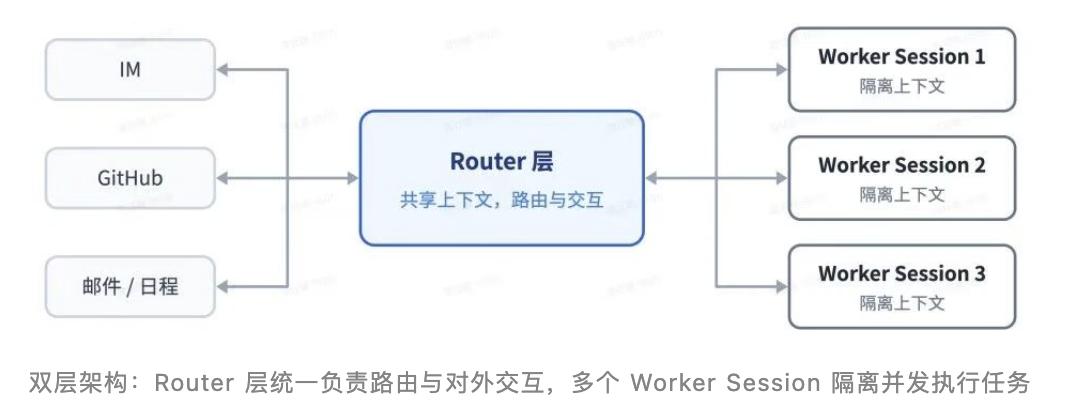
Of course, new problems also arise. When Agents start to take over human attention, a more tricky problem emerges —
Who will manage the Agent's own memory?
You know, a Session has more and more things to take care of, and the context window has an upper limit after all.
When a long-existing Session takes over more and more work, the problem of human attention is solved, but the memory bottleneck of the Agent itself appears.
The really hard nut to crack is to let the Agent have a system that can continuously learn, stay online for a long time, and retrieve key memories at any time.
And this precisely touches on the deeper technical proposition of Super-agent:
A personal Agent that is ubiquitous, always online like Jarvis, and can even continuously accumulate experience in long-term work.
This vision for future Agents has actually been integrated into Comma, turning into practical experiences that every user can feel personally.
From architectural consensus to product implementation, Super-agent has entered real products
Continuity and efficiency: One conversation, let the Agent lead the team to work
Let's first talk about "continuity" and "efficiency".
As mentioned earlier, a major architectural feature of Super-agent is to let the resident Router coordinate the overall situation, and multiple Workers with isolated contexts execute tasks in parallel.
Key point! This emphasizes not only multi-task execution in a single session, but also cross-environment execution, understanding and responding to changes in user intentions, and so on.
This seemingly ideal interaction method has now become a solid product experience in Comma.
For ordinary users, the most satisfying point for me personally is: Finally, there is no need to "create group chats" for Agents, set their personas, and assign tasks one by one every day.
One task per dialog box, queued task execution, repeated pasting of background materials, all of these can be discarded!

Recently I have been addicted to the game Overcooked, but I still feel it is not fun enough, so I got a sudden idea: directly ask Comma to make a custom version for me.
But the problem is, I still have a weekly report review to finish, and the task of sorting out recent AI model release information, plus many other pending items.
In the past, at this time I would have to open three Agent sessions at once, explain the background separately, assign tasks, and track progress one by one.
This time I simply took a shortcut, stayed in the same dialog box of Comma, and threw all three tasks into it at once.
The result really shocked me — the three tasks were assigned to different Workers.
The three Agents started working at the same time without interfering with each other, I could even interject at any time to add new tasks temporarily, and the background was still running at full capacity, there was no delay at all.
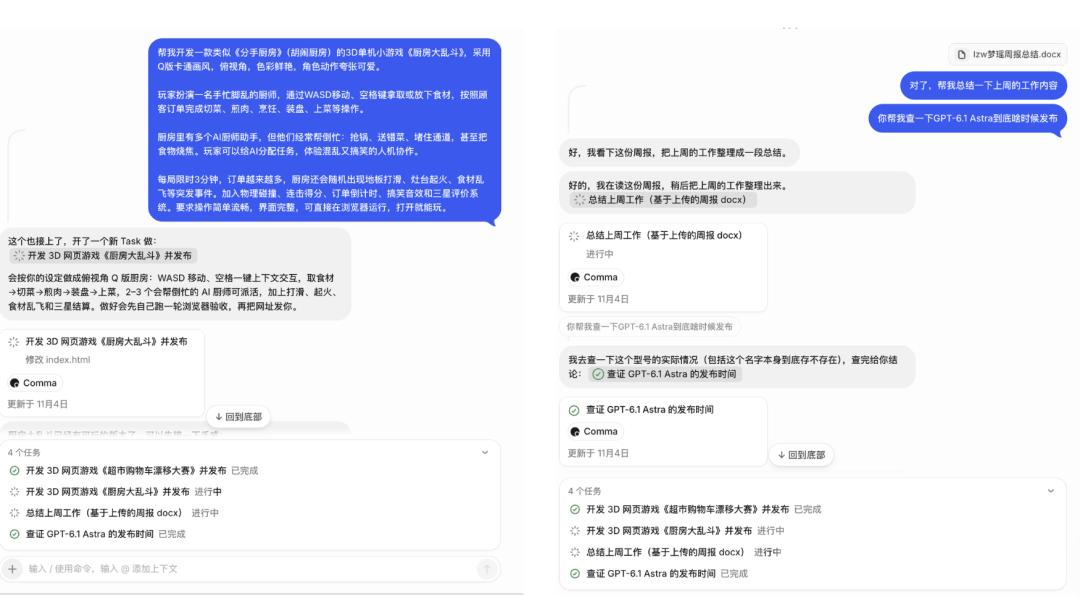
Of course, it is not enough to see the busy background, the final results speak for themselves!
You can directly check the handcrafted version of Overcooked that Comma made for me in ten minutes.
WASD movement, 3-minute countdown, grabbing pots, delivering wrong dishes, blocking passages... all the required gameplay features are implemented, fully 1:1 restoring my requirements:
At the same time, the other weekly report review was also freshly completed, the work content was sorted out in an orderly manner, key progress and follow-up arrangements were well organized, which is pretty good:
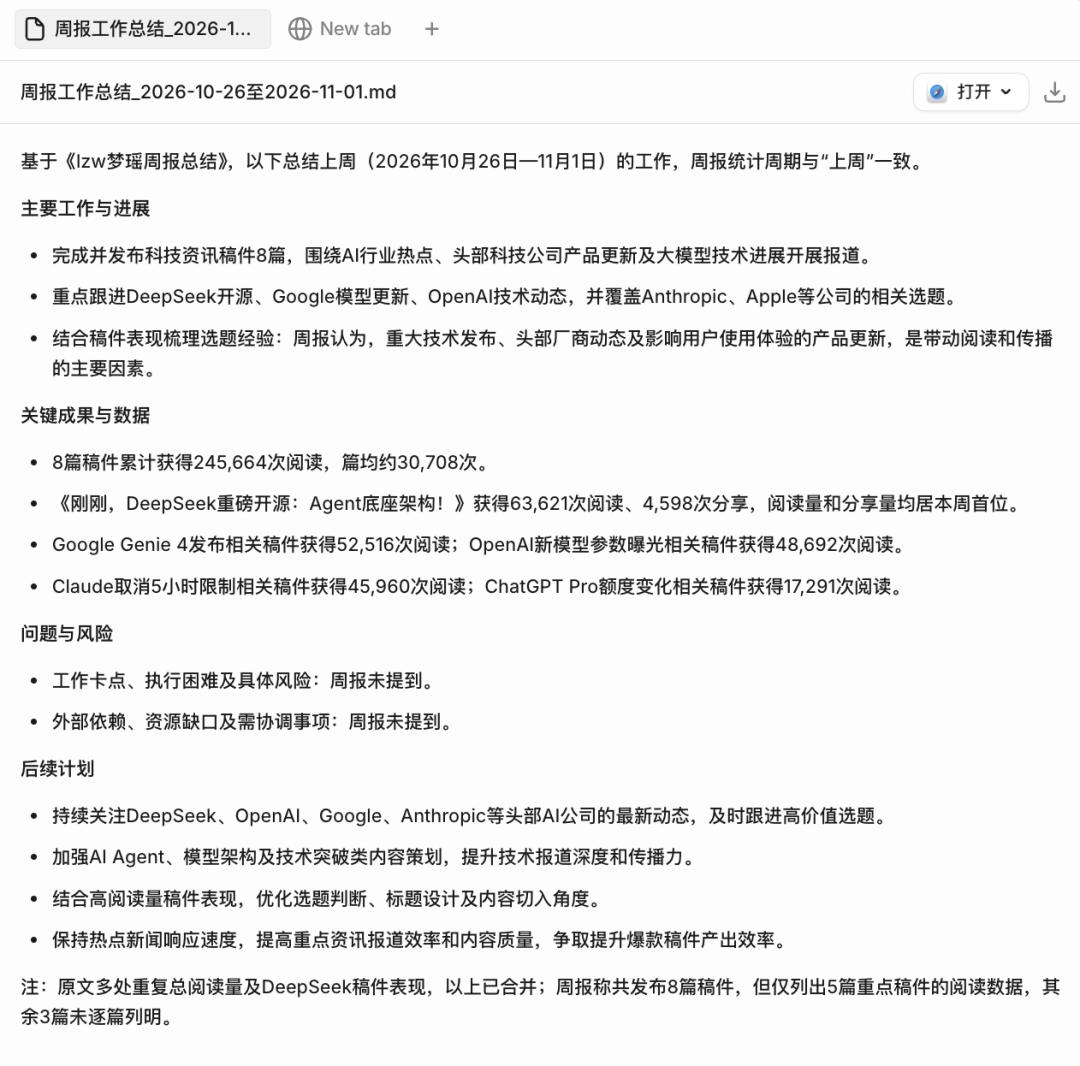
Throughout the whole process, I only need to put forward requirements, check progress, and accept the results.
Comma takes over all the background task assignment, parallel execution and status aggregation, I don't need to intervene at all.
This is the first time I truly feel that humans have finally freed themselves from multi-task scheduling and attention allocation.
Managing Agents has finally changed from "tracking the process" to "controlling the results".
Cross-environment: Accept, assign and complete tasks across Apps, one-stop service
However, being able to work simultaneously in one dialog box is only the first half of the journey.
The real test for Super-agent is whether it can continue to work after the user's task leaves this dialog box.
This is exactly the higher requirement that Super-agent puts forward for "continuity": cross-environment capability.
In the architecture proposed by DeepSeek, this relies on the underlying multi-channel interaction mechanism —
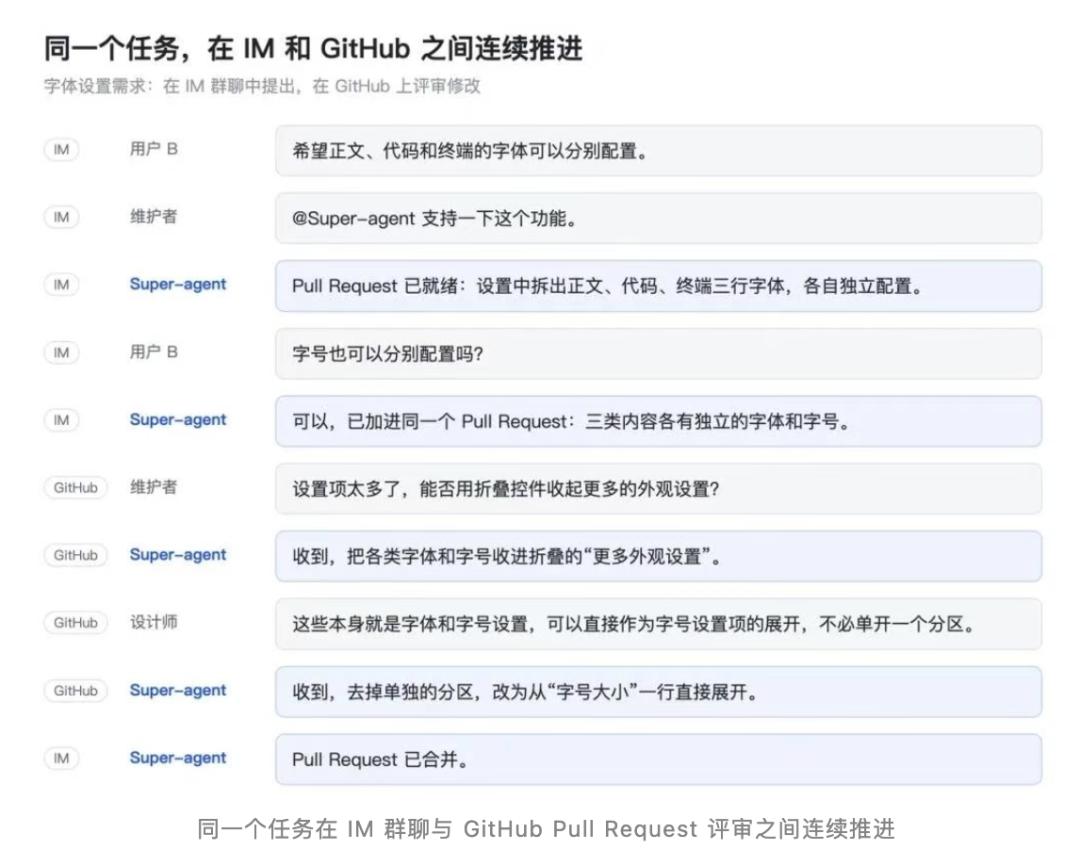
The Router uniformly receives messages from different platforms, Workers execute independently in the background, and then return results according to the interaction habits of different channels.
An official example they gave is that the same development task can be seamlessly advanced across IM and GitHub, AI can actively monitor group chats and automatically submit PR, just like:
It is worth mentioning that in Comma, this efficient and continuous "cross-environment" capability has long been made into a user-perceivable experience —
It is backed by the team's self-developed distributed Agent runtime framework Salix.
Through third-party application connectors, it can receive events from different platforms, and then a programmable Loop keeps monitoring, waking up the Agent to process when needed.
Moreover, the scope that Comma connects to is quite wide, we can access communication channels such as WeChat, Signal, iMessage, Linear ~
Not only that, Comma also supports secure self-deployment, BYOK and access to Codex, Claude Code, to supervise tasks uniformly and manage cross-end collaboration.
Even in corporate scenarios, you can assign tasks through the Comma Bot in IM, let the connected employee computers provide the required local working environment, and restrict the access scope through permission and information flow control.
Since I have too many manuscripts to handle recently, I also connected Comma to Linear, and directly issued project requirements to Linear in Comma:
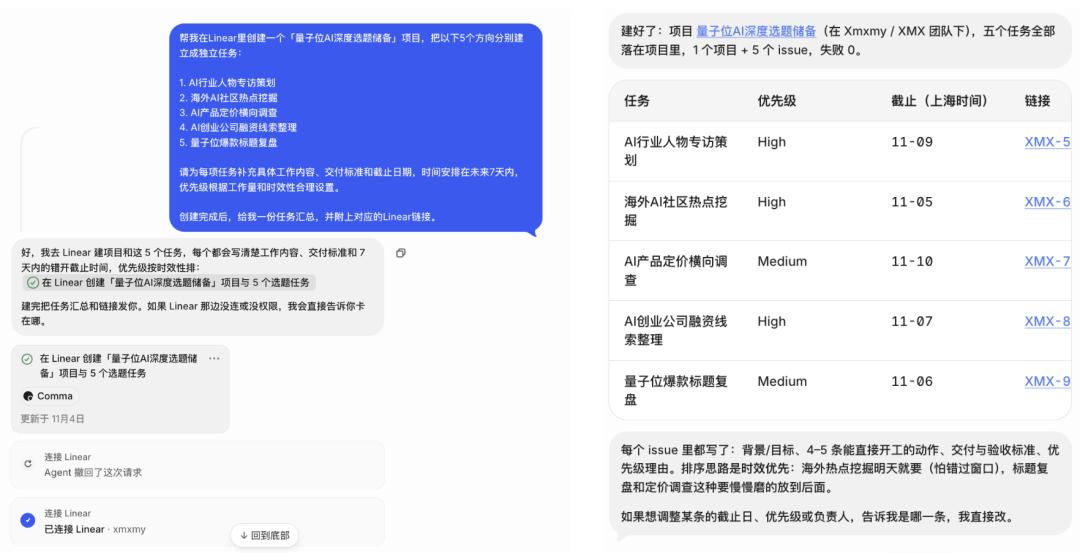
When I opened Linear, I found that the Issue had already been created, the specific tasks to be split and the follow-up work arrangements were all clearly arranged for me:
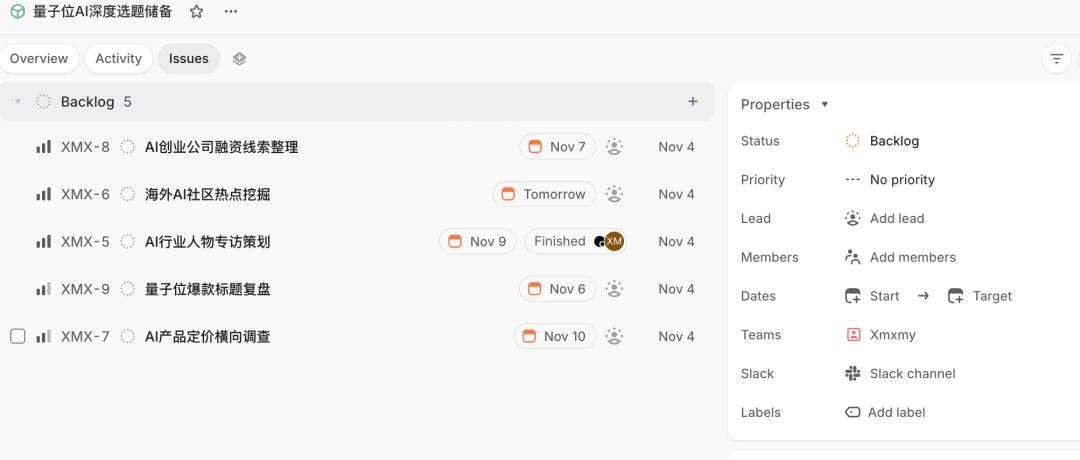
But what I really want to emphasize is that the Issue in Linear can in turn be handed over to Comma for execution, and the progress and results will be synchronized back to the original task!
The tasks assigned in Comma can be received by Linear, and the tasks in Linear can also be continued by Comma, the information granularity on both sides is always aligned.
Tasks can be relayed between different platforms. Now, we finally don't have to run around following various platforms and Agents, it is recommended that large factories learn from this: