Why is finding a good domestic helper just like opening a blind box?
"A truly great domestic helper—are they even circulating on the open market at all?" This sharp outburst came from Lin Xiao after she tried 11 different domestic helpers over two months.
She could not wrap her head around why all these helpers had increasingly higher ratings on the platform, yet their actual performance was more and more frustrating, leaving her speechless.
Helper No.1, who claimed to be a "gold-medal helper", did not wear shoe covers when entering the house, did very little work, and immediately started pushing customers hard to buy membership cards. Helper No.2, who was said to cook incredibly well, had unrivaled cooking skills but was always late and left early for various reasons. Helper No.3, who worked nimbly, was a total "snoop" that kept prying into every detail of the family, asking about their jobs, income, and relationship between mothers-in-law and daughters-in-law while wiping the table. When she finally met a satisfying No.4 helper, the person vanished completely after finishing one job, and even the agency could not get in touch with her. As for No.5 helper, it was obvious that she treated people differently based on their status...
Left with no other choice, Lin Xiao had to ask her relatives and friends for recommendations. A relative strongly recommended Aunt Wang, saying that they had booked regular recurring services from her for three years, and she was almost like a beloved family member.
Aunt Wang was indeed extremely warm and enthusiastic. When Lin Xiao was having a work call at home, Aunt Wang would push the door open directly to send her fruit. When Lin Xiao left a half-read contract on the table, Aunt Wang took it for waste paper and threw it away conveniently. In the home of the elderly who love liveliness, she would be a thoughtful "treasure", but in Lin Xiao's home, these behaviors became overstepping "landmines".
The great helper that worked perfectly for other families did not fit her situation at all. Lin Xiao even began to doubt herself, "Is it that my requirements are too high?"
Lin Xiao's problem is not an isolated case. Discussions about "how hard it is to find a great domestic helper" keep popping up on social media: "Why do all helpers use the same line that they have endless work to do?" "Why do helpers get more and more perfunctory as they work longer?" "I paid for a house cleaner, but ended up getting a 'nagging mom' who criticized me nonstop"...
If you dig deeper, you will find that there seems to be no standard answer to "what makes a great domestic helper". Some people think that a great helper is someone who does not talk unnecessarily and finishes all the work quietly. Others hold the exact opposite view, believing that a great helper should be able to chat with the elderly and be as thoughtful as a family member...
There are two reasons why there is no universal standard for a great domestic helper:
First, very few institutions in the industry are serious about building standardized service systems. What capabilities should a great domestic helper have? What exactly is the professional competence of a great domestic helper? When helpers want to improve their skills, can institutions provide them with clear guidance and training? How to clean dead corners? To what extent should items be organized? Where is the boundary for caregiving work? What is the appropriate level of communication... Very few institutions can break down these requirements clearly and provide targeted training. Therefore, most of the time, employers choose helpers blindly based on "first impressions", and agencies recommend helpers blindly based on "feelings".
Second, every family has very different requirements for a great helper, and standards vary from person to person. Some people rank quietness as the top priority, while others value good communication skills most. Some people are most afraid of helpers touching their personal belongings, while others hate helpers who are oblivious to uncompleted work. The same caring remark may sound warm to one customer, but feel like an overstep to another. The same nimble work style may be seen as high efficiency in one family, but recklessness in another.
That is why finding a great helper is so difficult. The challenge lies not only in how the industry can cultivate more great helpers, but also in how to better identify and effectively match suitable helpers to families.
The "excellence" of a great domestic helper lies in two evaluation systems: explicit and implicit
In the current market, the great helpers that most people are looking for are no longer live-in nannies. Today, domestic work positions are becoming more and more specialized, with professional cleaners, cooking specialists, organizing specialists, and many other roles. The more refined the division of labor, the more specific the requirements for "excellence".
Through a series of interviews, we found that two evaluation systems run in parallel for great domestic helpers: one is the explicit standard, which mainly refers to basic professional work competence, and the other is implicit demand, which mainly refers to interpersonal matching degree.
When listing their requirements for a helper, the first things that most families think of and are most willing to state out loud are mostly explicit indicators such as cleaning and cooking. But what really determines whether a domestic service relationship can last or suddenly break down are often those soft dimensions that are hard to articulate at the beginning and difficult to assess during interviews. People think they are looking for a worker, but in the end they find that the hardest part to match is the sense of propriety, emotional resilience, and respect for family boundaries. The latter items are usually not written into requirement lists, but they directly determine whether the helper will be rehired or booked for recurring regular services.
Professional Work Competence: Visible, verifiable basic work skills
Professional work competence is a very clear and fundamental demand of users. According to JD's research, for the typical traits of a great domestic helper, 80% of people have clear professional competence requirements: cleaning must be thorough, organizing must be logical, and items must be put back in order. This is the bottom line, which sounds very simple, but there is a clear gap in professional competence between "finishing the work" and "doing the work well".
"I can tell at a glance if the floor is mopped clean just by looking at the mop," said Fang Yizhen, a professional cleaner with JD Home Services. "Amateurs mop the floor in circles, but professional cleaners use an S-shaped mopping path, keeping the mop on the ground the whole time. In this way, only one side of the mop gets dirty after mopping, all the dirt is trapped in the bottom of the mop cloth, and no dirt will be flung to the corners of the wall."
Mopping the floor in an S-shape and keeping the mop on the ground are not magical moves in themselves, but they turn the old "experience-based work" that used to rely on personal understanding and habits into standardized "method-based work" that can be followed systematically.
Apart from these established standard moves, Aunt Fang also demonstrates professional competence through critical thinking and judgment. When she was training new apprentices, she found that when an apprentice followed only the basic workflow for a large house, they could not finish the work in three hours, but she could easily finish the same amount of work within the same time frame. Occasionally when an apprentice took over her shift, customers would feedback to Aunt Fang: "Sister Fang, how do you get all this work done? No one else can finish it as well as you."
The difference does not lie in working speed, but in work planning. The apprentice is not slow, but "does not know where to spend 10 minutes, and where to put in extra effort". When Aunt Fang arrives at a new house, she first observes the whole space, makes judgments, and then allocates her time. Time planning is never a mechanical distribution of duration against a standard checklist, but is completed within the first 3 minutes of entering the house.
"This comes from experience. A quick glance around the house when you enter is actually a 'work allocation diagnosis'. Many new cleaners are not unprofessional, they can perform all the required standard moves very well, they just haven't developed the judgment to flexibly adapt to different households," Aunt Fang explained.
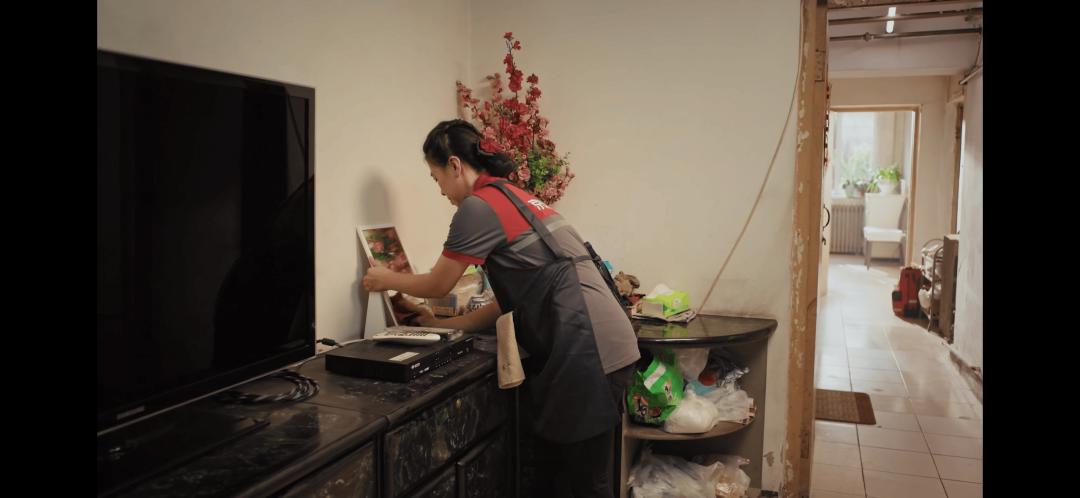
Many people think domestic cleaning is just "physical labor", but real professional competence means spending every minute of work on the areas that customers care most about, doing no unnecessary work, and never missing core requirements.
Eventually all actions point to the same result: stable and predictable service quality. No matter if Aunt Fang goes to the house herself, or her apprentice follows the method of "observe first, allocate time, then execute according to the plan", the cleaning effect and completion duration can steadily meet customer expectations. This no longer depends on personal skills or daily status, but becomes a set of visible, tangible basic work skills that can be verified during the service process.
This is the most practical value of professional competence training: standardized actions and skills can set a definite bottom line for service results - no need to supervise the work on site, no need to remind repeatedly, as long as the standard actions are completed properly, the final delivery result will be good. On this basis, further skill improvements can help achieve even better service standards.
Implicit Standards: Invisible, but determine whether long-term cooperation is possible
People's expectations for a great domestic helper do include implicit demands, but they often do not consciously describe them clearly. Facing these vague demands, most domestic service platforms only focus on facilitating transactions, and stop providing support once the helper is sent to the customer's home. But JD has gone a step further: it not only digs out these implicit demands, but also systematically teaches these soft skills to domestic helpers in their daily training, turning "intangible" demands into "tangible" services.
According to JD's research, the core implicit demands for great domestic helpers focus on boundaries, problem-solving skills, emotional stability and other aspects.
Among these traits, a strong sense of boundary is the most frequently mentioned. 75.8% of consumers believe that "having a sense of boundary, not disturbing employers unnecessarily, not inquiring about or participating in family topics at will, not judging the employer's family affairs, and not treating themselves as a 'family member'" is a very typical implicit requirement.
Li Qin, a professional cleaner with JD Home Services, admitted that among the families she served including lawyers, police officers and judges, the biggest concern is not whether the floor is shiny enough, but the conscious protection of privacy.
"Only do the work assigned to you, never ask too many questions." Do not go to areas you are not supposed to enter after entering the house, do not rummage through things you are not supposed to touch, and do not take the initiative to inquire about things that customers do not mention. A sense of boundary is not indifference, but being clear about what you are here to do, and what you should not do.
Sociologist Su Yihui put forward the concept of "boundary negotiation" when studying domestic service practitioners. This also reminds us that a sense of boundary does not mean working mechanically, but knowing when to advance and when to retreat, and mastering proper propriety. Know when to talk, and when to stay silent; know what to notice, and what to pretend not to see; know that being needed is a sign of trust, but overstepping boundaries is a betrayal of that trust.
Problem-solving ability is also a bonus item that surprises customers. According to the survey, 65.3% of people prefer helpers with "thoughtful attention to details", who can not only complete all tasks on the checklist, but also make the service experience smoother through small thoughtful moves.
One of the important reasons why Aunt Li keeps receiving positive reviews is that she always thinks one step ahead on details. She has been serving one customer for two years. The customer is a young woman who lives alone in a two-bedroom apartment, has a cat, and is always extremely busy. For two years, Aunt Li visits her home once a week. The things she does have long gone far beyond the scope of "cleaning". When the customer was sick, she cooked porridge for her conveniently. After cleaning the kitchen, she is used to checking the condiment cabinet, writing down which bottle of soy sauce has expired and which jar of chili sauce is almost empty on a note, and sticking it on the fridge. None of these things are written on the service checklist, but it is exactly these "extra-list" moves that bring unexpected surprises to the customer.
The competitiveness of a great domestic helper does not lie in "how many tasks they complete", but in "what problems they help others solve". Mopping the floor to a shiny finish is a basic skill; bringing customers a new experience beyond the standard process is the reason why customers remember them.
We tend to simplify the definition of "great domestic helper" into a list of skills. But the checklist only solves the problem of "can the person do the work", not "can the person get along with us". Regular standards are the bottom line, which can be filtered and verified; while a sense of boundary, emotional stability, sense of propriety, and aligned values are hidden implicit dimensions.
When you buy a refrigerator, it does not need to know why you put leftover food on the second shelf. When you buy a mobile phone, it does not need to judge what mood you are in that day. This is the fundamental gap between "hiring a person" and "buying a product". The quality of a product is fixed the moment it leaves the factory; but the quality of service is generated in real time every minute, in your living room, kitchen, and bedroom. It relies on standards, and also on people; it relies on processes, and also on the sense of propriety, observation, and emotional control at that very moment.
That is exactly why there are two evaluation systems for "great domestic helpers": professional work competence is the hard indicator that makes the "excellence" of a great helper obvious; implicit standards are the soft dimension that makes the "excellence" of a great helper bring surprises and expectations to customers. When both systems operate smoothly at the same time, the recognition of a "great domestic helper" will form in the customer's mind, and real trust in the helper will start to build.
Beyond domestic services, moving services are also a "non-standard test"
The non-standard nature of domestic services and the professional competence of service providers also apply to moving services, only in a different scenario.
"When I first started in this industry, I always thought moving was just a physical labor job. As long as you are strong enough and have a sense of responsibility, you can do the job well," Master Wang from JD Moving shared his experience of joining the industry, "but the longer I work, the more I realize this job is far from simple."
Many people have encountered the same dilemma when moving: items get bumped and damaged, boxes are packed in a mess, and all items are scattered all over the place when they arrive at the new home. Customers pay money, but often only get the physical labor of "moving items from point A to point B". How to pack and protect items completely depends on which worker shows up at their door that day.
"Moving is also a professional job." After joining JD, Master Wang gained new insights. For example, for large furniture, you cannot just lift it and go. You need to know how to disassemble and reassemble it, and label and categorize all screws, accessories, and panels to ensure no errors when putting them back together. For fragile items and cabinets with low load-bearing capacity, there are specific rules for how to wrap and protect them. "We also need to receive training and pass certification, we cannot start working just by putting on a work uniform. Movers cannot only know how to carry items, they also need to know how to disassemble and assemble; packing specialists cannot only know how to pack, they also need to know how to categorize items according to customer needs... We also work as a coordinated team..."
After getting in touch with the 1:1 restoration moving service, Master Wang found that the professional competence of moving service workers is also evolving. To achieve 1:1 restoration, it does not rely on the workers' good memory, but on a physical trace and indexing mechanism of "photos + labels + assessment notes + on-site confirmation".
The assessor visits the house and takes photos of each space clockwise. For a 10-cubic-meter house, there are usually 60 to 80 actual photos taken, including overall space photos, photos from different angles, large items to be moved, and large items that stay in the original house, with nothing missed. After taking photos, the assessor also records assessment notes, such as which piece of furniture has low load-bearing capacity, and which cabinet's contents cannot be rearranged. When the supervisor prints the box labels in the system, these notes will pop up automatically and become "digital construction instructions" for the execution team.
When packing, dozens of boxes are pasted with exclusive labels, marked precisely as "Master Bedroom - Left Side of Wardrobe - Winter Underwear", "Kitchen - Right Side of Countertop - Condiments". When arriving at the new home, the supervisor first "checks the blueprint" with the customer: confirm the position of all assembled large furniture first, verify valuables face to face, and only start moving small items after confirmation. Small items are restored according to the labels just like putting together a jigsaw puzzle.
