The AI sports hardware backed by Li Zexiang and HSG has secured a new round of financing exceeding 100 million yuan, raised millions of US dollars through crowdfunding, and has already shipped tens of thousands of units | Hard Krypton Exclusive
Author|Nan Huang
Editor|Silai Yuan
36Kr has learned that AI sports hardware company "Enhanced Robotics" recently completed a Series B financing of over 100 million yuan, with the investor being Sinovent Capital. The funds from this round will be mainly invested in technological R&D iteration, production capacity upgrading and expansion, market-oriented implementation, and further increase investment in overseas channel construction to build a stable overseas distribution and user service system.
Since its establishment, Enhanced Robotics has successively completed multiple rounds of financing, with the total accumulated financing amount reaching hundreds of millions of yuan. The investor lineup covers resources from the academic and industrial circles, including the XBOTPARK Fund under Professor Li Zexiang, Brizan Ventures under Professor Gao Bingqiang, Hu Yu, co-founder of iFlytek, as well as well-known institutions such as HSG, Xianghe Capital, Sena Capital, Dachen Caizhi, Different Capital, Chenhui Venture Capital, etc.
Enhanced Robotics, founded in 2018, takes robot power, perception and control technologies as its core foundation, focuses on two major tracks: AI intelligent consumer sports and professional sports intelligent training, and has successively launched products such as the T-APEX professional sports performance training system and the Tenniix AI tennis serving robot.
From the perspective of long-term layout, Enhanced Robotics plans to advance along two paths: model and product. On the one hand, it will build a sports physical AI model base that integrates perception, understanding and execution, and continuously improve the machine's judgment and interaction ability for sports scenarios through real sports data and user feedback. On the other hand, it will gradually expand the product matrix of ball games, sports training and sports rehabilitation, and apply the underlying technology to a wider range of sports scenarios.
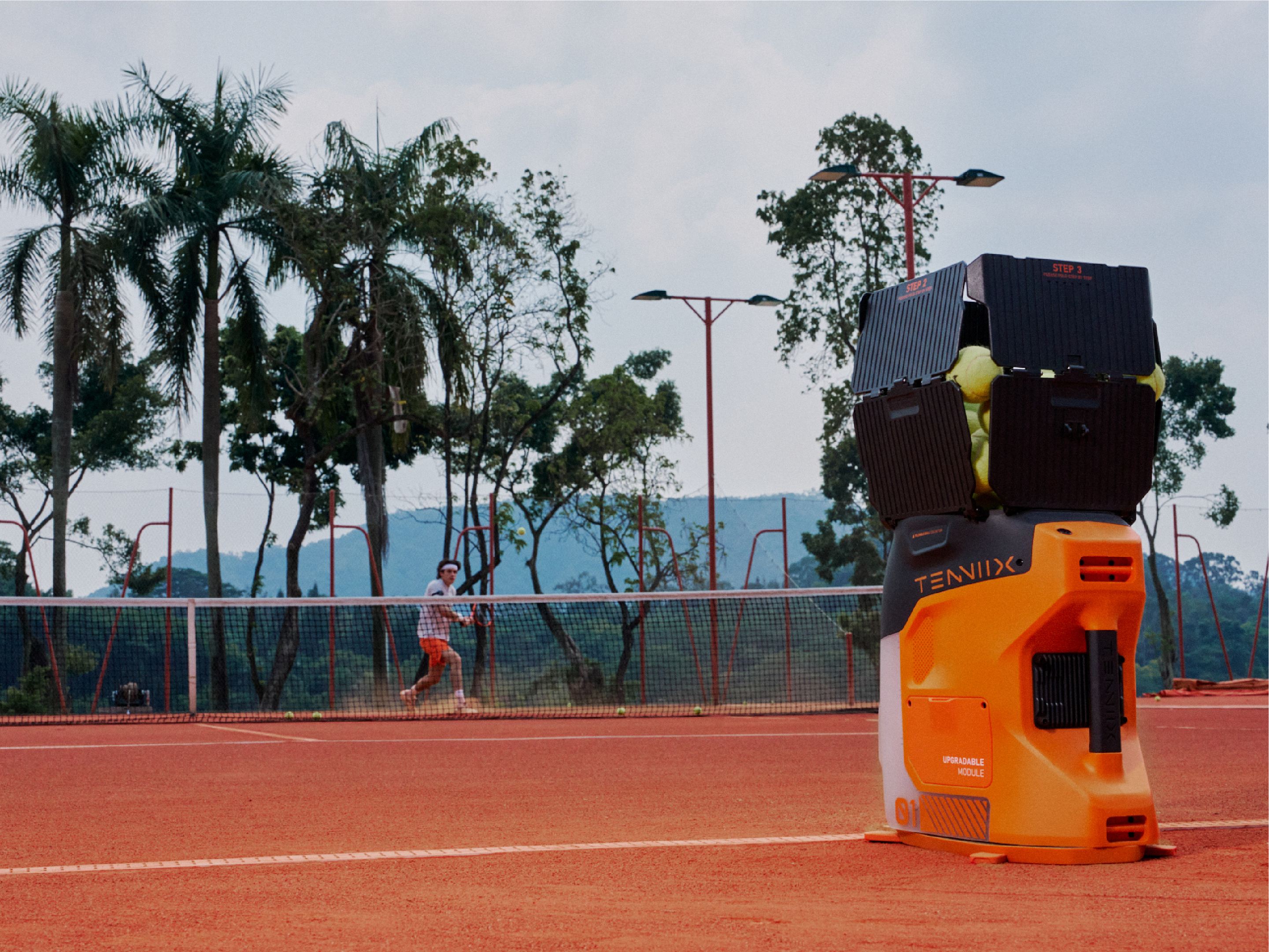
Tenniix S return training (Image source / Enterprise)
Founder Hanqi Zhu holds master's and doctoral degrees from Xi'an Jiaotong University and the University of Texas at Dallas (UTD), studied under Mark W. Spong, a leading authority in control theory. He has profound academic background in motor control and exoskeleton technology, and the consumer-grade power product he once led the design of won the TIME 100 Best Inventions of the Year. The core team brings together algorithm experts from DJI, CloudWhale and SenseTime, as well as manufacturing executives from CATL and Tesla, with complete industrialization experience in the fields of robot power, visual perception and lean manufacturing.
The hundred-billion-yuan sports training market has long faced a supply-demand mismatch of "backward hardware" and "scarce professional guidance". This contradiction is particularly typical in tennis training.
Tennis is a sport that puts extremely high requirements on muscle memory, ball path prediction and dynamic confrontation. The traditional tennis serving machine is essentially a "one-way output device", which mechanically serves balls according to preset parameters. It neither understands the real state of the court, the ball and people, nor can it simulate the confrontation rhythm in actual combat. For users who are eager to improve their performance, fixed landing point feeding can only build a basic feel for the ball, but it is difficult to expose the technical shortcomings of forehand and backhand in real confrontation.
"The core demand of users for purchasing training equipment is to improve their tennis skills, not to buy a toy that can only serve balls at fixed points," Hanqi Zhu, founder and CEO of Enhanced Robotics, told 36Kr. The limitation of traditional equipment lies in the lack of perception and decision-making capabilities. "But real training not only requires ball path output, but also needs to identify users' receiving weaknesses in interaction and give targeted ability improvement strategies."
This is exactly the core entry point of Enhanced Robotics: introducing embodied and multimodal technologies into the tennis court. Its goal is not simply to manufacture a serving machine with higher parameters, but to build a complete intelligent closed-loop system including "Learning (behavior analysis), Coaching (scheme guidance), Benchmark (movement calibration)", so that the machine can understand sports logic and provide practical combat feedback.
The difference in this product capability is rooted in the underlying technology stack of "motion, perception and control" proposed by Enhanced Robotics.
The reason why the high-performance serving machines in the past were bulky is that most of them used traditional direct-drive motors, weighing 20 to 30 kilograms. The team of Enhanced Robotics started with the hardware structure and independently developed a semi-direct-drive motor solution. This reduces the weight of the whole machine by 50% under the same performance, and the Tenniix body can be compressed to 8kg, so users can carry it to the court with one hand.
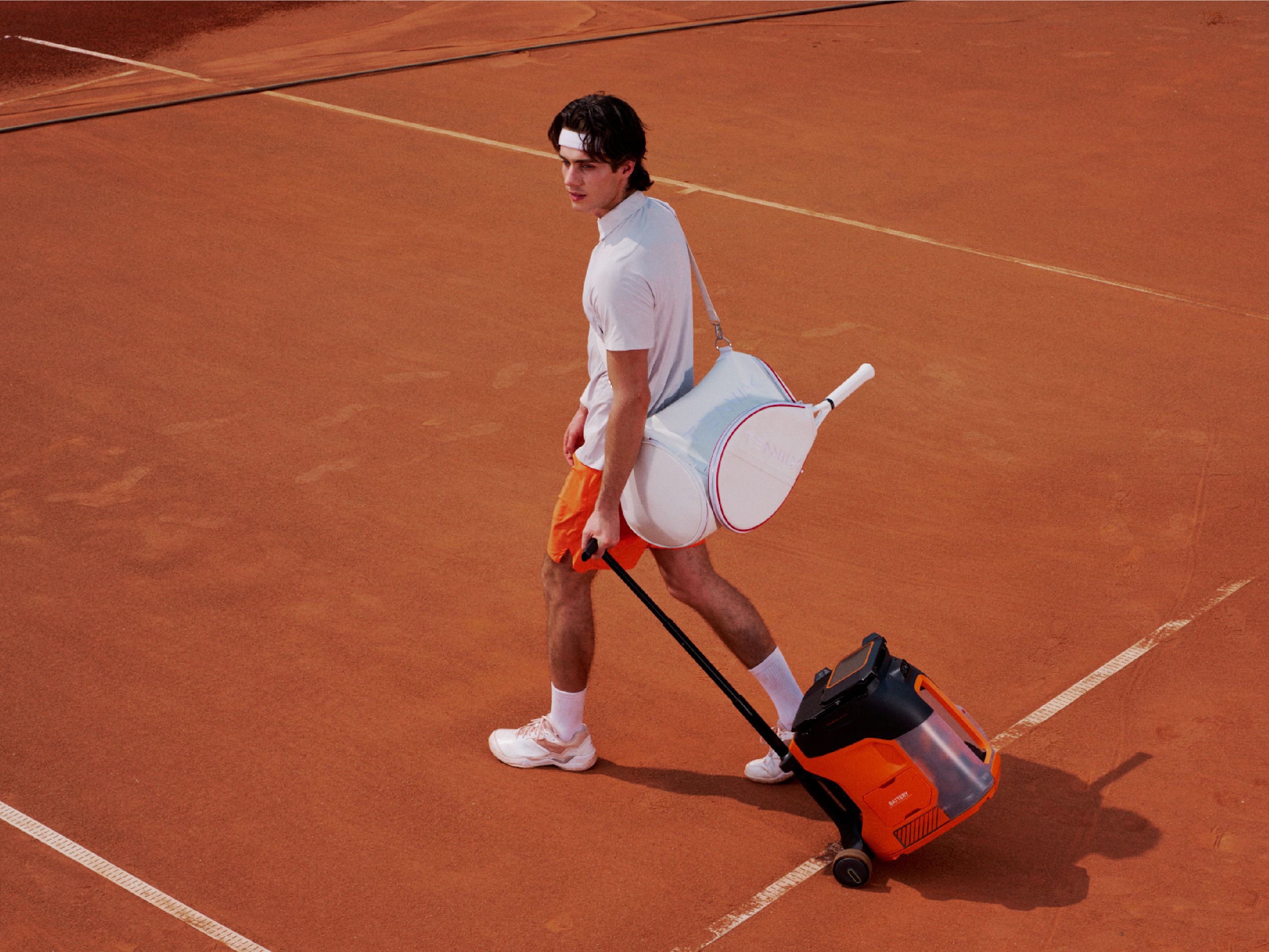
Matching design of accompanying pull rod (Image source / Enterprise)
"We give priority to zero-delay ball speed adjustment and lightweight design. The core threshold of training equipment is not the limit parameters, but whether it can go to the court with users. If it is troublesome to carry and can only be placed in the corner of the stadium, no matter how strong the performance is, it is difficult to be used frequently," said Hanqi Zhu.
At the perception layer, the team did not adopt the conventional binocular vision scheme, but created an integrated architecture of heterogeneous dual cameras with long and short focal lengths plus monocular space reconstruction. Traditional binocular vision relies on the fixed baseline of two parallel lenses for distance measurement. When facing high-speed tennis balls more than 20 meters away, the attenuation of distance measurement accuracy increases exponentially; moreover, the focal length of binocular is fixed, and the wide-angle field of view will inevitably lead to very small distant targets, making it difficult to balance "wide view" and "clear view".
Tenniix realizes division of labor and relay through two lenses. The telephoto end is responsible for "prediction": at the moment when the opponent hits the ball with a backswing on the baseline, the telephoto lens captures the outgoing angle and speed of the ball, establishes a spatial coordinate system combined with the standard geometric size of the court, and predicts the three-dimensional trajectory in advance. The wide-angle end is responsible for "locking": when the ball flies near the half-court, the system quickly switches to the wide-angle perspective for high frame rate tracking and coordinate calibration.
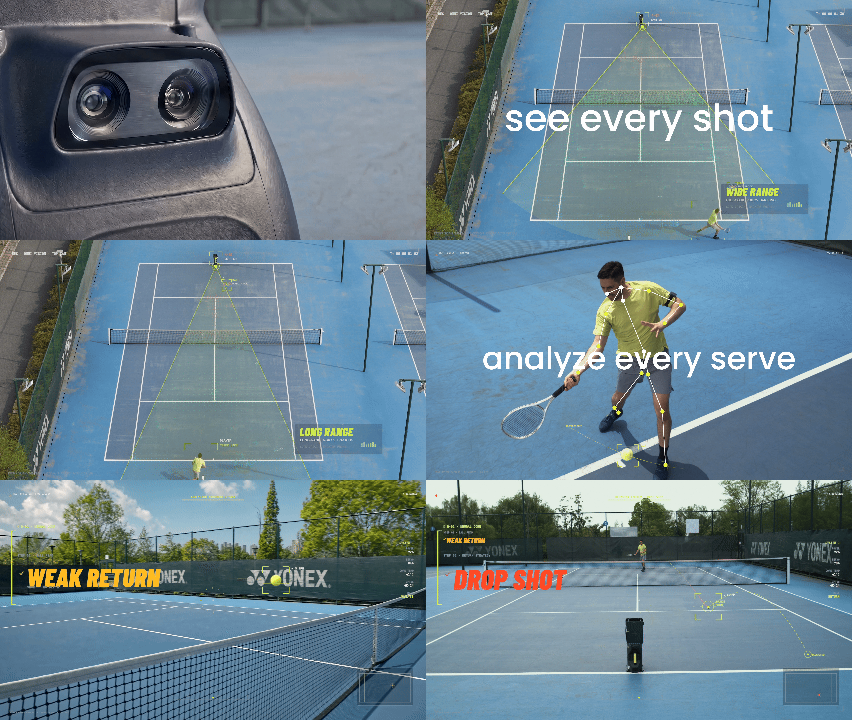
Integrated architecture of heterogeneous dual cameras with long and short focal lengths plus monocular space reconstruction (Image source / Enterprise)
At the control layer, the integration of hardware and algorithms is finally transformed into execution power. Combined with the real-time trajectory returned from the vision end and the edge-side AI algorithm, Tenniix has the "prediction" ability similar to human players, which can dynamically adjust the serving strategy of the next shot according to the landing point, rotation of the ball and the user's historical return quality, so as to realize the intelligent closed loop of "perception-decision-execution" in the complete playing scenario.
When the underlying technical architecture solves the problem of "whether the technology can serve the ball well", after entering the commercialization link, whether it can "make users at different stages willing to pay" is the real test.
The commercialization of sports hardware has always had a structural problem: high-level professional players need movement and actual combat confrontation close to real people, while the huge number of entry-level users pay more attention to portability and cost performance. If molds are opened separately for different groups of people, the supply chain will be overwhelmed; but with only one "full-function flagship", rich functions and high prices will keep the public out.
To this end, Enhanced Robotics designed Tenniix as a highly standardized 8kg lightweight body, and reserved abundant expansion interfaces on it. By stacking different functional modules, it has divided four clear SKUs: Basic, Pro, Ultra, and Ultra Max, which accurately meet the advanced needs of users at different stages.
Among them, the Basic series is priced at 899 US dollars, which only includes the basic body, focusing on extreme portability and stable ball feeding, solving the pain point of entry-level enthusiasts who "have no one to practice with".
The Pro version is equipped with an AI vision module and a voice interaction module, which can adjust the ball speed and landing point in real time through gestures, and generate a landing point analysis report. The "AI intelligent coach" meets the rigid needs of advanced tennis players for data feedback and movement error correction.
Ultra adds a wheeled mobile chassis on the basis of Pro, which can move to feed balls across the whole court and respond to returns. Ultra Max is a two-wheeled legged embodied tennis robot jointly launched with Exyn Dynamics in September this year, which truly realizes "the actual combat confrontation closest to real people" in terms of ball speed, serving height, anthropomorphic movement, autonomous decision-making, etc., to serve the high-level needs of professional athletes.
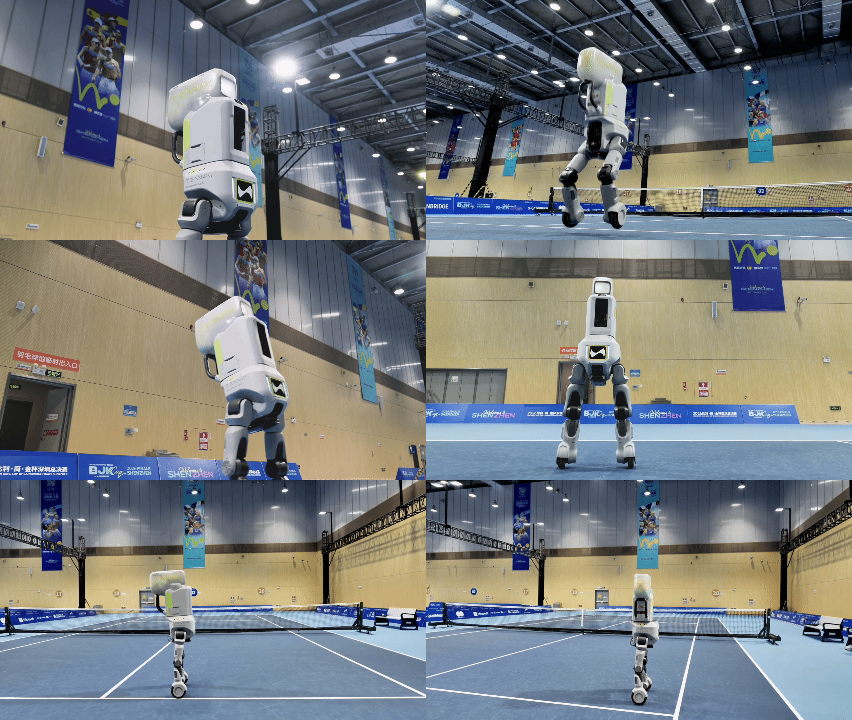
Tenniix Ultra Max (Image source / Enterprise)
Hanqi Zhu said, "We don't want users to pay in advance for functions that they can't use temporarily or are immature. The essence of modular design is to return the right to choose product upgrades to users, so that the machine can grow with their tennis skills."
This model of "platformized body + modular optional configuration" takes into account supply chain efficiency and the user's full life cycle value. The high reuse of the underlying main board and the core serving mechanism greatly reduces the R&D and manufacturing costs; at the front end, the low-threshold basic model can easily retain novices, and the high-level modules can seamlessly meet the advanced needs of professional players. This makes the hardware that users take home no longer a cold one-time transaction hardware, but an "AI coach" system that can evolve together with their tennis skills, effectively increasing the single-user life cycle value of the product.
Previously, Tenniix has successively completed crowdfunding on Kickstarter and Japan's Makuake, raising a total of nearly one million US dollars and 187 million yen respectively, ranking first in the sports category in the history of the Makuake platform. At this stage, the products are sold online through DTC independent stations, Joybuy, and Amazon's category bestseller channels, with a total shipment of tens of thousands of units worldwide. The team is accelerating the deployment of offline professional channels in Europe and the United States to drive revenue to multiply.
While stabilizing its tennis business, Enhanced Robotics will expand to general ball game scenarios; the new 2-in-1 product compatible with Padel has been launched in the European market, and the new Pickleball product for the North American market will be launched next year. Sports training products and sports rehabilitation products will also be launched in the market in the future.
In this plan, products in different scenarios are also entrances for accumulating real sports data and user feedback. With the continuous expansion of categories and users, diversified sports data feeds back to model iteration; the iterated model then optimizes products, supports new products, and attracts more users, forming a positive cycle of products, users and data.
The following is an excerpt of the interview between 36Kr and Hanqi Zhu, founder and CEO of Enhanced Robotics (slightly edited):
36Kr: Many sports hardware players in the industry tend to "add functions" and expand customer groups by making one machine multi-purpose. Between the functional generalization and vertical performance of products, how did you make trade-offs in the definition stage?
Hanqi Zhu: Our underlying principle is that we will not sacrifice the professional performance in a single scenario in pursuit of versatility.
Generalized compatibility is valuable, but generalization often brings compromise of capabilities. If we lower the performance upper limit of core ball games in order to cover more sports events, we will not accept this kind of compromise.
A product idea that easily appears in the market is to hope to make an all-in-one device, a set of hardware to adapt to multiple events such as tennis, padel, pickleball, etc., pursuing one product to sell to all users. But the sports category has extremely strong regional differentiation characteristics. For example, padel is popular in Europe, and pickleball is the mainstream in North America. The core sports demands of users in different regions do not overlap, so in our view, the so-called "all-round" is not a universal solution for the global market. Forcibly pursuing hardware versatility will eventually lead to the result that every sport can only be "good enough" but not professional.
Therefore, we choose to make products for different scenarios, rather than pursuing large and complete functions on a single piece of hardware. We give priority to serving deep sports enthusiasts. The primary goal of this type of users is to master one sport and improve their skills, rather than trying a variety of sports in a superficial way. On this basis, we extend the product categories, for example, launch a 2-in-1 tennis + padel model for the European market, and launch exclusive new products for the North American market next year.
The precondition for the design of each product is to ensure the complete training performance of the main sport, and will not reduce key indicators such as ball speed, response, perception and tracking due to compatibility with other events.
In terms of product decision-making methodology, we use the method of "doing single-choice questions" to resist the temptation of versatility. When receiving a large number of fragmented demands from different users, instead of doing multiple-choice questions that prioritize demands, we keep asking ourselves: if we can only meet one core demand, for which point will users pay? Most of the time, users put forward various demands verbally, but the real motivation behind their payment is highly convergent.
Versatility can be realized through our underlying reusable technical foundation, including the technical stack of motor power, edge-side perception and motion control that can be reused across ball games, but the reuse of the technical base does not mean that a single piece of hardware has to be universal for all categories. The technical layer can be universal, and the product layer should maintain professional focus. After the technical stack is accumulated, we will develop corresponding complete machine products for different sports separately, which not only gives play to the efficiency advantage of platform-based R&D, but also keeps the professional experience bottom line of each segmented scenario.
36Kr: The sports cultures in different countries vary greatly. In the global channel deployment for overseas expansion, how to ensure the effectiveness of the localization strategy?
Hanqi Zhu: When sports technology hardware goes overseas, we must not use one set of product and channel logic to "dominate everything". Localization is not just about language translation, but about adapting to the sports ecology, user portraits and venue costs of different countries.
At the research level, we insist on sinking into local courts. Taking Japan as an example, the market team found that the main paying group is men aged 35-55, because the hourly fee for indoor courts in Tokyo is as high as nearly 1,000 yuan, and this group of people is extremely lacking offline training partners. This determines their core demand that the equipment must be extremely portable and can support efficient independent training at home and in communities.
At the product end, tennis has globally unified rules, so our core mainframe is universal worldwide without revision. But for derivative categories, we require case-by-case localized development. For example, Europe and the United States are popular with multi-category compatibility, so we launch the "all-in-one" module; Japan prefers multi-ball training, so we launch a home-specialized version. We must ensure that the products sold in each region can 100% release the performance of the mainstream local sports, and never make compromises for the all-in-one function.
In terms of channel strategy, we follow the path of cold start via crowdfunding DTC first, and then drive offline development. We first use Kickstarter and Makuake crowdfunding to directly verify the local willingness to pay; then complete DTC word-of-mouth accumulation through independent stations, Joybuy and Amazon.
When real discussions and sales are formed at the end, local offline distributors will naturally take the initiative to seek agency. This method of "penetrating the C-end first and then promoting the B-end" can effectively reduce the risk of our expansion of offline channels.