DeepSeek Harness has 1.54 million daily active users, and the official team has started distributing Tokens to plugin developers: The Agent ecosystem relies on developers.
On the evening of November 5, DeepSeek Harness unveiled the latest updates of its product and community. As of November 4, counted by users who use the official API, the daily active users of DeepSeek Harness have reached 1.54 million, with a daily Token consumption of about 92 trillion. Meanwhile, the number of third-party plugins on the platform has grown to about 35,000, and around 60% of active users have created or installed at least one third-party plugin.
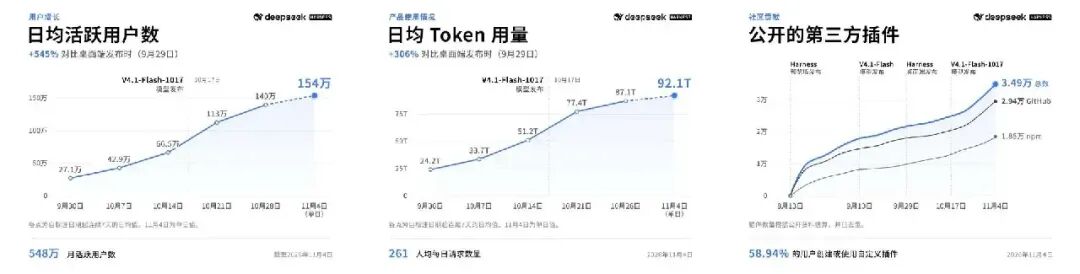
DeepSeek Harness stated that it aims to become the operating system in the Agent era, providing users with stable basic capabilities and general functions, while professional scenarios, specific industries and personalized needs are realized by developers through plugins. Its proposed "Everything is a Plugin" design even means that built-in functions can also be replaced by third-party plugins.
Since the release of the v0.1 version on August 13, DeepSeek Harness is expanding from an Agent tool to an open application platform. Community developers have developed a large number of third-party plugins around scenarios such as content creation, design, context management and scientific research.
However, as the number of plugins increases, new problems are also emerging: the more plugins there are, does the Agent really become more capable? Will a large number of plugin descriptions and tool rules take up the model's context and increase execution costs? For ordinary users, should they be given the space for free combination capabilities, or a complete out-of-the-box product?
Highly open, but will more plugins make the Agent harder to use?
The highly open plugin architecture of DeepSeek Harness is its most attractive feature: users do not have to accept the Agent workflow predefined by the manufacturer, but can combine models, tools, memory and interfaces according to their own needs to build an exclusive working environment.
Some users shared that they previously mainly used Hermes to handle general tasks and OMP for programming, but neither of the two tools could fully meet their customization needs. After switching to DeepSeek Harness, he added capabilities such as dashboards, themes, Token optimization, memory, visual connectors and browsers through plugins, and built an Agent environment that matches his own work habits in less than a day. What surprised him even more is that DeepSeek Harness runs faster for the same Qwen 3.8 model, which previously might take 24 hours to locate a Bug.
There are also users trying to expand DeepSeek Harness from a single tool to a general-purpose Agent working environment.
For example, some developers have launched dsh-aio-agent, which connects multiple coding Agents such as Cursor, Claude Code, Codex, OpenCode, CodeBuddy and Kimi Code to DeepSeek Harness, allowing users to select different tools to execute tasks in a unified interface; other developers have built a local long-term memory system through dsh-ltm, which supports Chinese keyword retrieval, dividing memory recall scope by project, as well as memory deduplication, modification and management.
Other developers have launched TheOne plugin, which identifies the topic of user messages through large language models and automatically routes them to corresponding independent sessions, avoiding mixing multiple projects and topics in the same conversation. There are also community projects that use the ESP32-S3 development board as a USB mouse and keyboard for iPhone, and receive the mobile phone screen mirroring through AirPlay at the same time. The Agent can take screenshots, click, long press, slide and enter text to control a real non-jailbroken iPhone.
The plugin ecosystem of DeepSeek Harness has seen a large number of applications with practical use value. But on the other hand, while plugins expand capabilities, they may also increase the complexity of using the Agent.
On November 5, a developer shared his experience of actively deleting plugins from "relying on plugins for everything". He said that he once installed more than 15 plugins for the Agent, but as the number of plugins increased, the system encountered problems such as infinite loops, context overflow and increased Token consumption.
In his opinion, every time a plugin is added, the model needs to additionally understand the corresponding description, usage rules and constraints. If the information of a large number of plugins enters the context at the same time, the model has to spend more attention on processing the tools themselves instead of focusing on task reasoning. He also proposed that the more plugins there are, the higher the freedom of the Agent is not necessarily, and too many preset tools and rules may instead limit the space for the model to solve problems independently.
However, some users pointed out that it is acceptable to keep streamlined on the premise that the core capabilities are not affected and no regression problems are caused, but developers must first take responsibility for their own plugin combinations. "For example, if I want to save tokens, I will not install plugins that are only for livening up the atmosphere at all. In my opinion, these examples are shifting self-responsibility. You can't blame the real estate developer for selling you a rough house instead of a fully furnished one just because your house is not well decorated."
In addition, some users pointed out that DeepSeek Harness has a larger prompt size than Pi, and suggested learning from its selective disclosure mechanism, which provides the description of the corresponding plugin to the model only when needed, instead of letting all plugin information occupy the context all the time.
Similar concerns also arise in terms of execution costs. Some users said that when they used DeepSeek Harness to complete a small project, the Token consumption was more than 20 times that of OpenCode, and a single task took 30 to 40 minutes, while OpenCode took about 30 seconds. This is only the experience of individual users, but it at least reflects users' attention to the cost of calling tools.
Frequent iterations, plugin governance is far from over
Facing problems such as plugin management, context cost and usage threshold, DeepSeek Harness has carried out multiple rounds of version iterations in the past few months. Sorting out the official GitHub Releases shows that its optimization direction is gradually shifting from providing plugin extension interfaces to improving plugin discovery, installation, update, dependency management and operation monitoring.
From October 15 to 23, DeepSeek Harness continuously updated its plugin management capabilities, successively supporting custom plugin indexes, version compatibility checks, plugin start/stop, uninstallation, dependency synchronization and hot reload, and added an entry for Agent-assisted plugin creation. Meanwhile, v0.2.1-rc.1 started to support automatic compression of long conversations in minimalist mode, and the Web and desktop versions can also manually compress the context through the /compact instruction.
v0.2.2-alpha.2 released on October 28 started to support third-party plugin package updates, and tried to restore the old version when the hot update failed. It also added an experimental developer statistics plugin to view the context, cache, model and tool time consumption; v0.2.2-alpha.3 released on November 3 further added plugin installation failure diagnosis and Host log entries, distinguishing between installation failure and post-installation activation failure to help users locate problems.
v0.2.2-rc.1 released on November 4, as the first candidate version of the 0.2.2 series, summarizes the improvements of several previous versions, also optimizes the reuse of historical context cache for Auto automatic review between consecutive tool calls, and uses the original model to compress historical records first when switching to a model with smaller context capacity; at the same time, it sets independent byte budgets for global and project-level AGENTS.md to reduce mutual preemption of instructions.
It can be seen from these updates that DeepSeek Harness has begun to respond to some of the problems raised by the community: the entry for plugin discovery and management is more complete, dependency synchronization and hot reload reduce maintenance costs, long conversation compression and cache reuse start to handle context and Token consumption, and statistical tools allow developers to observe the actual execution cost of the Agent.
However, some feedback shows that there are still unstable factors in the plugin update and configuration recovery mechanism.
On November 5, a Windows user reported that after upgrading the desktop client from v0.2.1-rc.5 to v0.2.2-rc.1, the 32 previously configured third-party and local plugin package entries were lost, and the number of plugins in the configuration file was reduced from 34 to 2. At the same time, due to the incompatibility of a localized plugin with the new version, the application failed to start directly for the first time. Since there was no automatic configuration backup before the update at that time, and the client did not support version rollback, the user could only manually restore the working environment, and the entire fault repair process took about 5 hours.
For long-term Agent users, plugins are not just small tools that can be replaced at any time. Users may have built their own workflows around specific plugins, configured MCP servers, model routes, Agent presets and local dependencies. Once the configuration is overwritten during the upgrade, what is lost is not just a certain plugin, but the entire set of working environment accumulated before.
Therefore, the plugin ecosystem also needs reliable mechanisms for version management, dependency check, configuration protection, automatic backup and fault rollback. Especially when Agents begin to undertake more complex work, users will have higher and higher requirements for the stability of the working environment.
Developer support, starting to build the plugin marketplace
The developer support program announced by DeepSeek Harness this time is centered on the continuous construction of the ecosystem.
The official stated that in the future, it will further improve the stability and compatibility of the plugin API, improve the plugin security mechanism, and build an official plugin marketplace, so that developers can upload plugins more conveniently, and users can more easily discover and install the required functions.
In terms of developer incentives, DeepSeek Harness is preparing a dedicated support program for plugin authors, initially considering supporting developers to explore new ideas and continuously improve their existing works through Token incentives, technical exchanges and work recommendations.
However, Token incentives can reduce the cost for developers to explore and test, but cannot directly guarantee plugin quality; work recommendations can increase the exposure of plugins, but do not mean that the plugins necessarily have long-term maintenance capabilities. For the platform, how to allow developers to obtain continuous revenue, allow users to find truly reliable plugins, and allow different plugins to collaborate stably in the same Agent environment is the key to the sustainable development of the ecosystem.
DeepSeek Harness has initially formed the scale of user and developer ecosystem. The next stage is to build a set of infrastructure that allows plugins to run continuously, be compatible with each other and be easy to use. In addition to providing distribution channels, the official plugin marketplace also needs to consider plugin review, quality rating, version compatibility, permission management and security prompts. Otherwise, the more plugins there are, the heavier the burden of user filtering and maintenance may be.
Reference Links:
https://mp.weixin.qq.com/s/xqyrRaiBpIcf0jeJzP7W0g
https://github.com/deepseek-ai/deepseek-harness/discussions/categories/show-your-plugins
https://github.com/deepseek-ai/deepseek-harness/discussions/12329
https://github.com/deepseek-ai/deepseek-harness/discussions/7374
https://github.com/deepseek-ai/deepseek-harness/discussions/12349
https://www.reddit.com/r/DeepSeek/comments/1wqb9se/deepseek_harness_feedback
Disclaimer: This article is an original work of InfoQ, does not represent the views of the platform, and does not constitute investment advice. Reproduction is prohibited without permission.
This article is from the WeChat official account "InfoQ" (ID: infoqchina), written by Chu Xingjuan, published by 36Kr with authorization.