Epic update to Bluetooth technology: HDT enables Bluetooth Low Energy to achieve a 4x speed boost
For a long time, Bluetooth has become a critical technology for short-range wireless connections between IoT devices, thanks to its low power consumption, low cost and good interoperability. From smartwatches, wireless earbuds to smart homes and industrial sensors, Bluetooth has built a massive ecosystem of connected devices. However, as end devices continue to become smarter, application demands for wireless connections are also changing — taking the audio market as an example, relevant solutions are evolving toward higher fidelity, multi-audio stream and other application directions, which require larger data capacity and faster communication speed to deliver smooth performance and user experience.
Against this backdrop, Bluetooth technology has ushered in an important advancement. On November 4, 2026, the Bluetooth Special Interest Group officially incorporated Bluetooth High Data Throughput (HDT) into the Bluetooth Core Specification 7.0 as an optional feature. HDT increases the maximum bit rate supported by Bluetooth Low Energy (Bluetooth LE) from 2 Mbps to 7.5 Mbps, an increase of nearly 4 times.
From a long-term perspective, the significance of HDT lies in expanding the capability boundary of Bluetooth. It not only provides a new technical foundation for lossless and high-resolution wireless audio, but also opens up room for imagination for smart wearables, AI terminals and more data-intensive IoT applications.
Technical Level: How Does Bluetooth HDT Balance Transmission Efficiency and Energy Efficiency?
Overall, the main advantages and values that HDT brings to Bluetooth technology include:
- Increase the maximum supported bit rate to 7.5 Mbps.
- Significantly improve wireless communication performance, rather than only increasing data throughput.
- Expand the communication capacity and functions available for existing Bluetooth applications and usage scenarios.
- Support a richer set of new application scenarios, such as high-resolution audio and lossless audio transmission.
The realization of these advantages relies on a series of architectural innovations and technical upgrades introduced in the Bluetooth Core Specification — By introducing high-order coherent modulation, forward error correction, dynamic rate adjustment, as well as more complete synchronization and anti-interference mechanisms, HDT attempts to improve transmission efficiency while taking into account connection reliability and energy efficiency performance in complex wireless environments.
① Physical Layer (PHY)
The Bluetooth HDT physical layer introduces three coherent modulation schemes, which use complex symbols to represent data and allow each symbol to carry multiple bits:
π/4 Quadrature Phase-Shift Keying (π/4 QPSK)
8 Phase-Shift Keying (8PSK)
16 Quadrature Amplitude Modulation (16QAM)
These modulation schemes transmit information by changing the phase of the radio frequency carrier; while in 16QAM, both the phase and amplitude of the carrier are changed to realize information transmission.
During the communication process, the transmitted symbols consist of two signal components, called the In-phase (I) component and the Quadrature (Q) component. According to the design, each group of I/Q signal pairs corresponds to a specific symbol value. For a specific modulation scheme, the pattern formed by mapping all possible I/Q signal pairs to points on the complex plane is called a Constellation Diagram. The figure below shows the constellation diagrams corresponding to the three modulation methods:
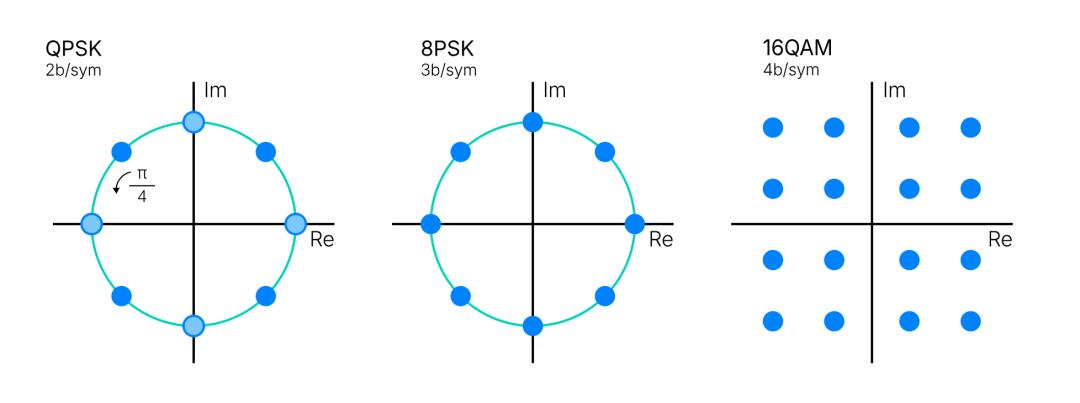
Constellation diagrams corresponding to the three modulation methods of π/4 QPSK, 8PSK and 16QAM
The HDT physical layer combines the above new modulation schemes with convolutional Forward Error Correction (FEC) and Puncturing technologies. Among them, forward error correction is realized through convolutional coding, with a basic coding rate of 1/2; and puncturing technology is used to achieve a higher coding rate.
In general, HDT supports five different bit rates, and all rates run at a fixed 2 Msym/s symbol rate. From the perspective of architectural design, these five different bit rates are regarded as different working modes of the same physical layer.
② Link Layer (LL)
At the link layer, Bluetooth HDT defines a brand new packet structure that connects PHY layer capabilities with intelligent mechanisms and processing procedures, so as to achieve higher throughput and more reliable and robust communication performance in practical applications.
In order to adapt to different communication scenarios and achieve a balance between efficiency and flexibility, HDT also defines three packet formats: Short Format, Packet Format 0 (PF0) and Packet Format 1 (PF1).
Short Format: The Short Format is a packet structure with the minimum overhead, which is suitable for scenarios where no actual data needs to be transmitted. It can reduce the over-the-air transmission time, and is suitable for synchronization between devices and exchange of acknowledgment information.
Packet Format 0 (PF0): Packet Format 0 is a low-complexity packet structure, which is suitable for transmitting unsegmented payload as a single data block.
Packet Format 1 (PF1): Packet Format 1 is the most fully functional and most robust packet structure, suitable for efficient and reliable transmission of large amounts of data.
③ Encryption
HDT enhances the encryption capability of Bluetooth LE by introducing support for longer Message Integrity Check (MIC) codes and the Encryption Key Schedule (EKS) feature.
EKS is a new feature added in Bluetooth Core Specification 7.0 — this feature supports the generation, management and refresh of encryption keys, enabling devices to update keys when PHY (and MIC length) changes, without disconnecting the connection or restarting the entire encryption process. Based on the shared key derived from ECDH and the AES-CMAC key derivation function, EKS supports the following capabilities:
- Opportunistic Encryption
- Perfect Forward Secrecy (PFS)
- Seamless PHY switching with simultaneous key and MIC updates
- Set independent stream keys for ACL and CIS transmission modes respectively
Through Opportunistic Encryption, devices can establish an encrypted link without pre-sharing the Life-Time Key (LTK). This means that encrypted communication can be realized even if the devices have not been paired before. The confidentiality and integrity protection it provides is similar to the protection level obtained after the device completes pairing through the Just Works method of LE Secure Connections, but it does not provide authentication or Man-in-the-Middle (MITM) attack protection.
Through Perfect Forward Secrecy (PFS), even if the device's LTK, private key or current session key is leaked, it will not lead to the exposure of previous session keys. Therefore, past encrypted sessions can still remain secure. After encryption refresh, if the current session key is leaked, the session key used before encryption refresh cannot be derived accordingly. With only one session key, no other session key or Traffic Secret can be derived. If a certain traffic secret is known, subsequent traffic secrets can be derived, but previous traffic secrets cannot be derived.
Previously, devices could also set independent keys for different data streams respectively, but this required a full repetition of the "Encryption with Diversifiers" process, and EKS PFS greatly simplifies this operation.
Application Level: Opening Up More Application Space From Wireless Audio to AI Terminals
Wireless audio will be the first application scenario where Bluetooth HDT is implemented. With the transmission rate increased to a maximum of 7.5 Mbps, Bluetooth is expected to further break through the traditional bandwidth limitation of wireless audio, providing more sufficient space for high-resolution audio transmission. More importantly, higher throughput also creates conditions for brand new audio experiences, such as spatial audio, multi-channel surround sound, etc. In the past, to meet the bandwidth and performance requirements of specific audio applications, some manufacturers needed to adopt proprietary wireless transmission solutions. The emergence of HDT is expected to make these experiences more built on standardized Bluetooth technology, lowering the threshold for realizing high-quality wireless audio interconnection between devices.
However, the beneficiaries of Bluetooth HDT are not limited to audio devices such as earbuds and speakers. Higher data transmission rate and more flexible link management capabilities also bring new possibilities to other IoT terminals.
Taking smartwatches and sports bands as examples, these types of devices continuously collect heart rate, exercise track, sleep and other health and fitness data. As the types of sensors and monitoring accuracy continue to improve, the amount of data that needs to be synchronized is also increasing. HDT can help devices complete bulk data transmission in a shorter time, reducing the continuous working time of the radio module, thus creating conditions for reducing communication energy consumption. This means that smart wearable devices have the opportunity to provide richer data recording and analysis capabilities without significantly increasing the battery burden. Of course, the actual battery life performance also depends on the device's communication strategy, data scale and overall power consumption design.
Spatial computing and Extended Reality (XR) devices are also worthy of attention. These devices need to continuously exchange data between the head-mounted display, controllers, tracking accessories and other peripherals, which have high requirements for connection latency, stability and transmission efficiency. Bluetooth connections with higher throughput are expected to undertake part of the data transmission tasks, improve the interaction experience between peripheral devices and the host, and reduce dependence on other wireless connection methods. However, HDT does not mean that Wi-Fi can be completely replaced: for scenarios that continuously transmit a large amount of high-resolution image or video data, appropriate wireless technologies still need to be selected according to bandwidth and latency requirements.
Another direction worthy of observation is personal AI devices. With the continuous emergence of AI glasses, AI earbuds, smart recording devices and various portable smart terminals, device forms are evolving toward lightweight and miniaturization. Limited by volume, heat dissipation and battery capacity, many terminals are difficult to independently undertake complex AI computing tasks. A more realistic way is to transmit the collected voice, image or other data to devices with stronger computing power such as smartphones for processing, and then receive the processing results. HDT provides a more efficient data transmission channel, which is expected to improve the data interaction experience between such devices and mobile phones, and provide more space for collaborative processing between the terminal side and the mobile phone side.
In addition, seemingly ordinary operations such as firmware upgrade, device configuration and data backup may also benefit from the popularization of HDT. For smartwatches, smart home accessories and other low-power devices, firmware updates often involve large data packets and take a long time to transmit. With the help of higher transmission rates, devices are expected to shorten the time required for updates, reduce the long-time occupation of wireless connections, and allow users to complete maintenance tasks that originally required waiting faster.
From this perspective, the significance of Bluetooth HDT is not only to allow wireless earbuds to transmit higher-quality sound, but to further expand the application boundary of Bluetooth in data-intensive IoT scenarios. From audio devices to smart wearables, from XR peripherals to personal AI terminals, Bluetooth is trying to undertake more high-efficiency data interaction tasks beyond low-power connections.
Conclusion
According to the plan of the Bluetooth Special Interest Group, the first batch of HDT-enabled devices are expected to be released in 2027. It is worth mentioning that users cannot enjoy this upgrade only through software updates. Since HDT requires brand new wireless hardware support, existing earbuds, mobile phones, smartwatches and other Bluetooth devices usually cannot directly obtain the 7.5Mbps transmission capability, and products equipped with a new generation of Bluetooth chips are required to give full play to all the advantages of this technology.
With HDT officially adopted, Bluetooth technology is entering a new stage of development. In the next few years, new wireless earbuds, mobile devices and smart terminals supporting this standard will be launched on the market one after another, and higher-quality wireless audio, faster file transmission and more efficient device interconnection will also become important development directions of the next-generation Bluetooth ecosystem.
References:
Bluetooth® High Data Throughput technical overview
Bluetooth is getting a big boost to data transfer speeds——The Verge
Bluetooth achieves a nearly fourfold speed increase, HDT technology paves the way for high-quality audio and high-speed transmission —— CNBeta
This article is from the WeChat Official Account "IoT Think Tank" (ID: iot101), written by Sophia, published with authorization from 36Kr.