36Kr Exclusive | Lithium-rich Manganese Battery Enterprise Completes Tens of Millions of Yuan Financing, Has Realized Mass Shipment and Achieved Profitability in the UAV Segment
Author | Qiao Yujie
Editor | Yuan Silai
This article contains approximately 2,600 words, with a recommended reading time of 6 minutes
Hard Krypton learned that Foshan Topu Technology Co., Ltd. (hereinafter referred to as "Topu Technology") has recently completed tens of millions of yuan in Series A financing, with investors including Huaibei Jishan, Anhui Hena, and Chongqing Haite. The funds from this round of financing will be used for capacity expansion of the 0.5GWh production base in Huaibei, Anhui, and the facility is scheduled to be put into operation in January 2027.
Founded in 2019, Topu Technology is an enterprise focusing on the R&D and industrialization of high-energy-density lithium batteries and solid-state battery technologies. Dr. Chen Guangseng, the founder of the company, has more than 30 years of experience in battery R&D and industrialization, and has previously worked at the Research Institute of Japan Co., Ltd., the Institute of Materials Research and Engineering of Singapore, and served as Deputy Manager of the Battery Development Department at Germany's Varta. In 2019, Chen Guangseng founded Topu Technology, focusing on technical directions such as lithium-rich manganese-based cathodes, full silicon-carbon anodes, and solid electrolytes.
High-energy-density batteries have long faced the challenge of balancing performance and mass production. On the one hand, increasing the energy density of batteries requires breaking through the performance upper limit of cathode and anode materials; on the other hand, the structural changes of materials during charging and discharging, interface stability and cycle life will affect the actual use performance of batteries. In particular, the long-standing voltage attenuation problem of lithium-rich manganese-based materials and the volume expansion problem of full silicon anodes during cycling are all difficulties that the industry needs to solve when promoting the industrialization of related technologies.
Dr. Chen Guangseng introduced to Hard Krypton that Topu Technology has currently established a relatively complete technical system around lithium-rich manganese-based cathodes, full silicon-carbon anodes, composite solid electrolytes and low-attenuation technologies, and is promoting related products to enter mass production and commercialization stages.
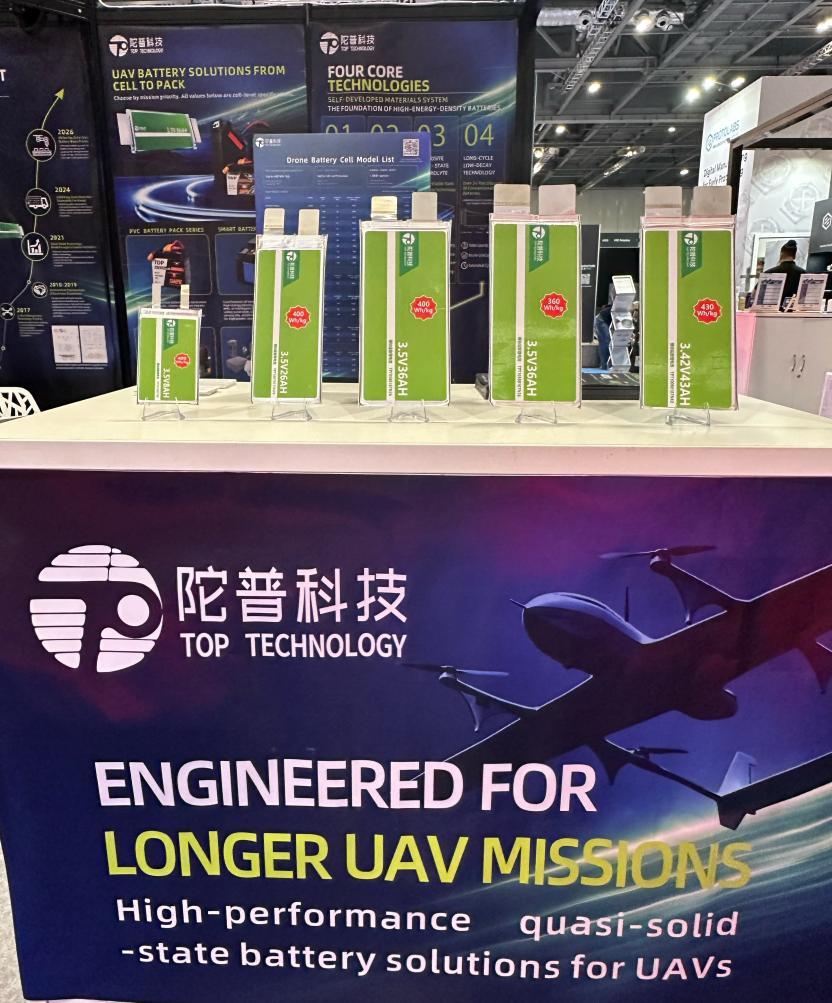
Among them, the company has achieved batch delivery in the field of quasi-solid-state (electrolyte ≤ 10%) batteries, with the energy density of mass-produced cells reaching 460Wh/kg, and plans to take the lead in realizing small-batch sample delivery and verification of all-solid-state batteries with electrolyte ≤ 5% that meet the national standard GB/T 43568-2026 indicators in 2027.
(Source / Enterprise)
In terms of cathode materials, Topu Technology focuses on the layout of lithium-rich manganese-based materials. Compared with traditional ternary materials, lithium-rich manganese-based materials have high theoretical specific capacity, and at the same time have cost advantages such as low nickel and no cobalt. However, its voltage attenuation problem has long restricted the practical application of the material. Topu Technology improves the voltage retention capacity and rate performance of the material through technical means such as material formula optimization, lithium replenishment process and surface modification.
According to the company, the gram capacity of its lithium-rich manganese-based cathode material can reach 300mAh/g, and vehicle-grade mass production verification has been carried out. The company is currently in technical service docking with FAW Besturn and has signed a non-disclosure agreement.
In terms of anode materials, the company promoted the mass production of full silicon-carbon anode technology in 2024. Silicon materials have high theoretical specific capacity, but their volume changes significantly during charging and discharging, which easily causes electrode structure damage and cycle life decline. To solve this problem, Topu Technology has developed an in-situ solid electrolyte coating technology to improve the interface stability during material expansion. According to reports, its full silicon-carbon anode can achieve 700 stable cycles. After matching with the self-developed cathode system, the overall number of cycles of the cell exceeds 500, and the energy density of mass-produced cells reaches 460Wh/kg.
In the direction of solid-state batteries, Topu Technology chooses the oxide and polymer composite electrolyte route, hoping to strike a balance between safety, ion conductivity and adaptability to existing production equipment. Compared with the sulfide route, this route requires less transformation of the production line, has stronger process compatibility, faster industrialization implementation and higher mass production certainty. The company has completed the verification of related laboratory button batteries, is promoting full battery testing, and plans to further reduce the content of liquid electrolyte in the cells to evolve to products with a higher degree of solidification.
In addition to the material system, Topu Technology has also laid out cell low-attenuation technology, which improves the capacity retention performance of batteries during long-term cycles through the collaborative optimization of material formula, cell structure, interface regulation and manufacturing process. The company said that related technologies have been applied to different battery material systems, with the goal of extending the effective service life of cells, which can achieve a capacity retention rate of ≥80% after 500-700 cycles.
From the perspective of commercialization progress, drone batteries are currently the main business of Topu Technology. Its 400Wh/kg class high-energy-density batteries have been stably supplied for two years, and 460Wh/kg batteries have achieved batch delivery. Drones are sensitive to the energy density, instantaneous discharge capacity and weight of batteries, so they have become a niche market where high-performance batteries are first implemented. Compared with new energy vehicles and other fields, the verification and application scenarios of drone batteries are relatively concentrated, which also provides a commercial entry point for high-performance battery products.
The company has also expanded high-rate batteries to the high-speed electric motorcycle field. Related products support continuous 8C and instantaneous 12C discharge, and have carried out cooperation with brands such as Kuailun Technology and Hanneng. In addition, the company has laid out ultra-thin high-energy-density power bank products, and related products have passed 3C certification. In 2026, the company estimates its revenue to be 180 million to 200 million yuan, and has achieved profitability.
In terms of production capacity layout, Topu Technology currently takes Foshan as its headquarters and R&D center, with a cell pilot line and PACK production line; the Huaibei base in Anhui is the key capacity expansion direction after this round of financing, building a more than 20,000 square meter production line for lithium-rich manganese-based cathode material synthesis and cell mass production with 90% automation, to further support the large-scale delivery of high-energy-density battery products, which will be put into operation in January 2027.
The following is an excerpt of the exchange between Hard Krypton and Dr. Chen Guangseng, the founder:
Hard Krypton: Why did you choose the oxide and polymer composite route for all-solid-state batteries, instead of the sulfide route that is currently receiving more attention? What advantages will the company's accumulation in lithium-rich manganese materials bring to the R&D of solid-state batteries?
Dr. Chen Guangseng: Different solid electrolyte routes have their own advantages and disadvantages. Sulfide electrolytes have high ionic conductivity, but they are sensitive to moisture and may produce toxic hydrogen sulfide gas when exposed to water, so they have high requirements for the production environment, equipment and safety management, and the industrialization investment is also relatively large.
In contrast, the oxide and polymer composite system is easier to connect with existing battery manufacturing equipment, which can reduce the transformation cost of the production line to a certain extent. However, the oxide material itself is relatively hard, which easily leads to high interface contact resistance with the electrode, and it is necessary to improve the contact and ion transmission through polymer and interface engineering. At present, the company is continuously promoting technical verification around these issues.
The advantage of Topu Technology is that we have accumulated technology and mass production experience in the industrialization of lithium-rich manganese materials. No matter using oxide, halide or sulfide electrolytes, solid-state batteries ultimately need to solve the problems of cost and large-scale production. We hope to combine lithium-rich manganese materials with solid-state battery technology to further reduce battery costs while increasing energy density. In the long run, we are optimistic about the industrialization prospect of lithium-rich manganese solid-state batteries, and believe that this is expected to become an important competitive advantage of the company in the future.
Hard Krypton: At present, about 90% of the company's shipments come from drone batteries. What other considerations do you have for the expansion of application scenarios in the future?
Dr. Chen Guangseng: At this stage, we prioritize the layout of drone batteries, mainly because this market is well matched with the company's technical advantages. Drones have high requirements for the energy density and rate performance of batteries, hoping that the battery is as light as possible, and also need to meet the instantaneous high current discharge demand during flight. Our high-silicon-carbon anode technology can support cell energy density above 400Wh/kg and meet the high-rate discharge demand. At present, drone batteries have become the company's main shipped product and source of profit. In contrast, the new energy vehicle battery market is more competitive. Therefore, we hope to establish advantages in high-performance niche markets first, and then gradually expand the automotive battery business after the production capacity is further improved.
At the same time, we are also laying out other application scenarios. For example, we use existing battery technology to develop ultra-thin power bank products, and further expand the high-speed electric motorcycle market. At present, the company is promoting relevant business cooperation, and is also paying attention to opportunities in the Vietnamese and Southeast Asian markets.
In addition, we are paying attention to emerging demands such as data center energy storage. As the requirements of data centers for power supply capacity and energy storage systems continue to increase, the energy density, safety and space utilization efficiency of batteries are becoming more and more important. We believe that if lithium-rich manganese materials can be further combined with solid-state battery technology, it is expected to form new competitive advantages in these scenarios. On the whole, the company will first give full play to the advantages of existing technologies in high-performance niche markets, and then gradually expand to new energy vehicles and other larger-scale application fields.