The "national team" of the manufacturing industry is expanding, and these cities are teaming up to achieve breakthroughs.
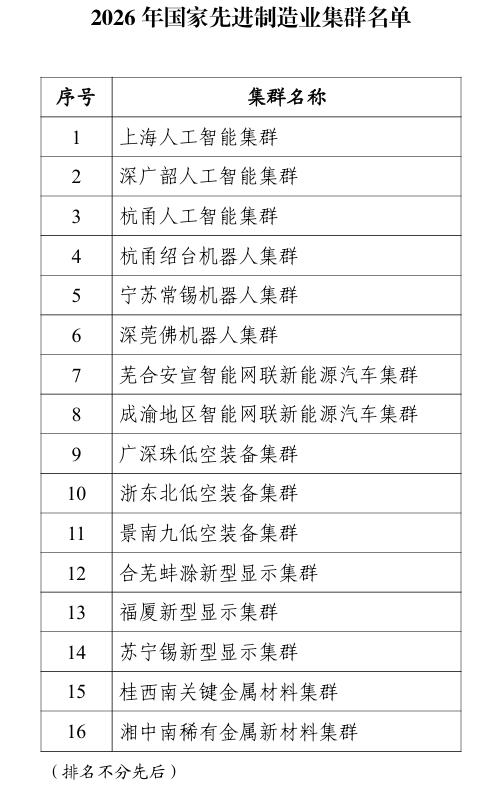
On November 4, the official website of the Ministry of Industry and Information Technology released the "Public Notice on the 2026 List of National Advanced Manufacturing Clusters", with 16 clusters shortlisted. The public notice period runs from November 4 to November 10. Any objection during the public notice period may be submitted in written form to the Department of Planning of the Ministry of Industry and Information Technology. This selection is organized in accordance with the "Notice of the General Office of the Ministry of Industry and Information Technology on Organizing the Selection of National Advanced Manufacturing Clusters in 2026", and is generated through recommendations from provincial competent departments of industry and information technology and expert reviews.
Advanced manufacturing clusters represent an advanced form of deepened industrial division of labor and agglomeration development, and are a critical pillar for promoting the high-quality development of advanced manufacturing. Since 2019, the Ministry of Industry and Information Technology has implemented a special action for the development of advanced manufacturing clusters, driving quality improvement and upgrading of clusters through selection and cultivation. Up to now, 80 national advanced manufacturing clusters have been cultivated and constructed across the country, covering six key fields including new generation information technology, high-end equipment, and new materials.
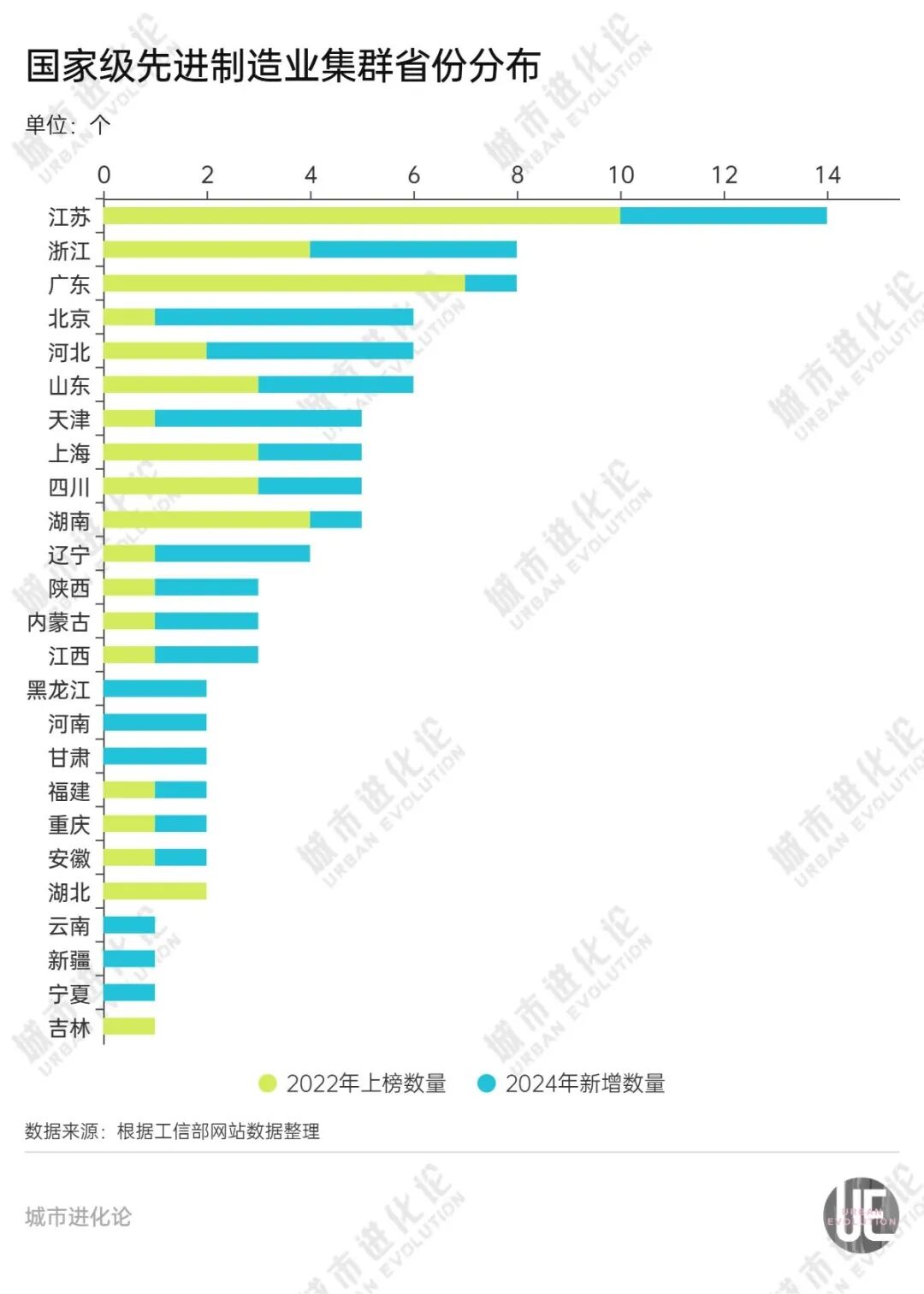
Distribution of 80 National Advanced Manufacturing Clusters
Of the 16 newly publicized national advanced manufacturing clusters, in terms of field distribution, there are 3 artificial intelligence clusters (Shanghai, Shenzhen-Guangzhou-Foshan, Hangzhou-Ningbo), 3 robot clusters (Hangzhou-Ningbo-Shaoxing-Taizhou, Nanjing-Suzhou-Changzhou-Wuxi, Shenzhen-Dongguan-Foshan), 2 intelligent connected new energy vehicle clusters (Wuhu-Hefei-Anqing-Xuancheng, Chengdu-Chongqing region), 3 low-altitude equipment clusters (Guangzhou-Shenzhen-Zhuhai, Northeast Zhejiang, Jingdezhen-Jiujiang), 3 new display clusters (Hefei-Wuhu-Bengbu-Chuzhou, Fuzhou-Xiamen, Suzhou-Nanjing-Wuxi), and another 2 clusters including key metal materials cluster in Southwest Guangxi and rare metal new materials cluster in South Central Hunan are shortlisted in the same batch.
In terms of regional distribution, there are 8 clusters in the Yangtze River Delta (1 in Shanghai, 2 in Jiangsu, 3 in Zhejiang, 2 in Anhui), 3 clusters in the Guangdong-Hong Kong-Macao Greater Bay Area (all located in Guangdong), 2 clusters in the middle reaches of the Yangtze River (1 in Hunan, 1 in Jiangxi), 1 cluster in Chengdu-Chongqing (jointly built by Sichuan and Chongqing), 1 in Fujian, and 1 in Guangxi. It is worth mentioning that among them, only the Shanghai artificial intelligence cluster is declared by a single city, and the remaining 15 clusters are declared jointly by multiple cities.
The value of cross-city layout lies in integrating the industrial strengths of different cities into the same collaboration network, so that technology, supporting facilities and the market can support each other. The Guangzhou-Foshan-Huizhou ultra-high-definition video and smart home appliances cluster, which was shortlisted in March 2021, is the first national-level cluster jointly cultivated by multiple cities in China. Up to now, among the 80 national advanced manufacturing clusters across the country, 37 are cross-regional clusters, including 27 cross-city clusters and 10 cross-provincial clusters, accounting for 46% of the total number of clusters.
Focusing on the newly publicized list, taking the Wuhu-Hefei-Anqing-Xuancheng intelligent connected new energy vehicle cluster as an example, according to local Wuhu media reports, this cluster is led by Wuhu for establishment, with Wuhu and Hefei jointly serving as the "dual cores", focusing on high-end complete vehicle manufacturing and key technology research of intelligent connection; Anqing and Xuancheng give play to their comparative advantages, focusing on the parts tracks such as power batteries, electric drives, chassis, and lightweight materials.
It should be noted that multi-city co-construction also faces problems such as high coordination costs, difficult benefit distribution, and unequal rights and responsibilities between the leading city and member cities. Previously, the "China Industry and Information Technology" journal supervised by the Ministry of Industry and Information Technology pointed out in a special research that the "benefit barriers" caused by the traditional administrative division thinking are the "pain point" hindering the cross-regional collaborative development of clusters, and proposed that it is necessary to build a long-term mechanism of "benefit sharing and cost sharing", and explore a benefit distribution mechanism of "tax sharing + indicator sharing + mutual recognition of assessments".
This article is from the WeChat Official Account "City Evolution Theory", written by Yang Huan, and authorized for release by 36Kr.