Xiaohongshu and Rokid plan to join forces to address the pain points of Lingguang's Personal Agent.
Ever since Muse went viral, major internet giants, large model companies and AI entrepreneurs have been racing to launch their own personal Agent products. Currently, the most high-profile offerings in the domestic Chinese market are Qwen Go, WeChat Mini Agent, Lingguang 2.0 and Today AI.
After Lingguang's massive publicity blitz recently, many people almost believed that a local Chinese Muse had arrived that would outperform products from Alibaba and ByteDance, but real-world tests show its actual performance is far below expectations.
Lingguang 2.0 can connect to systems and third-party services including calendar, alarm clock, Baidu Netdisk and QQ Mail, but authorization interfaces for high-frequency daily scenarios such as WeChat, Douyin, Xiaohongshu and Meituan are basically not open. Even among Alibaba's own apps, only Alipay and DingTalk are interconnected. The product direction is correct, but the insufficient permissions make its experience far from satisfactory.
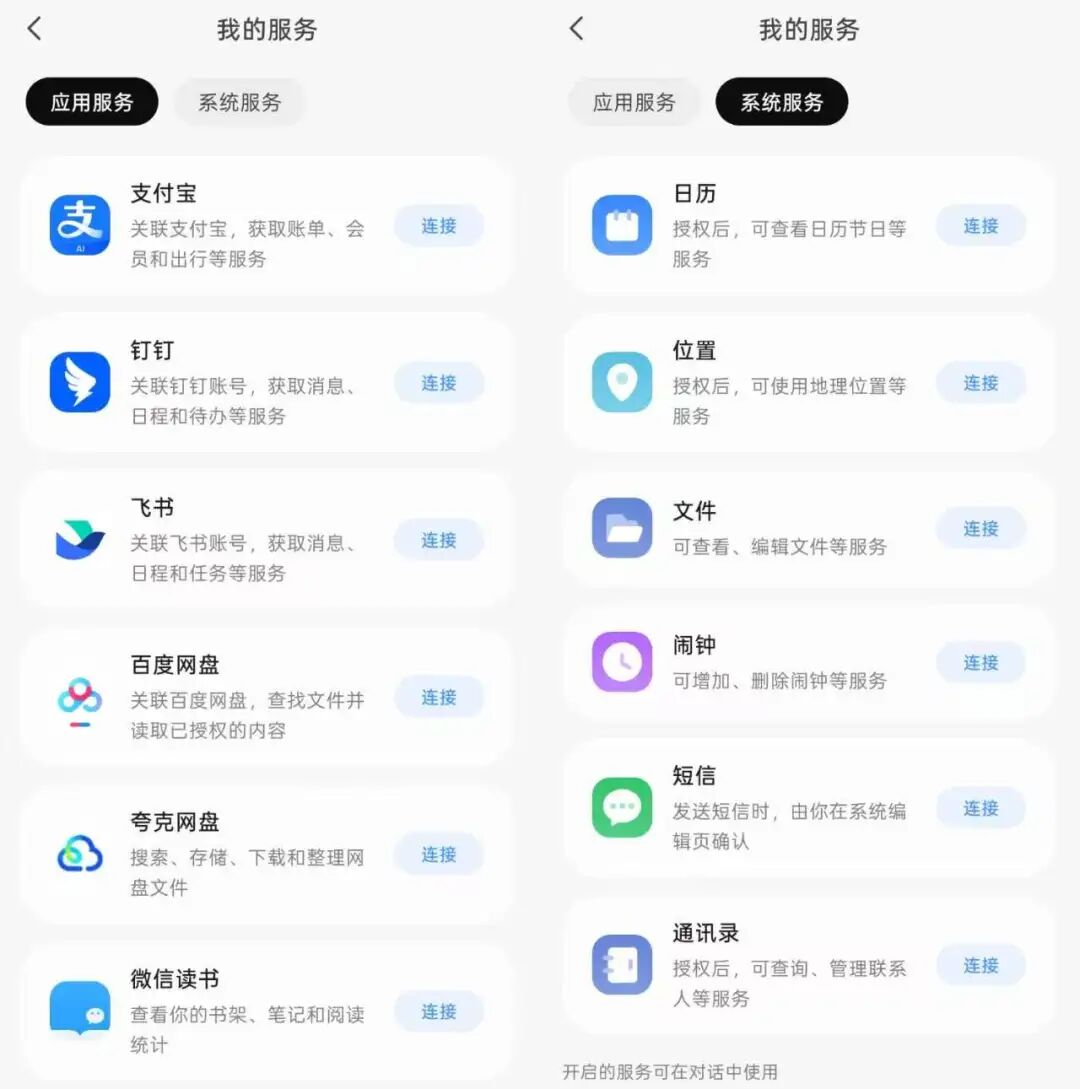
The app ecosystem of China's internet industry is dominated by closed "walled gardens". Doubao mobile assistant once faced widespread resistance from a large number of applications, and the number of national-level applications that Lingguang can deeply integrate with is also very limited. Lingguang takes "application generation" as its entry point, but eventually hits the existing boundaries of application distribution and digital service transactions.
In this sense, the shortcomings Lingguang faces cannot be eliminated by a single product iteration. It represents the shared ceiling of the path of "building a smarter Agent inside a mobile phone dialog box": the Agent can understand user intentions, but it is difficult to stably reach the real world targeted by those intentions.
Permissions are in the hands of other platforms, scenarios are in the hands of other platforms, and data is also in the hands of other platforms. When all actions have to pass through layers of application barriers to be completed, the "personal" attribute of Personal Agent will be diluted into a limited proxy restricted by platform permissions.
The "Xiaohongshu Sweet Potato" jointly built by Xiaohongshu and Rokid recently does not provide a different solution to the same problem, but changes the starting point of the whole problem.
01
The unfinished task of Siri is now being taken over by AI glasses
In the past few months, Personal Agent has been repeatedly described as the "next stop" of consumer-grade AI. It is supposed to remember a user's preferences for a long time, actively discover demands when no one is monitoring, and complete tasks within the authorized scope. This vision is not new at all.
From Siri to Alexa, voice assistants once promised similar roles, but most of them finally only stayed at the level of "question and answer" and "command execution". The technical conditions were not sufficient to support a truly reliable active assistant, and platforms also lacked the motivation to open permissions.
The real bottleneck is not the model capability, but the "perception position". Mobile phones are currently the most important carrier of Personal Agent, but essentially they are devices that need to be picked up, viewed and operated manually.
To understand what the user is doing, seeing and needing at the moment, the Agent can only rely on the user's active input, or the historical data that has been accumulated in the mobile phone. This "post-event perception" mode determines that the initiative of mobile phone Agent always has a structural delay: it knows what you searched for yesterday, but it is difficult to judge what store is on the other side of the street where you are standing at the moment.
AI glasses provide a different possibility. Its camera and sensors are naturally aligned with the wearer's line of sight, hearing and movement status, forming a continuous first-person data stream. This means that the Agent finally has the physical conditions to intervene at the exact "moment" when the demand occurs.
The super Xiao Ai built into Xiaomi AI glasses supports first-person shooting, object recognition, translation and scan-to-pay; Rokid Glasses projects teleprompter content, navigation and real-time translation in front of the lens, so that information appears within the user's field of vision instead of in the palm of their hand.
These functions are not amazing when viewed separately, but together they point to the same direction: the Agent is shifting from "you come to me" to "I am right there when you need me".
This is exactly the missing part of the Personal Agent vision represented by Lingguang. Large models excel at memory, planning and task execution, but without a continuously present perception terminal, no matter how strong the planning capability is, it can only be built on the basis of the user's "notification". What the glasses make up for is the perception entrance that has already started working before the user speaks.
What Rokid is doing essentially answers the question of "where does the Agent reside". YodaOS released in June 2026 is an agent-centric operating system that removes the traditional App architecture. Its significance does not lie in the addition of a new OS, but in transforming glasses from "hardware that runs applications" to "platform that carries intelligent agents".
The supporting AIUI Studio further lowers the development threshold: developers can complete the design, debugging and release of agents directly on the browser side, and can even simulate the operating environment without physical devices.
By the second half of 2026, its developer community has about 35,000 registered users, and more than 500 agents are available on the Agent Store. These numbers are not amazing, but in a hardware category that has not yet taken shape, it means that a prototype of the ecosystem is forming: some people are willing to write "skills" for these glasses, instead of just waiting for manufacturers to iterate functions on their own.
What Xiaohongshu makes up for is the other end of the chain. Its agent "Sweet Potato" previously only stayed at the in-platform assistant stage, responding only after users search or ask questions. The combination with Rokid glasses changes a key variable: the Agent no longer needs the user to first "translate" the real scene into text description, and the camera and sensors of the glasses can directly feed the "here and now" into the decision-making chain.
When a user sees a restaurant and asks "how is this place", Sweet Potato gives a judgment by combining the captured image and community notes; when the user looks through the menu, it continuously identifies new dishes, and gives matching suggestions combining the number of diners and taste preferences.
Xiaohongshu calls this mode "progressive perception", the core of which is that the timing for the Agent to obtain information changes from "user active reporting" to "natural presentation of the scene".
For a community platform that has long been criticized for "lacking consumer transaction data", the strategic value of this offline perception capability is far more noteworthy than the number of glasses sold in the short term: for the first time, it enables community content to establish a physical connection with the user's real-time decision-making scene.
02
Building ecosystem is tough, hardware competition is fierce, only platform can bring network effect
There are still several constraints that are not easy to cross between successful verification and large-scale success.
Rokid needs to prove that glasses are not just a collection of functions that "can take photos, translate and navigate", but a platform that can carry third-party agents, otherwise the hardware will eventually slide into price competition; Xiaohongshu needs to make the life experience accumulated over more than ten years go beyond the App, and enter the moments when users have no time to open their mobile phones.
One side lacks "depth of scenarios", and the other side lacks "physical foothold". This complementarity is closer to the real path for Personal Agent to move from demonstration to daily use than unilateral product parameters.
The maturity of end-side computing power is a basic condition. Hybrid AI architecture is becoming the industry consensus: efficient vertical models run on the terminal side, responsible for real-time perception and fast response; the cloud undertakes heavier reasoning and long-term memory tasks.
Glasses do not need to complete all calculations locally, they only need to be the closest link to people in the perception chain. Qualcomm summarizes this trend as "shifting from smartphone-centric to agent-centric". The distribution method of computing is changing, and the definition of entrance is also changing.
But the migration of entrance is never only related to technology. Quark AI glasses connect the Qwen assistant with the ecological scenarios of Alipay, Amap, Taobao and Fliggy, trying to make glasses the "portable tentacle" of Alibaba's service system, while Xiaomi embeds Super Xiao Ai into the existing smart home and mobile phone collaboration system.
The common point of the two is that the glasses themselves do not create services, they create the timing when services are called. The party that controls the timing will occupy a more forward position in the process of Agent scheduling services.
This also explains the ongoing differentiation in the Personal Agent track.
When large manufacturers develop Agents, their advantages lie in ready-made accounts, payment systems and ecosystems, so they do not need to acquire new users from scratch or connect new channels separately. When startups develop Agents, they have to face a narrower gap: either achieve the depth in vertical scenarios that large manufacturers are unwilling to do, or hold the perception entrance in their own hands through the way of integrating software and hardware.
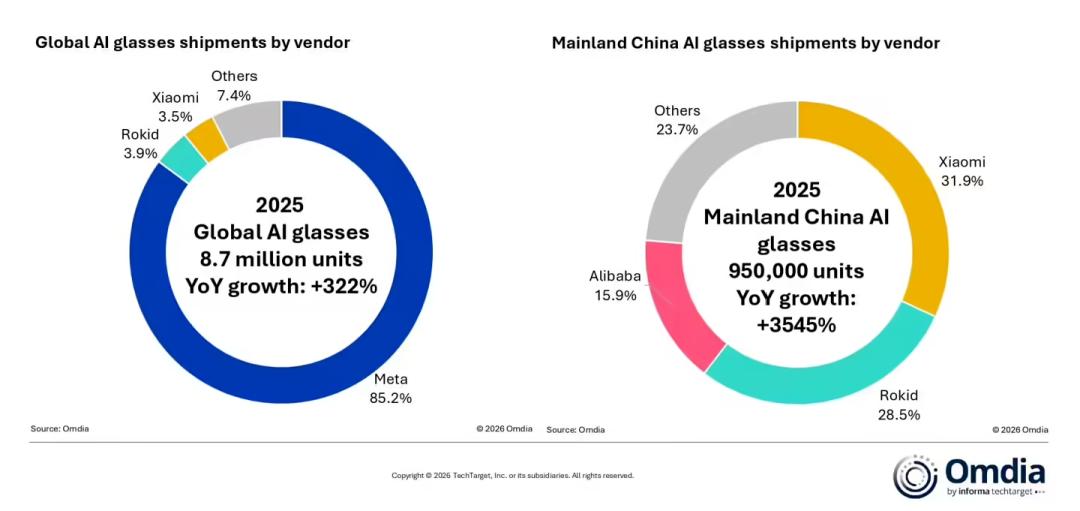
Rokid's choice belongs to the latter: it uses AI+AR glasses with display function to enter business, cultural tourism and industrial scenarios, and maintains the second position with the differentiated capability of "display" in the global pattern where Meta occupies an absolute advantage.
But this does not mean that glasses have solved all the problems of Personal Agent. IDC analysts point out that the real user value of smart glasses remains to be explored, and the industry is still in the transition stage from "early adopter experience" to "practical tool". The data privacy boundary brought by first-person perception, interaction specifications in public scenarios, and physical constraints of battery life and weight are all variables that have not yet been finalized.
Glasses make up a piece of the puzzle in the perception layer, not the final answer.
IDC data shows that global smart glasses shipments reached 14.773 million units in 2025, a year-on-year increase of 44.2%; among them, shipments in the Chinese market reached 2.46 million units, a year-on-year increase of 87.1%. According to Omdia statistics, Xiaomi ranks first in the domestic market with a 31.9% share, followed by Rokid with 28.5%, and the two together take more than 60% of the total market.
In the first half of 2026, the industry return rate is in the range of 30% to 70%. Among more than 200 AI functions launched in the past two years, the long-term usage rate by users is less than 6%. This means that a considerable number of sold glasses have not been transformed from "novelty experience devices" to "daily wearable devices".
This puts an implicit test on the cooperation between Rokid and Xiaohongshu. The value of Sweet Potato depends on whether users are willing to habitually speak to their glasses in real consumption scenarios, and let the glasses perceive continuously.
If the wearing rate itself is unstable, the data chain of progressive perception will break frequently, and the Agent's "understanding of you" will degenerate into occasional demonstration moments.
What the glasses are carrying at present is more like a technical verification field: to verify the availability of real-time multimodality, active service and long-term memory in the real environment, rather than a mature mass entrance. Xiaohongshu's positioning for this cooperation also shows restraint: polish the capability first, then talk about large-scale promotion.
The larger background is that the AI glasses track is experiencing a dense "hundred-glasses war". The entry of players such as Xiaomi, Huawei, Alibaba and Li Auto has pushed the competition in price and channels to the forefront. Rokid's path of building operating system, developer ecosystem and offline store system is a narrow path. It has higher thresholds and longer return cycles, but once the agent ecosystem forms a network effect, the substitutability of hardware will decrease.
Zhu Mingming sets the sales target of 10 million units before 2030, and says "if we fail to achieve it, we lose". This time scale points out that the current stage of competition is not the distribution of final market share, but the qualification race of "who can stay on the user's nose, and who can let developers make money on the platform".
The competition of Personal Agent is shifting from "whose model is smarter" to "who is closer to the user's intention". Mobile phones used to be the closest, but their interaction logic requires users to take actions first. Glasses do not need that: as long as they are worn, the perception process has already started.
This subtle difference may be closer to the threshold for Agent to move from "usable" to "useful" than any model upgrade.
This article is from the WeChat official account "Super Focus foci", written by Bai Mo, and published with authorization from 36Kr.