Uncovering the "Batteries with a Range Exceeding 2000 Kilometers"
Power batteries for new energy vehicles now present two completely different development directions. One is heading downward. "In the next ten years, lithium iron phosphate batteries will continue to dominate the domestic power and energy storage battery markets." On October 28, Ouyang Minggao, academician of the Chinese Academy of Sciences, spoke in support of lithium iron phosphate batteries at the 33rd Annual Meeting of the China Society of Automotive Engineers. The other is heading upward. Ouyang Minggao also mentioned two technical routes: one represented by lithium iron phosphate that pursues low cost, high safety and long service life; the other represented by ternary batteries that develops toward higher energy density. More "advanced" than ordinary ternary lithium batteries are solid-state batteries. And lithium-air batteries have more theoretical performance advantages than solid-state batteries. "The cruising range can reach 2,000 or even thousands of kilometers!" "It's just a concept hype!" Opposing voices have once again set off waves. Today, C Dimension will reveal the true nature of lithium-air batteries: are they a rising star, or just a marketing gimmick?
01
Lithium-air Battery, More "Ultimate" Than Solid-state Batteries?
A while ago, Wu Kai, chief scientist of CATL, listed lithium-air (lithium-oxygen) batteries as the company's long-term core R&D direction at the Forum on Building a Strong Equipment Industry.
Lithium-air batteries are called "breathable batteries", which use metallic lithium as the negative electrode, directly take oxygen from the air as the positive electrode reactant, absorb oxygen to generate lithium peroxide during discharge, and decompose to release oxygen during charging, which means the battery can "breathe air".
Since no scarce positive electrode materials such as nickel, cobalt and manganese are needed, the theoretical energy density of lithium-air batteries is extremely high, with the theoretical upper limit in the laboratory reaching thousands of Wh/kg, which can support the cruising range of electric vehicles over 1,000 kilometers.
Although the concept of lithium-air batteries was put forward as early as the 1970s, even compared with solid-state batteries, lithium-air batteries are still too far away from mass production.
Even as strong as CATL, it has only established lithium-air batteries as its long-term core R&D direction. It is no exaggeration to say that this is a cutting-edge topic where "dawn" is unlikely to be seen until ten years later.
To achieve formal mass production and landing, lithium-air batteries need to solve far more problems than solid-state batteries, and almost every link of charging and discharging is full of "huge pitfalls".
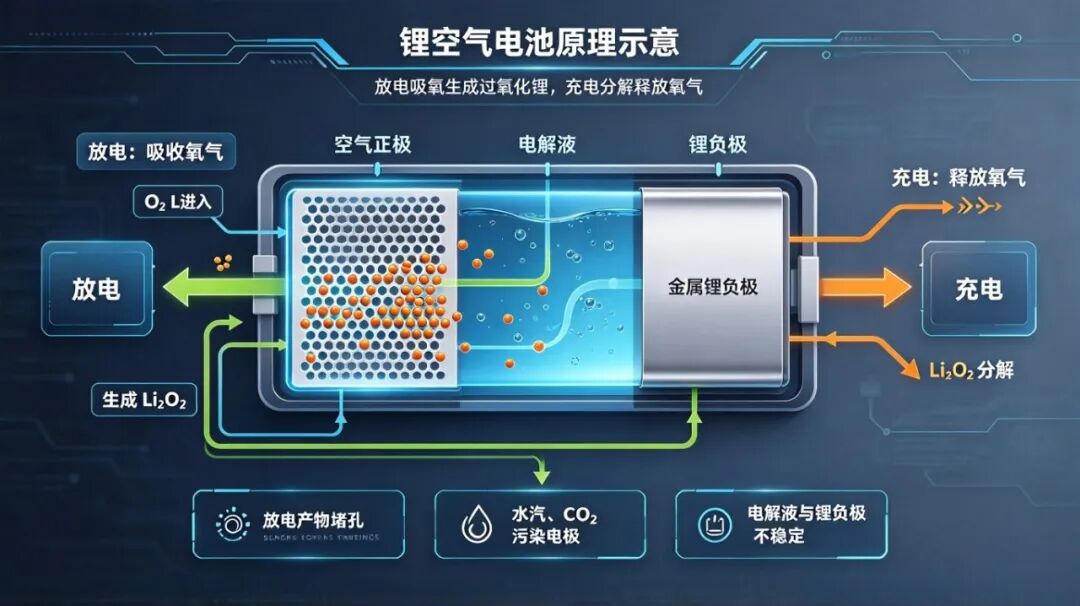
The biggest trouble comes from the discharge product lithium peroxide.
Lithium peroxide itself is non-conductive, which can easily block the micropores of the air positive electrode. When charging, a very high voltage is required to decompose it, resulting in high energy consumption, severe heat generation, and a part of it can never be completely decomposed, with more and more by-products accumulating, leading to rapid attenuation of battery capacity.
Secondly, water vapor and carbon dioxide in the air will directly pollute the electrodes.
Lithium-air batteries can "breathe", but once water vapor and carbon dioxide enter, they will react with lithium and lithium peroxide to generate irrecoverable substances, further locking the battery capacity.
To work normally, a complex air purification device can only be installed to remove water and carbon; once this structure is added, the original advantages of light weight and high energy density will be greatly reduced.
In addition, it is very difficult to select suitable electrolyte.
Ordinary organic electrolytes are easily corroded and decomposed by active oxygen substances in the reaction process; in addition, the metallic lithium negative electrode itself is prone to dendrite growth and continuous erosion by active oxygen, leading to prominent safety hazards.
It is understood that most current laboratory samples can only achieve hundreds of cycles, which is far from the requirement of thousands of cycles for automotive power batteries. Moreover, there is no mature industrial chain for catalysts, air-permeable electrodes, gas-liquid seals, BMS and gas management systems.
After this comparison, don't you think solid-state batteries are much more mature than lithium-air batteries?
02
Standard Implementation Paves the Way for Solid-state Batteries
At present, players around the world that are making layouts in solid-state batteries have formed clear camps.
Among battery enterprises, leading domestic players including CATL, BYD, CALB, Gotion High-Tech and others are all conducting R&D on solid-state battery routes; overseas companies such as Toyota, Panasonic, QuantumScape, SES AI, Solid Power are also continuing to invest in this field.
At the automotive enterprise level, BYD plans to launch the demonstration installation of all-solid-state batteries in vehicles around 2027, and achieve large-scale implementation after 2030; Toyota, Honda, Nissan, Volkswagen, BMW, Hyundai and other enterprises have all announced trial installation and mass production schedules, making 2027 the key node for small-batch vehicle installation that all players are targeting.
However, the real industrialization and implementation of solid-state batteries cannot be separated from the support of national standards and industrial planning, in addition to the bottlenecks in materials and processes.
The "15th Five-Year Plan" new energy battery industry plan clearly puts forward the goal that by 2030, all-solid-state batteries will initially realize large-scale application.
At the same time, a series of national standards for solid-state batteries are being implemented in batches. GB/T 48093.1-2026 Solid-state Batteries for Electric Vehicles — Part 1: Terminology and Classification has been officially released, which for the first time provides "standards" to follow for solid-state batteries.
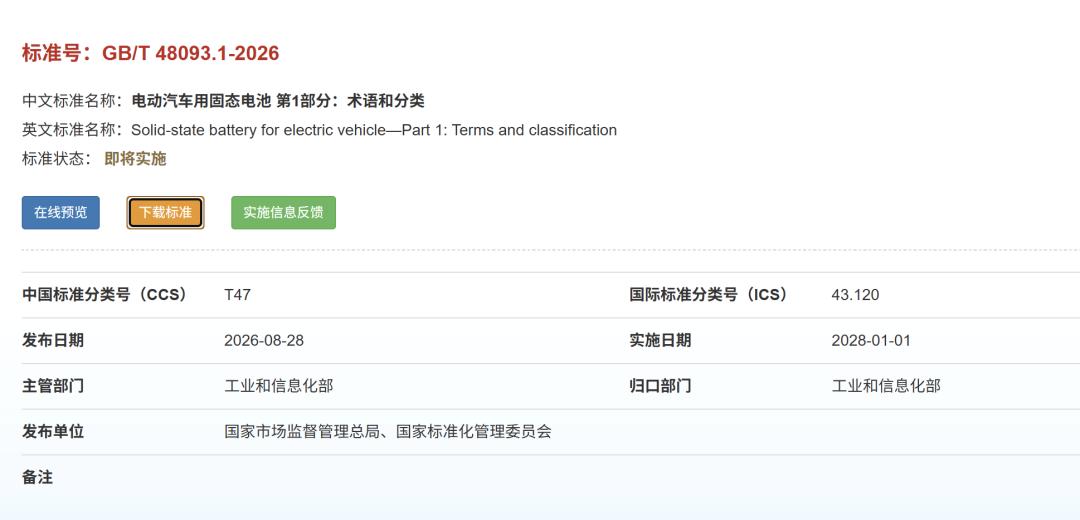
It is reported that the series of standards for Solid-state Batteries for Electric Vehicles includes terminology classification, safety specifications, etc., which are jointly drafted by China Automotive Technology and Research Center Co., Ltd. together with CATL, BYD, Gotion High-Tech, CALB and other units.
It is mainly used to define the test methods and safety thresholds of solid-state batteries, and solve the chaos in the past where the industry had vague definitions and different test standards among different enterprises.
This standard stipulates that solid-state batteries need to meet corresponding test conditions:
First, conduct the weight loss rate test in an environment with relative humidity no more than 0.035%. Make a break on the preprocessed test object, place the break downward, hang it for no less than 2 minutes, and visually check that no liquid flows out from the break of the test object.
Second, put the test object into a vacuum drying oven, heat it to 120℃ and keep the temperature for 360 minutes. After the test is completed, cool the vacuum drying oven to below 50℃, restore the air pressure to normal pressure, and the calculated weight loss rate shall not exceed 0.5%.
In other words, all batteries that meet this series of tests can be called solid-state batteries. But it needs to be made clear that laws and standards only "pave the way" rather than "force premature maturity".
Policies can guide capital and scientific research resources to tilt toward solid-state batteries, and remove the compliance thresholds for product launch, but cannot directly solve the underlying engineering problems such as solid-solid interface, cost and yield.
This is the fundamental reason why solid-state batteries have been talked about for so long, but are still on the eve of mass production.
03
Compared with Falling Behind, Automakers Fear Having No Compelling Story to Tell More
Many people may wonder, since automakers choose to develop batteries independently, why don't they go straight to the point and directly research solid-state batteries and lithium-air batteries, instead of "lingering" in the existing lithium iron phosphate and ternary lithium battery systems?
The answer is simple. Compared with more cutting-edge technical routes, automakers at this moment need a visible story to tell. What's more, they do not have enough money to invest in something full of uncertainties.
Regarding independent R&D, many people have misunderstandings, thinking that independent R&D means building a complete cell production line and developing a brand-new electrochemical system from scratch. In fact, the "independent battery R&D" of automakers is divided into different levels. At the current stage, the core of real independent R&D of automakers is mainly concentrated in four sectors:
First, the battery pack integration solutions, that is, structural innovations such as CTP and CTC, which directly determine the space and weight of the whole vehicle;
Second, BMS battery management algorithms and thermal management strategies, which determine the fast charging capability, low-temperature performance and battery life;
Third, customized cell definition for vehicle scenarios. Based on their own vehicle positioning, automakers put forward customized cell specifications to battery enterprises to match their own 800V high-voltage platforms and 5C/6C ultra-fast charging demands;
Fourth, accumulate capabilities in materials and solid-state pre-research synchronously, so as to avoid the situation where automakers cannot understand the underlying design of cells at all when the solid-state battery era comes, and continue to passively rely on external suppliers.
Power batteries account for a very high proportion of the total vehicle cost, and the cruising range, fast charging, safety and other indicators directly determine product competitiveness. If the battery is completely defined by external suppliers, it is difficult for automakers to create differentiated experiences, and they will also lack a sense of "security".
Therefore, enterprises including Li Auto, GAC Group, Geely, Chery, Great Wall Motors and others are making layouts in the battery business. On the one hand, they want to solve the problems of supply chain fluctuations and bargaining power.
On the other hand, they try to make batteries the core selling point of the vehicle product strength, such as 8-minute fast charging, full-domain thermal runaway protection, long-life battery packs, etc.
However, the cruel part of the market is that the performance dividend of lithium batteries has reached the ceiling, and the iteration space of lithium iron phosphate and ternary lithium batteries is limited. Leading battery enterprises have already completed the extreme involution in materials, processes, yield and cost.
For automakers, the current crazy rush for independent battery R&D seems to grasp the initiative of the supply chain, but it is easy to fall into the awkward dilemma of "involution in old technologies and absence of new technologies".
Of course, in this case, does it mean that they should not conduct independent battery R&D?
The competition of power batteries is no longer a simple competition for production capacity and integration, but a contest of forward-looking layouts spanning a ten-year technical cycle. The independent battery R&D of automakers led by new vehicle power brands is also to maintain their own brand power, reduce achievable costs, and continue to tell their stories.
It's just that some tell the story well, while others don't.
This article is from the WeChat Official Account "C Dimension", written by Zhang Zhidong, edited by Wang Yue, and published with authorization by 36Kr.