Claude's evolution speed has doubled, and 80% of the increment comes from AI.
Concrete figures have finally emerged to quantify how fast AI is accelerating the R&D of next-generation AI.
On November 5, third-party evaluation institution METR released an investigation report on Anthropic, stating that the benchmark capability progress the company has made in the past year is roughly equivalent to the progress it achieved in the previous two years.
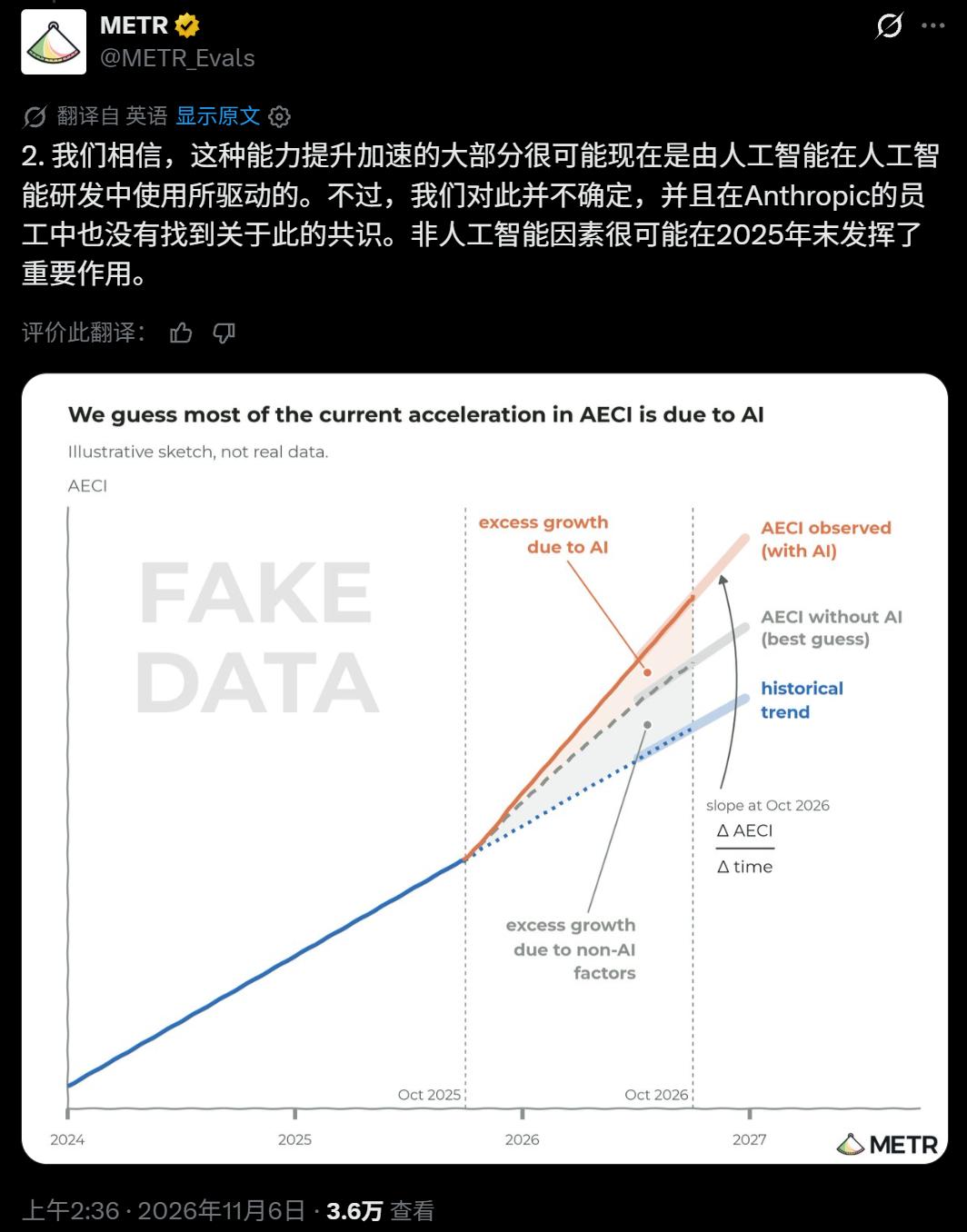
From August 12 to October 29, the institution spent about 11 weeks accessing Anthropic's internal data including model performance, training computing power, R&D efficiency, and conducting interviews with researchers.
Their analysis adopted Anthropic's comprehensive capability indicator AECI. The data shows that since October 2025, the progress speed of large models on this indicator is about 1.9 times of the previous level, with a 95% confidence interval of 1.5 to 2.8 times.
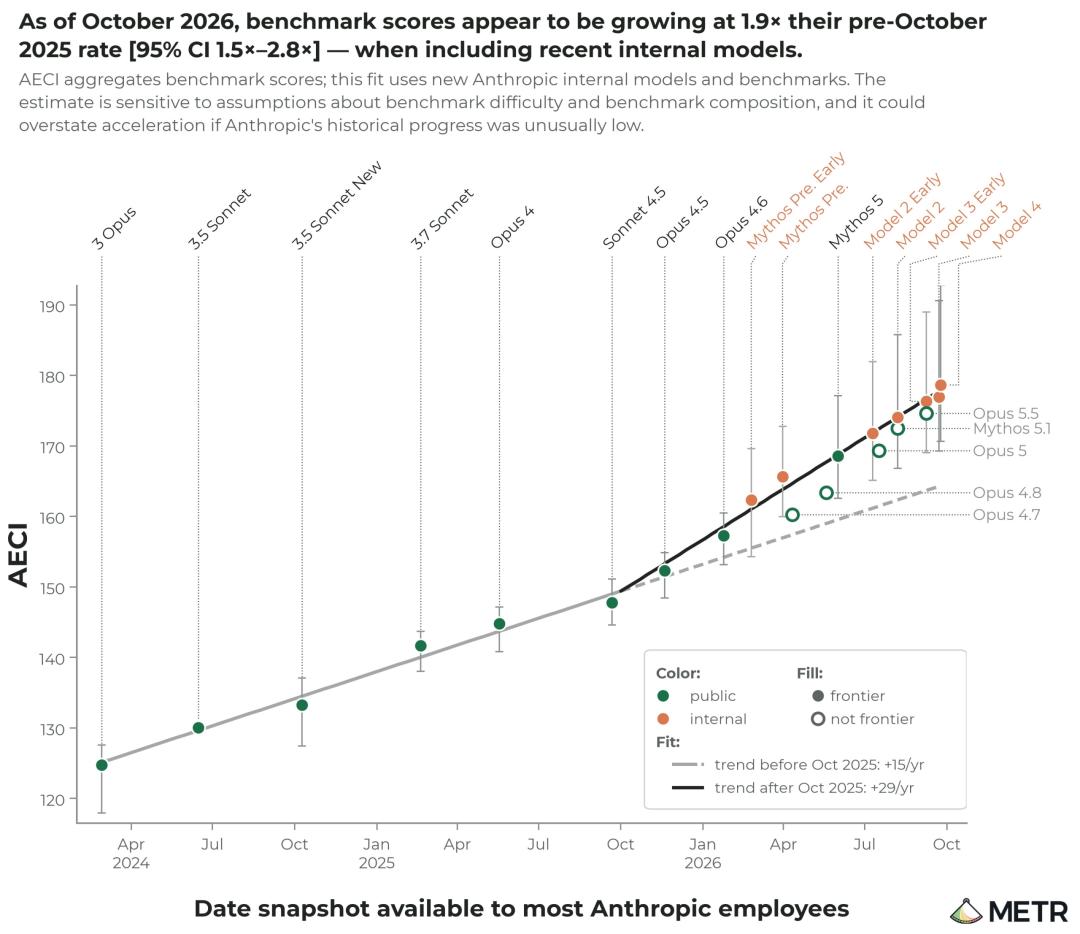
Since October 7, 2025, the score has jumped from about 15 points per year to about 29 points per year, covering the progress that previously took roughly two years, which is roughly equivalent to the leap from Claude 2.1 to Sonnet 4.5. Anthropic's own risk report previously assumed that Mythos Preview was a single leap after which progress would return to the original trend, but now with the emergence of new models, the new growth slope is still continuing.
Across the whole industry, the acceleration of cutting-edge models is only 1.4 times.
More critically, METR is quite convinced that this acceleration does not come from the growth rate of the computing power scale for training AI. The main driver of AI capability improvement comes from AI's own assistance.
A recurring phenomenon in the interviews is that researchers can finally test far more ideas than before.
In the past, an experiment might take one or two days to implement, and the time and computing cost were insurmountable, so many ideas were shelved before they could be verified. Now, researchers can hand over multiple ideas to Agents to see which ones are worth further pursuing.
One researcher described that his current work is mainly limited by ideas and computing power, and code is no longer a bottleneck. Others said that after using Claude, it feels like they have postdoctoral fellows and graduate students working on projects together. Experiments and implementation have become much cheaper, making researchers more willing to try new things, and many small experiments that were previously considered not worth investing energy in now have the opportunity to develop into new research directions.
METR's report also uncovered part of the internal progress that was previously invisible to the public. Their analysis included three models that Anthropic has not yet made public, referred to as Model 2, Model 3, and Model 4 respectively. They completed training between July and October this year.
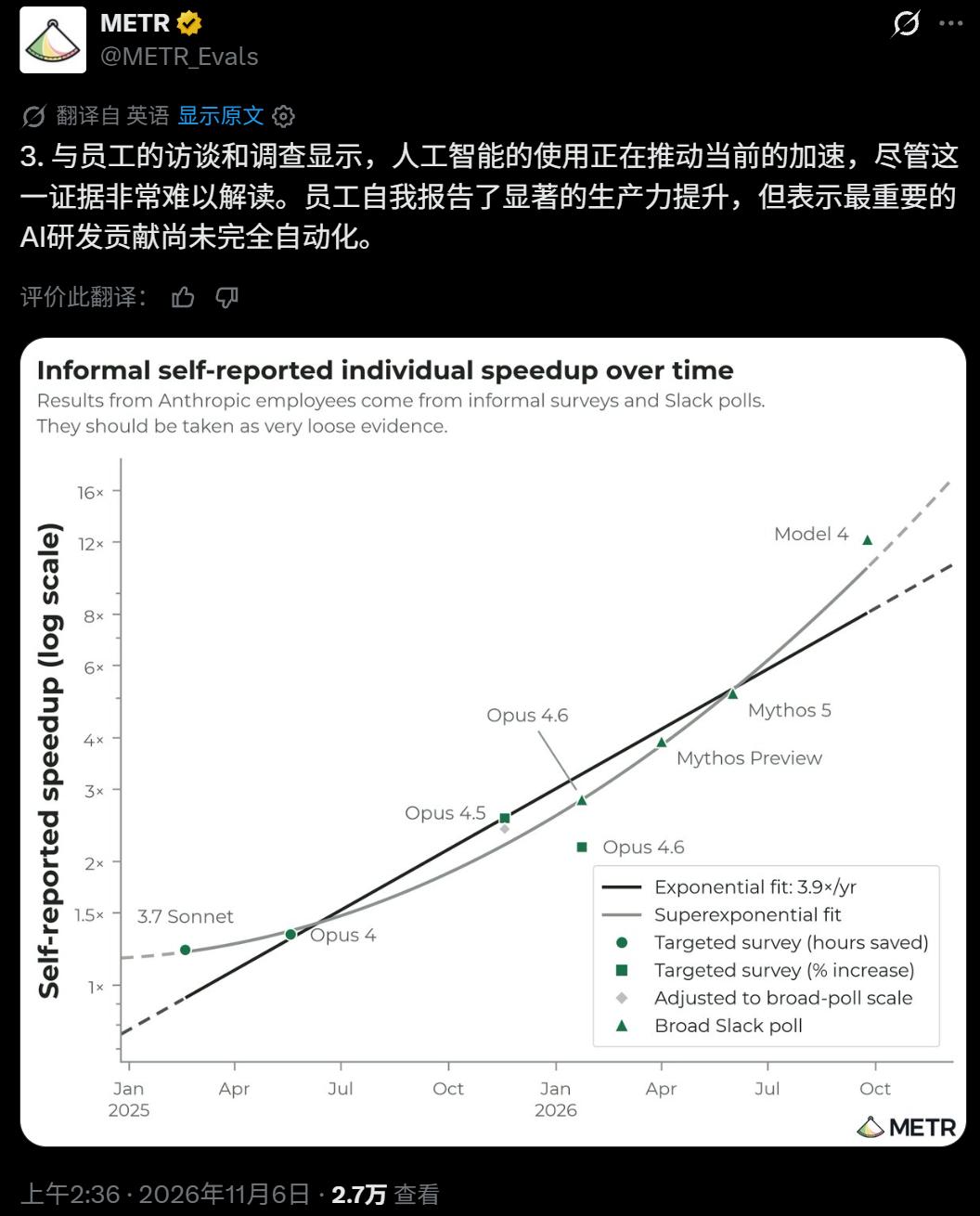
The currently strongest one is Model 4 (some people speculate it is Claude 6), whose scores on many common benchmarks have exceeded 90%. Anthropic employees made a subjective internal estimate in October, voting that the model has improved their average work efficiency by about 12 times.
These models have not been released, and may not even become public products, but their existence reminds the public that judging what is happening inside large AI companies solely by press conferences and public leaderboards cannot give a complete picture. From about 1x at the beginning of 2025, to about 2.5x for Opus 4.5, about 5x for Mythos 5, and a jump to 12x for Model 4, the exponential fit shows a 3.9x annual growth rate.
METR estimates that as of October this year, about 80% of the current acceleration in AI research comes from AI. The remaining 20% are non-AI factors, whose details Anthropic has prohibited from disclosing.
So, has AI been able to independently develop its own next generation?
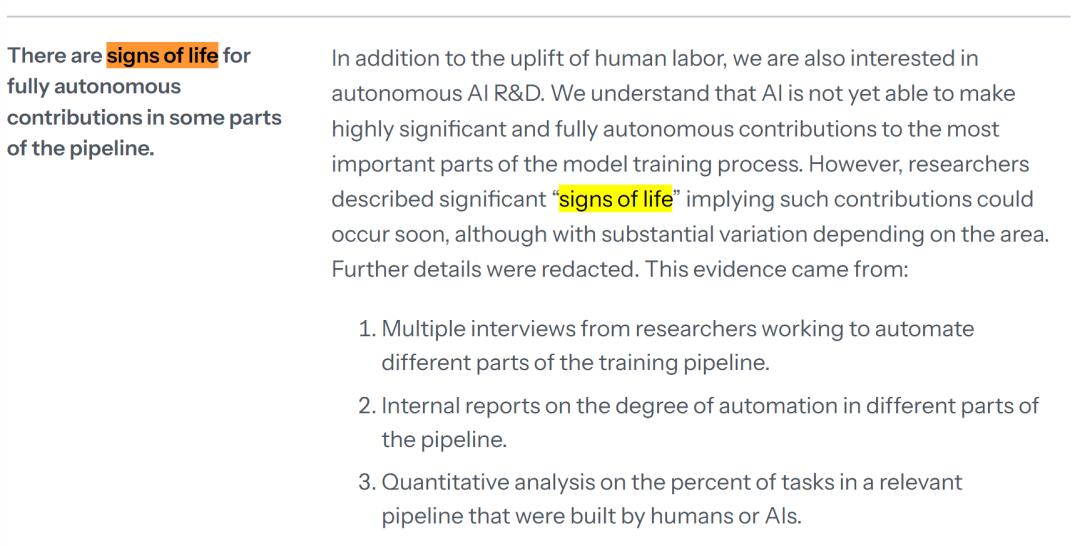
There is still a gap before achieving full Recursive Self-Improvement (RSI), which allows AI to independently develop next-generation models. Anthropic's own researchers believe that AI has not yet made highly important and fully autonomous contributions to the most critical parts of model training, and the main benefits currently still come from AI-assisted human R&D.
But Anthropic researchers have described a large number of AI's autonomous contributions as "signs of life", and there are quantitative analyses counting the proportion of tasks completed by AI versus humans in each link, but the data has been deleted by Anthropic.
As long as more powerful models can help researchers develop the next generation faster, the feedback process will likely continue to strengthen. How far the RSI path can go depends on the links that have not yet been automated, and whether resources such as computing power can keep up.
For near-future predictions, METR does not see any bottlenecks that will significantly block rapid progress in the next 12 months, but also admits that they have revised their judgments many times as more information became available, and their current confidence is limited.
In addition, although Anthropic allowed the third-party institution METR to conduct an internal investigation, the 100-page report released now has been heavily edited by them. Most of the most convincing evidence has been deleted by Anthropic itself.
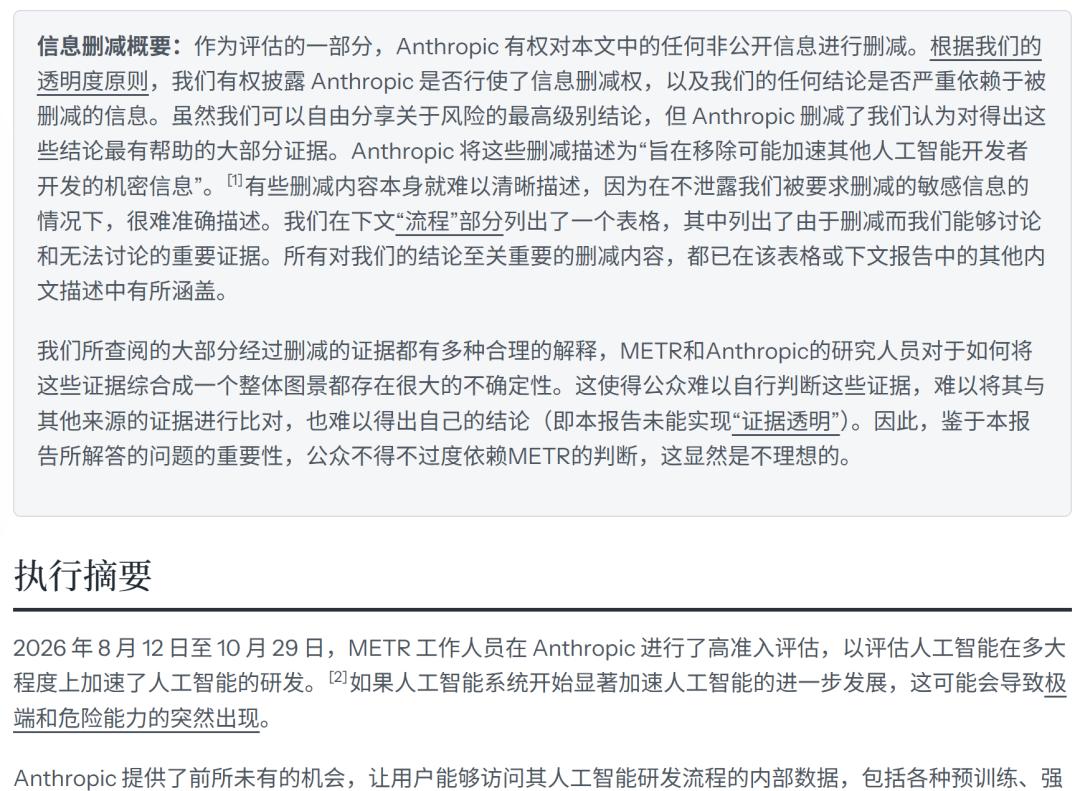
The accompanying review released on the same day also shows the differences between the two sides in risk expression: Anthropic once described a leading indicator as a progress speed of "less than twice", while METR calculated it to be about 1.97 times based on internal data, and believed that the more accurate statement should be "about twice". The 2x acceleration is related to Anthropic's early warning threshold.
METR believes that the possibility of crossing the relevant threshold as of July 15 cannot be ruled out, but most relevant researchers still tend to believe that the threshold had not been crossed at that time. Both sides also agree that the direct catastrophic risk of the relevant models at that time was relatively low.
As models participate in R&D at an increasingly faster pace, whether people can see the changes in time and whether companies can fully disclose uncertainties is becoming a question that must be answered before the arrival of next-generation AI.
References:
https://metr.org/blog/2026-11-05-anthropic-ai-rd-acceleration-assessment/#executive-summary
https://x.com/METR_Evals/status/2118412183860351084
This article is from the WeChat Official Account "Synced" (ID: almosthuman2014), written by Synced team focusing on RSI, edited by Zenan, and authorized for release by 36Kr.