Everything You Need to Know About AI Product Managers: Six Core Tracks and Career Transition Guide
In the past two years, one of the most anxiety-provoking topics in the product manager community is probably whether to transition to work as an AI product manager.
When you open recruitment apps, you will see a growing number of AI product manager positions. Monthly salaries of 30,000 to 40,000 RMB are very common, and some senior positions even offer 70,000 to 80,000 RMB per month. Looking back at the traditional product work you have been engaged in for many years, you can hardly avoid feeling a little tempted.
However, when you actually try to submit your resume, you will find that things are not that simple.
Some positions require familiarity with large model training and evaluation, some require knowledge of Agent, RAG and MCP, and others require more than five years of experience in the finance, manufacturing or enterprise software industry.
Although all these positions are called AI product manager, their recruitment requirements are as different as those for completely unrelated occupations.
What is even more frustrating is that you have already worked as a product manager for five or even ten years, but in the AI field, do you really have to start all over again as a junior product manager?
This anxiety does not come out of nowhere.
The 2026 AI Talent Report released by Maimai High Recruitment shows that from January to July this year, the number of AI product manager positions increased by 120.54% year on year, ranking first in terms of expansion speed among non-technical positions.
The number of positions is indeed growing, but opportunities are not evenly distributed to every product manager.
The reason is very simple: today's AI product manager role has long differentiated into several completely different career directions. Some people study the capability boundary of large models, some focus on user retention every day, some build Agents for enterprises, and others are responsible for deploying AI into customers' actual business systems.
All these people are called AI product managers, but their daily work, technical thresholds, salaries and future development spaces vary greatly.
For product managers who want to make a transition, choosing the wrong direction is sometimes more troublesome than not making the transition for the time being.
Today we will systematically sort out: what types of AI product managers are there exactly? Why is the salary gap so huge? How should traditional C-end and B-end product managers choose their own path?
01
AI product managers have been divided into six major camps
If divided according to the technical level of the product, service objects and work content, AI product managers can be roughly classified into six categories at present.
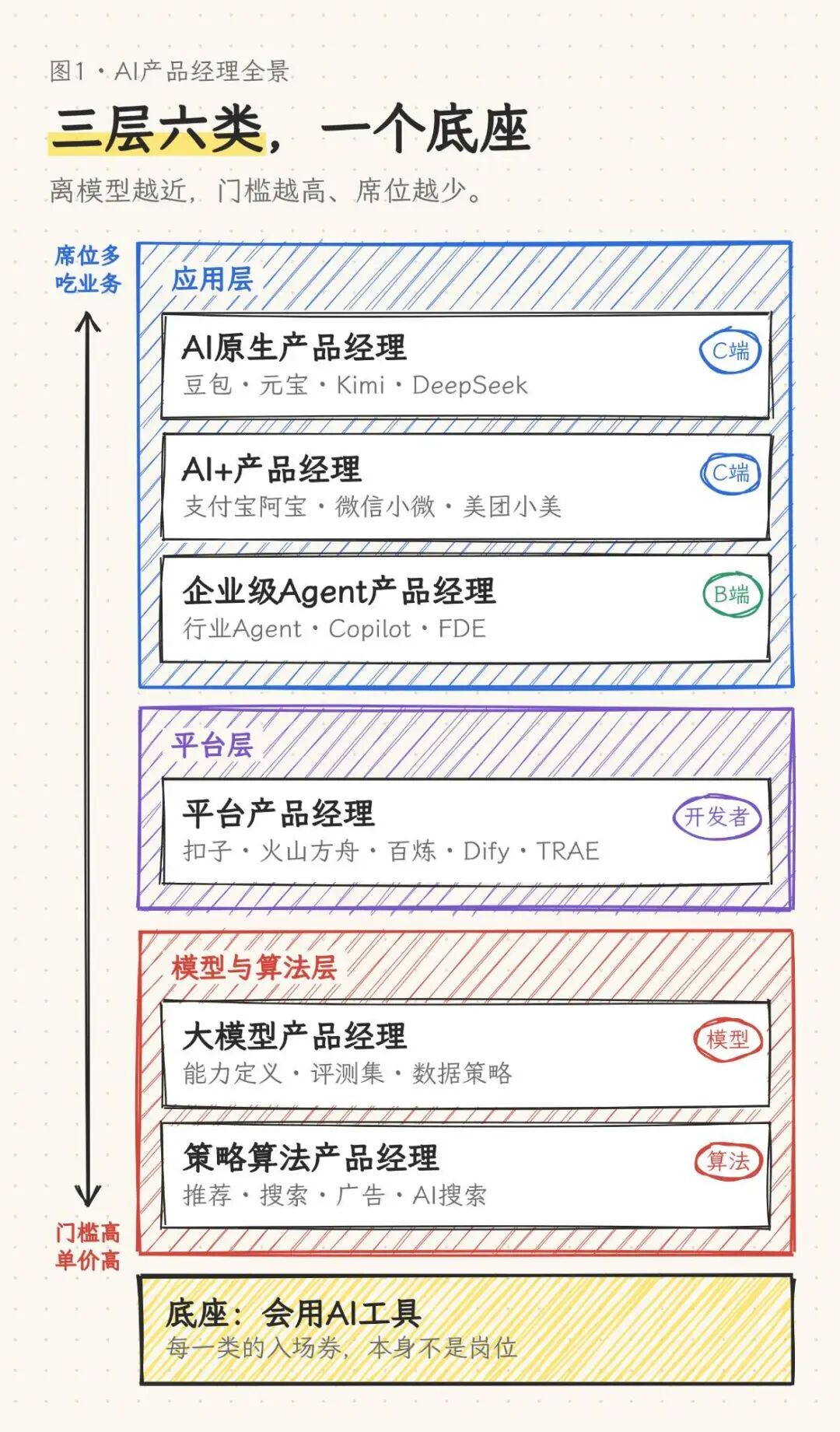
The first category: AI-native application product managers.
This is the direction that many people are most eager to pursue.
Behind AI applications such as Doubao, Yuanbao, Kimi, DeepSeek, Qianwen, as well as Jimeng and Keling, there are corresponding product teams.
The common feature of these products is that their core experience is highly dependent on large models. If the AI capabilities are removed, the main value of the products will no longer exist.
AI-native product managers have a huge number of questions to think about every day: Why do users use your product? Why do they leave after using it once? What capabilities should the model have? When to use conversational interaction, and when to use buttons, canvases or other operation methods?
There is also a very practical problem: Tokens cost money.
Assuming that users call the model dozens of times every day, and the cost exceeds the membership revenue, then the more popular the product is, the more losses the company may suffer.
When working on traditional Internet products, product managers mainly focus on traffic, retention, conversion and commercialization. For AI-native applications, none of these problems are gone, and you also need to study model capabilities and reasoning costs.
What is more troublesome is that models are upgraded extremely fast. Functions you worked hard to design may be directly realized by a model update next month, and the previous product design has to be adjusted accordingly.
Such positions generally have high requirements for technical understanding and innovation, especially for leading general AI assistants.
Tencent, Alibaba, ByteDance, Baidu, as well as companies like Kimi and DeepSeek, are continuously investing in this direction. It is imaginable how difficult it is for small and medium-sized enterprises to compete with these companies in the general assistant track.
However, there are still opportunities for vertical AI applications. For example, in fields such as AI education, AI healthcare, AI design, AI companionship and AI legal services, the understanding of specific users and business scenarios is equally important.
For ordinary product managers, joining a vertical AI application team is usually more realistic than directly competing for positions in leading general assistant teams.
The second category: AI+ product managers.
This category is probably the direction that traditional Internet product managers should pay the most attention to.
The so-called AI+ means endowing an existing product with AI capabilities.
For example, Alipay launched the AI assistant Abao, WeChat is testing its native AI assistant Xiaowei, and Meituan launched Xiaomei.
These products already have a large number of users, rich business scenarios and mature service systems. The problem now is how to make AI understand user demands and then mobilize the original functions.
Here is an example.
In the past, if a user wanted to order takeout in WeChat, he needed to find the corresponding mini-program, search for merchants, select products and confirm the order.
With the AI assistant, the user may only need to say one sentence: Help me order a lunch near me with good reviews and within 30 yuan.
This seemingly simple sentence involves a series of links including intent understanding, merchant search, service invocation, user confirmation and payment permission.
There are even more troublesome issues.
If the AI orders the wrong meal for the user, or miscalculates a consumption bill, how should the responsibility be divided? What operations can be performed automatically by AI, and what must be confirmed by the user?
When working on such products, it is certainly important to be familiar with the model, but the business experience, user habits and risk awareness accumulated over many years are often more important.
This is also why I believe that most traditional C-end product managers should prioritize AI+ positions when making a transition.
Your user insights, interaction design, growth experience and industry knowledge can continue to play a role. There is no need to completely discard all your previous accumulated experience just to transition to the AI field.
The third category: enterprise-level AI/Agent product managers.
This direction is not as bustling as the general AI assistant, but it may be the most realistic transition opportunity for a large number of B-end product managers.
Nowadays, many enterprises are discussing building their own Agents.
Financial companies want to use AI to assist underwriting and claims settlement, manufacturing enterprises want to use AI to optimize production and supply chains, and retail enterprises want to use AI to improve the efficiency of customer service, sales and operation.
On the surface, all these demands seem to be solvable through large models.
When it comes to actual implementation, troubles are just beginning.
For example, an insurance company wants AI to automatically handle part of the claims settlement business.
You have to first figure out the claims settlement process, know which materials need manual review, which rules must be strictly implemented, which data cannot be called arbitrarily, and consider how to deal with the situation when AI gives wrong answers.
Completing the Demo is often just the first step of the project.
Next come system integration, permission management, data security, staff training, customer acceptance, and the final ROI evaluation.
Traditional product managers are used to discussing user experience, while enterprise-level AI product managers often have to answer a very simple question from the boss:
We have spent so much money on AI, how much money has it actually helped the company save?
There is a noteworthy change here.
In the past, many B-end product managers felt that what they did was not attractive enough. Dealing with ERP, CRM, OA and approval processes every day is not as glamorous as working on social, content and consumer products.
In the Agent era, the situation has changed.
What enterprises lack the most is exactly those people who truly understand business processes, are familiar with industry rules and know how to connect systems.
For example, a product manager who has worked on supply chain products for eight years may not understand model training, but he knows how procurement, inventory, logistics and settlement collaborate with each other. When he is in charge of the supply chain Agent, his business understanding may be much deeper than that of a new person who has just learned to build Agents.
Of course, business understanding cannot replace technical capabilities. At least you need to know how Agents call tools, retrieve enterprise knowledge, control permissions and evaluate actual effects.
Here we also need to mention a rapidly growing new position: FDE, Field Deployment Engineer.
According to data from Maimai, from January to July 2026, the number of FDE and on-site deployment engineer positions increased by 1522.73% year on year.
The growth rate is really amazing, but we also need to consider the fact that the original base of emerging positions is relatively small.
FDEs usually need to go to the customer site to connect AI capabilities to real business systems, and many positions also require the ability to independently write code and complete engineering deployment.
It has obvious intersection with enterprise-level Agent product managers, but it is not the same position. If product managers want to transition to FDE, they must seriously make up for their practical engineering capabilities.
The fourth category: AI platform and developer product managers.
If the first three categories mainly target end users and enterprise customers, then many of the users served by this category are developers themselves.
Representative products include Coze, Dify, Ali Bailian, Volcano Ark, as well as AI development tools such as TRAE and Qoder.
The problem they need to solve is to make it more convenient for others to develop AI applications.
For example, if an enterprise wants to build its own customer service Agent, how to import the knowledge base? How to configure the workflow? How to access external tools? If the call volume suddenly surges, how to ensure stability and control costs?
For AI programming tools, the problems become: How to understand the project code? How to modify multiple files? How to execute and verify tasks? How to reduce repeated intervention by developers?
Such positions have a feature: developers are not easy to fool.
Ordinary users may think it is enough if the function can be used, but developers will pay close attention to API design, call latency, error messages, compatibility, stability and cost.
Therefore, the technical understanding threshold for platform product managers is relatively high.
If you have worked on products such as low-code, data middle platform, cloud services, developer tools and API platforms in the past, the transition will be relatively smooth.
If you have no technical background at all and submit your resume just because you think AI platforms offer high salaries, you will probably find it difficult to even answer the technical questions in the interview.
The fifth category: large model product managers.
This type of product manager is closest to model R&D, and is the most likely to be misunderstood by laymen.
Many people think that large model product managers are responsible for designing products similar to ChatGPT.
The actual work may be completely different.
For example, the product manager in charge of a certain large model needs to judge what capabilities the model should focus on improving in the next stage.
Is it programming capability, mathematical reasoning, or tool invocation? How to build an evaluation set? After the model is upgraded, which scenarios are improved and which scenarios are regressed?
When the model outputs nonsensical content, product managers also need to work with the algorithm and data teams to analyze the problem, and judge whether to optimize the prompt words, tool chain, training data or the model itself.
The requirements for technical understanding, data analysis and model evaluation capabilities here are very high.
In terms of salary ceiling, senior positions related to large models are indeed very attractive.
But for most traditional product managers, this is also one of the directions with the highest transition threshold.
Especially for people who have worked for many years and have no algorithm or data background, it may not be worth making up a large amount of underlying technical knowledge from scratch just for a high-paying position.
On the contrary, practitioners who have experience in model evaluation, AI training and data products may have a more similar ability foundation.
The sixth category: strategy algorithm product managers.
Many people easily ignore this category.
In fact, before the emergence of large models, a large number of product managers in the Internet industry have been dealing with AI algorithms.
For example, Douyin's recommendation strategy, search engine sorting strategy, advertising delivery algorithm, etc.
They already need to understand machine learning, data indicators, A/B experiments and algorithm strategies.
In the era of large models, these positions are also changing.
AI search, generative recommendation, intelligent advertising, and model-driven user operation may all become new business directions.
For product managers who originally worked on recommendation, search and growth strategies, they have certain advantages in transitioning to AI-related positions.
They are already used to evaluating products with data and experiments, and know that algorithm outputs cannot fully meet expectations every time.
However, such positions still emphasize solid data analysis, experimental design and business strategy capabilities. Simply being able to call large model APIs is not enough to be competent.
02
All are called AI product managers, why does someone get 20,000 RMB a month while others get 80,000?
After talking about the six types of positions, let's talk about the salary that everyone cares most about.
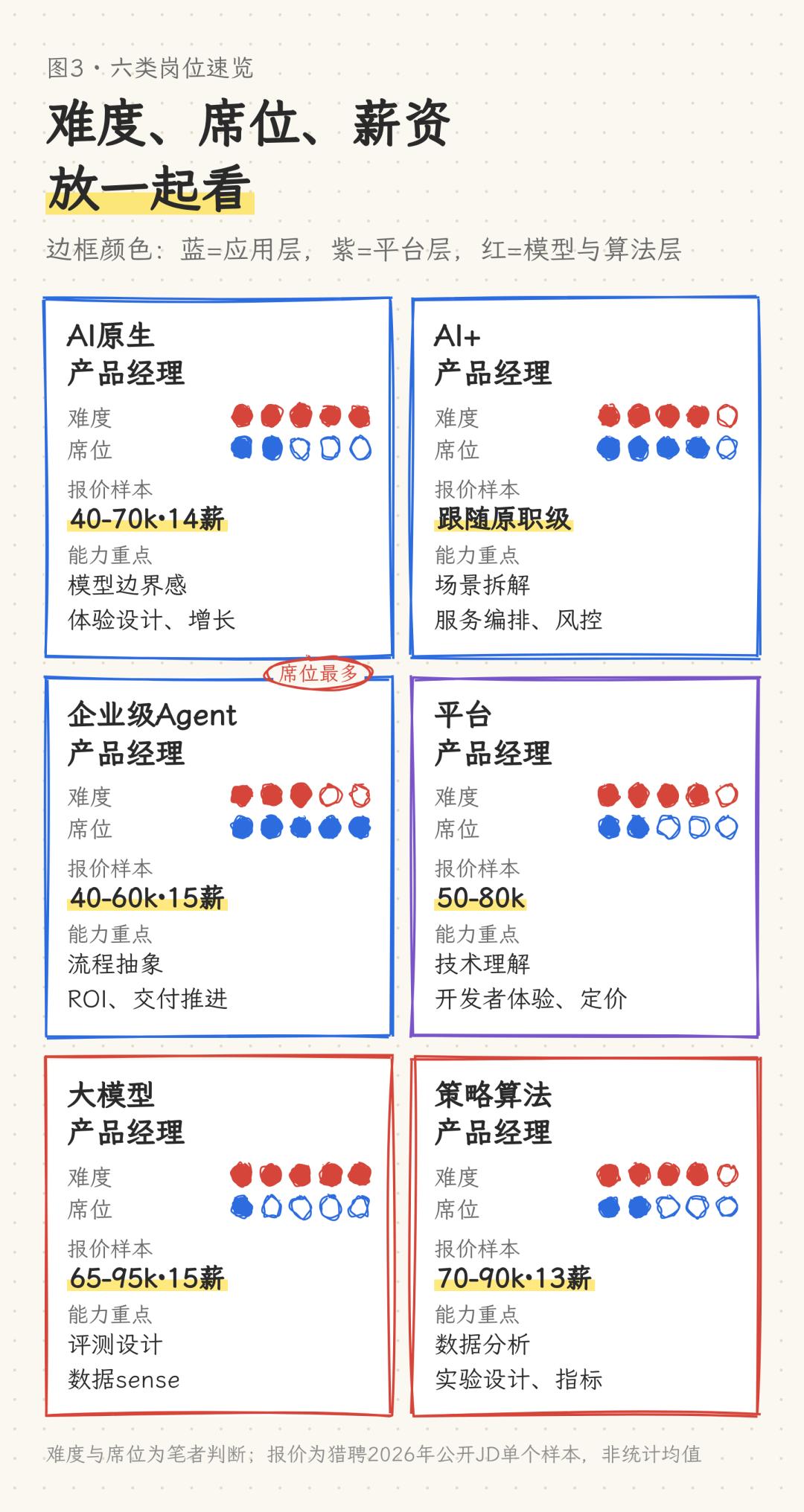
Quick overview of the six types of positions: difficulty, number of openings, salary
Let's first look at several sets of data.
From January to July 2026, the number of new AI positions posted on Maimai platform increased by 789.47% year on year, but the average monthly salary of new AI positions was 63,160 RMB, an increase of only 2.74% year on year.
Note that 63,160 RMB here is the overall average of new AI positions, covering different categories such as technical positions, and cannot be directly regarded as the average salary of AI product managers.
Another "2026 Talent Trend Report" from BOSS Zhipin shows that the salary premium of AI-related positions has dropped from 3.3 times in 2022 to 2.6 times in 2025.
Putting these two sets of data together is quite thought-provoking for product managers.
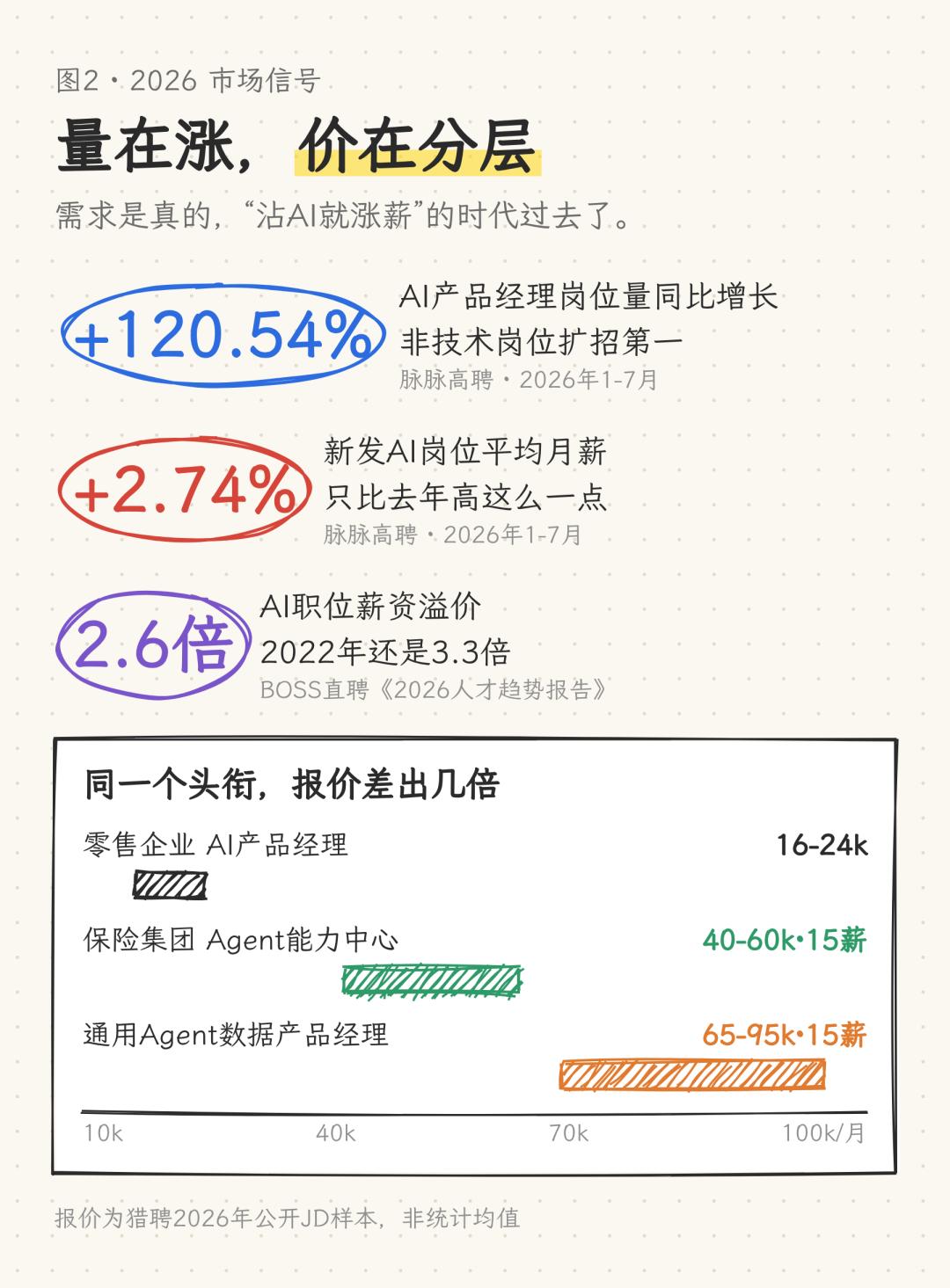
2026 market signal: the number is rising, and the price is stratified
There are more and more AI-related positions, but the salary premium brought by the AI label itself is no longer as exaggerated as in the early stage.
From the public JD samples of Liepin sorted out in the original manuscript, even with the same title of AI product manager, a retail enterprise offers 16-24K, while a certain general Agent data product manager position offers 65-95K with 15 months' salary