OpenAI has acquired a mysterious team, and Sam Altman wants to build another GitHub within Codex.
Silicon Valley is incredibly bustling today!
Just now, OpenAI officially announced the acquisition of a mysterious startup team — Pierre Computer.
Sam Altman just approved the deal, and immediately integrated its code browsing, in-line review, and distributed Git capabilities into Codex's ecosystem.

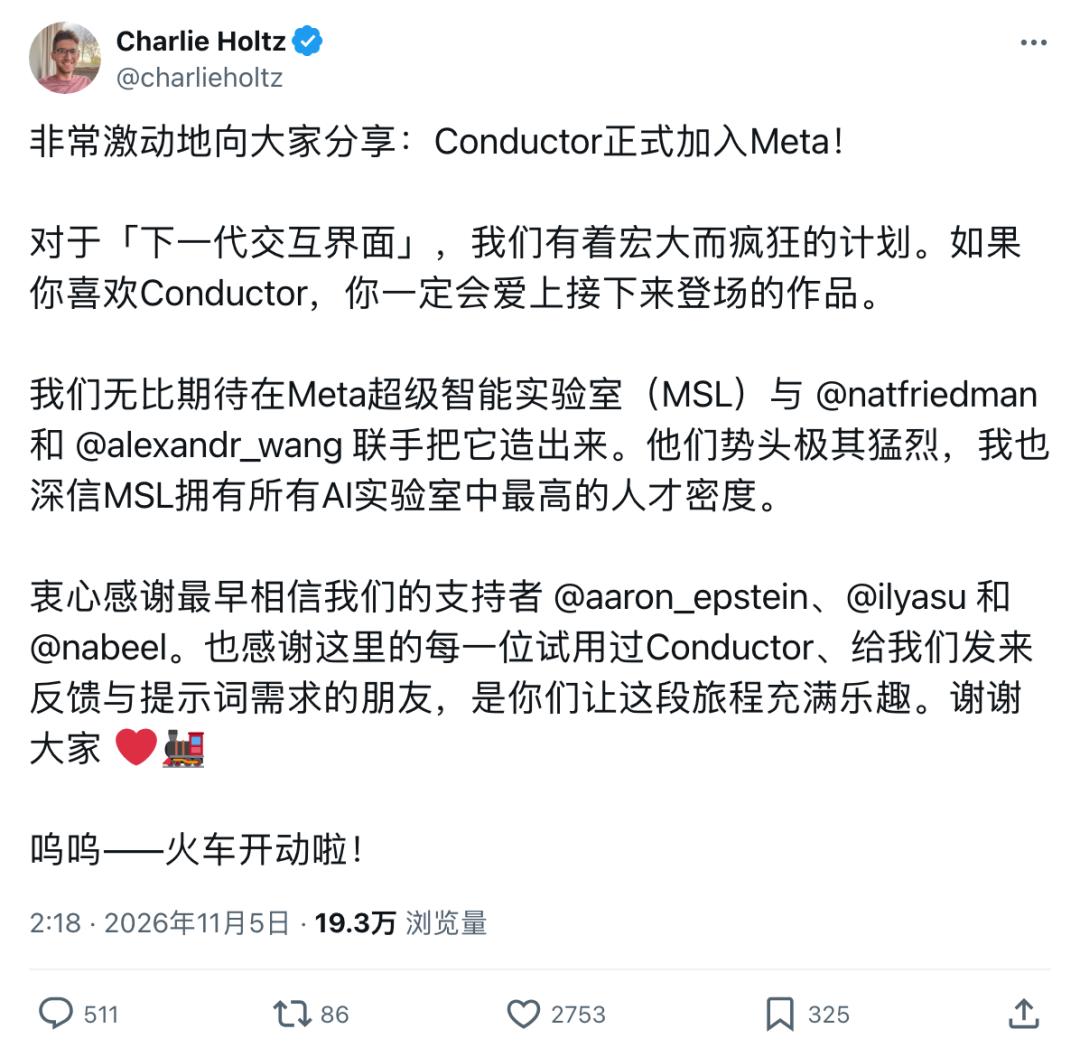
Almost at the same time, Conductor, the parallel programming tool used by more than 100,000 developers, was fully acquired by Meta today.
Founder Charlie Holtz announced that the entire team will join Meta Superintelligence Lab (MSL).
They will team up with former GitHub CEO Nat Friedman and Chief AI Officer Alexandr Wang to jointly build the "next-generation interactive interface".
Behind the sudden wave of acquisitions of development tools by major AI giants lies a clear strategic plan —
Writing code is just the starting point. They now want to take full control of every step of a developer's workflow, from branching, code review to online deployment.
OpenAI Recruits Pierre: Codex Integrates Code View, Review and Storage Capabilities
The Pierre team, which caught OpenAI's attention immediately, has extremely strong industry credentials.
Jacob Thornton, co-founder of the legendary front-end open-source framework Bootstrap, former Discord core engineer Amadeus, and Je Xia, creator of esm.sh, are all members of this team.

The Pierre team went to an outdoor street basketball court to shoot a deadpan short film "filmed in one take without a shooting permit" to officially announce their joining OpenAI
Even though the announcement video looks very low-budget, Tibo, head of OpenAI Codex, directly compared Pierre to the "Random Access Memory (RAM)" in a computer when reposting, and stated that they aim to "reshape everything".

The reason Tibo gave such high praise is that even though the current Codex can deploy more than a dozen Agents to write code at the same time, the final delivery process has become a major pain point.
Dozens of Agents run code intensively in the background, generating tens of thousands of lines of modifications that fill the screen instantly. Not only can human developers not keep up with reviewing them, but there is also no proper place to store such a huge number of branches.
The three core capabilities that Pierre has accumulated perfectly help Codex make up for the shortcomings of "viewing code, reviewing code, and storing code" in one go.
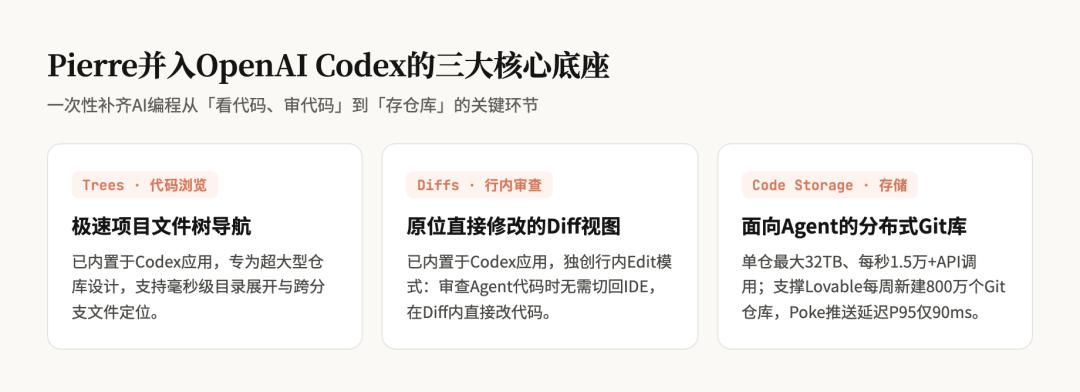
- Code View (Trees): It has already been built into the desktop version of Codex, responsible for smooth millisecond-level expansion of directories for ultra-large projects and cross-branch file positioning.
- Code Review (Diffs): Previously, when reviewing PR on GitHub, even if you found that the AI miswrote a variable name, you had to switch back to the local IDE to modify it and re-push the code; Pierre's Diffs directly embeds an "in-line Edit" mode in the comparison view, so you can modify any line of code immediately with one click if you find it unsatisfactory.
- Code Storage: A distributed Git warehouse specially designed for high-concurrency read and write by AI Agents. It has long become the invisible infrastructure behind popular applications such as Lovable, Bolt, Poke. The unicorn Lovable alone creates more than 8 million new Git warehouses every week relying on it, and Poke even performs 40,000 Git operations per minute to store Agent memories.
In the next step, this technical base will be fully integrated into Codex; OpenAI promises that all original open-source projects of Pierre and services for existing customers will remain unchanged without any interruption.
AI Pushes Git to Its Limits, Competition Reaches Microsoft GitHub's Backyard
The reason why OpenAI is in such a hurry to integrate Pierre into Codex is rooted in a major awkward problem —
Its own Git system was crashed by AI generated code not long ago.
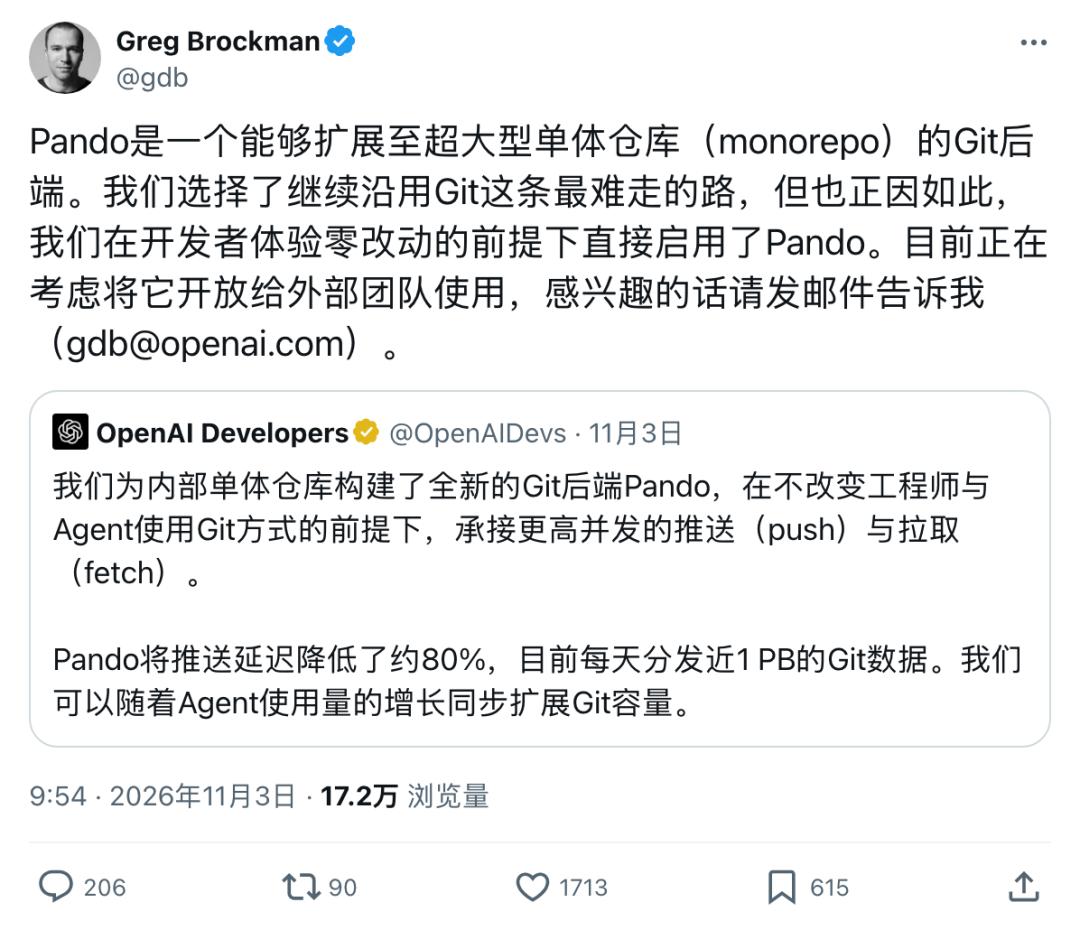
Just two days before the official announcement of the acquisition of Pierre, OpenAI just released a new self-developed internal Git backend called Pando.
It turns out that since all OpenAI engineers started using Codex, they release a group of Agents to create branches, push code and run CI tests in parallel every day, and the huge internal monorepo has been completely overloaded since the end of last year.
Developers could not pull code or push new commits, merge operations kept throwing errors, and the reliability of OpenAI's internal Git system once dropped below 90%.
Forced by the urgent situation, OpenAI completely rewrote the underlying Git architecture.
As a result, the push speed increased by nearly 5 times, and nearly 1PB of data is transmitted internally every day. Even President Greg Brockman personally shared the impressive performance results.
The public originally thought this was just OpenAI's "internal self-rescue", but unexpectedly, only two days later, it acquired Pierre right after.
With this combined set of moves, OpenAI has directly entered the core territory of GitHub, which is owned by its major shareholder Microsoft.
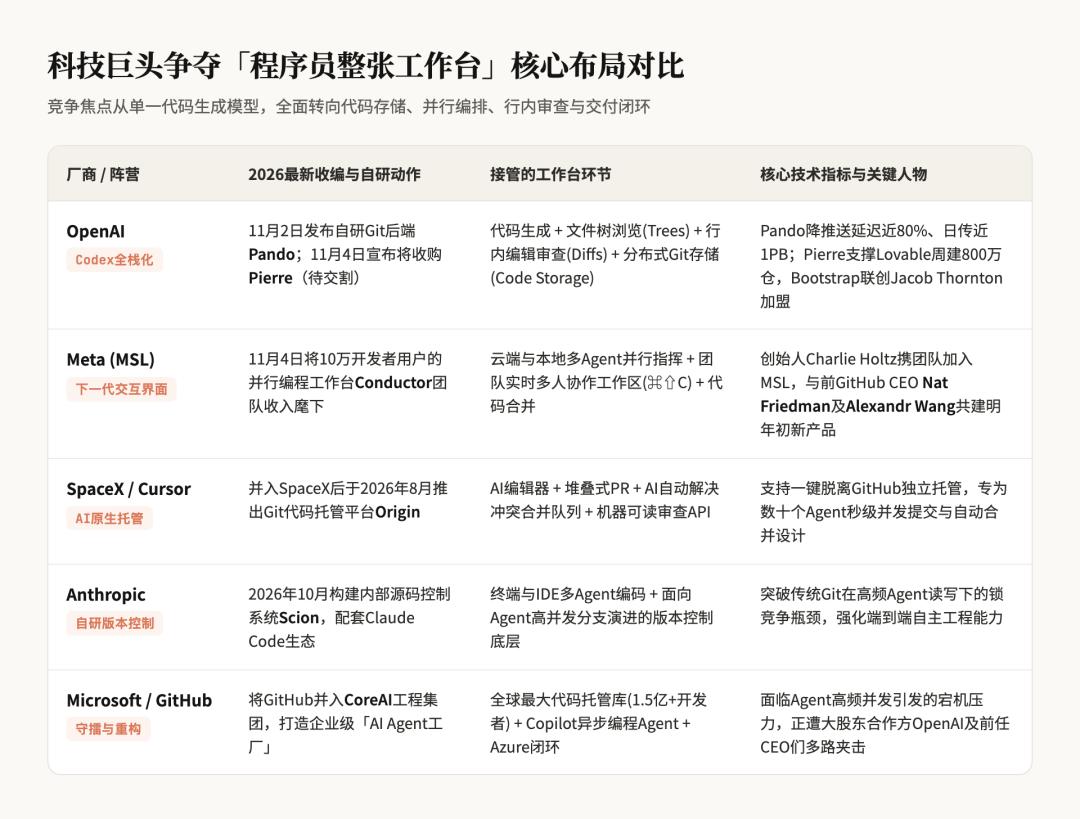
Of course, OpenAI is far from the only company eyeing this lucrative market.
Cursor, which launched the Origin hosting platform, Anthropic, which has self-developed Scion version control, and former GitHub CEO Thomas Dohmke who started his new business last month, are all launching a joint encirclement of the traditional code hosting sector.
From editors, review platforms to the underlying Git repository, none of the major AI giants want to rely on third-party platforms and only act as a "plug-in" that completes code snippets.
Although GitHub, which has 150 million developers, still firmly holds the position of the open source base, even the former head of GitHub has turned around and joined this "subversion" wave.
Former GitHub Head Steps In, Meta Snatches the Tool Used by 100,000 Developers
On the same night when OpenAI acquired Pierre, Meta's MSL also completed a lightning-fast talent acquisition.
The most notable name in this acquisition is the person in charge of the project on Meta's side, Nat Friedman.
He was the first CEO of GitHub after Microsoft acquired the platform for 7.5 billion US dollars in 2018, and he personally led the development of the previous generation of developer workflow.
Now he teams up with Chief AI Officer Alexandr Wang at Meta, and immediately acquired the most popular "next-generation Agent control console" in Silicon Valley's tech community.
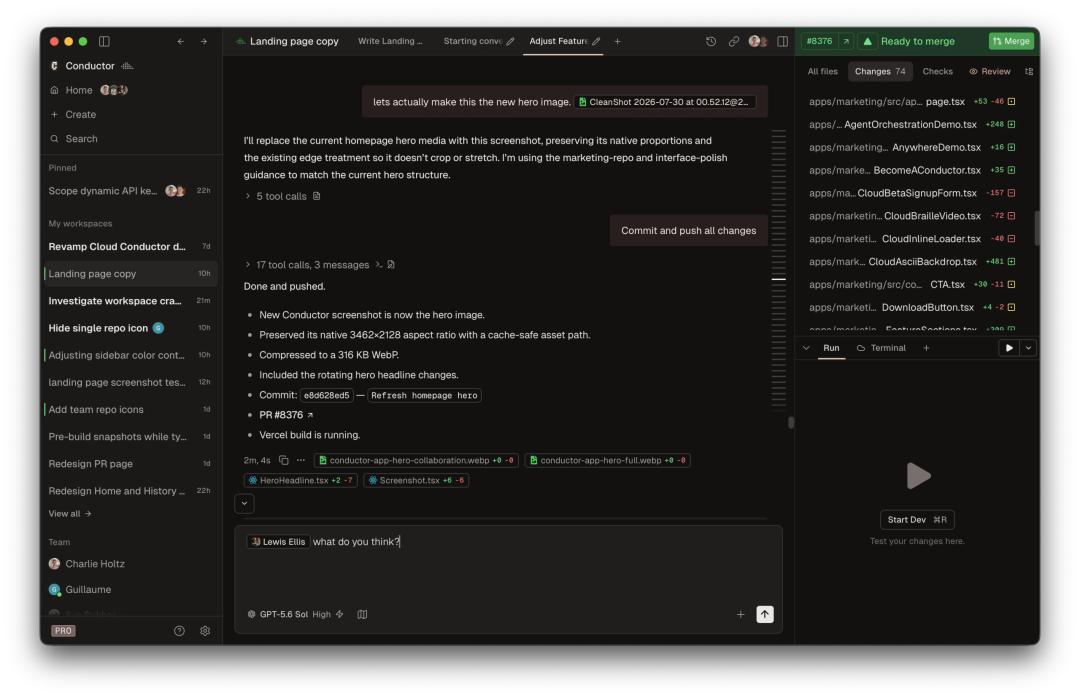
Conductor, which was launched only last July, is loved by 100,000 developers from well-known companies including Linear, Vercel, Notion and Spotify, because it makes "working with Agents" feel as smooth and fun as teaming up to play games:
- Multi-Agent Isolation and Concurrency: You can assign tedious tasks to multiple Claude Code or Codex Agents, and let them work simultaneously in their own isolated workspaces without conflicting with each other.
- Co-work on the same screen just like using Figma: Press the shortcut key "⌘⇧C" to share the workspace with colleagues, so that multiple people can watch Agents write code on the same screen, send instructions in relay, and click Merge directly after reviewing the Diffs.
Even Ilya Sutskever and YC partner Aaron Epstein are its early supporters.
If you look closely at the screenshot of the Conductor official website workspace above, you can even spot Ilya's avatar and name in the team list at the bottom left corner.
Developers' Old Workstations Are Being Completely Replaced
Nowadays, writing code has become the cheapest step. With a few lines of prompts, more than a dozen Agents can modify code, add tests and fix bugs at the same time.
The real bottleneck comes after the code is written: how to review tens of thousands of lines of modifications, how to audit dozens of branches, and where to store massive numbers of repositories.
Major companies know better than anyone that relying only on large models cannot retain developers: you can switch from Claude to GPT when GPT updates, and changing to another model only takes one click.
However, once the code base, review process and historical records are all built in its tools, it will be extremely difficult for users to migrate to other platforms.
As OpenAI stated in its acquisition announcement:
Every workflow left over from the old software era needs to be redesigned for the new era where humans and Agents write code together.
How to write code is no longer important. Which platform developers choose to work on is the market that major companies will compete for next.
References:
https://openai.com/index/openai-to-acquire-pierre/
https://x.com/OpenAINewsroom/status/2117999237745049883
https://openai.com/index/scaling-git-at-openai/
https://www.axios.com/2026/11/04/openai-pierre-computer-github
https://x.com/charlieholtz/status/2118045232218743264
https://www.conductor.build/announcement
This article is from the WeChat official account "New Zhi Yuan", author: ASI Revelation; editor: Moses, published with authorization from 36Kr.