Boasting 6-second image generation and one-sentence GIF creation features, OpenAI is poised to compete with the likes of Meitu Xiuxiu for market share.
On the morning of November 5, many users noticed that ChatGPT quietly added a new capability.
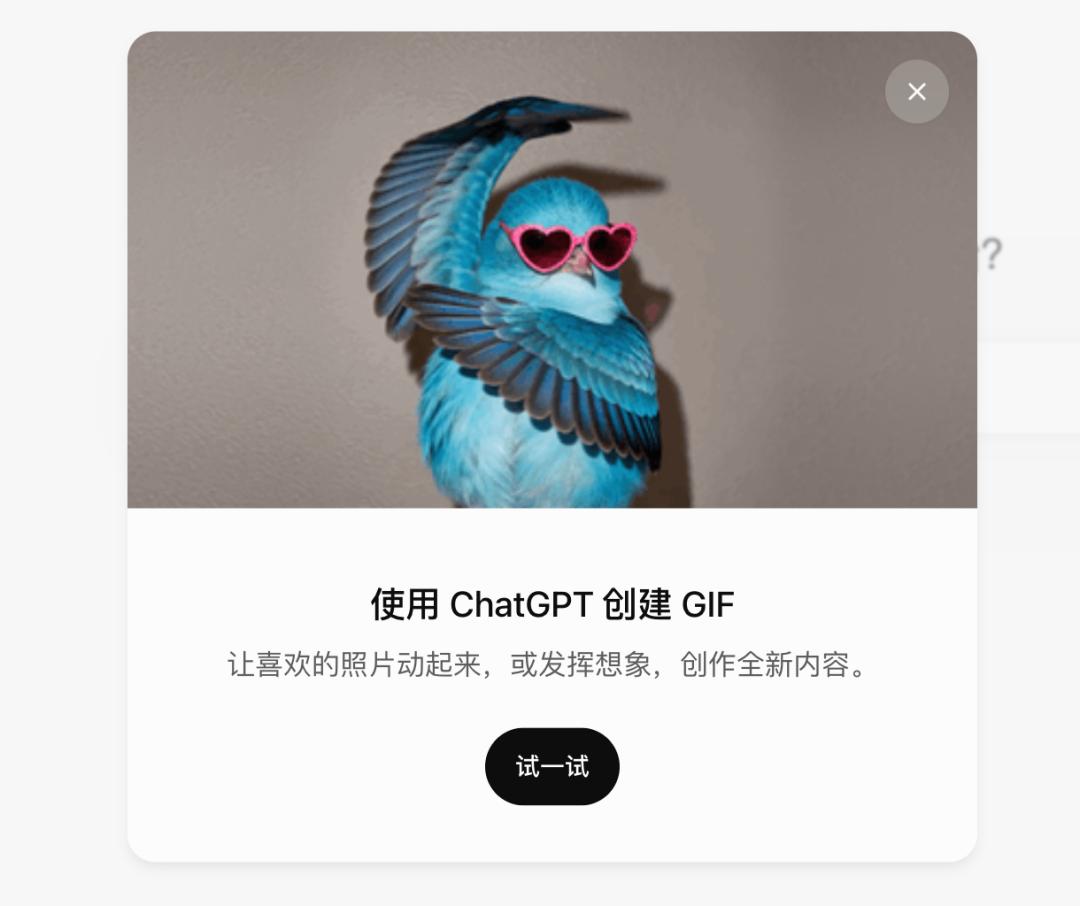
Users can input a sentence or upload a photo to make it generate a loop-playing GIF. After generation, they can also adjust the playback speed, view each frame, and even modify a specific frame individually.
We did a simple test, and some of the effects turned out pretty good, especially for animal-themed or animation-style content.

Photo | Cat jumps and bear shivers with fur fluffed up
However, some generated results are relatively rough. For example, when our prompt was to generate Elon Musk doing a shimmy step, the GIF looked neither like Musk nor showed the shimmy step at all.

I believe many people still remember clearly that when Images 2.0 was first launched earlier this year, many people were sighing that the era of "seeing is believing" has truly passed.
Image generation has long been one of OpenAI's most competitive capabilities, but this update still brings some distinct differences.
In the past, AI image generation tools solved the problem of creating content from scratch. Users provide a piece of text, and the model turns it into an image. But before an image can actually enter the workflow, it usually has to go through processes such as modification, typesetting, and format conversion. For ordinary users, these operations mean opening several additional software; for designers and content teams, it means a considerable amount of post-production work.
The newly updated Images 2.6 from OpenAI starts integrating all these processes into the model itself.
In addition to GIF generation, the new model also delivers faster image generation speed, more stable multi-round editing, as well as SVG vector export and image annotation editing interfaces for developers. Moreover, OpenAI has not raised its prices.
In the past, a large part of the value of AI image startups came from the gap between model capabilities and actual user demands. They packaged complex models into easy-to-use products, and charged users through functions such as image editing, typesetting, templates, and material management.
But when model manufacturers start to fill in these links themselves, the original business model is no longer that stable.
For OpenAI, this may just be an image product upgrade; but for a group of AI tool companies that survive on single-point functions, the changes may have just begun.
More features at no extra cost: three types of tool workflows are now integrated into the model
Images 2.6 is not a simple speed-up version upgrade.
From the perspective of product design, OpenAI has done two things this time: first, to make image generation faster, and second, to make post-generation modification and usage more convenient.
First, let's talk about speed.
According to the data released by OpenAI, Images 2.6 is 50% faster overall than the previous generation. On the API side, the company has launched two versions: GPT-Image-2.6 Flare and Sunburst.
Among them, Flare puts more emphasis on response speed and efficiency, and is suitable for tasks that require rapid iteration such as posters and product images; Sunburst focuses more on details and the consistency of multi-round editing, and is suitable for work that requires higher picture accuracy.
Under the low-quality setting, Flare can generate an image in as fast as about 6 seconds. For content producers who need to adjust materials repeatedly, the improvement in generation speed means they can run more rounds of attempts in the same amount of time.
Here's a little-known fact: Kuaishou was originally a GIF making tool, and its product name was exactly "GIF Kuaishou". It only later grew from a tool software to one of the largest short video platforms in China, after an important product transformation.
The point of this example is that the demand for GIFs is very clear.
In ChatGPT, users can now directly generate animated GIFs through text description or by uploading images. For example, they can animate a portrait photo, or turn a static product image into a loop-playing display material. After generation, users can adjust the playback speed, and also view and modify individual frames.
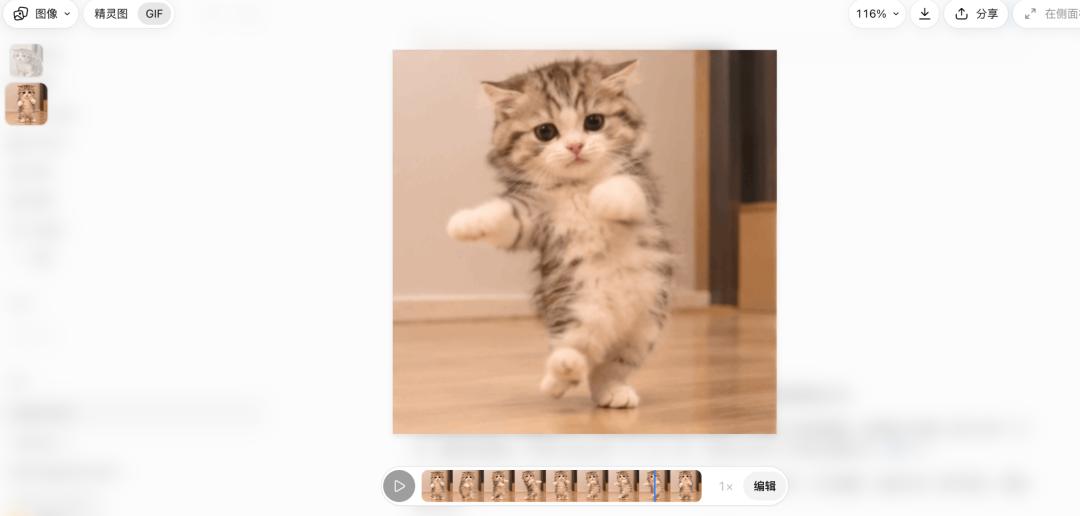
This capability has practical significance for social media operation, advertising marketing and content creators. In the past, turning a static image into a GIF usually required steps such as image processing, frame-by-frame production and GIF synthesis. For ordinary users who use it occasionally, this process is not worth learning specifically; for teams with large material demands, it means additional time and labor costs.
OpenAI mentioned in its official blog that Town, an AI office assistant company, has used the new model to make typing waiting animations for virtual characters in its products.
Another change lies in the output of design files.
Images 2.6 starts to support SVG format export, though this capability is currently mainly available for API developers. Different from common PNG and JPEG, SVG saves vector paths, which will not become pixelated after zooming in, and is also convenient for further adjustment of graphics, colors and details.
This means that what the model generates is no longer just a viewable image, but also design materials that can be used in web pages, applications and printing workflows.
This point is very important for designers.
Local editing is also advancing in this direction.
ChatGPT has previously provided the image annotation feature, allowing users to circle the area that needs adjustment on the image, and then describe the modification requirements in text. With this update, OpenAI has further opened this capability to API developers.
For developers, this means they can embed image modification into their own products, without having to fully rely on users to re-enter prompts, or specify the modification range through complex mask operations.
In addition, OpenAI has added a complexity parameter, allowing developers to control how much planning computation the model invests before generation. For simple tasks, planning time can be reduced to prioritize speed; for complex compositions, more computing resources can be allocated.
This is somewhat similar to the idea of adjusting inference strength in text models. The model no longer only provides a fixed generation mode, but allows developers to decide how to allocate resources according to the complexity of tasks.
In terms of pricing, the image output price for both Flare and Sunburst is $30 per million tokens, $8 for image input, and $5 for text input, which is consistent with the corresponding models of the previous generation.
When capabilities become interfaces, the situation of middlemen changes
In the past few years, a group of fast-growing startups have emerged in the AI image market.
Some of them focus on AI portrait generation, some on product images, and some specialize in posters, avatars and social media materials. Their product forms vary, but their business logics are similar: they call underlying models, provide interactive interfaces and specific functions on the upper layer, and charge through subscriptions, point systems or enterprise services.
This model was very easy to establish in the early stage of generative AI development.
On the one hand, the threshold for using basic models is relatively high, and ordinary users do not know how to write prompts, nor how to control the picture; on the other hand, the model itself can usually only complete a single task, and users need to use other software to process the generated results.
Startups just fill this gap.
They may not have their own models, but through product design, they can turn complex technical capabilities into services that ordinary people can use. Users pay for convenience, and startups gain commercial revenue from it.
Meitu, a product born in the Internet era, has regained strong growth in the AI era, which exactly follows this logic. It does not build its own large foundational model, but makes huge profits by acting as the connection between large models and users. In the first half of 2026, its revenue increased by 22.1%, and its net profit surged by 39.5%.
Now the problem arises: top-tier models like OpenAI start to directly integrate the functions that used to be undertaken by the application layer into the model, and the competitive advantages of startups will be directly affected.
Take AI poster generation as an example. In the past, a product might provide dozens of templates, where users select a style, enter text, and the model generates the image. Now, if the underlying model can already understand poster layout, process text accurately, and complete local modifications directly, products that only provide templates and prompts will find it very difficult to maintain their original differentiation.
AI image editing follows a similar situation.
If users only need to change a background, adjust a character's clothing, or modify a certain detail in the picture, completing it directly in ChatGPT may be more convenient than opening a separate application. Especially when these functions are already included in the user's existing subscription, third-party tools will face an awkward situation: why should users pay for the same capability a second time?
From this perspective, OpenAI's ambition is also huge. It not only masters the underlying technology, but also owns a traffic entry like ChatGPT, which can push new functions directly to a huge user base.
Not only Meitu, Canva and Adobe are also affected. They need to be alert to the changes in users' demands for tools.
Adobe Firefly currently does not compete purely on model image quality, but emphasizes the safety of commercial use. According to the previously announced enterprise policy of Adobe, the early Firefly models are mainly trained with Adobe Stock, open-licensed content and public domain content, and some enterprise customers can also get intellectual property compensation guarantees as stipulated in the contract.
For brands and enterprise customers, commercial design must take copyright risks, material sources and final usage responsibilities into consideration. This is also where Adobe's current position is relatively stable.
Some application parties have already taken the initiative to integrate the new model into their own products.
Figma Weave and Picsart have become early partners of Images 2.6. OpenAI disclosed in its release information that Figma Weave will use the new model for reusable creative workflows, while Picsart hopes to help users create serialized visual content more conveniently with faster generation and more stable editing capabilities.
In the final analysis, the stronger the underlying model is, the more the application layer needs to re-prove its own value.
If a tool company only provides functions that the model itself already has, it will be difficult to maintain a premium in the long run; but if it can integrate the model into complex business workflows, accumulate user data, industry experience and collaborative relationships, the improvement of model capabilities will instead become its own growth driver.
This is also a possible differentiation that will emerge in the AI application market in the next stage.
OpenAI has many more businesses it wants to tap into
When OpenAI launched Images 2.5 this September, it already started to emphasize more precise editing, reference images and faster generation speed. According to the data released at that time, users generated more than 3 billion images per week through ChatGPT and API.
Just two months later, this number has increased by another 1 billion. For a company that started with conversational products, this means that image generation has become a fairly large-scale usage scenario in ChatGPT.
In particular, if image generation enters more specific workflows, its commercial value will be different. What model manufacturers are competing for is no longer just a single API call, but which platform users will use throughout their entire work process.
OpenAI's strategic adjustments in recent months can also provide another perspective for observing this image update.
This March, OpenAI announced that it would discontinue the standalone Sora product. Reuters reported at that time that this decision was related to the company's reallocation of resources, and OpenAI began to pay more attention to directions with clearer commercial prospects such as programming tools and enterprise customers. Sora-related products stopped services in April, and its API was also shut down in September.
This incident once surprised the outside world. Sora is one of OpenAI's most high-profile products in the field of video generation, which has sparked a lot of discussions, and was once regarded as an important entry point for generative AI to enter the content production industry.
But judging from subsequent actions, OpenAI is adjusting its judgment on product value.
Compared with a standalone video generation application, capabilities that can be embedded into ChatGPT, Codex and enterprise workflows may be easier to achieve continuous usage and commercial revenue.
To some extent, the product design of Images 2.6 also reflects this trade-off.
It does not focus on building a brand new independent creative community, nor does it try to build another dedicated GIF application. Instead, it directly adds GIF generation to ChatGPT, and opens up capabilities such as SVG and markup to API developers. Users can complete more tasks in the original product, and developers can also integrate these capabilities into their own applications.
This gives OpenAI opportunities in two directions at the same time: on the C-end, it increases the usage scenarios of ChatGPT, and on the B-end, it enters more professional software and business workflows through APIs.
Among them, the significance of APIs is particularly noteworthy.
If ChatGPT directly faces end users, then APIs face companies that already have their own users, businesses and scenarios. OpenAI does not need to develop every vertical tool by itself, and can let other enterprises embed its capabilities into their own products by providing the underlying model.
For domestic entrepreneurs, some opportunities may have been quietly slipping away.
AI image editing, AI poster generation, AI avatar generation, AI product image generation were once the easiest entry points for generative AI startups. The product development cycle is short, user demands are intuitive, and it is easy to achieve early commercialization through subscriptions and traffic.
But as model capabilities continue to sink, simply relying on prompt optimization, interface design and simple function combination can hardly become a long-term barrier.
The truly valuable part may lie outside the model.
For example, can e-commerce image tools understand the product features of different categories, ensure that product details are not distorted, and connect to merchants' product databases and advertising delivery systems; can enterprise design tools manage brand materials, unify visual specifications, and integrate with internal approval and collaboration workflows.
The question that tool startups need to re-answer next is: when the underlying model can complete more and more tasks, what exactly do they still have under their control?
Even, when the capabilities of top-tier models are getting stronger and stronger, shouldn't humans think about what is left for them?
This article is from the WeChat Official Account "Phoenix Tech", Author: Phoenix Tech, published with authorization from 36Kr.