After Google's 30 GWh order, China's iron-air solution emerged on the Watt stage.
Founded last year and starting team recruitment only in March this year, Zhongke Rongyi now has around 21 employees, with its production lines and office space rented from a research institute. What seems to be a cost-conscious startup at first glance has, backed by 15 years of technical accumulation, stepped onto the stage of the World Laureates Forum · Future Energy Conference & the *Watt* Journal Anniversary Celebration held on October 31.
This year's conference was attended by 33 top scientists, including 7 Nobel laureates and 3 Turing Award winners; Zeng Yuqun, founder and chairman of CATL, also delivered a keynote speech at the main forum.
What Zhongke Rongyi brought to the event is an all-solid-state iron-air battery that stores electricity through the reversible "rusting" reaction of iron.
Its emergence comes exactly at a time when the AI era puts new demands on power supply. The International Energy Agency (IEA) estimates that the global power consumption of data centers will rise from 485 billion kWh in 2025 to about 950 billion kWh in 2030. If relevant bottlenecks are not resolved, roughly 20% of the planned data center projects may face delays.
Against the backdrop of the rapid development of AI computing power, the power system needs to cope with instantaneous load fluctuations as well as ensure continuous power supply. As a result, the demand for low-cost, high-safety, long-duration energy storage has become increasingly prominent.
In the power supply plan for its data center in Minnesota, the United States, Google has planned to deploy a 300MW/30GWh iron-air energy storage system with a designed discharge duration of 100 hours. With its all-solid-state configuration, Zhongke Rongyi combines the material advantages of iron, the scientific research accumulation left by national special projects and the existing manufacturing foundation to respond to the energy storage needs of the new era.
01. Making rust discharge electricity: ordinary iron gains new value
In daily life, rust on iron nails means wear and loss; in iron-air batteries, "rusting" becomes a process of releasing electric energy.
Marvin Kosin, a researcher at the Fraunhofer Institute UMSICHT in Germany, once used "rusty nails" to explain its principle: iron discharges when it is oxidized, that is, when it rusts, and electrons pass through an external circuit to supply power to equipment; charging reverses the reaction and reduces iron oxide back to iron. In this way, iron can repeatedly act as a carrier for electricity storage and discharge.
The primary reason for choosing iron is its abundant and low-cost material base. Kosin believes that material price and availability are the main advantages of iron-air batteries for stationary energy storage (energy storage equipment installed in fixed locations such as power grids, wind and solar power stations or data centers). Data from the World Steel Association shows that the global crude steel output in 2025 is about 1.849 billion tons, while the global lithium ore output is about 290,000 tons. This means that there is already a huge industrial production and supply system behind iron-based raw materials.
For Zhongke Rongyi, this choice also comes from the requirements of national research projects. He Mingxing, Chairman of Zhongke Rongyi, told 36Kr that the team needed to find batteries with high safety, controllable resources and independent intellectual property rights. After comparing routes such as lithium batteries and high-temperature liquid metal batteries, they finally chose iron-air. China's crude steel output in 2025 is about 961 million tons, accounting for about 52% of the global total. The larger the amount of electricity stored, the more obvious the importance of resource controllability becomes.
Moreover, "Safety and cost potential are the two biggest advantages of this battery system in our opinion," said He Mingxing.
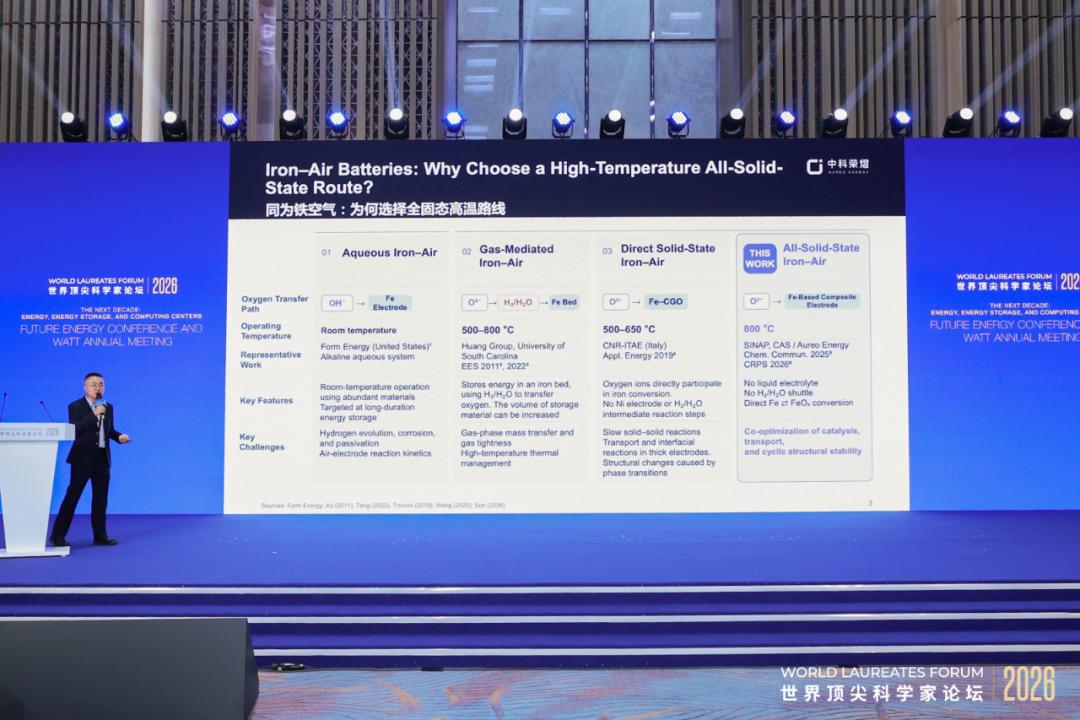
He Mingxing, Chairman of Zhongke Rongyi
The all-solid-state configuration gives this material system an implementation method different from that of overseas representative enterprises. The iron-air batteries of Form Energy in the United States and Ore Energy in the Netherlands use water-based liquid electrolytes; Zhongke Rongyi chooses to replace this ion channel in liquid with solid-state ceramics.
According to He Mingxing, the water-based route needs to deal with side reactions such as hydrogen evolution, while the all-solid-state route reduces such problems caused by liquid water. It also contains no flammable organic electrolyte, which reduces the corresponding combustion risk from the material selection perspective and leaves room for simplifying the manufacturing process.
These characteristics are in line with the needs of stationary energy storage. Kosin pointed out that such applications mainly focus on operational reliability, service life, cost and raw material utilization efficiency. For power grids and wind and solar power stations, whether the battery can supply power in a long-term, stable and economical manner is more meaningful than pursuing a single parameter alone.
According to the company's disclosure, its small-area all-solid-state iron-air battery has achieved more than 1,600 stable cycles, and the data is still under continuous testing; at the same time, the existing large-size batteries have shown obvious advantages in main electrochemical indicators. The company stated that relevant results have been published in journals such as *Cell Reports Physical Science*, and are currently in the process of pilot scale-up verification.
02. Behind the 21-person company: 15 years of nuclear energy research
The youthfulness of the company forms a sharp contrast with the depth of its technology.
The technical origin of Zhongke Rongyi can be traced back to the nuclear energy electricity storage research direction in the "Thorium-based Molten Salt Reactor Nuclear Energy System", a strategic priority science and technology special project (Class A) of the Chinese Academy of Sciences launched in 2011. The partner is the Shanghai Institute of Applied Physics, Chinese Academy of Sciences, and the iron-air battery undertakes the supporting energy storage research for the nuclear energy system. In March this year, the achievement "Realizing thorium-uranium nuclear fuel conversion based on molten salt reactor" completed by the institute was selected into the top 10 scientific advances of China in 2025.
He Mingxing described the initial project as a national "assigned essay". The requirements of nuclear energy systems for high temperature environment, safety and long-term operation pushed the team to continuously compare and screen materials. This route has gone through multiple rounds of evolution: the iron-air direction was selected in 2015, the dual-electrolyte molten salt system was verified in 2018, the semi-solid molten salt system was advanced in 2021, and then it moved to all-solid-state. The experience has also been gradually accumulated in material formula, interface bonding and structural design.
Taking the solid-solid interface as an example, even if two solids are pressed tightly, there may still be gaps at the microscopic level, just like two not-so-flat bricks that do not fit perfectly even when placed together. According to He Mingxing, the team uses high-temperature sintering to better combine the electrolyte layer and the iron-based negative electrode, solving the conduction problem at the solid-solid interface; and since iron will undergo volume change during oxidation and reduction, the team restrains expansion through skeleton design, and suppresses problems such as structural collapse caused by volume change during phase transition.
The experience is also reflected in the matching of materials. He Mingxing said that the electrolyte, iron-based negative electrode and sealing material need to be sintered and combined under the same temperature conditions, and the formula and process conditions of glass or ceramic sealing materials need to be explored item by item. In his view, long-term trial and error has formed a time barrier. He said that these experiences were gradually accumulated by the scientific research team over about 10 years.
From 2022 to 2025, the team further scaled up the button cell into a sheet-shaped cell and completed performance verification. In He Mingxing's view, this means that the technology has the premise to continue to move towards mass production, and has become an important basis for establishing the company and promoting industrialization.
These experiences can also connect with the manufacturing accumulation in the hydrogen energy field. He Mingxing judges that about 70%-80% of the processes, capabilities and knowledge systems in the links of electrolyte and negative electrode preparation, sintering and coating can draw on the experience of Solid Oxide Fuel Cells (SOFC). The data of Lawrence Berkeley National Laboratory released by the U.S. Department of Energy also shows that the solid oxide cell field has accumulated many years of experience in support structure, metal and ceramic sintering and sealing.
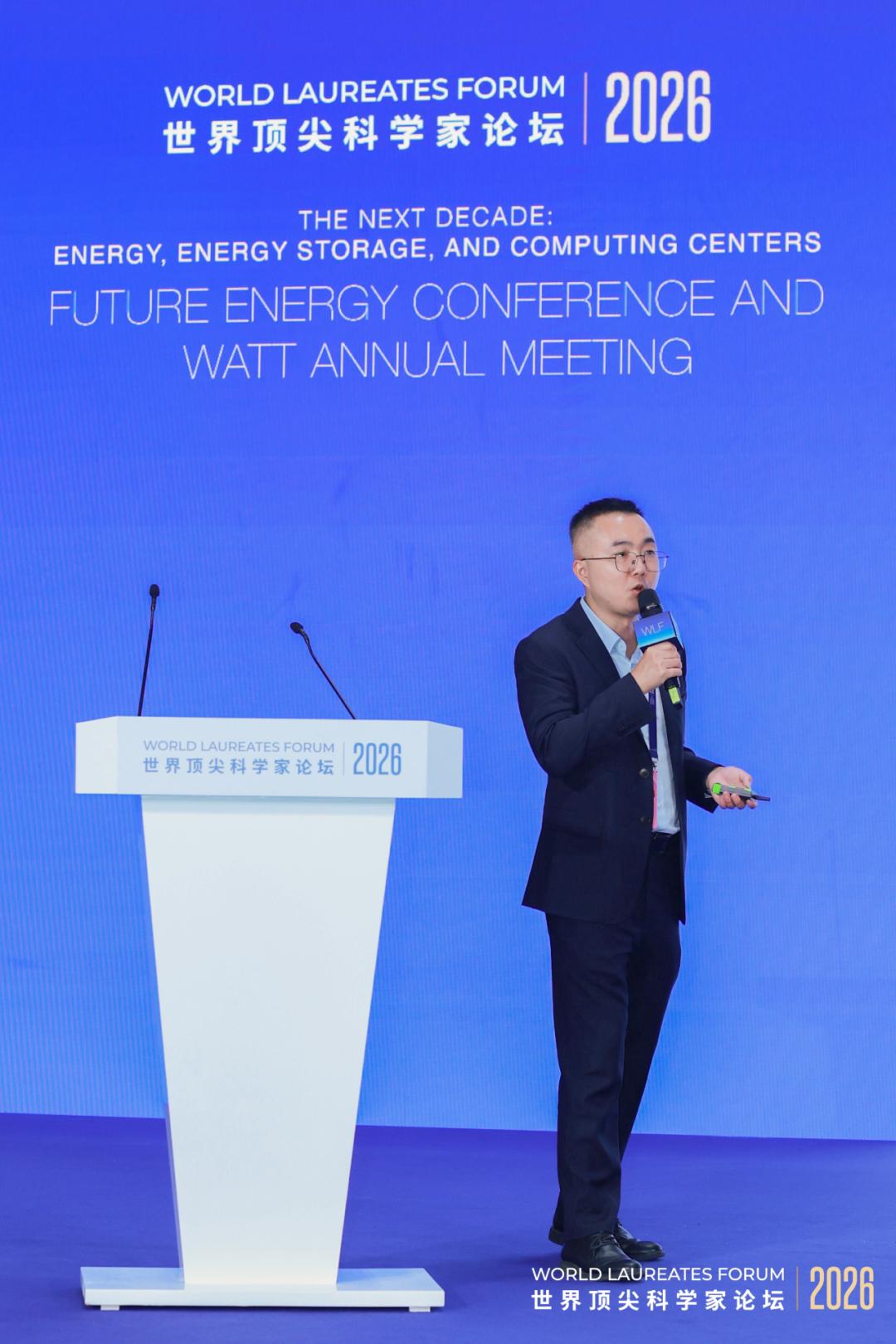
He Mingxing, Chairman of Zhongke Rongyi
"We are confident because we do not need to explore a brand new battery system while creating the whole set of equipment and preparation processes from scratch," said He Mingxing.
The similarity in technology has also been translated into ready-made equipment and site support. According to He Mingxing, the company originally planned to build its own laboratory and pilot line, but after negotiation with the research institute, it rented a small solid oxide cell (SOC) pilot line and site to work and conduct trial operation there. The construction of this line cost tens of millions of yuan back then, so the company saved the investment in re-construction, and allocated the funds to R&D, supplementary equipment and material procurement.
The company's own team configuration also balances scientific research, industrialization and capital experience. According to the disclosure of Zhongke Rongyi, the chairman has more than 10 years of primary market investment experience and has participated in the investment of dozens of enterprises in the battery industry chain; the CEO has more than 20 years of experience in the operation and industrialization of science and technology innovation enterprises; the CTO is the head of the High Temperature Electrochemistry Group of the Shanghai Institute of Applied Physics, who has been engaged in high-temperature battery and molten salt electrochemistry research since 2011; the expert consultants have long been engaged in the research of molten salt chemistry, fuel cells and comprehensive utilization of nuclear energy.
For scientific research achievements to be transformed into enterprise products, it is also necessary to clarify intellectual property rights and R&D division of labor. When He Mingxing worked in the primary market, he saw many projects encounter problems in this regard.
Thanks to mature management experience, Zhongke Rongyi has realized a clear definition of intellectual property ownership through technical development, horizontal cooperation with research institutes and corresponding intellectual property cooperation. Through the R&D team efficiently built by the company, it realizes the rapid precipitation of technical experience and promotes the coordinated development of technology and industrial marketization.
How to use the original technology, who owns the new achievements, and who will promote the follow-up R&D, these arrangements provide the basis for continuous investment and achievement transformation.
03. Starting from nuclear energy supporting applications, moving towards a larger energy storage market
The application space of batteries is expanding with the changes of the power system. Technology enterprises are becoming important buyers of clean power. IEA data shows that among the global renewable energy power purchase agreements signed by enterprises in 2025, the technology industry accounts for about 40%.
Photovoltaic power generated at noon on sunny days can be reserved for use in the evening; in case of consecutive days with little wind and little sunshine, the power system also needs reserves spanning a longer period. A report from the California Energy Commission points out that multi-day energy storage can provide reliable services in scenarios such as consecutive low generation of renewable energy, extreme weather and wildfires, and technologies including iron-air batteries are expected to support a clean and reliable power grid.
A study jointly released by the Long Duration Energy Storage Council and McKinsey in 2021 estimated that under the scenario of power system decarbonization, the global deployment potential of long-duration energy storage could reach 85-140 TWh by 2040. It covers a variety of technical routes, reflecting the overall demand for energy storage extending from hourly regulation to multi-day regulation.
Overseas projects have already demonstrated the specific path of customer procurement. In Google's power supply plan, utility company Xcel Energy plans to deploy the Form Energy system to store electricity when power is abundant and send it back to the grid when needed, providing continuous power supply support for the data center and the local power system.
Dutch company Ore Energy has also reached a 1GWh deployment agreement with Dutch energy supplier Budget Thuis, with the first phase of 400MWh scheduled to be delivered in 2028, which is used to store surplus wind power and supply power during low generation periods. In this way, iron-air technology has further moved from grid-connected demonstration to the procurement plans of energy suppliers.
Capital is also gathering towards this route. In August this year, Form Energy announced the completion of a $750 million Series G financing, with cumulative equity financing exceeding $2 billion. The funds will be used to expand the manufacturing and commercial deployment of iron-air batteries.
The Chinese market has its own pace of entry. A report from the National Energy Administration shows that by the end of 2025, the installed proportion of new-type energy storage with a duration of 4 hours and above has reached 27.5%, an increase of 12.1 percentage points year on year. He Mingxing believes that the main demand in China will be concentrated in the 4-8 hour range for a quite long period of time, and the projects the company contacts also position their products accordingly.
The pricing logic of iron-air battery products varies: for wind and solar power supporting energy storage, the price needs to be compared with the use income, while for important backup scenarios, safety and reliable power supply are more valued, and the price will be higher. Even if continuous power supply is only needed for a few periods of the year, what customers buy is the guarantee at critical moments, rather than the value calculated according to the income of peak shaving and valley filling.
To truly enter the market, all-solid-state iron-air batteries need to have cost advantages, starting with material costs. According to the estimation of Zhongke Rongyi's business plan, the initial investment cost of all-solid-state iron-air batteries can be controlled at 0.5-0.6 yuan/Wh, and the levelized cost of electricity can be about 0.1 yuan/Wh.
In addition to materials such as iron and ceramics, the preparation process also has room for cost reduction. According to He Mingxing, this system reduces the wet manufacturing process related to electrolyte, and has no positive electrode production process, so the manufacturing environment requirements are not as strict as other solid-state battery routes. The process listed in the company's plan is mainly forming, sintering, sealing and assembly, which does not involve liquid injection and long-period formation, and it also plans to simplify maintenance and recycling by leveraging the characteristics of the solid-state system.
The final accounting, of course, has to cover the complete system. According to He Mingxing, the company has calculated the costs of materials, manufacturing, system and operation and maintenance together, and after taking into account the round-trip efficiency, heat preservation and heat radiation losses, it still judges that this route has the opportunity to achieve a lower comprehensive cost than lithium batteries in long-duration energy storage. "According to our calculation, the account can be balanced for scenarios with a duration of more than 4 hours, and the longer the duration, the more advantageous our unit cost will be, because the active material we use is iron," he said.
It is reported that around these demands, Zhongke Rongyi plans to take nuclear energy electricity storage as its cornerstone market, and at the same time target wind and solar supporting energy storage, power grid peak regulation and AI Data Center (AIDC), providing modular energy storage systems for large power generation groups, power grid-related entities, local energy groups and project operators. Modules of different power and capacity are combined according to scenarios, and the market is gradually expanded through joint verification, demonstration projects and subsequent replication.
Clean power not only needs to be "generated", but also "available" at critical moments. The rarity of Zhongke Rongyi lies in connecting the all-solid-state iron-air route, more than ten years of nuclear energy research accumulation and large-scale energy storage applications. This technology derived from national research projects is also expected to move from nuclear energy supporting applications to a broader market, providing a new choice for stable and affordable power supply.