Nearly 2 billion yuan of financing has been raised in less than half a year. Is sparse computing power really so valuable?
Recently, Moffett AI (hereinafter referred to as "Moffett AI"), which focuses on the sparse computing ecosystem, announced the completion of a C+ round financing of nearly 1 billion yuan. This is only about 5 months after the previous round of nearly 1 billion yuan financing was closed.
In less than half a year, the company has completed two rounds of financing totaling nearly 2 billion yuan. In May, Moffett AI stated that the financing was used for mass production of new-generation computing cards and expansion of the computing power network. By November, the new round of funds will be used for software and hardware upgrades of inference chips, pre-research of next-generation chips, and industry-university-research cooperation in sparse computing.
The two financing amounts are close: one was to produce the computing cards and deliver them to more customers, and the other was to bring the problems encountered by customers during deployment into the R&D of next-generation products. For Moffett AI, the problem is not just to produce the chip, but how to make customers willing to pay for a set of software and hardware systems that is different from existing solutions, which is the key.
01. What are the capital players betting on?
Founded in 2018, Moffett AI's financing history can be traced back to March 2020, and industrial capital has already appeared among its early investors.
The nearly ten million US dollar angel round at that time was led by Kaiwu Ventures, with participation from Chuangxiang Fund and Cloud Angel Fund.
After that, Moffett AI went through multiple rounds of financing. In January 2021, Moffett AI received strategic investment from Inspur Yunhai Fund, and old shareholder Kaiwu Ventures continued to participate in the follow-up investment. Inspur is a server supplier, and AI server is one of its businesses.
From 2021 to 2024, Moffett AI successively disclosed a 100 million yuan Pre-A round of financing, several hundred million yuan of Series A financing, and several hundred million yuan of Series A+ and Series B financing respectively. Among them, Series A+ and Series B were disclosed uniformly in April 2024, and were actually completed in the previous six months.
In the Series C financing disclosed in May this year, institutions including SCGC, Greater Bay Area Common Home Capital, Lead Capital, Yunsheng Capital participated, and old shareholders such as Kaiwu Ventures, Shengjing Jiacheng, Yanshan Technology continued to invest. The Series C+ round disclosed in November includes investors such as Ren'ai Capital, Haitang Fund, Dongheng Petroleum, Biqiu Capital, Pilot Capital, Zhongcai Capital and other investors.
The background of the founding team may be one of the reasons why it has gained capital recognition. The team's experience covers chip architecture, algorithm and engineering development. Wang Wei, founder and CEO, once worked at Qualcomm and Intel; Yan Enxu, co-founder and chief scientist, holds a doctorate in machine learning from Carnegie Mellon University and once worked at Google and Microsoft Research; Lu Yong, co-founder, once engaged in chip design at SK Hynix and Marvell. The three correspond to different links in the same product chain: algorithms need to find operations that can be omitted in the model, chips need to skip these operations, and the toolchain also needs to enable customers' models to be deployed smoothly.
The capital use announced by the company also follows the path from product R&D to commercialization. In 2021, Wang Wei said that the 100 million yuan Pre-A round of financing will be used for product R&D and expanding the domestic market. In 2022, hundreds of millions of yuan of Series A financing began to be invested in the mass production of the first chip and the construction of the sparse computing ecosystem. For Series A+ and Series B, the company integrated the R&D of the second-generation AI chip, market expansion and ecological construction together. By May this year, the purpose of fundraising has been specified to the mass production and commercialization of the new-generation SparsePrime computing card, as well as the expansion of the computing power network. The use of funds in November extends to the pre-research of next-generation chips.
Capital investment is paying for the company's future, and the question they need to answer has always been: what exactly is the advantage of the sparse computing route?
02. Fewer operations, can it equal lower costs?
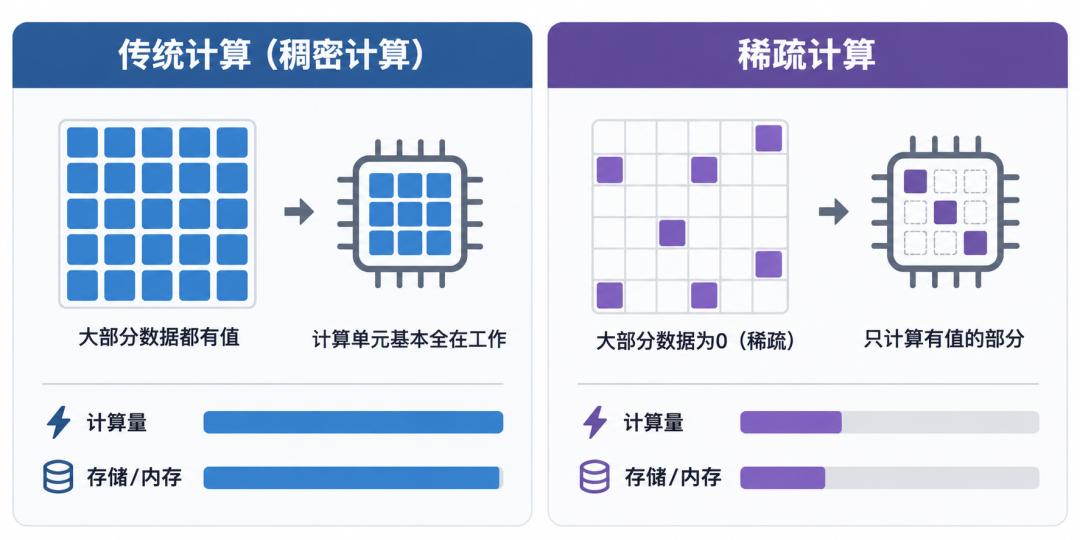
Different from general-purpose GPUs that can undertake multiple tasks such as training, inference and scientific computing, Moffett AI has chosen a route focusing on AI inference with sparse computing as the core. The product idea is to first identify and reduce unnecessary calculations through algorithms, and then execute these optimized tasks with supporting software and chips.
Sparse computing is not a unique capability of dedicated chips. NVIDIA has supported structured sparsity since A100, by limiting the data arrangement to let the hardware skip some zero-value operations. Its public Rubin architecture materials further introduce activation sparsity support in attention and MLP modules.
But unlike general-purpose GPUs that are adding relevant capabilities, Moffett AI, which focuses on sparse computing, needs to build a software and hardware platform from scratch.
When the company completed the Series B financing, it listed ecological construction as one of the capital uses. Guo Weijun, vice president of the company's marketing department, mentioned in the media that in August this year, Moffett AI established the first domestic industry-university-research alliance for sparse computing, and has launched a number of joint projects with universities such as Fudan University, Tsinghua University, and Xi'an Jiaotong University. In June, Guo Weijun revealed that about 50% to 60% of the company's personnel are engaged in software-related work. In September, Moffett AI updated the MACS software system, adding model service deployment examples and cluster device management functions.
AI-generated image
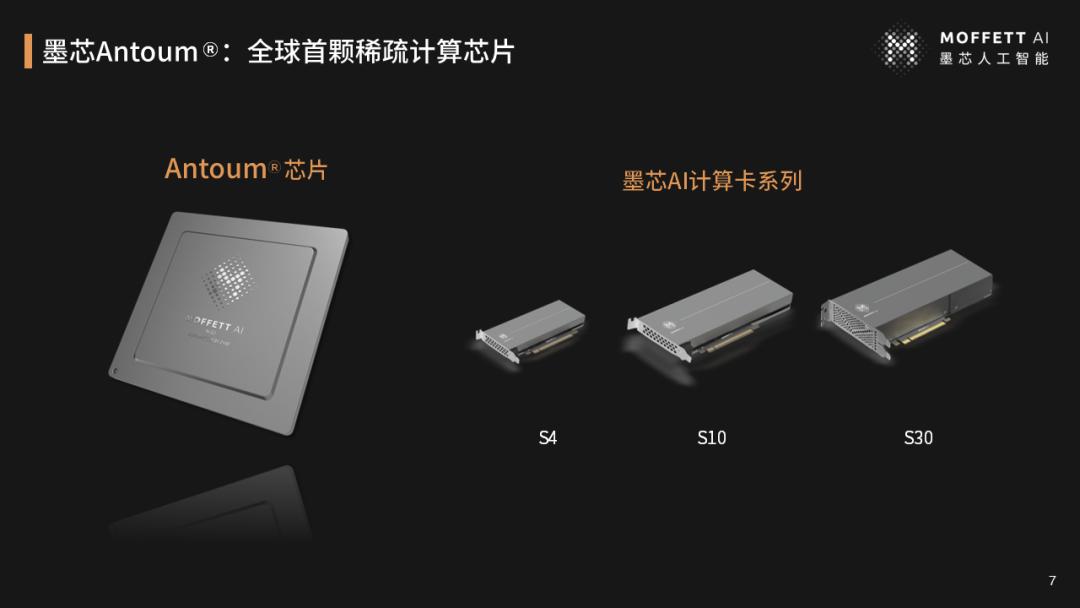
Moffett AI has currently launched computing cards such as S4, S30, and S40 equipped with self-developed Antoum chips. Among them, S4, S30 and S40 integrate one, three and four chips respectively, to meet deployment needs of different scales. Around these hardware, Moffett AI also provides model sparsification, compilation and operation tools, as well as supporting software responsible for equipment monitoring and cluster management, helping customers migrate existing models to Moffett AI computing cards, and complete deployment and subsequent operation and maintenance.
Moffett AI plans to launch the new-generation board card SP200 before the end of 2026, and will release the upgraded software stack SECA. According to the company's latest disclosure, SECA will improve the operator library, compilation and software-hardware co-design capabilities around the sparse architecture, and later launch supporting MaaS platforms and model framework adaptation management tools to further lower the threshold for customers to deploy and use sparse computing power.
According to disclosures, inference clusters based on self-developed chips have been deployed in regions such as Northwest, Southwest, East and North China, and have carried out cooperation with telecommunications operators. Cluster deployment demonstrates the progress of products entering actual business, but relying only on the deployment scale is not enough to judge equipment utilization, order revenue or the cost benefits obtained by customers.
For customers who already have GPU systems, replacing the solution means re-adaptation, testing and maintenance. The operating costs saved by sparse chips need to cover these new investments, so that customers have the motivation to migrate or make additional purchases. Under the same model, the same effect and similar load, we cannot only look at the peak computing power or a single test.
Moffett AI has obtained funds for continued investment. Next, whether the new-generation board card can be launched as planned, whether the software can keep up with model changes, whether customers will continue to purchase, especially under the background that general-purpose GPUs have strengthened their sparse computing capabilities, whether Moffett AI can continuously beat the comprehensive usage cost of GPUs in real businesses will also determine whether it can move from segmented scenarios to a large-scale market.
This article is from the WeChat official account "The Fourth Wave", author: Wang Chen, published with authorization from 36Kr.