The competition for Personal Agent starts before users think it through.

Whoever can take on users' undefined demands at an earlier time will have a greater chance to become the new consumption entry point.
When exactly does a consumption process start? Most people would say it is the moment you place an order and make the payment. But as long as you recall your most recent outing, you will find its starting point is far earlier than you think.
Before booking a restaurant, you may go through different thoughts such as wanting to meet friends, wanting to hold a celebration, or wanting to change to a new environment. Similarly, the thought of "wanting to go out tonight" may eventually correspond to a meal, a performance, or even a route with no preset destination.
In other words, consumption has already started before specific information like store names, categories and prices appears. At that stage, it has no clear definition yet, more like a vague mood or an unformed wish. Search, content recommendations and suggestions from friends are all influencing this process.
Karpo, launched by MachinePulse, is exactly an AI product focused on urban life that makes choices at this very stage.
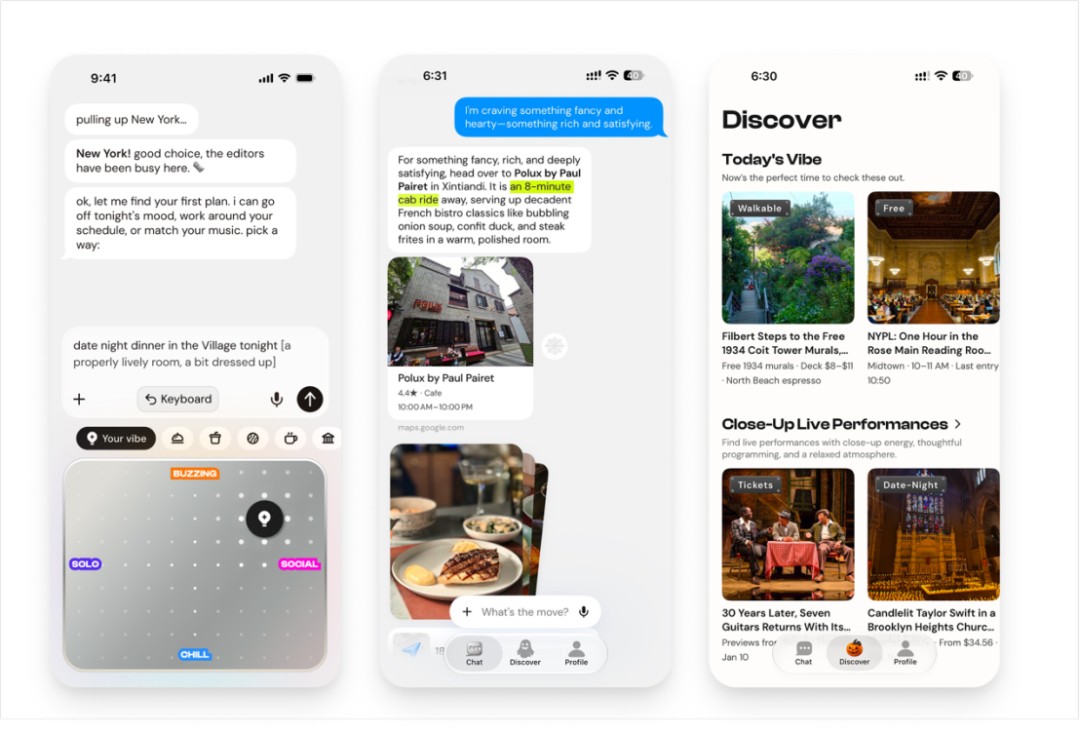
Start from a mood: select your desired state, describe the feeling you want, and Karpo will give you specific destinations. Image source: Karpo
It does not share the same starting point as tools like Resy and Google Maps. The latter handles scenarios where you already know what you are looking for, such as checking locations, viewing ratings, planning routes and so on. Karpo, by contrast, focuses on helping users move from a vague thought to a concrete arrangement when they have not confirmed the destination, or even what type of activity they want to do.
Behind this choice is a team with rich experience in developing consumer-grade AI products. Leah, the founder, is an early member of the Doubao team and participated in the entire process of Doubao growing from 0 to 100 million DAU. Allen, the co-founder, once worked as an engineer at Doubao and TikTok and has founded multiple startups. The other co-founder, Alex, previously led the Step Function Agent product team.
With these experiences, the team chose to explore the "Lifestyle × AI" track for overseas markets. From their perspective, to provide quality service for a person, it is necessary to get close to specific scenarios, understand personal tastes, and connect with real offline supplies, which provides a concrete entry point for consumer-grade Personal Agents.
So when AI is able to intervene in decision-making before users form clear demands, what changes will happen in the Personal Agent competition?
From Finding Answers to Participating in Demand Formation
First of all, we should make it clear that the key change brought by Personal Agent, besides its ability to handle more tasks, is that it turns the problem of "whether the demand is clear or not", which used to be solved by users themselves by default, into a problem that products need to deal with.
This is essentially a boundary between two types of capabilities. Execution capability solves the problem of how to get things done: once the goal is determined, the remaining work is to split steps, call tools and push the process forward. Intent understanding, by contrast, solves the earlier problem, helping users figure out step by step what they really want. The latter scenario is particularly common in life decision-making.
Life experiences are often mixed with emotions, aesthetics, social relations and random impulses. People may already expect a certain feeling, but do not know what kind of activity or place can satisfy it. The demand does exist, but it has not been sorted into executable requirements.
This kind of understanding is also reflected in the unspoken information. For example, when you ask Karpo "I want to go to a quiet place to run, where is suitable?", you do not mention your dog or your car.
But Karpo's reply starts with: "It's totally fine for you to go running along the river with Koda." Koda is your dog at home, and Karpo remembers that. It recommends two quiet, dog-friendly places that are easy to get close to the water, and then adds: "It's no problem to drive the Sportage there. The car needs an oil change, but it won't affect your round trip today."
You don't have to explain your life to it every time, which is the most authentic feeling after you receive the reply.
Of course, this is an interaction that can only happen after personal understanding accumulates to a certain level: the basis is not only the current message, but also the context formed by previous conversations. Intent capture does not only happen in a single question and answer, it needs a continuous relationship as the foundation.
But to do this well, simply remembering what users like is far from enough.
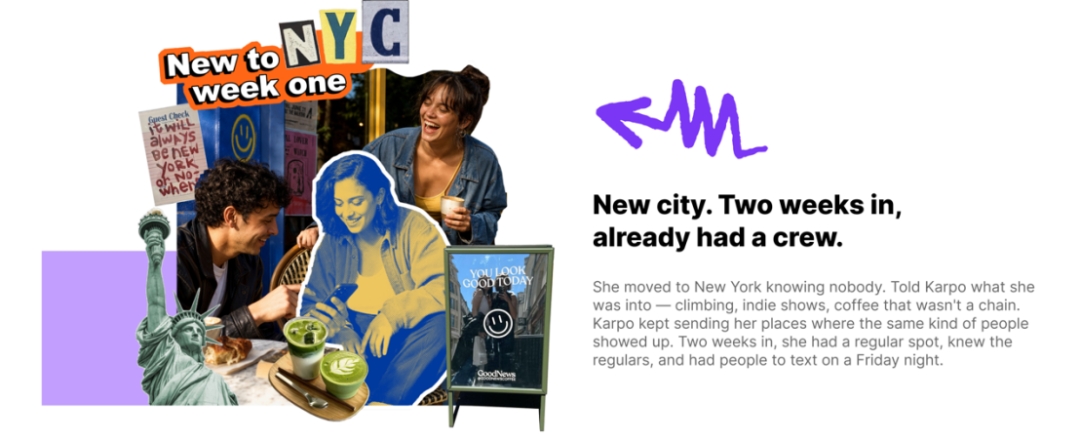
New users in New York tell Karpo their interests, and Karpo continuously recommends places that people with similar preferences often go to, helping them find regular spots and make new friends in the new city.
A person who has loved art for a long time does not mean that he is willing to go to the art museum every weekend. Past preferences provide the basis for understanding, while current emotions, people you go with and schedule determine how to adjust the suggestion this time. For the same exhibition, you may want to spend half a day studying artworks when you go out alone, but you may pay more attention to whether both you and your friends are interested when you go with others.
Feedback also needs to be understood in specific situations. A user gives up an exhibition, which may be because the content does not meet his interest, or simply because the location is too far. The two reasons will provide different basis for the next suggestion. Personal understanding needs to accommodate these changes, and distinguish between stable preferences and one-time selection conditions.
"Proactive experience" is also built on this layer of understanding. Sending a message actively is only an interaction form, and the value of suggestions depends more on the context, timing, and whether it helps users move to the next step. Products need to put forward relevant choices at the right time based on conversations, preferences and specific scenarios, so that users can continue to confirm, adjust, and gradually form a complete arrangement.
The starting point of intent competition is to reduce the cost for users to express demands and form choices. But whether the choice can really become a complete experience depends on another thing: how AI connects its understanding of a person with the real existing supplies in the city.
After Understanding a Person, It is Necessary to Reorganize the World in Front of Him
In fact, clarifying a vague intent does not mean the service is completed. What is nearby, when it opens, whether it is suitable for the people you go with, and how to connect transportation and activities will all affect whether a suggestion can become a real arrangement. No matter how accurate the subjective perception is, it eventually needs to be tested by time, space and supply conditions.
This means that besides figuring out what is worth recommending, AI also needs to understand the relationship between different options. How long a place is suitable for staying, how far it is from the next destination, and whether the rhythm of the whole arrangement meets users' expectations will all affect the final experience.
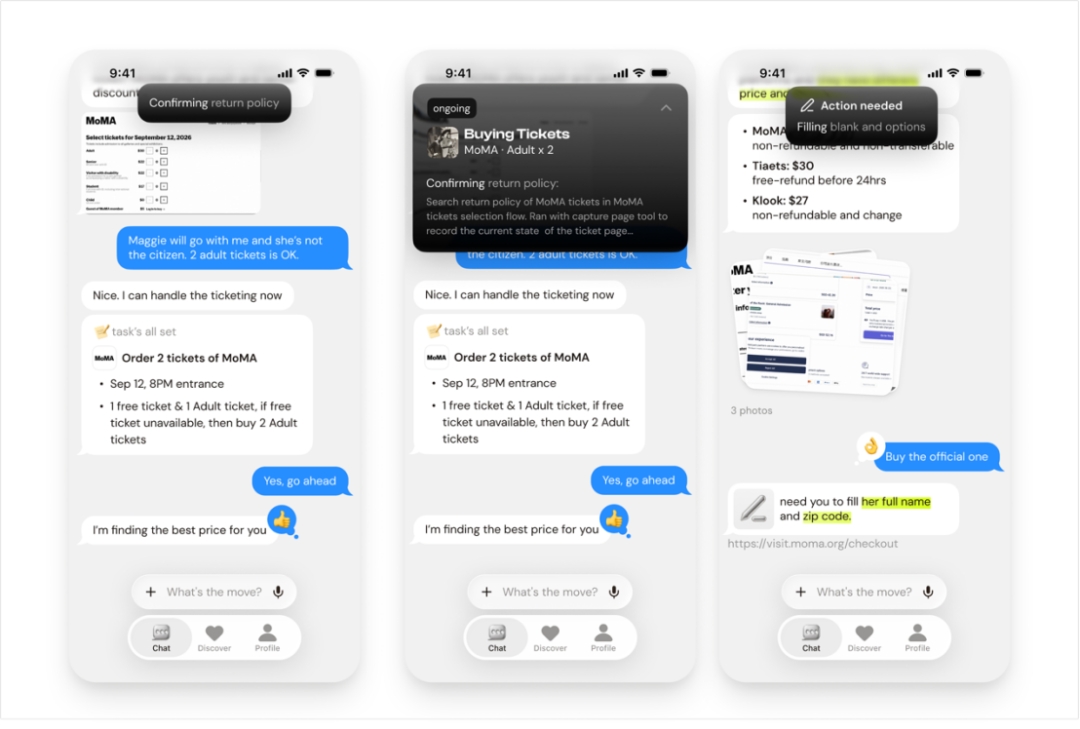
After confirming the demand, Karpo compares prices, verifies refund and change rules, pushes forward the ticket purchase process, and submits the final result to the user for confirmation before placing the order.
There is a type of demand that can better test this capability: when the time window is compressed, can AI organize urban supplies into a rhythmic route? For example, a user sends a message during the flight transfer: "I land in Barcelona at 1:10, and my next flight is at 9:20, what can I do in between?"
Karpo converts the 8-hour constraint into a closed loop route: first go to El Born, walk along Santa Maria del Mar to Port Vell, then continue to Barceloneta Beach, connecting the old town and sea views together to avoid backtracking; then book a table in advance at Can Solé, "otherwise you will waste your transfer time waiting in line"; go to Montjuïc to watch the sunset in the afternoon, leave at 6:45, and return directly to El Prat Airport.
At this time you may wonder: "Wait, I can see the sea, eat paella, and still catch the sunset?" Karpo replies: "And you can still catch your flight."
The key point is not which places Karpo recommends, but that the sequence and timing of each place are arranged around the transfer window: the route reduces backtracking, restaurant reservation reduces queuing, and the return node ensures that you can catch the next flight.
This is exactly the difference between "supply organization" and "information retrieval": retrieval is to find a suitable option, while supply organization is to combine multiple scattered merchants and locations according to the individual's demand and rhythm, so that they can jointly meet a complete life arrangement.
After figuring this out, you will understand why Karpo chooses urban life as its entry point.
Food, drinks and entertainment seem to be light scenarios, but they contain complex problems such as personal taste, local information and action arrangement at the same time. Users often do not lack choices, but do not know what choice is the most suitable for them at the moment. The rich content provided by a city also means that screening and combination require a lot of energy. The more locations and activities there are, the process of finding a suitable arrangement is not necessarily easier.
The same is true for the supply side. Merchants have supplies, but they may not be discovered by people who happen to need them. A restaurant has its own atmosphere, an exhibition has its specific expression, and these features cannot always be fully presented by labels such as ratings, categories and popularity.
The opportunity of AI lies right between these two sides.
Whoever Takes Charge of the Intent Will Have the Opportunity to Influence the Direction of Consumption
When AI participates in demand formation and further organizes choices and actions, it will have the opportunity to change the consumption entry point and distribution relationship, which is the commercial implication of intent competition worthy of industry attention.
As mentioned above, the direction of a consumption is often affected before the order is placed. What Personal Agent explores is to further connect the understanding of intent with subsequent arrangements through continuous communication around the individual.
If a person can start a life arrangement without first determining the category, destination or merchant, the demand can cross the original classification in the communication with AI. From wanting to relax, to deciding to visit an exhibition, to arranging a nearby restaurant, several options that originally need to be searched and compared separately can be gradually expanded around the same thought. The logic of the supply side will also change accordingly, and the service will have the opportunity to take on the whole section of demand instead of just providing a single product.
In the era of search and review platforms, whether a merchant or an activity can be discovered largely depends on whether it matches the keywords entered by users, whether the rating is high enough, and whether the position is prominent enough. But when the selection is organized by AI around a specific person, it depends more on the degree of fit between the option and the specific user and specific scenario.
This will bring an important change: those experiences that are difficult to describe with keywords and thus hard to be found in the past may enter users' selection range for the first time because they precisely match a person's interest. The visibility of supplies is no longer only determined by the search box.
Seeing the value of this position, capital has already placed bets in advance.
At present, Karpo has received support from institutions including Creekstone Ventures, GL Ventures and BlueRun Ventures, with cumulative financing of tens of millions of US dollars.
If we put it in the whole Personal Agent track, the significance of this action will be clearer: when products like Muse and Instinct are fiercely competing at the task execution level, a group of capitals and entrepreneurs are willing to price the more upstream "intent competition".
They are betting on whether the consumption entry point will move forward from the stage where you already know what you want to the stage where you have not yet figured out what you want. This leads to a deeper competition logic beyond who has more accurate recommendations.
An isolated recommendation is very easy to be replaced, and users can switch to another tool to ask questions at any time. What is really irreplaceable is a continuous relationship. AI understands a person's preferences for a long time and continuously takes over subsequent actions, which is a self-reinforcing process. Users' feedback makes suggestions more and more accurate, more accurate suggestions improve users' willingness to entrust more things to the AI, and more entrustment brings richer understanding and data.
In other words, the real competition indicator here is more about how many things users are willing to entrust to this AI, and how early they are willing to do that, rather than the result of a single round of question and answer. The exploration Karpo makes around personal taste and urban supplies is exactly accumulating such a relationship, and presents a possibility of "Lifestyle × AI".

During the New York Marathon, Karpo cooperated with local running groups in New York, supported on-site activities and integrated into the urban running community.
When intents can be received earlier and more smoothly, the form of consumption will change accordingly. A large number of demands that did not happen in the past because they were hard to describe, too troublesome to find or too complicated to handle will be released. Karpo has only taken the first step, and an era where more thoughts can be seen and realized is kicking off.