Apple's two-years-overdue AI has left users far from pleased.
After waiting for more than two years, users of the Chinese mainland version of iPhones have finally got access to Apple Intelligence. On November 4, Apple released the iOS 27.3 developer beta, marking the first time that Apple Intelligence for the Chinese mainland version is open for public testing.
This is the first time Apple's AI has officially entered the Chinese mainland market, though it was first unveiled back in June 2024. Over the two years, domestic smartphone manufacturers have successively rolled out features like AI object removal, smart summarization, real-time translation and even cross-app intelligent agents on their devices, so consumers are already quite familiar with these functions. For Chinese mainland users who have bought two or three consecutive generations of iPhones but never got the chance to experience Apple's AI, this update from Apple is more or less long overdue.
However, there is a variable in the launch of Apple's AI in China: the formal implementation of the cooperation between Apple and Alibaba, which integrates Qwen into the Chinese mainland version of Apple Intelligence to provide text and image understanding capabilities through entrances including Siri, writing tools and visual intelligence.
Can this long-overdue Apple AI really bring a refreshing experience to users?
Two Years Behind Schedule, Apple Is Catching Up at Full Speed
The first batch of features opened for the Chinese mainland version of Apple Intelligence mainly includes real-time translation, writing tools, visual intelligence, photo object removal, smart emoji generation, email summarization, notification summarization, smart reply and so on.
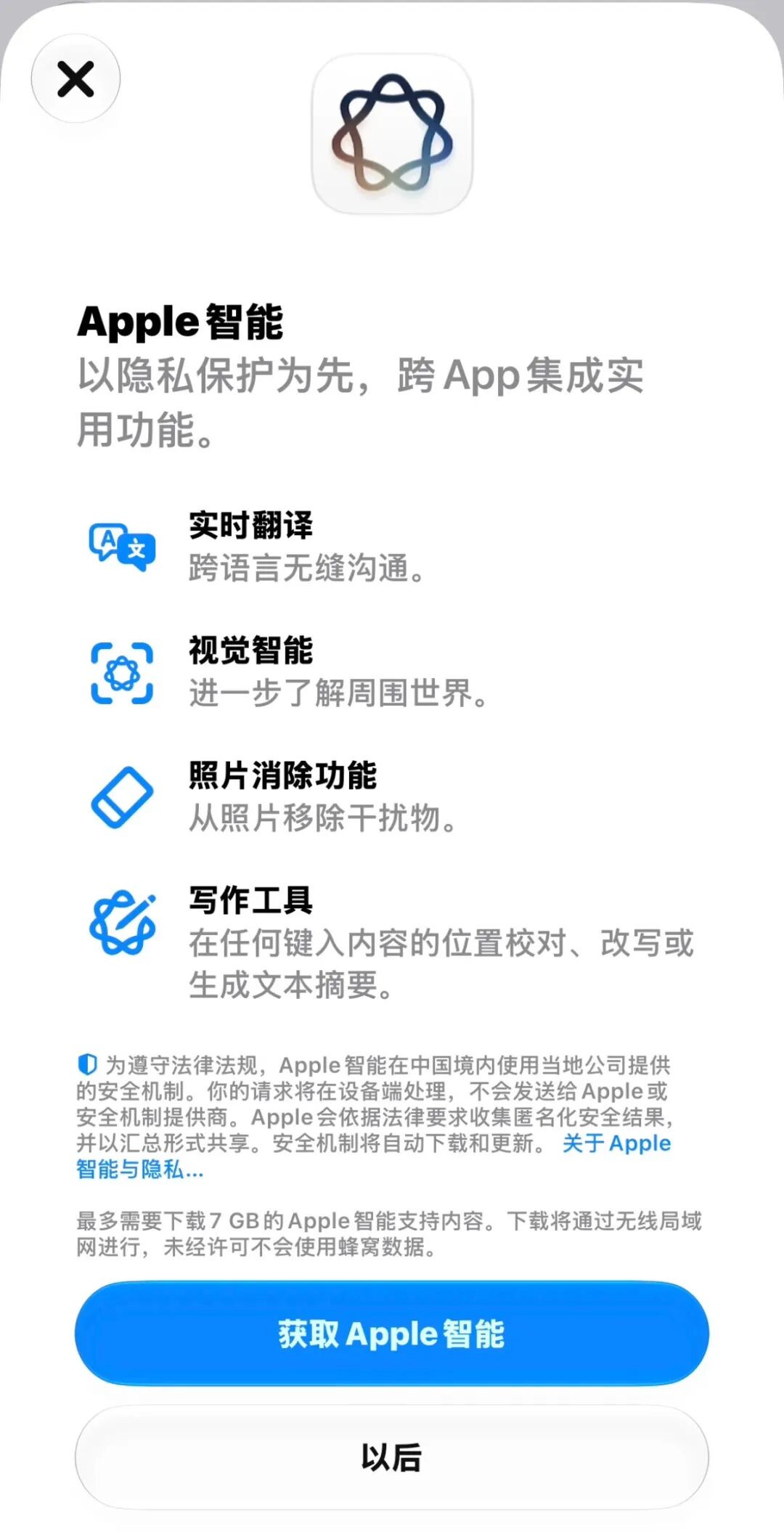
Source: mobile phone screenshot
From the perspective of actual experience, some features can still bring pleasant surprises.
Take real-time translation for example. This feature is integrated into apps such as Messages, FaceTime and Phone, enabling direct translation during calls and text messaging. Paired with AirPods 4, AirPods 5, AirPods Pro 2 and AirPods Pro 3, it supports real-time translation during face-to-face communication, which can directly translate the other party's speech into Chinese for playback. Its response speed and accuracy are sufficient to support daily oral conversations, but users need to download the corresponding language pack when using it for the first time.
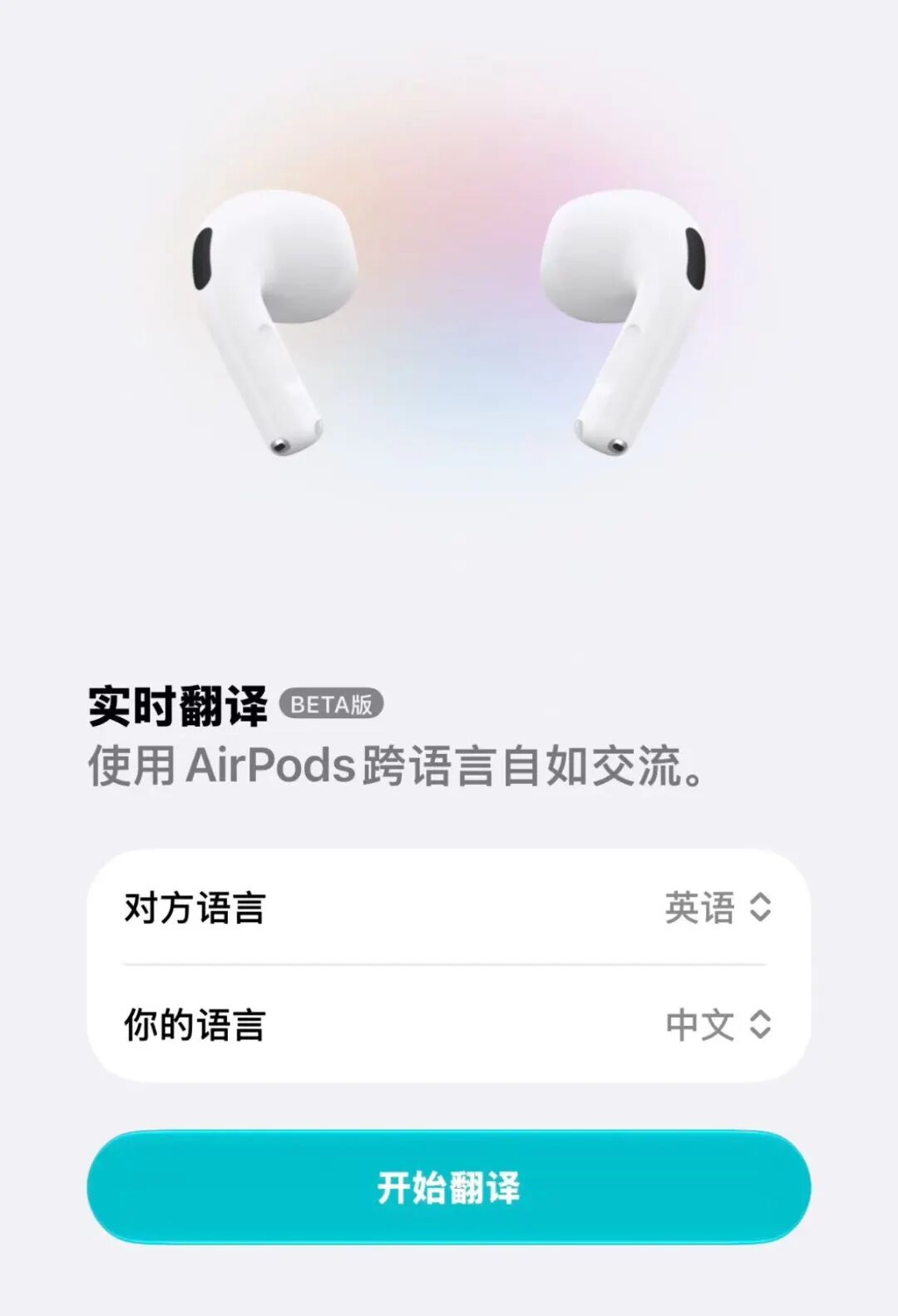
Source: mobile phone screenshot
The writing tool can help users rewrite, proofread and summarize input texts, which is accessible no matter in Notes, Mail or the text input boxes of third-party apps. However, the writing tool still has some problems in actual tests: for example, in Chinese context, some rewriting results are still relatively template-based, and there is still a gap before it can truly understand Chinese tones, scenarios and expression habits.
Apple's native writing tool is mainly responsible for processing existing texts, while after enabling the Qwen extension, users can directly ask the AI to create content from scratch, generating articles, emails and even images. Users can independently choose whether to enable the Qwen integration function, and the system will pop up a confirmation dialog to verify the permission every time before uploading information such as images and documents to Qwen for processing.
For other features such as photo object removal, the system can complete the removal quickly for photos with simple backgrounds and clear boundaries of target objects; but when dealing with complex backgrounds, large-area textures or detailed human figures, problems such as blurring and unnatural edges may still appear in the repaired area. In addition, visual intelligence helps users instantly perceive objects and places around them through the iPhone camera, identify objects, commodities and scenarios in front of them, and then conduct further inquiries or searches.
It is worth noting that although Siri in the beta version has higher semantic understanding accuracy and more coherent continuous conversations, and can directly use Qwen to answer questions after the Qwen extension is enabled, this Chinese mainland version does not bring the new-generation Siri that the market has long expected. Apple has officially made it clear that this update does not include Siri AI and other next-generation Apple Intelligence features announced at Apple's 2026 Worldwide Developers Conference.
From this perspective, the Apple AI that Chinese mainland users have waited for two years is more like a supplementary improvement of basic capabilities, rather than a true AI revolution in the strict sense.
At present, only the developer preview version is open for testing. The first batch of supported devices mainly include iPhone 15 Pro, iPhone 15 Pro Max, iPhone 16 and later models, iPhone Air and iPhone Duo; iPhone 15 and iPhone 15 Plus are not within the supported range; Siri and the device language need to be set to Simplified Chinese or English.
iPad and Mac are not included in this round of testing for the time being. Apple plans to launch relevant features for Chinese users along with the official version of iOS 27.3 in December, but the stability and actual performance of the official version remain to be observed.
Apple's "Marriage" with Qwen: To What Extent?
In overseas markets, Apple first chose to cooperate with OpenAI, integrating ChatGPT into system-level features such as Siri and writing tools as an optional extension, so that users can hand over complex problems to ChatGPT when needed. In January this year, Apple and Google announced their cooperation, and the new-generation Siri released by Apple at the 2026 Worldwide Developers Conference in June was built on a customized Gemini model. According to Bloomberg, Apple pays Google about 1 billion US dollars per year for this.
However, this new Gemini-powered Siri has not been introduced to the Chinese mainland version. In the Chinese market, Alibaba's Qwen undertakes the cloud-side capability of Siri in the current version.
The cooperation between Apple and Alibaba's Qwen is the most noteworthy part of Apple's AI entry into China this time. According to public information, Qwen is integrated into three system-level entrances of Apple: Siri, writing tools and visual intelligence. Users can call Qwen in Siri for specific questions, and ask questions about content such as photos, PDF files and presentations. In the writing tool, Qwen provides the capability to create content from scratch. In visual intelligence, users can identify objects and scenarios in front of them through the iPhone camera and raise further questions. It is worth noting that the "inquiry" function in visual intelligence is undertaken by Qwen, while the "search" function is provided by Baidu's visual model.
This "marriage" means that Qwen is no longer just an independent AI application that users need to actively download, open and use, but has entered part of the interaction process of Apple's operating system. For Alibaba, this is an extremely important system-level entrance, while Apple has made up for its local cloud model capability for the Chinese market through this cooperation.
But it needs to be clarified that Qwen does not take over the entire Apple Intelligence, nor is it the underlying model of Siri — on the Chinese mainland version, the whole system is still based on Apple's self-developed on-device model, and some tasks are processed by the on-device model; the system will call the cloud capability provided by Qwen only when the user puts forward a request beyond the capability of the local model, or actively selects the relevant function. The two are more like a division of labor between the on-device side and the cloud side, rather than a simple model replacement.
From the perspective of actual experience, this division of labor also has clear boundaries.
For example, when a user asks Siri a relatively complex question, the system can ask for permission to call Qwen to get the model-generated answer. But if the task is further extended to complex data processing, app service invocation or multi-step operations, users may still need to jump to the Qwen App for further interaction.
The privacy mechanism is also an important part of this cooperation. Apple emphasizes that users can independently choose whether to enable the Qwen extension, and the system will ask for user consent before sending questions, documents or images to Qwen. Alibaba has also clearly responded that Apple users' requests and generated replies will not be used for Alibaba's model training.
This design conforms to Apple's consistently emphasized privacy control logic, but from the perspective of product experience, the authorization pop-up also means that the interaction link is extended. How to balance privacy protection and interaction efficiency still needs to be answered through subsequent product iterations.
The Real Test Has Not Yet Begun
Why did Apple choose Qwen? Since Apple first announced its partners, the market has been full of such questions. According to media reports, before selecting Qwen, Apple had contacted many leading domestic manufacturers in China, and finally settled on Alibaba.
Apple has not made the full set of partner selection criteria public, so it is difficult to regard a single factor as the decisive reason. But from the actual requirements of this cooperation, what Apple needs is obviously not just a supplier with decent model capabilities.
The first priority is localization and compliance capabilities. The implementation of generative AI services in the Chinese market faces a regulatory environment and service requirements different from those in overseas markets. Apple needs to find a partner that can provide model services in China, meet the requirements of localized operation, and coordinate with its global product system.
The second is model capability. The scenarios where Qwen is integrated involve text generation, image understanding and complex question answering, and the model needs to cover multiple tasks rather than only perform well in a single capability. In addition, the stability of cloud services, engineering delivery capabilities and long-term collaboration capabilities are all unavoidable requirements for system-level cooperation.
Although Apple and Qwen match each other in current demands, the real cooperation pressure and test are yet to come.
On the one hand, there is still an obvious gap between the Chinese mainland version of iPhone and the overseas version. Apple has been testing more advanced new Siri and next-generation Apple Intelligence capabilities overseas, while Chinese users are currently getting a version dominated by basic functions. On the other hand, domestic smartphone manufacturers have not stayed at the simple stage of stacking AI features: no matter in system-level assistants, cross-app task execution, or integration with local life, e-commerce and content services, domestic smartphone manufacturers keep bringing forth new ideas.
This means that the competition Apple's AI will face next is no longer a simple comparison of model parameters or individual features, but a test of whether the entire operating system can become the scheduling center of AI services.
However, in the long run, the cooperation between Apple and Alibaba may promote the formation of a new relationship between smartphone manufacturers and large model companies: smartphone manufacturers hold the operating system, hardware and user entrances, while large model companies provide cloud intelligent capabilities, and the two sides re-divide labor around permissions, data, services and application ecology. But how far this cooperation can go still depends on product performance.
Apple's AI entry into China has just taken the first step, and the real competition has not yet started.
This article is from the WeChat Official Account "China Entrepreneur Magazine" (ID: iceo-com-cn), written by Deng Shuanglin, and published with authorization from 36Kr.