The world's first comprehensive teardown of Tesla Cybercab: hundreds of manufacturing processes have been drastically reduced to just 25, leaving traditional automakers utterly dumbfounded.
Robotaxi is Elon Musk's ultimate destiny!
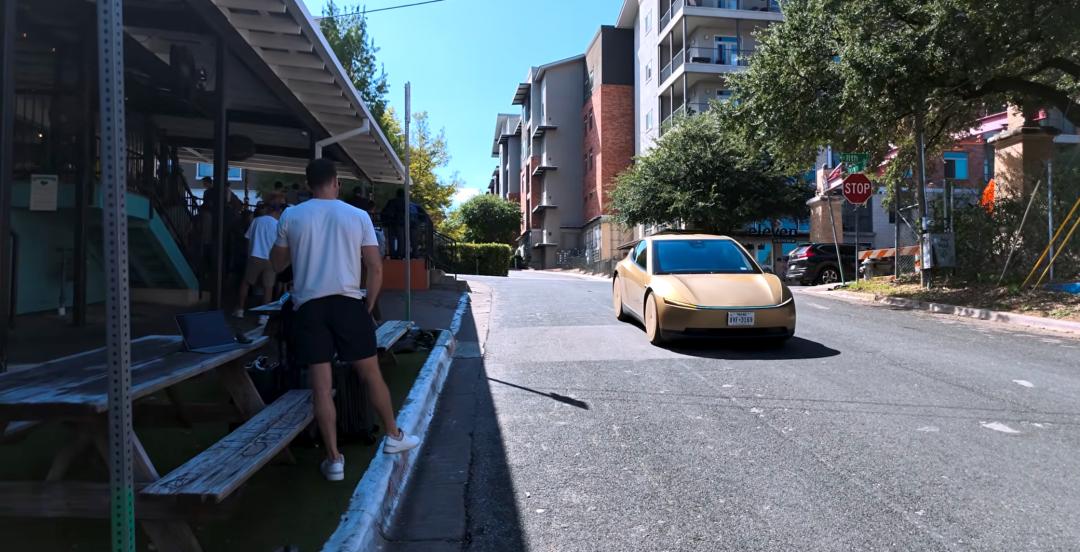
Tesla officially released the full detailed teardown video of Cybercab for the first time.
The previous "innovation and reform" of the production and manufacturing processes and concepts of the Model 3/Y/S/X has already made the traditional automotive industry overwhelmed, and the latest Cybercab will probably directly "drive crazy" and "shock silly" the old-timers in the sector.
It's really hard to comment. The Cybercab cuts every possible unnecessary cost, is no different from Lego, and is simply a big toy Elon Musk built for himself.
The Latest Technological Revolution of Cybercab: Battery and High-Voltage Electronic Systems
Let's start with the most core battery and high-voltage system of the whole vehicle.
Cybercab has made several important changes here: removing the pyro fuse, adopting wireless BMS, redesigning the battery pack structure, and introducing the high-voltage blind-mate interface, with the shared goal of simplifying the internal structure of the battery system to make production, assembly and subsequent maintenance easier.
Looking at them respectively, the first is to remove the pyro fuse that is commonly used in traditional electric vehicles.
In the high-voltage circuit of a traditional battery pack, a pyro fuse is usually installed. When the vehicle is in a severe collision or suffers a major electrical fault such as short circuit, the system will trigger the built-in miniature pyrotechnic device, which cuts off the high-voltage circuit through the mechanical effect generated by explosion.
The pyro fuse is a one-time protection component that must be replaced after being triggered. Once triggered, the entire battery pack is basically scrapped, resulting in extremely high post-maintenance costs.
In contrast, Cybercab uses Fast Interrupting Contactors, which monitor abnormal current through high-speed electrical switches and control circuits to cut off the high-voltage circuit when a fault occurs.
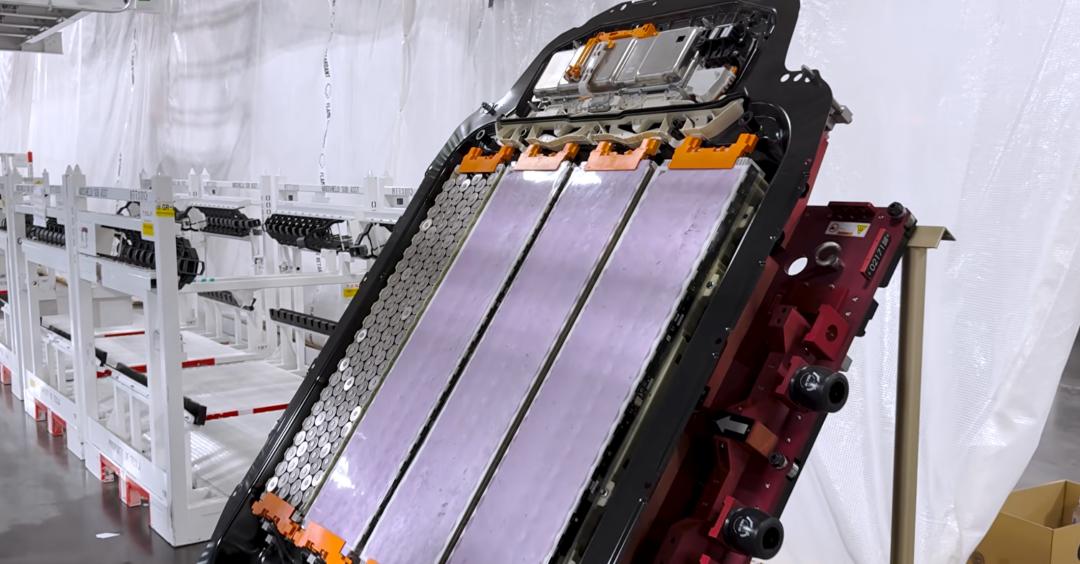
After some faults are resolved, the contactor can be closed again, reducing the need to replace one-time components.
Secondly, the communication method inside the battery pack has also changed.
Cybercab adopts a wireless battery management system (Wireless BMS) inside the modules, integrating RF communication chips on the sampling boards of each module to transmit data through wireless signals and support module-level edge computing.
This eliminates a large number of internal sampling wires and connectors. Of course, the chip cost of each module increases by 20 to 30 cents, but the entire system can save more than 1.5 US dollars - saving per cell unit adds up to a very considerable cost reduction for the entire battery pack.
It is worth mentioning that this wireless BMS solution also shares relevant technologies with Tesla's Optimus humanoid robot.
Third, the structure of the battery pack has also been adjusted.
The previous Model Y adopted a fully structural battery pack, which fixed the cells inside with a large amount of potting adhesive and formed a whole with the body structure. This design is conducive to improving structural rigidity, but after the cells are highly fixed, it is difficult to repair individual local faults.
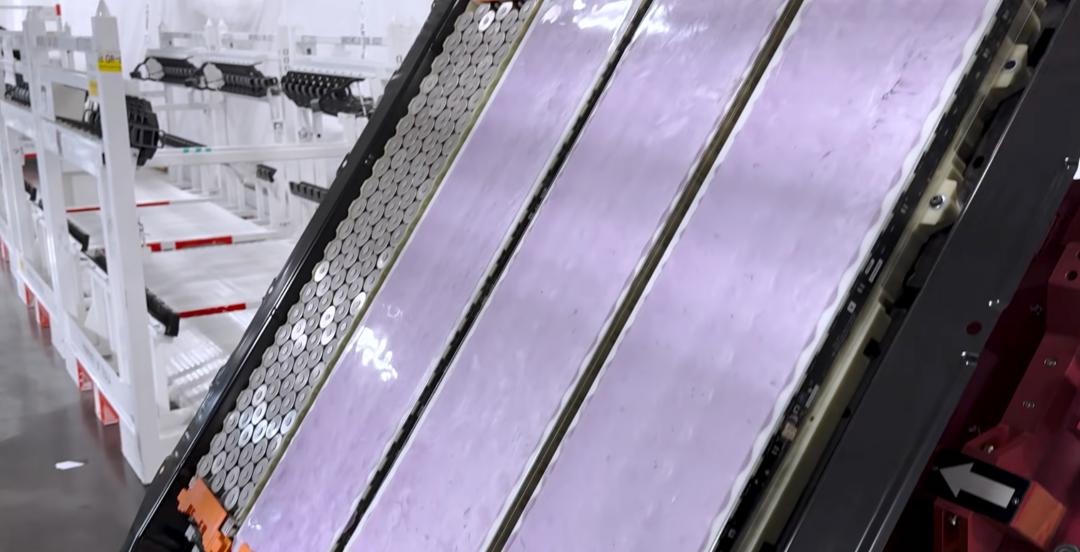
Cybercab is changed to a Semi-Structural Pack, which limits the potting adhesive to the inside of the battery modules, and the modules are connected to the battery pack shell through structures such as mechanical longitudinal beams.
This not only retains the fixing and protection capabilities inside the modules, but also enables independent disassembly and assembly of different modules. When a local fault occurs, the corresponding module can be replaced without directly scrapping the entire battery pack, and the cost of a single module is about 1,500 US dollars.
The bottom shell of the battery pack is made of 1.2mm stamped steel plate to further reduce material cost.
The last change directly serves automated assembly: HV Power Blind-Mates.
Traditional high-voltage interfaces require manual or robotic arms to complete connector insertion, and a high-voltage interlock loop (HVIL) is also needed to monitor the connection status. Cybercab uses a high-voltage blind-mate interface with positioning structure. When the battery controller and the modules are assembled together, the high-voltage connection can be completed automatically just by pushing them in according to the preset position.
To ensure that the interface is fully inserted in place, Tesla also introduced Force-Distance Curve control: the robotic arm monitors the resistance change and travel distance during the insertion process in real time, and judges whether the interface is aligned, fully inserted, and whether there is any abnormality during the connection process through the preset curve.
To sum up, from battery protection, internal communication to structural design and high-voltage connection, Cybercab further divides the battery pack into modules that can be independently assembled, tested and maintained. The only goal is to reduce costs, including the hard cost of the components themselves, the labor cost of the assembly process, and the post-maintenance cost.
Front Integrated Module: Thermal Management and Brake-by-Wire System
Outside the battery pack, another highly integrated area of Cybercab is the front module, which gathers about 50% of the components of the whole vehicle, with thermal management, drive inverter, high-voltage power distribution and part of the braking system all integrated here.
We are familiar with this point. Domestic players such as BYD have long mass-produced the integrated cabin-air conditioning module.
Looking at the thermal management system first, Cybercab adopts an Indirect Thermal System with pure ethylene glycol, which concentrates the refrigerant compressor, heat exchanger and control manifold inside the front module, limiting the refrigerant to the local circulation system as much as possible.
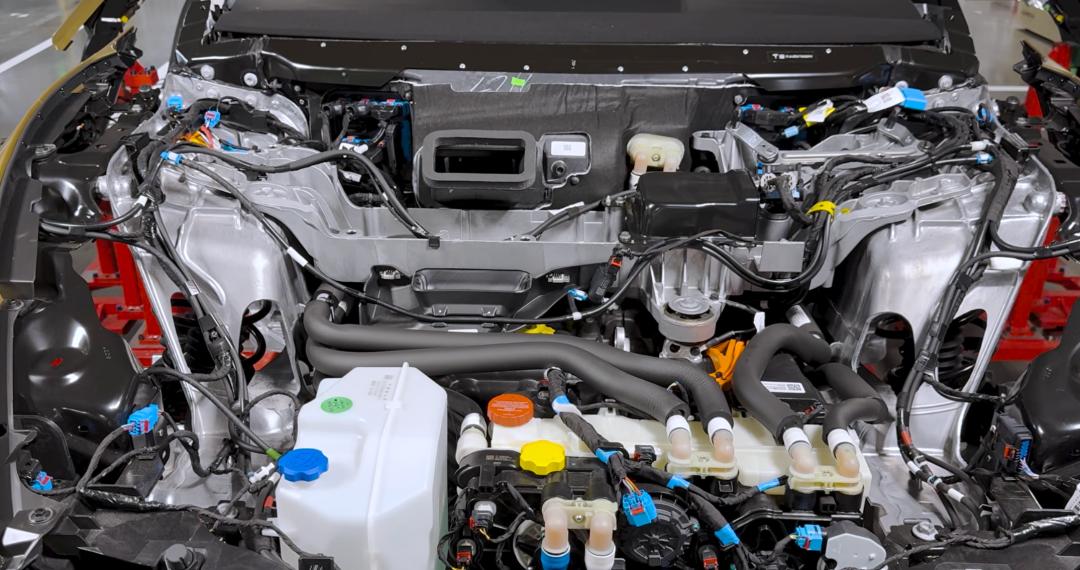
This means that the refrigerant pipelines that need to extend to different areas of the whole vehicle in the traditional thermal management system can be greatly reduced. For manufacturing, a large number of pipelines and connection points are eliminated; for maintenance, some components can be disassembled independently without evacuating the entire vehicle refrigerant circuit or disassembling the suspension.
At the same time, the Electric Air Conditioning Compressor (EAC) is also directly integrated on the thermal management module, eliminating independent brackets and additional connecting structures, and the entire module can complete testing before entering the final assembly line.
In addition to thermal management, Cybercab also adopts Brake-by-Wire.
The traditional braking system relies on hydraulic pipelines to transmit braking force, and a complete hydraulic transmission link is required from the braking input to the execution at the wheel end.
Cybercab eliminates the hydraulic brake pipelines spanning the front and rear of the vehicle body, and controls the actuators at the wheel end through electrical signals to complete braking. This is especially important for Robotaxi without steering wheel and traditional driving pedals, as the autonomous driving system can directly send braking commands to the actuators to complete the action.
At the same time, the front and rear brake modules can independently conduct function tests before the whole vehicle is assembled, eliminating the processes of layout, connection and exhaust of traditional hydraulic pipelines.
Another easily overlooked change is that the drive inverter directly undertakes the function of the high-voltage Power Distribution Center (PDC).
Traditional electric vehicles usually need an independent high-voltage power distribution unit to distribute the electric energy output by the battery to different components such as the drive motor, air conditioning compressor and thermal management system.
Cybercab integrates the high-voltage power distribution function into the drive inverter. The battery pack only needs to connect the inverter through the main high-voltage line, and other high-voltage electrical equipment can be tapped here.
This reduces the number of independent power distribution boxes, high-voltage wires and connectors.
Putting these designs together, the integration logic of Cybercab's front module is quite clear: the thermal management system reduces long-distance refrigerant pipelines, the brake-by-wire system eliminates cross-body hydraulic pipelines, the inverter takes into account high-voltage power distribution, and multiple functional modules can also complete independent assembly and testing in advance.
Body Process and Drive Unit
The adjustments made by Cybercab in body manufacturing are more intuitive.
The most prominent one is the body outer panels adopt Reaction Injection Molding (RIM) and In-Mold Color, directly eliminating the traditional painting process.
RIM, namely Reaction Injection Molding, is different from traditional plastic injection molding. Traditional injection molding requires heating and melting solid plastic particles before injecting them into the mold; RIM mixes liquid polymer raw materials and injects them into the mold, and completes curing through internal chemical reaction.
In-Mold Color means adding pigment directly during the molding process, so that the parts have the final color when they are demolded.
After the combination of the two technologies, the outer panels such as doors, fenders and roof can directly complete molding and color treatment, reducing subsequent painting processes. Tesla can thus cut the painting workshop related equipment and production space.
Wait a minute, this feels familiar:

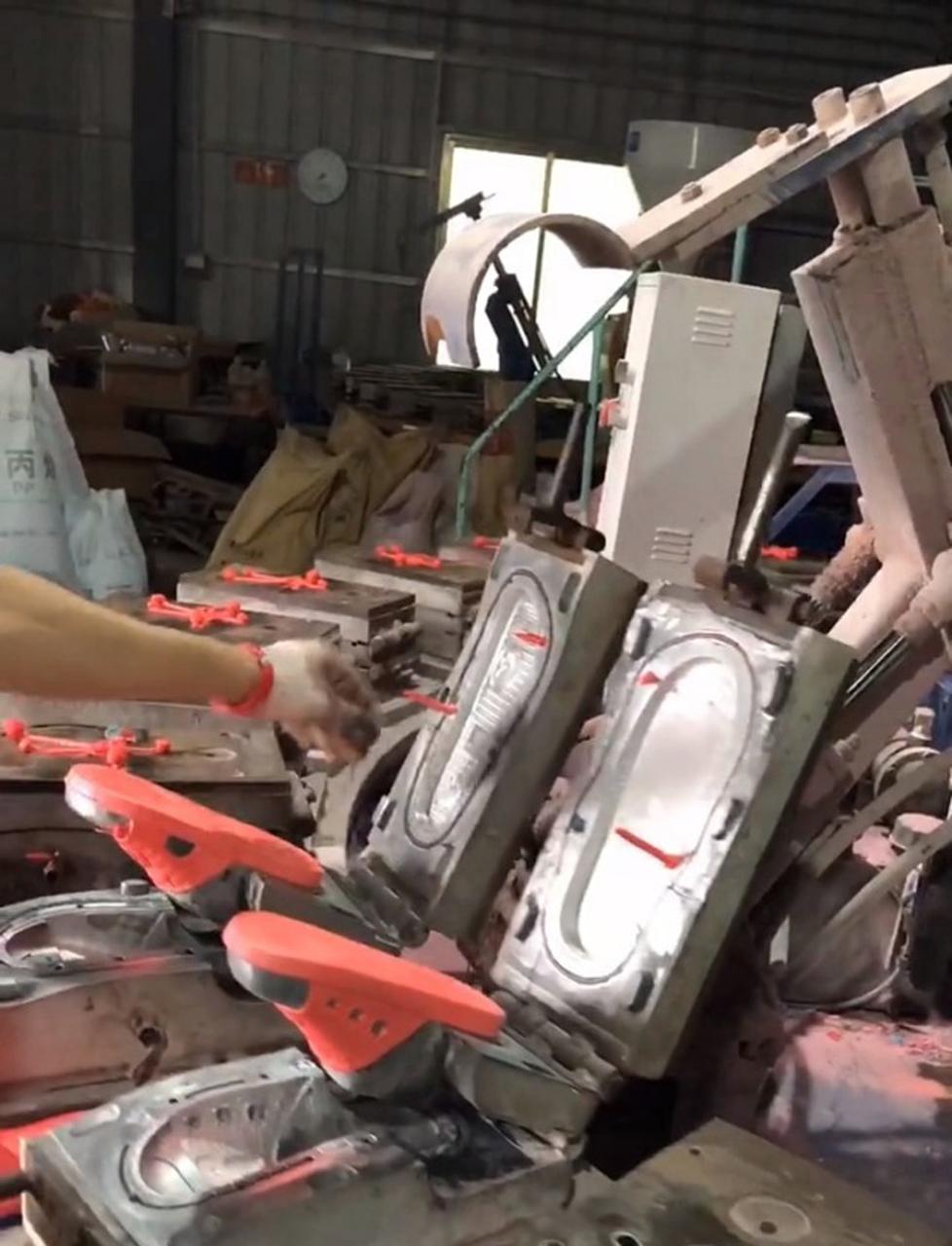
The idea is similar, but Tesla is obviously at a higher dimension.
To match this, the large aluminum alloy die-casting parts at the front and rear of Cybercab themselves greatly reduce the number of components and processes, and special alloy materials are also adopted to eliminate the traditional electrophoretic coating process.
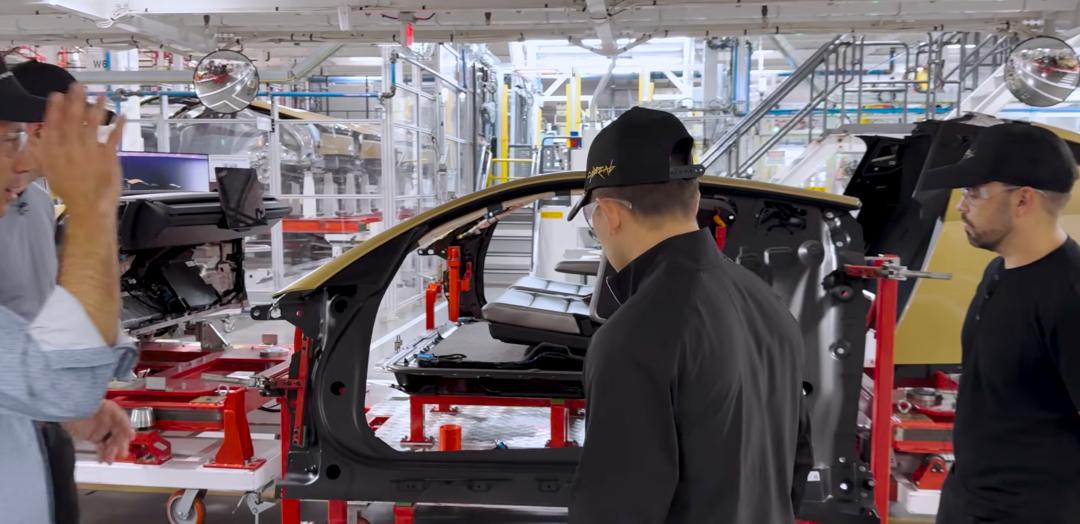
Apart from the body process, Cybercab's drive unit is also redesigned for the urban Robotaxi scenario.
This drive system is called 5DU, which adopts a front-wheel drive layout with the reduction ratio increased to 11:1.
The reduction ratio of previous Tesla models is usually around 9:1, which needs to take into account both urban commuting and a relatively high maximum speed. However, Cybercab is mainly for urban operation, where frequent starting, stopping and low-speed driving are the core working conditions. Therefore, the reduction ratio is increased to 11:1, which amplifies the torque at the wheel end through a larger reduction ratio, while reducing the demand for high-speed performance.
There are two more simplified designs inside the drive unit: replacing the independent electronic oil pump with a mechanical oil pump, eliminating the related motor, drive circuit and control software; integrating the cooling water channel directly inside the die-cast aluminum housing, transferring heat through the housing, and reducing additional machining of parts such as the motor stator.
From outer panel molding, body die-casting to drive unit, Cybercab continues to reduce independent parts and subsequent processing links, and these hardware designs also provide conditions for the larger-scale reconstruction of the manufacturing process that follows.
Unboxed Process, Inverted Decking
All the aforementioned technical changes ultimately point to a more essential question: how on earth can Cybercab be produced efficiently with high quality and low cost?
Traditional automobile manufacturing usually completes body welding and painting first, then enters the final assembly line, and installs instrument panels, interiors, seats, wiring harnesses, chassis and power systems in sequence.
But as the body gradually forms a closed structure, many components can only be installed inside the compartment through limited openings, and robotic arms also need to complete complex actions in a narrow space.
With the aforementioned greatly simplified body components, Cybercab can naturally adopt the Unboxed Process, splitting the whole vehicle into multiple relatively independent modules, allowing them to be assembled synchronously on parallel production lines, and finally carrying out the final vehicle assembly.
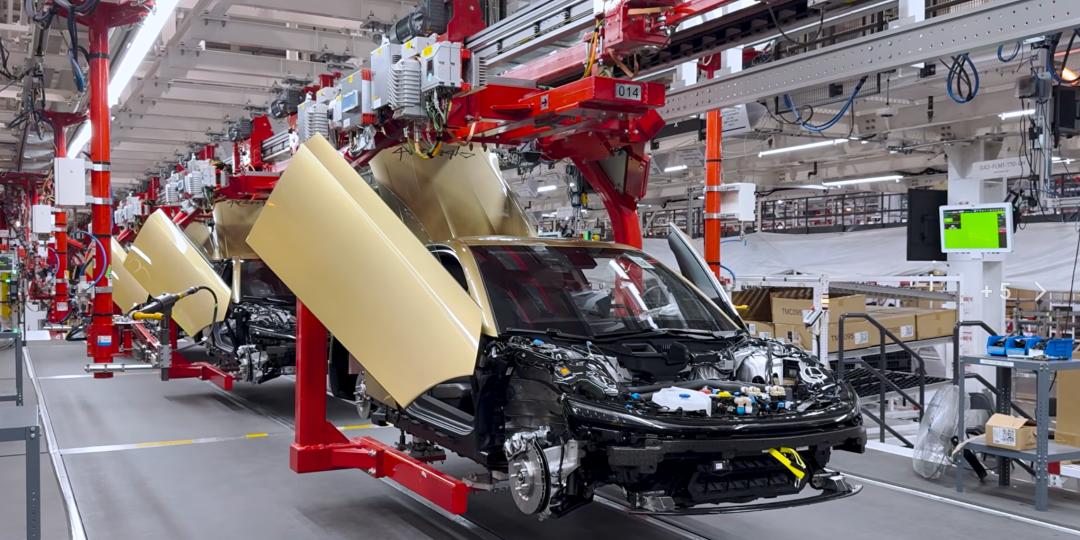
The two most critical processes are as follows.
The first one is Flat Bench Assembly:
That is, the left and right side body modules are placed horizontally on the workbench, and the roof, interior, wiring harness and control components can be directly installed from above, providing a more open operation space for robots and workers, and reducing the complex assembly actions that need to extend into the compartment. The side modules can also complete assembly and testing in advance on independent production lines.
The second one is Inverted Decking:
First fix the drive unit, suspension and thermal management system on the Geo Pallet, then lower the partially assembled body from above to directly dock with the chassis module.
This method allows the chassis to complete independent assembly in advance, and the body and the chassis are positioned and connected through preset positions, reducing the complex lifting, alignment and adjustment actions in traditional assembly.
The high-voltage blind-mate, brake-by-wire and integrated thermal management mentioned earlier also provide conditions for this assembly method. For example, the high-voltage interface can be automatically plugged in, the braking system does not need additional cross-body hydraulic pipelines, and the thermal management components have been integrated inside the front module.
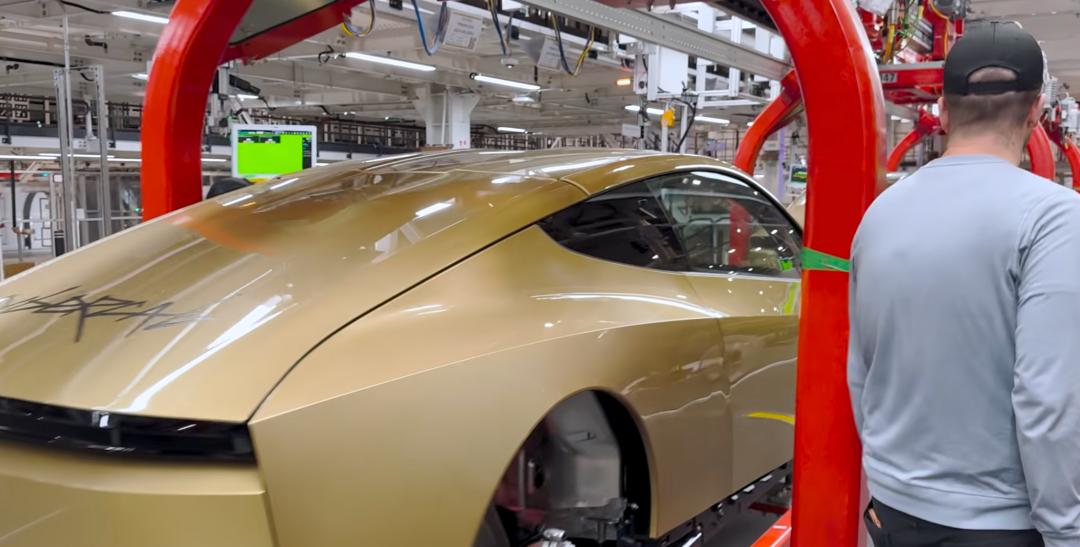
Finally, this manufacturing process is reflected in a quite striking figure: it is disclosed that Cybercab's whole vehicle General Assembly (GA) line only