Just now, AutoDNA from the AI Native Lab of Shanghai Jiao Tong University has been published in Nature: it can autonomously coordinate more than 20 types of instruments and complete over 11,000 steps of biological experiments.
Building an AI-native laboratory that enables autonomous scientific exploration with minimal human intervention has long been a long-standing goal. Although autonomous experimental systems have emerged continuously in recent years, they are still mainly limited to fields with single objectives, clear workflows and simple instruments. This is partly related to the "add-on" architecture of existing systems: AI is usually used to perform specific tasks in experiments, and it is difficult to form a global understanding of the entire experimental process. This problem is particularly prominent in engineering scenarios involving multiple instruments, complex processes and multi-objective optimization.
Nowadays, the AI-native laboratory AutoDNA proposed by the team of Shanghai Jiao Tong University and its collaborators is expected to break through this limitation. The relevant research paper was published in the authoritative scientific journal Nature today.
Paper link: https://www.nature.com/articles/s41586-026-11228-6
According to the paper, AutoDNA is an AI-native autonomous experimental platform oriented to biomolecular engineering, supporting core operations such as nucleic acid synthesis, transcription, amplification and sequencing. It can autonomously coordinate more than 20 types of instruments and perform over 11,000 steps of hardware operations. In the representative applications mentioned in the paper, AutoDNA achieved the enzymatic DNA synthesis yield optimized by human experts, reduced the execution time of concurrent experimental workflows to about one-third of the original, completed an end-to-end DNA data storage cycle and accurately restored the original digital content, and also identified and verified the KRAS G13D mutation in a clinical sample.
The research team believes that AutoDNA provides a new implementation blueprint for "science-as-a-service", which is expected to accelerate biological discoveries and promote applications in fields such as synthetic biology and information storage.
In a News & Views comment published in the same issue, James Zou, Associate Professor of Biomedical Data Science at Stanford University, pointed out that AI may design potential bioactive molecules in minutes, but experimental verification still takes weeks or even months and requires a lot of manpower.
News & Views article link: https://www.nature.com/articles/d41586-026-03270-1
"This work demonstrates how AI systems are beginning to narrow the gap between proposing experiments and actually performing them."
From Add-on AI to AI-Native Laboratory
To understand the design idea of AutoDNA, we first need to look at the limitations faced by current autonomous experimental platforms.
In recent years, the combination of large language models (LLMs) and automated hardware has enabled core links such as data analysis and experimental decision-making to be handled by models. However, existing platforms usually adopt a human-centric add-on architecture, which limits AI to specific separate tasks. Human participation is still required for instrument configuration, experimental process definition and optimization rule setting.
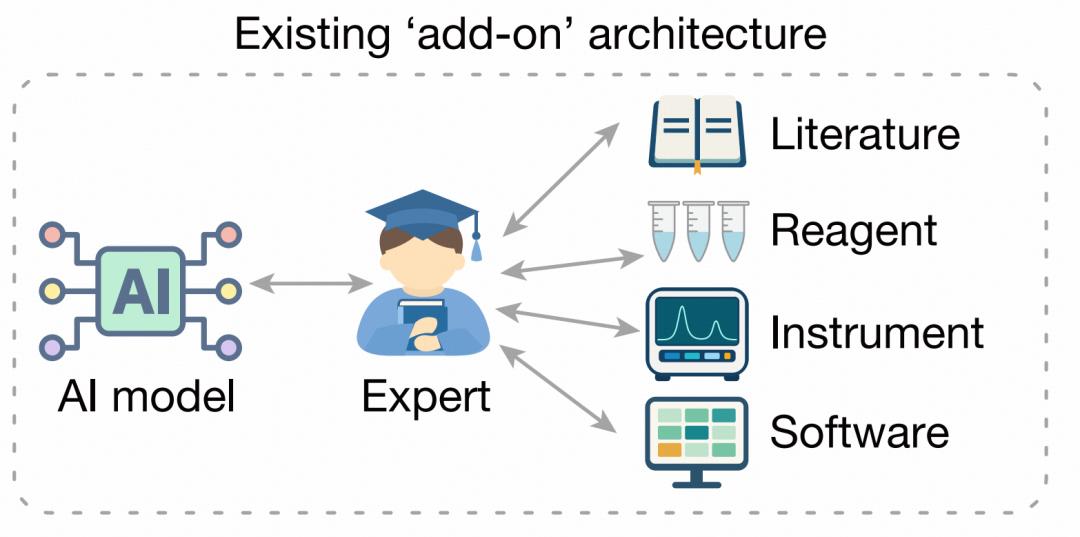
Figure | The traditional add-on architecture treats the AI model as a tool, and the entire experimental process is still led by human scientists
There is still a gap between this and the AI scientists envisioned by researchers. In the ideal system they describe, users only need to put forward experimental requests in natural language, and the model-based agent can independently complete experimental design, code generation, instrument control and iterative optimization, providing end-to-end experimental services for non-professional users.
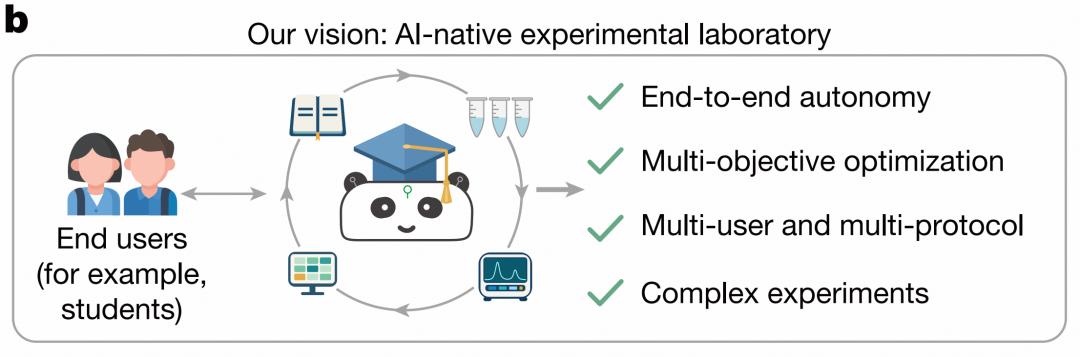
Figure | The vision of AI scientists. Model-based agents independently handle complex experiments and obtain results at the level of human experts
To achieve this goal, the inherent complexity of biological experiments is an important threshold.
Biological experiments often involve multiple mutually restrictive objectives, and the optimization directions form a huge and complex search space. Taking temperature, pH and concentration as examples, these variables may interact with each other, and it is difficult to fully cover them through manually preset processes. At the same time, biological laboratories are usually equipped with many different types of instruments, and there are high difficulties in cross-device collaboration and information integration. Experiments themselves put forward strict requirements for real-time execution, environmental stability and operation accuracy.
These characteristics mean that autonomous experimental systems need to have the ability to understand the overall experimental process, perform multi-objective optimization, and coordinate different hardware devices at the same time.
The core idea of AutoDNA is to integrate these capabilities into the same end-to-end framework through the collaborative design of models, experiments and instruments.
Specifically, AutoDNA adopts a multi-agent architecture, where different agents are respectively responsible for literature retrieval, reagent management, experimental process design, code generation, hardware control and experimental hypothesis formulation, and are uniformly coordinated by the central Planner agent. After the user gives natural language instructions, the Planner agent will independently select and schedule different agents according to the task requirements, and gradually complete the complete process from literature retrieval, reagent selection, experimental design to code generation, hardware execution and result analysis.
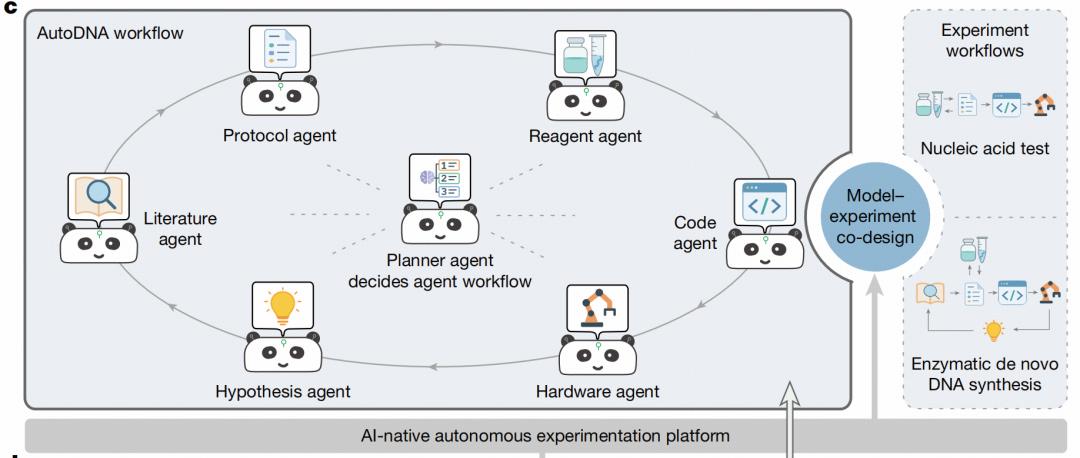
Figure | The proposed AI-native autonomous platform AutoDNA adopts a multi-agent architecture
Through this architecture, the system can form an overall understanding of the experimental process in complex scenarios such as nucleic acid detection, enzymatic de novo DNA synthesis, DNA data storage and cancer detection, and establish a model-led "design, experiment, optimization" closed loop. With the reasoning ability of LLM, AutoDNA can continuously adjust the scheme according to experimental feedback, and explore multi-objective optimization strategies in open optimization dimensions.
Let AI Understand and Control Different Instruments
After completing the experimental design, AI also needs to convert the experimental scheme into hardware operations in the real world. This is also another key challenge faced by autonomous laboratories.
Different instruments have their own control methods and operation interfaces. If the agent is required to directly handle the underlying control details of each device, the development and expansion of the system will become complicated.
To this end, AutoDNA introduces a hardware abstraction layer optimized for AI. The system can parse instrument specifications and user manuals, abstract the functions of different devices into a set of atomic services, and describe them in natural language for agents to understand and call.
For example, the functions of a pipette can be abstracted into two basic services: reagent transfer and mixing. Based on this abstraction layer, the code agent can independently generate instrument control code, and perform error detection and correction; the hardware agent is responsible for managing hardware resources to realize the cooperative operation of different types of instruments.
In this way, AutoDNA can coordinate more than 20 types of instruments, complete more than 11,000 steps of hardware operations, and achieve micron-level position accuracy and microliter-level liquid operation accuracy.
Regarding the interface compatibility problem between different instruments, James Zou also put forward a noteworthy point in the same issue's comment: instruments from different manufacturers may adopt different programming interfaces, making it difficult to migrate automation solutions from one laboratory to another. He believes that industry standard interfaces need to be established between AI agents and instruments, otherwise each autonomous laboratory may be reduced to a customized engineering project.
In addition to the hardware interface, how to ensure the reliable execution of the generated operation code is also a problem that autonomous laboratories need to solve.
Zou specifically mentioned the value of the digital twin of the laboratory. He believes that agents can test and improve experimental plans through a simulation environment before actual execution. Taking AutoDNA as an example, the system will first run the generated instrument code in the simulation environment, track the liquid volume, and check the position of experimental utensils and instrument settings. The comment points out that in one experiment, the simulation environment successfully found the problem that the code tried to read the fluorescence value before the sample container was placed in the instrument. In this way, the agent can find potential errors before the costly real experiment starts.
After solving the execution problem of a single experiment, AutoDNA further considers resource management when multiple experiments run in parallel.
Facing the situation where multiple users and multiple experimental schemes are submitted at the same time, the system can dynamically schedule according to the real-time available status of instrument resources, and coordinate the execution sequence of different tasks. When a certain instrument is occupied, the system can also find alternative devices with the same function and adjust the control code accordingly, so as to reduce waiting time and improve instrument utilization.
As a result, model decision-making, experimental design, hardware control and resource scheduling are integrated into the same end-to-end framework.
Representative Applications
The research team verified the capabilities of AutoDNA in different biological experimental scenarios through the following representative applications.
In nucleic acid detection, AutoDNA uses a commercial fluorescent isothermal detection kit to detect African swine fever virus.
In the experiment, 42 microliters of buffer was first used to reconstitute the lyophilized powder to prepare the premix, then 5 microliters of sample and 3 microliters of activation solution were added to start the reaction. The system immediately recorded the initial fluorescence value after the reaction was started, and then performed 5 rounds of detection, each round was incubated at 39 °C for 5 minutes before measuring the fluorescence. The manual control adopted the same operation process.
In enzymatic de novo DNA synthesis, AutoDNA demonstrated its autonomous multi-objective optimization capability.
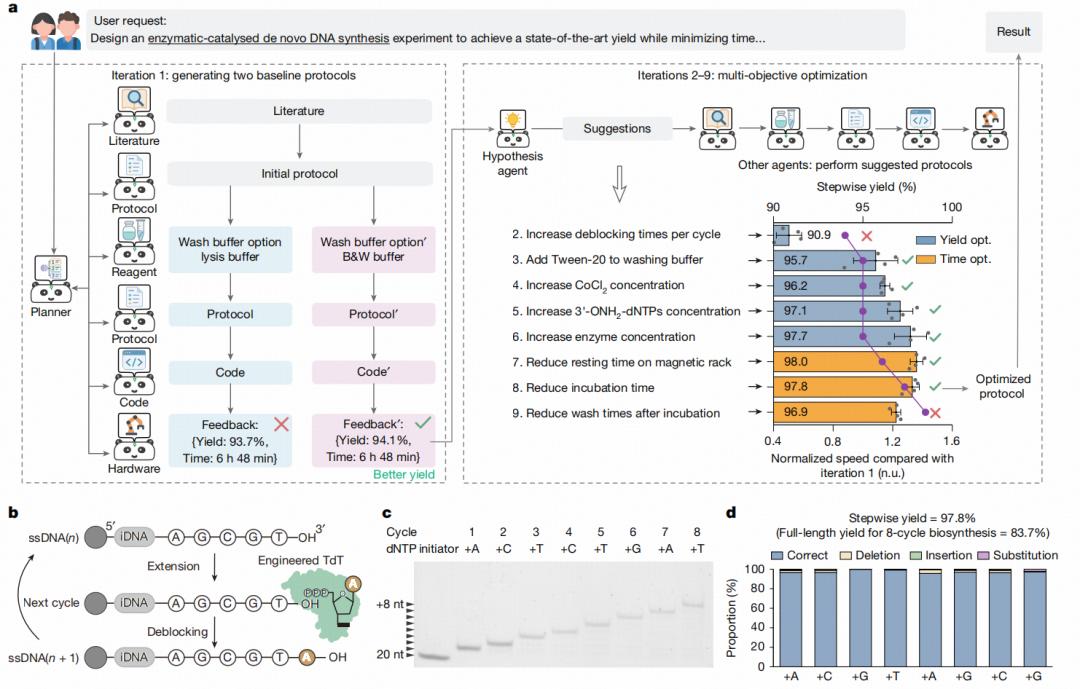
Figure | The autonomous workflow of optimizing enzymatic DNA synthesis using AutoDNA
This experiment requires simultaneous optimization of DNA synthesis yield and reaction time. Faced with the huge parameter search space, AutoDNA can dynamically adjust the exploration direction according to experimental feedback, try different variables such as buffer, surfactant, reaction time and reagent concentration, without the need for humans to pre-define the complete search space.
After multiple rounds of iteration, the system finally found an experimental scheme that balances yield and execution time, with an average single-step synthesis yield of 97.8%, which is comparable to the published optimization results by human experts.
In DNA data storage applications, AutoDNA completed an end-to-end data storage cycle.
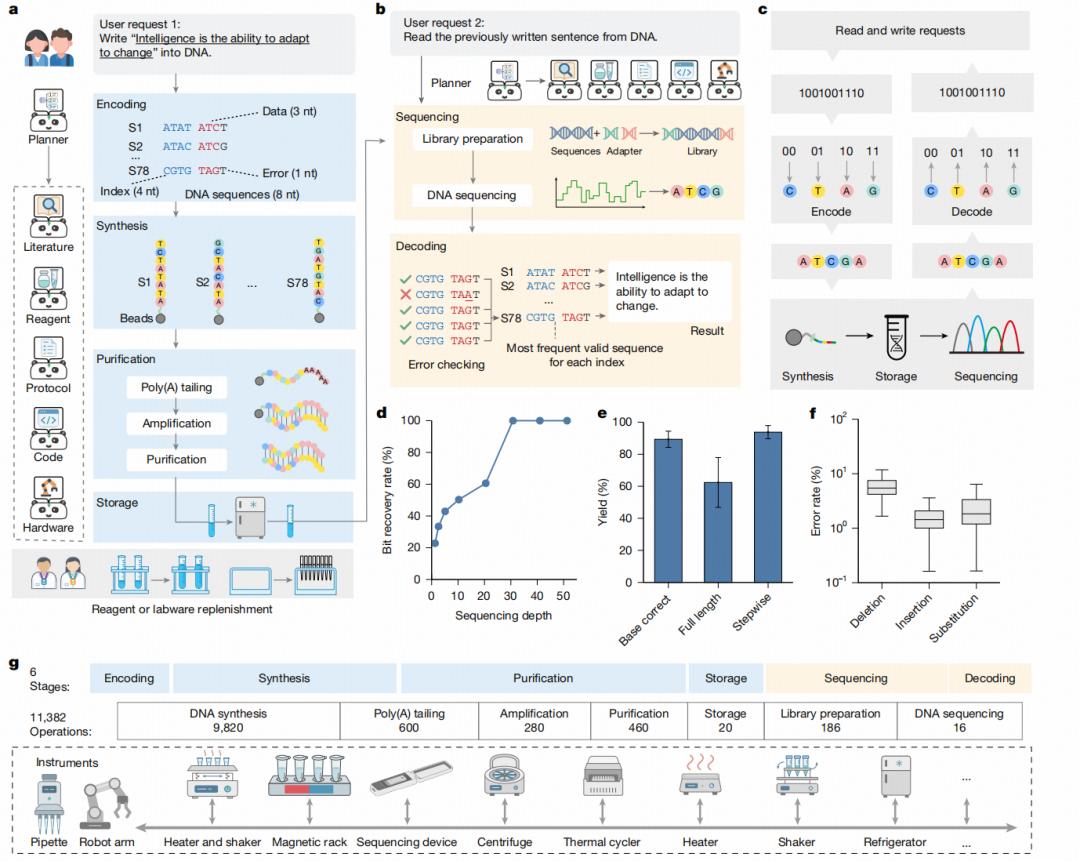
Figure | End-to-end DNA data storage service supported by AutoDNA
The entire process involves multiple links such as digital information encoding, DNA synthesis, storage, sequencing and decoding. AutoDNA independently coordinated the relevant experimental processes, completed the synthesis and sequencing of 78 DNA strands, and finally accurately restored the original digital content.
This experiment lasted for about 203.5 hours, with a total of 11382 hardware operation steps performed. During this period, human participation was mainly limited to regular disposal of experimental waste, and replenishment of reagents and experimental consumables according to system reminders.
In cancer detection applications, AutoDNA further demonstrated the ability to process clinical samples.
The research team provided the system with a pre-processed colorectal cancer tissue sample with unknown sequence information. AutoDNA independently completed five stages: sequencing, mutation site identification, primer design, primer synthesis and detection verification, and finally identified the KRAS G13D mutation, and successfully verified the detection result using the self-synthesized primers.
How Far Is the Autonomous Laboratory from Fully Unmanned Operation?
Although AutoDNA demonstrates a high degree of experimental autonomy, its capability boundary still needs to be viewed objectively.
James Zou clearly pointed out in the comment that the selection of experimental tasks and the configuration of the physical platform are still completed by humans. Before the experiment starts, the operators need to prepare reagents and experimental equipment; during long-term operation, it is also necessary to replenish supplies and dispose of waste.
In addition, the experiments currently suitable for full automation are still mainly relatively standardized tests. More complex experiments involving animal models are still beyond the capability scope of existing automated systems.
Reliability is also an issue that needs to be solved for further promotion. Zou mentioned that during the experiment of AutoDNA, the research team recorded 14 hardware errors, 8 of which were automatically recovered by the system, and the remaining 6 still required human intervention.
The research team also pointed out in the paper that LLM itself has certain randomness, which may affect the repeatability of experimental schemes. In the future, they plan to introduce more powerful instruments, mobile robots that can independently complete reagent transportation, as well as more complete literature databases and retrieval-augmented generation systems, to further improve experimental autonomy and result reliability.
Overall, AutoDNA demonstrates a new path for AI agents to move from computational tasks to real experimental operations. With the further integration of computational intelligence, experimental automation and hardware systems, AI scientists are expected to gradually take on more experimental links, making complex biological experiments open to researchers in a more standardized and automated manner.
For more technical details, please refer to the original paper.
Author: Zhang Jiayi
This article is from the WeChat official account "Academic Headline" (ID: SciTouTiao), written by Academic Headline, and authorized for release by 36Kr.