Baidu has launched the model trading platform "Ciyuansuo", which brings together 42 large models.
DuJia learned that Baidu recently launched an open and trusted model service platform for developers, enterprise customers and model suppliers called "TokenHub", which integrates multi-model and multi-supplier resources, provides model selection, invocation, transaction and management capabilities, and implements credit evaluation for resources and suppliers as well as blockchain deposit and certification. In short, developers only need to connect to the API of TokenHub once, then they can freely switch between large models from multiple manufacturers, compare prices, check performance, and invoke and bill on demand.
01
What is TokenHub?
DuJia understands that TokenHub is a model matching and transaction service platform for the large model field, connecting model suppliers and model consumers.
The platform brings together 42 large models, including mainstream text and video large models such as DeepSeek, Kimi, Zhipu GLM, etc. Multiple suppliers will be connected under the same model. Developers can directly compare real operation indicators such as quotations of different service providers, first Token delay, throughput speed, 7-day invocation success rate, and historical invocation volume, to intuitively see the price difference and performance gap between different suppliers.
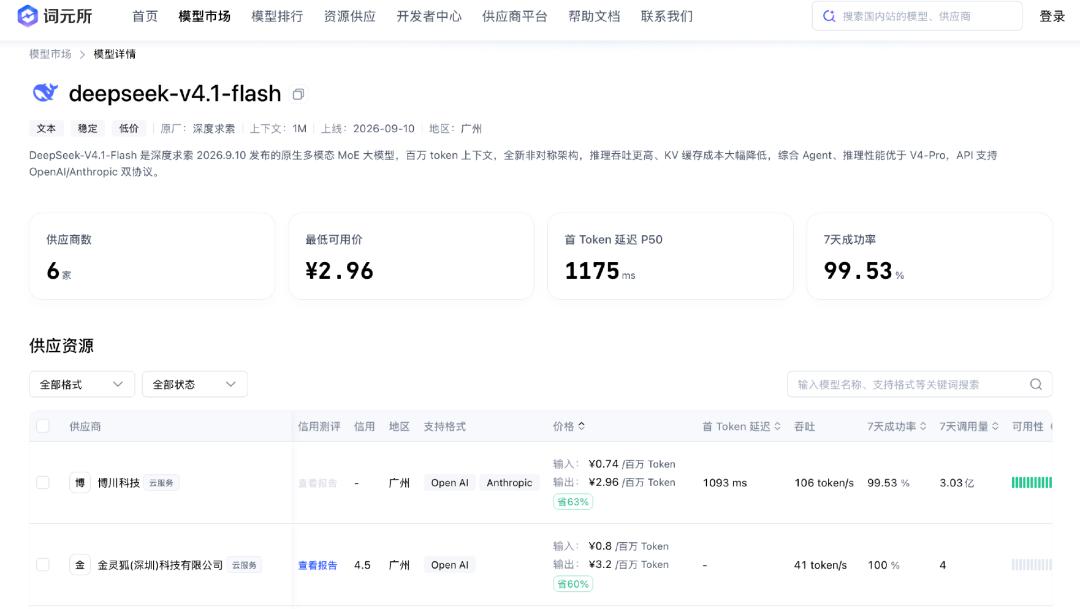
Taking DeepSeek-v4.1-flash as an example, 6 suppliers provide resources for this model on the platform. The input and output Token pricing, response delay and throughput capacity of different manufacturers are all different. The page will mark the price saving ratio to facilitate the selection of supply sources with higher cost performance.
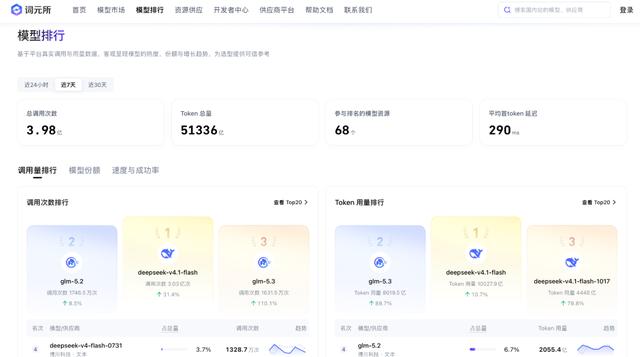
The platform also displays basic model information, including context window length, launch time, deployment region, and allows users to view the supplier's credit assessment report. Suppliers support both OpenAI and Anthropic protocols.
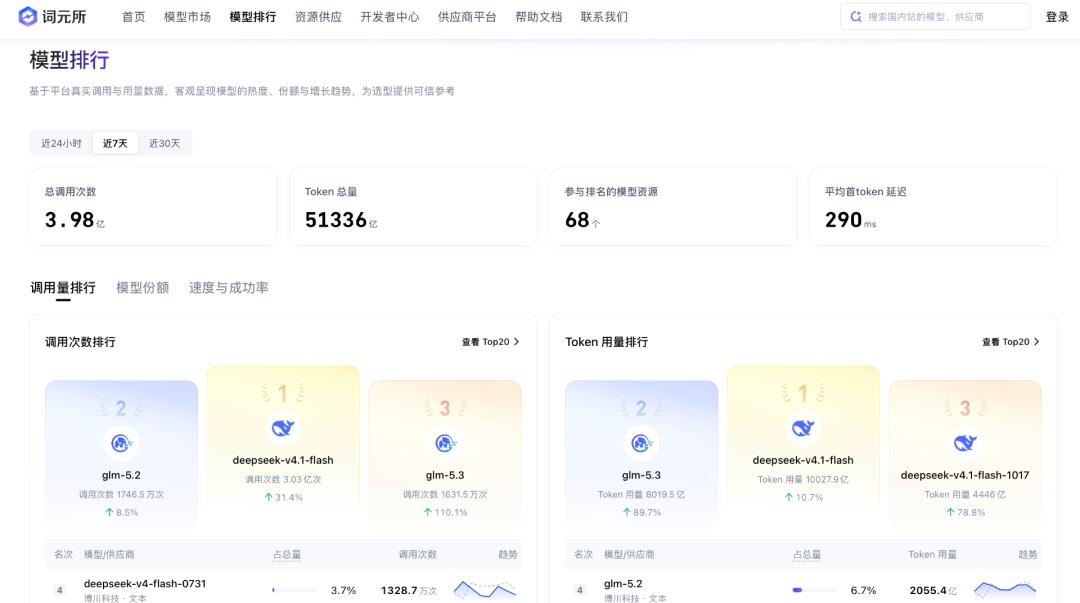
The platform is equipped with a model ranking section, which objectively presents the model popularity, market share and growth trend based on the real invocation and usage data on the platform, providing reliable reference for developers to select models. The ranking can be switched between the dimensions of the last 24 hours, the last 7 days, and the last 30 days, showing four overall market indicators: total invocation times, total Token volume, number of model resources participating in the ranking, and average first Token delay. At the same time, it is divided into three types of rankings: invocation volume ranking, model share, speed and success rate, which intuitively shows the invocation times, Token consumption and month-on-month growth trend of each model. In the screenshot, the total invocation times of the platform in the last 7 days is 398 million, the total Token volume is 5133.6 billion, there are 68 model resources participating in the ranking, and the average first Token delay is 290ms. DeepSeek-v4.1-flash ranks first in both the invocation times and Token usage rankings.
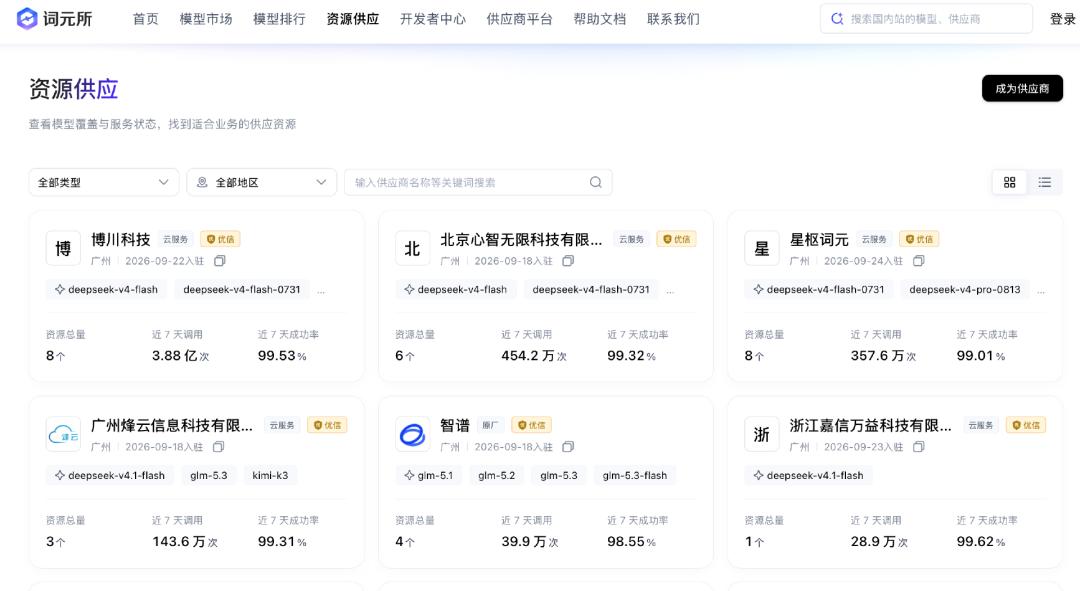
TokenHub serves both ends of the supply and demand, accepting model service providers to settle in and supply resources on one hand, and providing developers with one-stop selection and invocation channels on the other hand. On the resource supply page, you can view all settled suppliers, including manufacturers such as Bochuan Technology, Mind Unlimited, StarPivot Token, and Zhipu Original Factory. The platform will show each supplier's settlement time, deployment region, list of available models, total resources, invocation times in the last 7 days and service success rate, and also mark the "Trusted Supplier" label, so that developers can directly select reliable service providers. There is an "Become a Supplier" entry in the upper right corner, which supports model resource parties to settle in the platform and list their interfaces.
It is worth mentioning that the platform has four core values:
- Support test and selection, which can horizontally compare the effect, delay and cost of multiple large models, helping businesses complete model screening and evaluation
- Realize unified access to massive models. Developers only need to connect to the API interface once, without adapting to each manufacturer separately, and can flexibly switch model resources, reducing the cost of building Agents and AI applications
- Provide real-time data ranking, intuitively display indicators such as performance, invocation usage, and operation status, so as to detect operation anomalies in time
- Provide neutral and credible evaluation, and ensure that the model-related data on the platform is open, transparent and credible by means of access test, regular spot check and dial test, model fingerprint comparison and other methods
02
Betting on model trading, can Baidu seize the new opportunity in AI?
China's domestic large model MaaS track has entered the competition stage of multi-model aggregation and matching. Alibaba Bailian, Volcano Engine Ark, and Alibaba's Meta-Context JellyToken have all laid out their layouts. Baidu's launch of TokenHub is precisely to seize the model trading track.
In the past, the ERNIE large model was mainly sold through Baidu Cloud's own channels. TokenHub puts ERNIE into the open market to display alongside DeepSeek, GLM and Kimi. The same model supports supply from multiple suppliers, reaching more developers and small and medium-sized enterprises that would not have purchased Baidu Cloud separately, driving the invocation revenue of the ERNIE large model.
In addition, it can compete for the developer ecosystem against competing products. Alibaba Bailian, Volcano Engine Ark, and JellyToken all aim at the pain point of developers: connecting to multiple models requires maintaining multiple sets of APIs. TokenHub uses unified API and unified billing to attract developers, keeps the selection and invocation traffic on the platform, and prevents customers from being intercepted by competing aggregation platforms.
Moreover, building a supply and demand matching market opens up new platform-based revenue. The platform is open for suppliers to settle in, and both original model manufacturers and cloud service providers can list their interfaces. Acting as a matching and verification role, TokenHub is no longer limited to selling its own large models. Under the trend of Token standardization, it seizes the commercial opportunities of computing power distribution and model trading, while lowering the threshold for Agent and AI application development, and expanding the overall AI ecosystem.
However, the implementation of this model matching platform is not easy. On the one hand, it needs to connect a large number of third-party suppliers, unify the heterogeneous interfaces of each party, align the billing standards, and continuously carry out dial-up test monitoring to ensure the stability of different service providers and the authenticity of data. On the other hand, it needs to balance the interests of multiple parties, not only to safeguard the rights and interests of third-party model manufacturers and computing power suppliers, but also to prevent its own ERNIE from being at a disadvantage in the same-stage price comparison. The platform must also continuously ensure the neutrality of evaluation. Once there is data deviation or supplier service failure, it will directly damage the trust of developers, which is also a long-term test commonly faced by similar aggregation platforms.
This article is from the WeChat Official Account "DuJia", the author is DuJia, and 36Kr is published with authorization.