Xiaohongshu is stepping into the Personal Agent track, starting with a pair of glasses?
Over the past two months, the Personal Agent track has heated up rapidly. Overseas companies including Meta, OpenAI, Anthropic and others, as well as domestic giants such as Alibaba and Tencent, have successively launched products to compete for the next-generation entry point of consumer decision-making.
In this race for the industry trend, Xiaohongshu has also been mentioned frequently. The reason is not hard to understand: after years of accumulation, Xiaohongshu has precipitated a large amount of real life experience, and many users will come here first when looking for restaurants, selecting products and planning trips. The outside world generally believes that Xiaohongshu owns a rich content mine for building Personal Agent, so its entry into this field seems to be a natural progression.
However, Xiaohongshu has not rushed to enter the market. Its current AI layout is mainly focused on the in-app assistant Diandian, which only responds when users search and ask questions. There is still a considerable distance from a Personal Agent that can continuously perceive demands and proactively provide help.
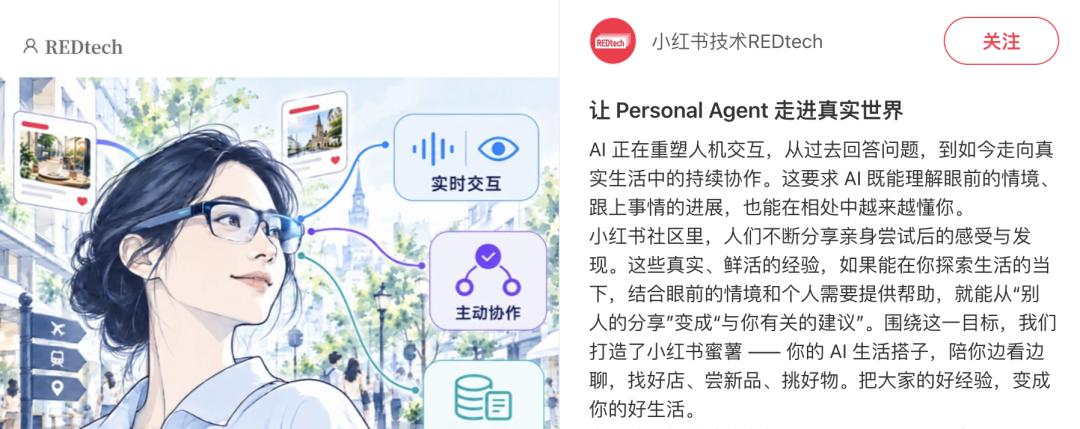
Now, this situation is changing quietly. A few days ago, Xiaohongshu's technology brand REDtech released an article. While officially announcing Xiaohongshu Mishu, it directly used the expression "Personal Agent" and described its long-term vision as "a Personal OS that continuously serves individuals". Rokid also confirmed at its recent new product launch that users can use Xiaohongshu Mishu to find stores and select products through Rokid AI glasses.
This time, Xiaohongshu's Agent has stepped out of its own App, entered offline life scenarios with the help of smart glasses, no longer just waits for users to ask questions, but can also continuously obtain on-site information during the task process and give timely suggestions according to environmental changes.
Different from the major manufacturers that have launched independent Agent applications one after another, Xiaohongshu chose to bring the Agent into the real world first with a pair of glasses. This not only reflects its judgment on its own advantages, but also makes the outside world see the shortcomings it urgently needs to make up for in the Personal Agent competition.
From Diandian to Mishu, when AI starts to directly call on community experience to filter information and assist decision-making for users, Xiaohongshu also faces another test: how to improve efficiency without weakening creators' continuous enthusiasm for sharing.
01
Chat While Viewing Activates Community Experience
But Glasses Are Only A Technical Test Field
First look at Xiaohongshu's positioning for Mishu: "AI life buddy". REDtech listed four types of daily scenarios: looking for small shops loved by locals in a strange city and discussing how to order against the menu; comparing the real use experience of two products; learning the trial feedback of new drink products; finding weekend exhibitions and markets based on recent notes.
The common point of these scenarios is: what users want is not a single search result, but the judgment of "this time, this place, this matter". This is also the reason why Mishu chose smart glasses as this niche carrier — to connect the life experience precipitated in the community with real scenarios.
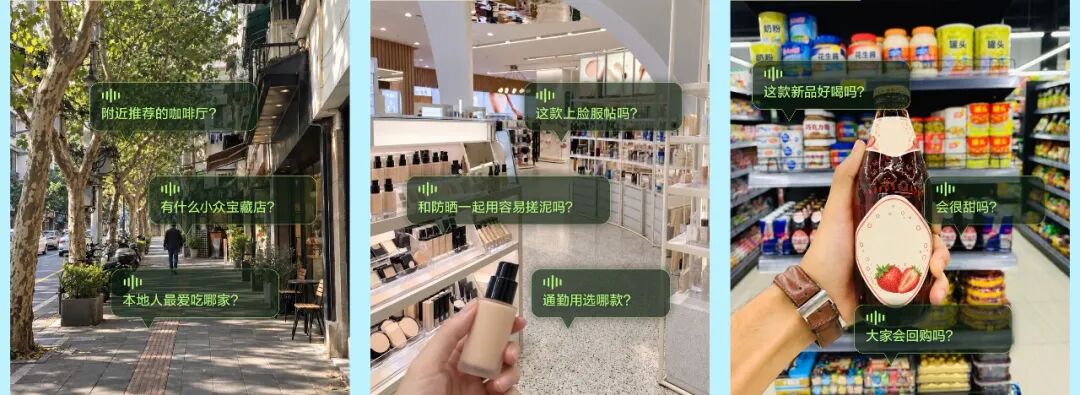
In the past, when users wanted to find a restaurant, they needed to open Xiaohongshu, search and browse notes, and filter them one by one according to their own needs. Even if AI could summarize the strategy, users still had to take the initiative to describe the problem and supplement on-site information. Smart glasses have changed this process.
Take "what to eat" as an example, when a user sees a restaurant and asks "how is this one", Mishu will make a judgment combining the store picture taken by the glasses and community experience. After entering the store, the user turns the lens to the menu and adds "we have 5 people, want to try the specialties, and also take care of the taste and portion". As the user flips through the menu, Mishu continuously identifies the newly appearing dishes, compares them with the previous requirements, and gives ordering matching suggestions at the right time.
Xiaohongshu calls this way of obtaining on-site information on demand as the task progresses "progressive perception". Real-time multi-modal full-duplex is responsible for chatting while viewing, Proactive continues the task and judges the timing of proactive response, and Memory accumulates personal background in the background for subsequent interaction calls.
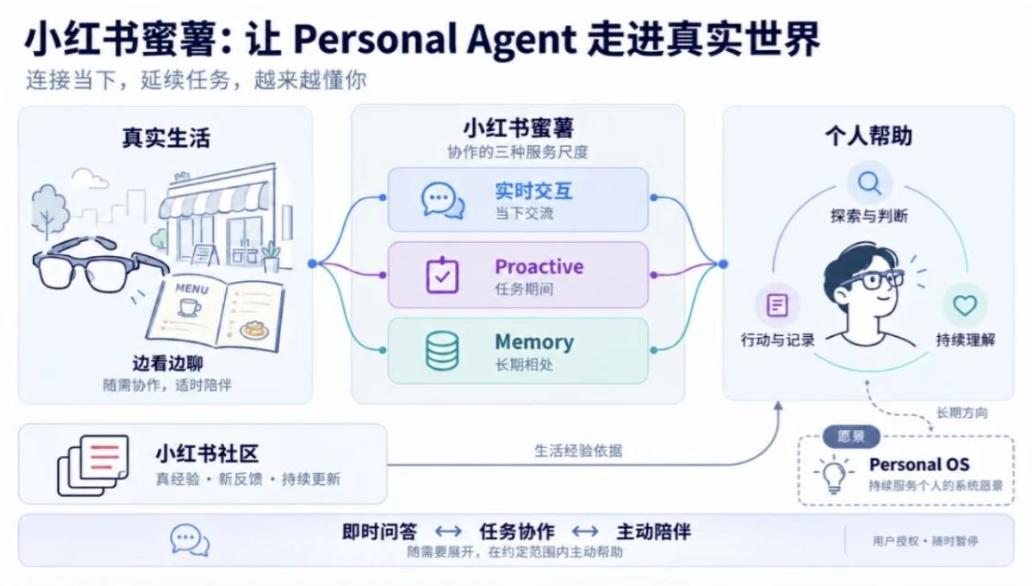
This kind of on-site perception makes up for Xiaohongshu's shortboard of lacking consumer data to a certain extent. Although it cannot get the user's historical orders, it can perceive the scene in front of the user and the immediate demand, and obtain information closer to the consumer decision-making scene.
However, the technical feasibility does not mean that glasses can become a mass-level AI entry. IDC data shows that the shipment volume of smart glasses in China in 2025 was 2.46 million units, a year-on-year increase of 87.1%, and it is expected to exceed 4.915 million units in 2026. But compared with the scale of smartphones, it is still a niche market.
Another IDC report also mentioned that products supporting large model voice assistants accounted for 50.5% of China's smart glasses market in 2025, but most AI functions still stay in general scenarios such as question and answer and translation, and have not formed the core value that truly drives users to use for a long time.
Users have not yet developed the habit of wearing glasses to make consumer decisions. For Xiaohongshu, smart glasses are more like a technology verification field, using first-person interaction to polish key capabilities such as real-time multi-modality, proactive service and long-term memory.
To achieve real large-scale application, the entry will eventually have to return to the more popular and higher-frequency mobile phones. The industry has also shown such signs. On October 31, Apple and Alibaba announced that Tongyi is connected to the China-version Apple Intelligence. iPhone users can select "Ask Tongyi" through "Visual Intelligence" to identify what they see in front of them, and the camera's ability to understand the scene is becoming a system-level capability.
The "chat while viewing" verified by Mishu on glasses has almost no technical barriers to migrate to mobile phones. The article also depicted such a picture: users plan complex tasks on mobile phones, put on glasses to get on-site help, and then review and sort out the experience after finishing.
Starting from glasses, Xiaohongshu's goal is obviously far more than glasses.
02
Own "Taste Data" of Life Decision-Making
Lack "Hands and Feet" That Can Get Things Done
Mishu is not an isolated experiment. In the past six months, Xiaohongshu's actions on AI have been denser than the outside world imagined.
In April, Xiaohongshu upgraded the humanistic intelligence laboratory Hi Lab to Dots, a first-level AI department. On October 16, Xiaohongshu released another all-staff letter, announcing the integration of Dots with the company's core infrastructure team — making the second major adjustment to the AI organizational structure within half a year.
There is a sentence in the all-staff letter that well illustrates Xiaohongshu's self-positioning: the value of technology does not lie in the competition of model capabilities and computing power scale, but in the deep integration of models and real applications.
In September, the in-app AI search product "Ask a Question" was merged into Diandian, further strengthening the capabilities of search and multi-round dialogue. Users can directly ask questions about food, travel, shopping and other issues, and AI will sort out answers combined with community content, and then further refine the demands. From organizational adjustment to in-app assistant, Xiaohongshu is gradually turning community content into capabilities that can be called by AI.

The reason why Xiaohongshu chose this path relies on its long-term accumulated content assets — which is often called "taste data" in the industry. It comes from users' real experience, including personal preferences, consumption evaluations and subjective judgments in specific scenarios, scattered in massive notes and comments.
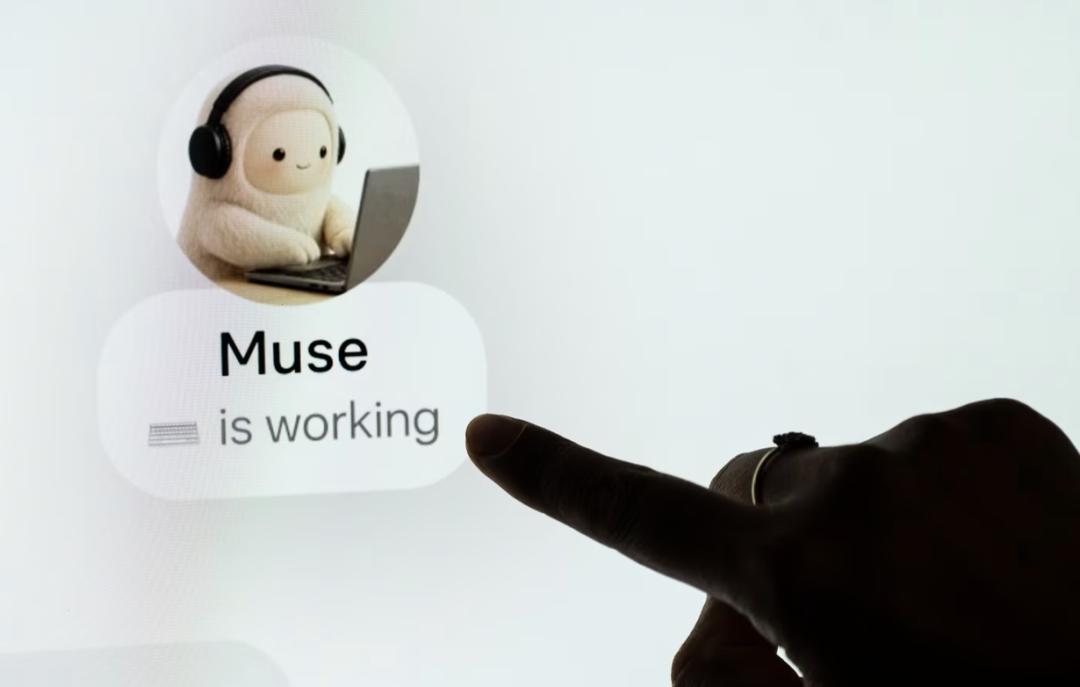
This is also the capability boundary of Personal Agents such as Muse and Lingguang: they can perform specific tasks, but may not have the experience accumulation required to understand user preferences and assist consumer decision-making.
And Xiaohongshu has begun to transform it into specific product capabilities. Now, when you search for "Bluetooth headset recommendation", the first thing you see is the product list sorted out by AI, marked with reference to the real experience of thousands of people, and you can go directly to the product page by clicking in. As a result, community content has changed from notes for users to browse to a basis that can directly participate in consumer decision-making.
However, recommendation is only part of the Personal Agent's capabilities. As the track heats up, the focus of competition is shifting from "who has more accurate recommendations" to "who can get things done". Behind Qianwen Go! there are businesses such as Taobao, Amap, Fliggy and Alipay, which can help users communicate with airlines for delay compensation, inquire about prices and make appointments for car maintenance, and apply for Taobao price protection; Tencent has WeChat and the mini-program ecosystem, and ByteDance holds Douyin E-commerce and local life services.
Compared with these products, Xiaohongshu's capability boundary is quite clear: it can tell users which restaurant to choose, but may not be able to take numbers, place orders and verify group purchases for users. The community is good at discovering demands and providing decision-making references, but there is still a long way to go from recommendation to transaction and subsequent performance.
This is not the first time Xiaohongshu has faced this problem. In the early stage, Xiaohongshu launched the self-operated cross-border e-commerce "Welfare Club", and also tried Taobao external link shopping guide, then gradually turned to platform e-commerce centered on buyers and third-party merchants. In 2025 and 2026, Xiaohongshu successively launched "Red Cat Plan", "Red Jing Plan" and "Red Mei Plan" with Tmall, JD and Meituan, trying to further connect community grass-planting with transactions and instant retail services on external platforms.
Behind several rounds of adjustments, there is always the same problem: Xiaohongshu can create consumer demand, but does not necessarily control the final transaction and performance. Users are attracted by the content in the community, but finally place orders on other platforms, and it is difficult for consumption experience to flow back.
Entering the Agent era, this problem will become more prominent. Facing this shortboard, in addition to continuing to expand its own entry with the help of glasses, cameras and independent applications, Xiaohongshu also needs to explore the connection with the external business ecosystem.
At the content level, Xiaohongshu can provide an authorized call entry for third-party Agents. After the external Agent raises a specific question, Xiaohongshu provides relevant note summaries, user reviews and original text links according to the permissions, instead of directly opening all community content. In this way, external Agents can obtain Xiaohongshu's real experience, and Xiaohongshu can also retain control over the scope of content call and usage methods.
At the performance level, Xiaohongshu has no lack of cooperation experience. In the past year, from the "Red Cat Plan", "Red Jing Plan" to the "Red Mei Plan", Xiaohongshu has formed a cooperation model of "content grass-planting — platform undertaking — data backflow", which converts community traffic into commercial revenue by diverting traffic to external platforms.
But entering the Agent era, this "traffic selling" business will also change. A transaction may be supported by multiple notes to provide decision-making basis, Xiaohongshu is responsible for providing community experience, the Agent is responsible for screening and recommendation, and the external platform completes transaction performance. The contribution of all parties is difficult to measure through click attribution, so Xiaohongshu, cooperative platforms and creators need to renegotiate the revenue sharing mechanism.
More importantly, Alibaba, Meituan and others have no lack of consumer data and user behavior records. Agents can further mine and activate these data, transform them into capabilities to understand user preferences and assist consumer decision-making, and gradually weaken Xiaohongshu's value. In the process of developing Agents, they may be more inclined to open up internal closed loops, rather than open up deeper transaction capabilities to Xiaohongshu.
In the future, the competition of Personal Agent is likely to no longer be a contest between individual products, but a competition between platform ecosystems. Xiaohongshu needs to find its own ecological position: not only make community experience an irreplaceable decision-making basis for Agents, but also make these recommendations smoothly enter subsequent services.
Otherwise, even with unique content advantages, Mishu may only stay as a more convenient life strategy assistant, and it is difficult to grow into a real Personal Agent that can continuously do things for users.
03
After the Agent Takes the Answer
How to Retain Real Human Creators?
No matter building Personal Agent on its own or opening content to external Agents, Xiaohongshu cannot avoid a problem: when AI is getting better and better at directly extracting and summarizing community experience, what changes will happen to the content ecosystem that originally operates relying on user browsing, interaction and sharing?
Diandian has already made some creators feel this change.
Recently, some creators posted on Xiaohongshu saying that in the past, when researching the practice of a dish, they needed to flip through various notes and summarize experience, and the relevant notes also got a lot of views. Now Diandian can directly sort out the relevant information, users will no longer browse the notes one by one after reading the answer, and the traffic of their own notes has decreased instead.
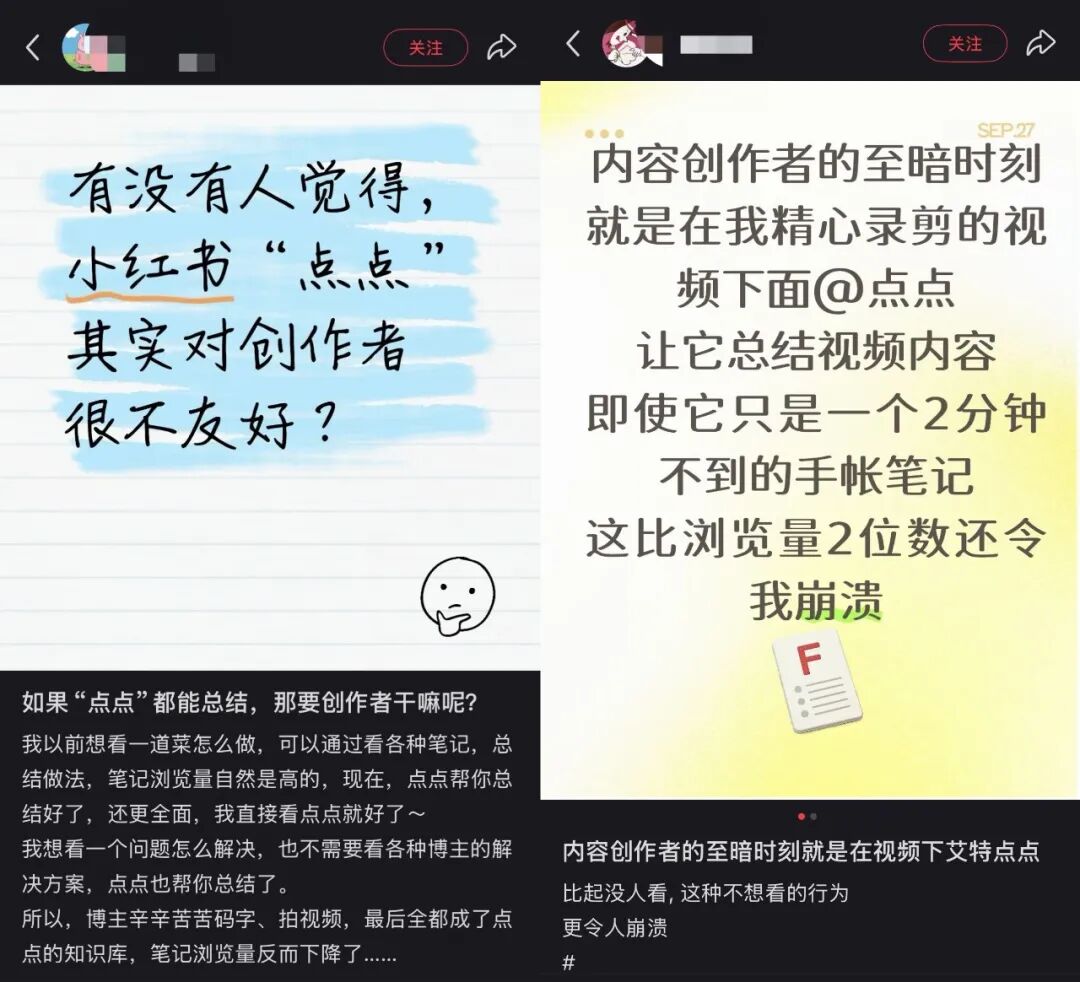
Similar discussions also appeared in the comment area. Some readers are worried that shifting from Xiaohongshu to Diandian will weaken the original "human sense" of the community; others think that the two serve different demands: if you want to solve the problem quickly, you can ask Diandian directly; if you want to understand the real experience of ordinary people, you still need to go back to the original notes.
These feedbacks reflect the dual impact of Diandian on creators. On the one hand, AI sorting community content reduces the cost of information screening, makes the experience scattered in different notes easier to be discovered, and brings new traffic to creators. On the other hand, if users leave after reading the AI summary, the original notes lack clicks and interactions, and creators may also lose corresponding readings and feedback.
In the Personal Agent era, this impact may be further amplified. Agents can not only summarize notes