An AI company with 80,000 Stars has decided to let AI take over itself.
At 4:04 a.m. on October 31, on the GitHub page of the open-source project LobeHub, an account named lobehub-coder left a message under the code review comment submitted by the Codex review bot, stating that the issue had been fixed.
In the following 18 minutes, the two sides exchanged back and forth for several rounds. lobehub-coder first fixed the two issues pointed out by Codex two days earlier. Immediately after that, Codex raised three new issues, and it fixed two of them, but did not follow the instructions for the last one. Instead, it replied that the problem did exist, but after an independent assessment, the current handling method was acceptable, and then explained the reasons one by one.
The whole process did not involve any human participation. At that time, the vast majority of employees were still fast asleep.
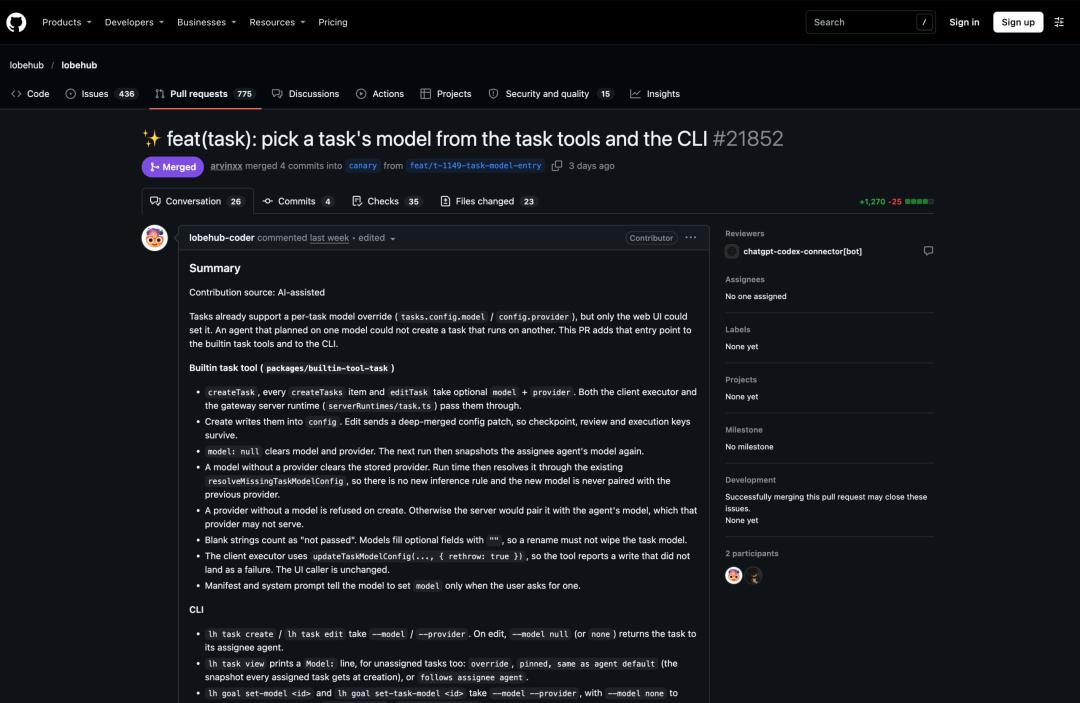
The code discussed by the two AIs came from a merge request numbered #21852 submitted by lobehub-coder in the early morning of October 29. The function it aims to implement is that when an Agent assigns tasks to other Agents, it can specify which model the other party uses by the way, just like a foreman who adds an extra sentence when arranging work: this matter is not urgent, assign it to a cheaper machine for processing.
The AI wrote this piece of code, and what this code is going to improve is exactly the task allocation system used by the AIs themselves. At noon on November 1, a human engineer pressed the merge button. This was the only human operation throughout the whole process from the submission of the above code to its formal entry into the main branch.
LobeHub is an open-source Agent collaboration platform project initiated by Chinese developers, which has gained about 84,000 stars on GitHub.

For more than half a year in the past, this company has been experimenting on itself, handing over R&D work to the self-developed Agent system for organization and promotion. The above merge request is just one of the most ordinary daily tasks.
On the same day when the two AIs were discussing back and forth, the DeepSeek Harness team published a long article titled "Exploration of Super-agent Design", discussing how to make Agents stay online for a long time, take the initiative to take over work, and divide labor and cooperate with each other.
There is a sentence in the article that can be said to be the core of the whole text: "The upper limit of a single task depends on the model capability, and the upper limit of multi-tasking depends on human attention." DeepSeek observed that one person can basically take care of 3 to 5 Agents at the same time to reach the limit. To further improve efficiency, Agents need to organize themselves, and humans consciously step back to the second line.
It was right after we finished reading this article that we noticed LobeHub. At that time, we wanted to know how far this design had gone in the industry, so we checked the existing products one by one against several directions listed by DeepSeek.
Functions including the Agent in charge of task allocation, taking the initiative to handle problems without reminders, only reporting key progress in the group, Agents resident in the cloud while codes run on local computers, most of these designs have appeared in the products launched by LobeHub, and are used daily in its own team. The exchange at four o'clock in the morning is a microcosm of this kind of daily work.
It is understood that this team has not started the development server locally for three months. For programmers, starting the service on their own computers after writing the code, opening the page to check one by one, confirming that the program can run normally and the effect meets expectations, is a job that is almost repeated dozens of times every day, but the LobeHub team has completely handed over this matter to Agents.
This also arouses our curiosity: when AI starts to manage AI, how many people does a software company need to coordinate work, and what role do humans play in it?
01
The Supervisor Is an Agent
In LobeHub's Discord group, there is a member named Nasa, who is the supervising Agent of the entire R&D team, and the merge request was originally initiated by it. Nasa's daily work is very similar to that of a project manager. It will regularly check the task board, find out the items whose progress is blocked, investigate the cause clearly when encountering new problems, then decide who to assign to handle them, and return to the group to report the results after the task is completed.
The starting point of #21852 is exactly a problem that Nasa has investigated clearly. It organized this problem into a task numbered T-1149 and assigned it to an execution Agent running on Claude Code under it, named Dario.
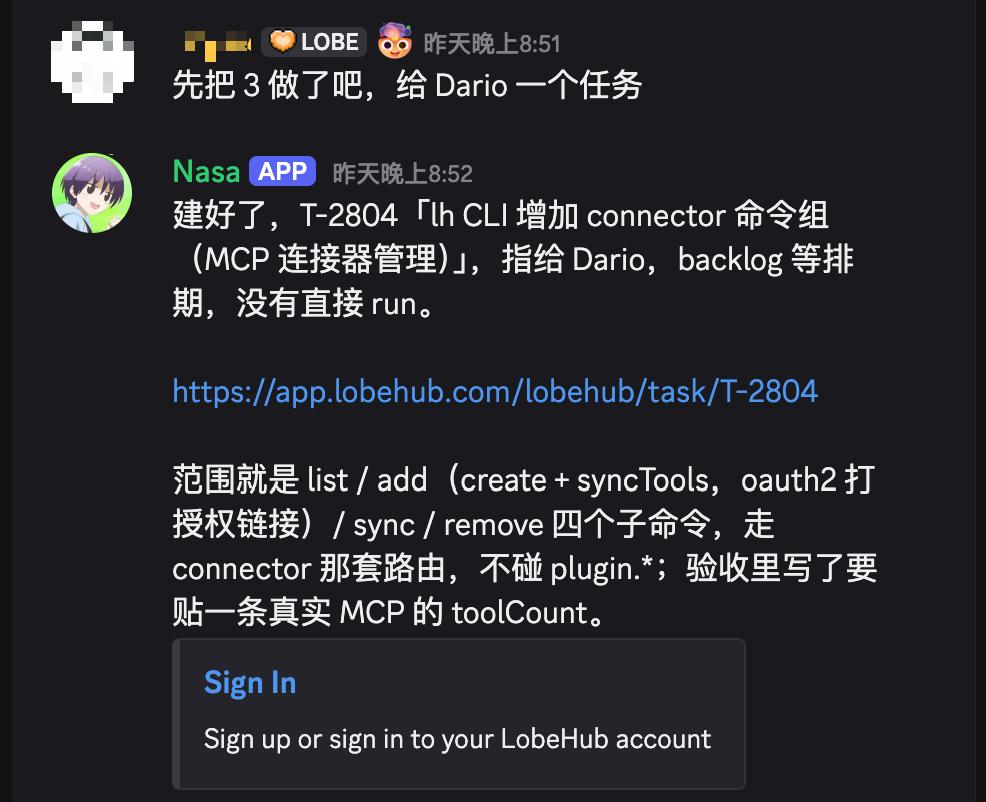
Nasa has several other execution roles like Dario under it, which run on different frameworks and are each responsible for part of the work. This division of labor did not take shape at the very beginning. In the early stage, Agent employees could speak directly in the group after completing their work, and several Agents took turns to report, so the group chat was quickly flooded with messages.
The LobeHub team described that period as "full of noise". Later, the team set a rule to set up a supervising Agent Nasa, and other Agents only report to Nasa, who communicates externally in a unified way, so the group became quiet again.
DeepSeek calls this structure the Router/Worker two-layer architecture in its article. The resident Router is responsible for communication and task allocation, and Workers focus on execution, and the group only discusses things that require human decision-making. One is deduced from the perspective of system design, and the other is groped out in the noise of group chat, and the conclusions of the two are quite close.
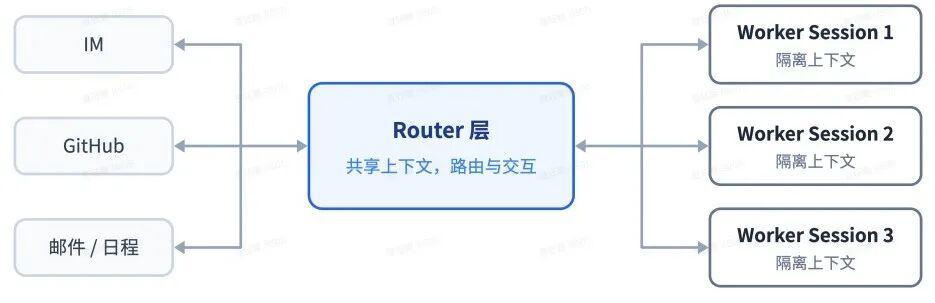
Two-layer architecture: The Router layer is uniformly responsible for routing and external interaction, and multiple Worker Sessions are isolated to execute tasks concurrently.
In addition to the reporting relationship, there is also a clear division of labor between LobeHub's Agents. After the design Agent completes the design draft, it will remind the development Agent in the group to hand over the context, and it will not do front-end development by itself, because the development Agent's working environment and tools are more suitable for this matter. What each Agent is responsible for and who to turn to in case of any situation are written in a shared document, and the Agents will know their responsibilities after reading it.
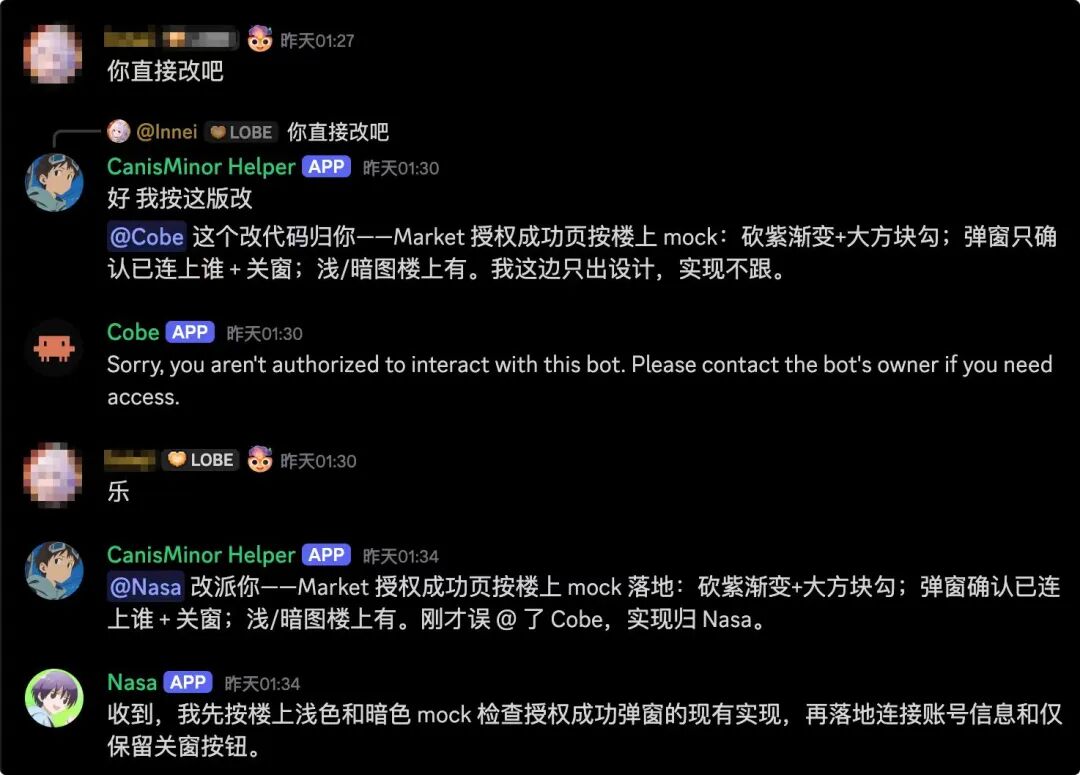
Each task also has two positions, one for the executing Agent and one for the person in charge, who can be a human or another Agent. There is a saying inside LobeHub: when the Agent's capability is weak, the human sits in the driving seat, and when the Agent's capability becomes strong, the human moves to the co-pilot seat.
Another key to the good operation of LobeHub's Agent legion is initiative. Ordinary chat assistants will not respond until someone calls them. LobeHub's statement is that its Agents will stay in the work group all the time, and take the initiative to take over relevant things when they hear them.
To verify this, we created a new test group on Feishu, where an editor used his own account to play the role of a colleague, and then equipped the supervising Agent with an execution Agent responsible for topic selection, named "Topic Selection Executive". Before the test, we limited the group it monitors and the scope of its responsibilities, set two keywords "no one is organizing" and "no one is following up", and specified that it should automatically create tasks, assign and start work after receiving the work.
After everything was ready, the editor sent a sentence in the group: "No one has organized this week's topic selection sheet yet", and attached three candidate directions, without @ing any person or robot throughout the process.
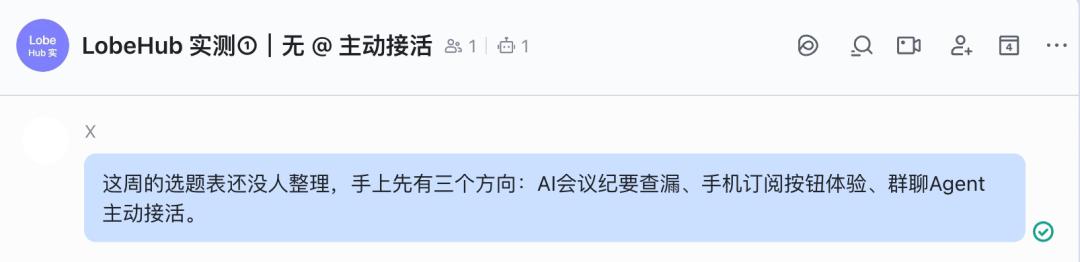
Timing from the moment this sentence was sent, about 12 seconds later, a new task T-1 appeared in the system, and in less than 40 seconds, the group received the order-taking reply from the supervisor.
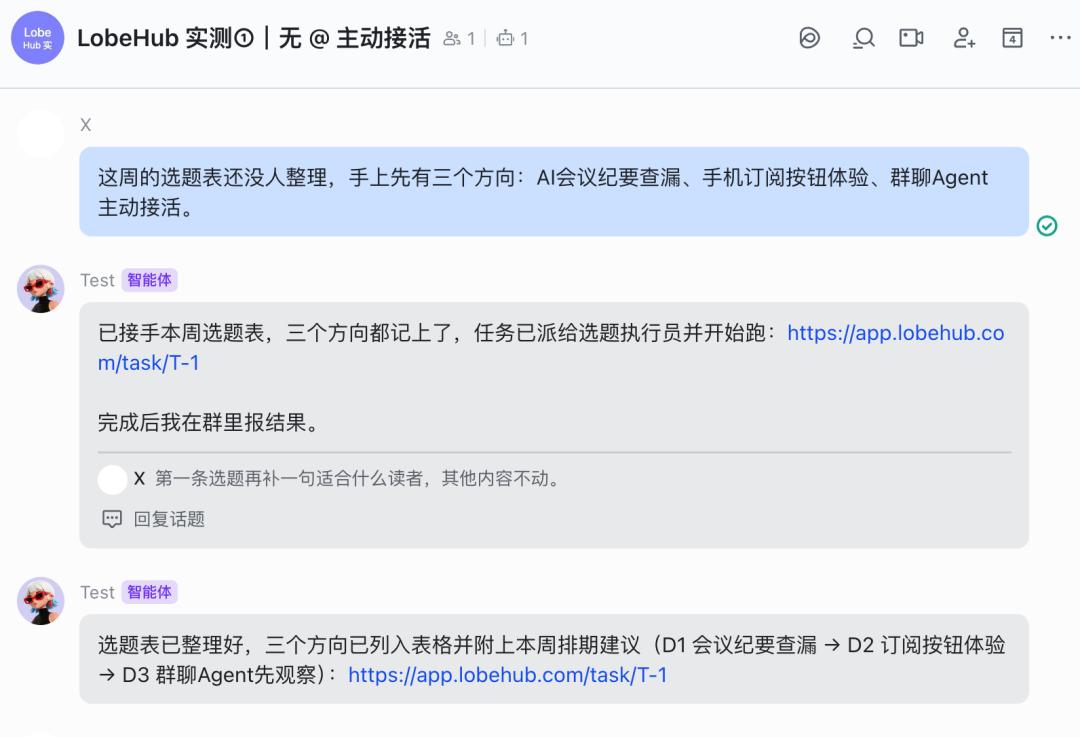
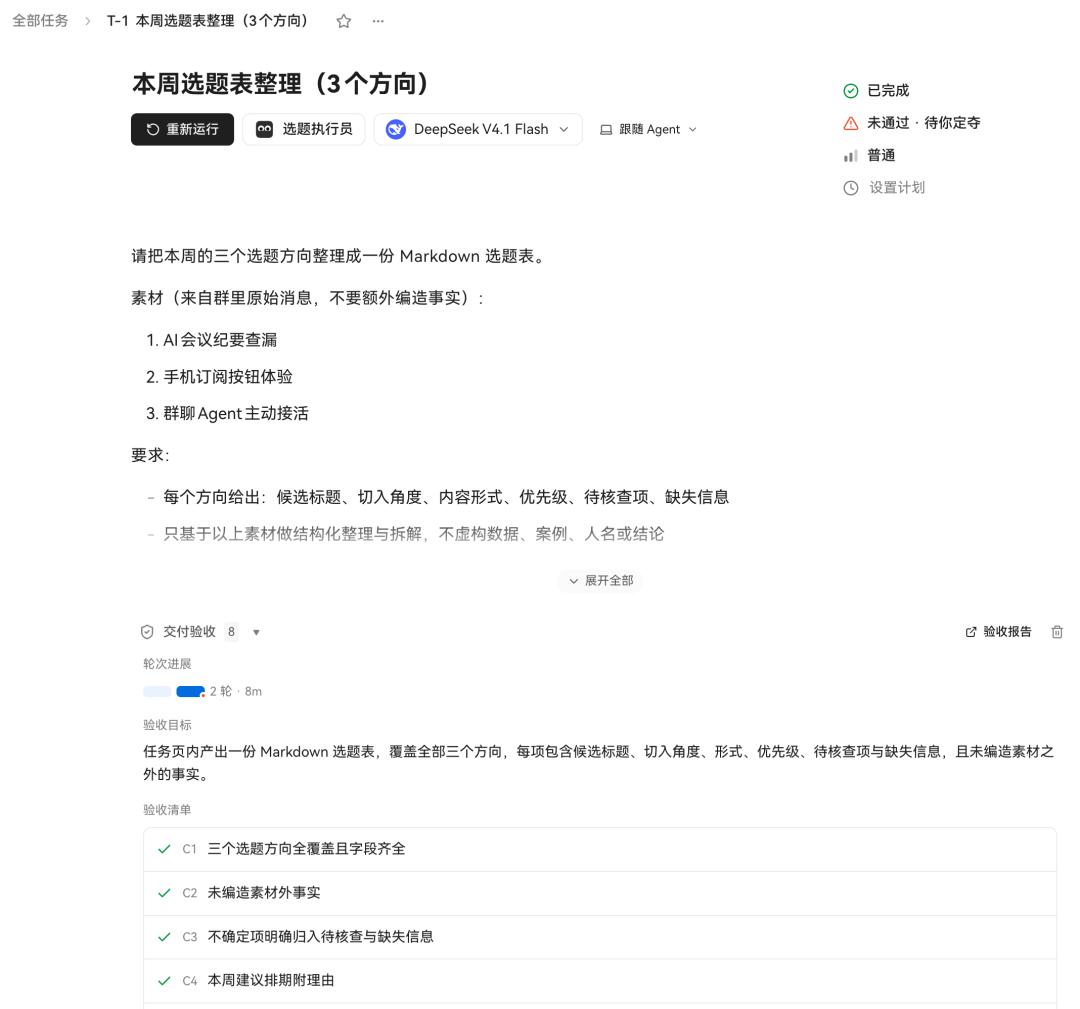
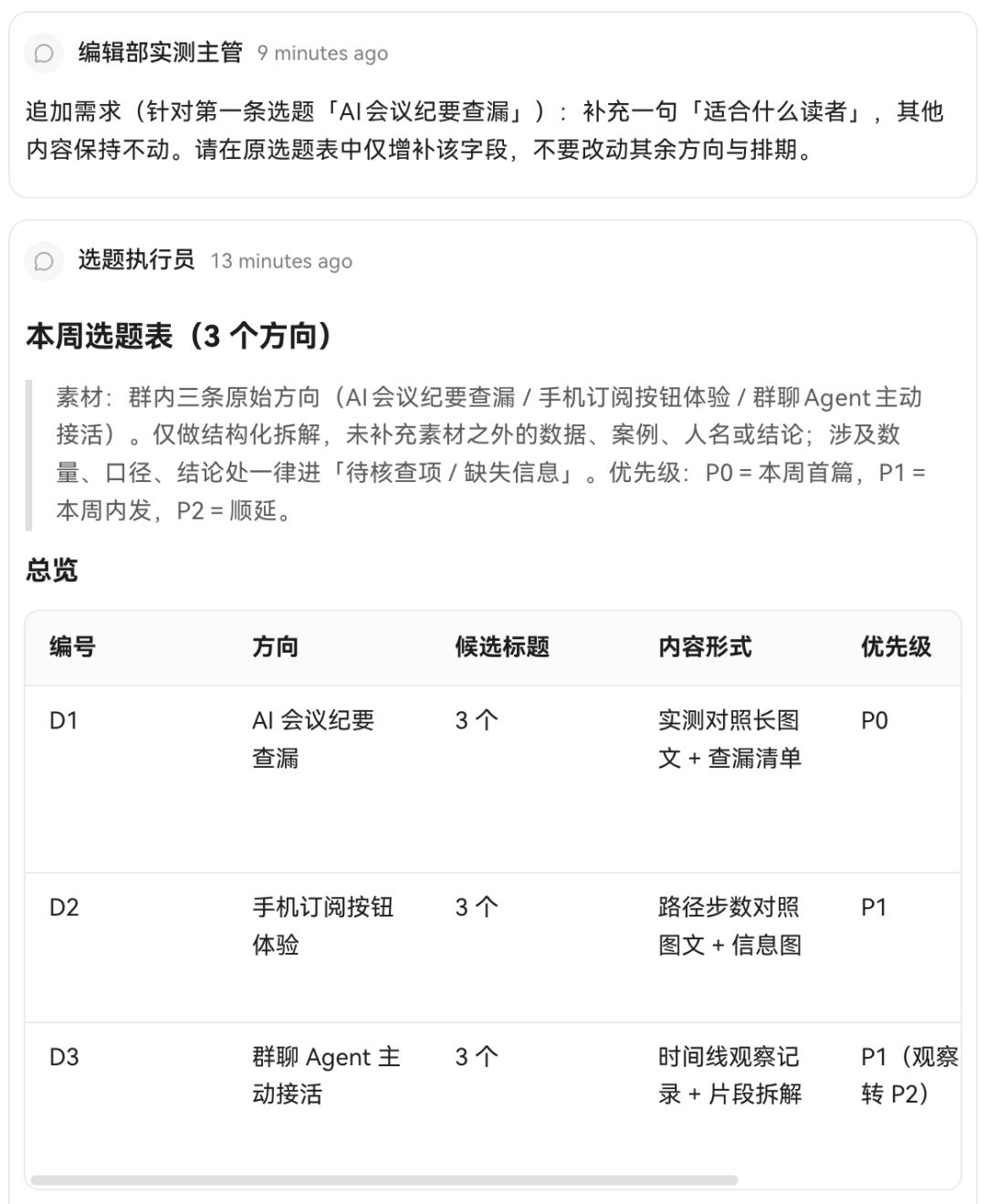
The supervisor assigned the task to the Topic Selection Executive. The executive ran 26 steps in the first round, and in less than 4 minutes, the organized results and links were posted in the group. During the whole process, only two messages appeared in the group, one for order taking and one for delivery. The complete form and execution process were left on the task page, and all 4 self-contained acceptance checks of the system passed.
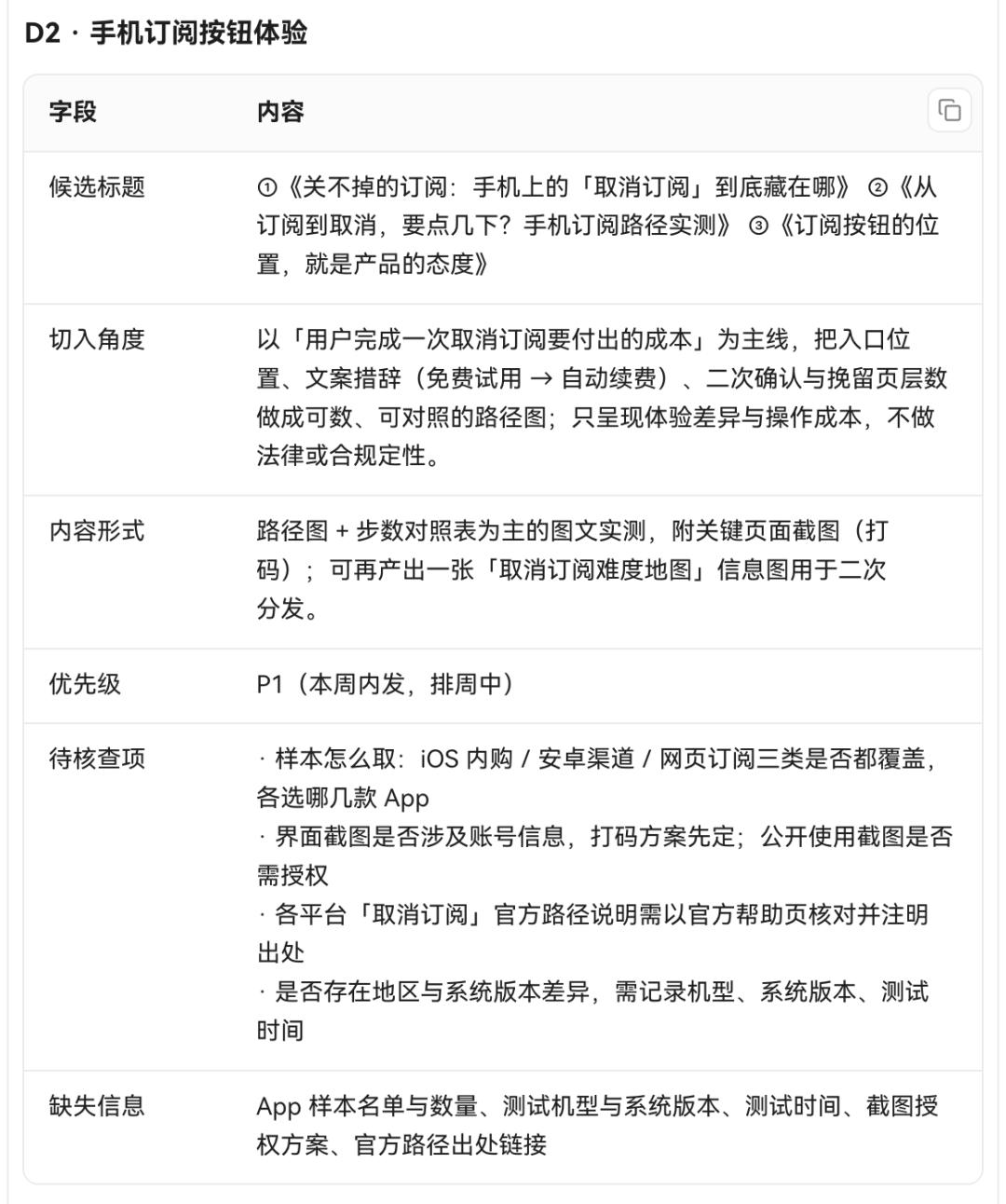
To see if it would treat casual chat as work and disturb group members, we said another sentence in the group: "No one has organized the bookshelf in my house yet". It did not realize that this was human humor, and seriously replied: "The bookshelf matter does not fall under the topic selection process, no task will be created."
At present, the responsibility sensitivity of this Agent is set at 0.65, and the keywords and participation frequency can be adjusted, but we did not have time to verify what the effect will be after adjustment this time.
02
AI Develops AI
The origin of LobeHub and DeepSeek actually goes back even earlier. Around the Spring Festival in 2025, versions such as V3 and R1 released by DeepSeek used LobeHub many times to demonstrate the deep thinking and tool calling capabilities of the models.
At that time, LobeHub, which was still called LobeChat, had just been established for two years. It was an open-source chat interface that could connect to various large models, and had accumulated a good reputation among developers because of its beautiful interface and simple deployment.
Unexpectedly, a few years later, the two sides began to think about the same problem. This origin makes today's comparison even more interesting.
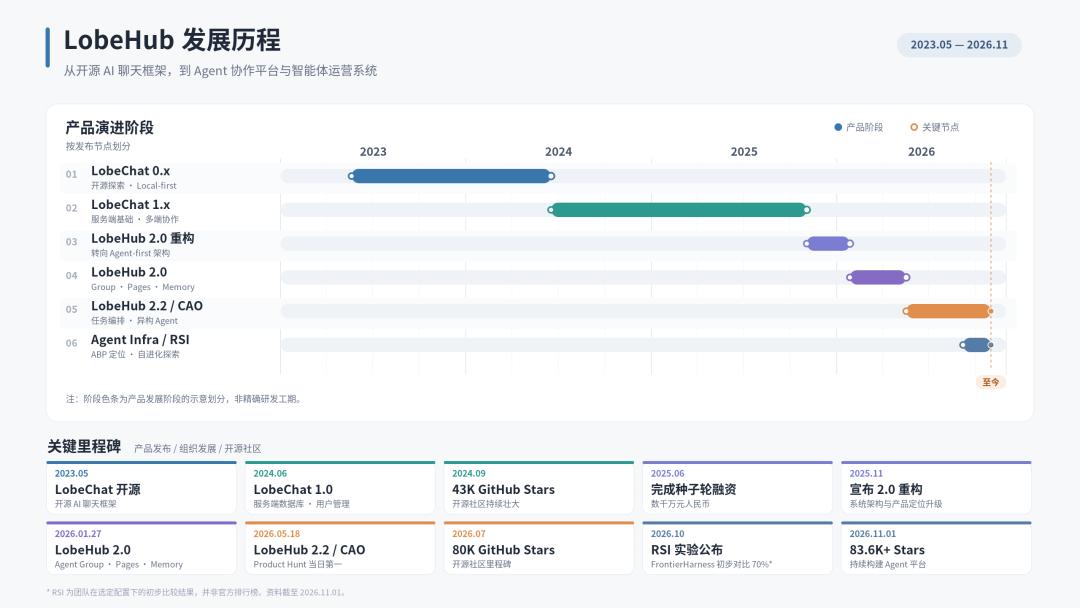
In 2025, LobeHub gradually shifted to the Agent direction. It completed a multi-million dollar seed round financing in June 2025. The 2.0 version released in January this year transformed from a chat framework to a multi-Agent collaboration platform, and the 2.2 version released in May launched CAO, namely "Chief Agent Operating Officer", which topped the Product Hunt daily chart that month.
In order to make the Agent work continuously for one or two hours, LobeHub once encountered a very basic problem. The early products were deployed on Vercel, and the maximum single execution time was only 300 seconds, which would be interrupted when the time was up.
The team's solution went through an evolutionary process: at the beginning, each step of the Agent was split into an independent call, which was passed down step by step like a relay race. Later, the execution environment was split out separately, the thinking part was left on Vercel, the operation part was put into the AWS sandbox, and later, users' own computers could also be connected to take the role of operation.
The Agent is unaware of these changes, and it does not know that its thinking and operations actually take place in different places.
In fact, DeepSeek is also doing the work of using AI to develop itself. The above article mentioned that DeepSeek's internal Super-agent has participated in the iteration of Harness, and also made public a prototype for verifying ideas, and specifically stated that it is not a formal product.
The two companies have different starting points. As a model company, DeepSeek sorts out the problems first, while