After 30 years of stunning turnaround for China's core national heavy equipment, domestic shield tunneling machines have flipped the situation, turning the tables to reverse the former technological stranglehold they were subjected to and even gain the upper hand in related fields.
Recently, the Ministry of Commerce, in conjunction with relevant departments, issued an announcement on the implementation of export controls on items such as shield machines. According to the announcement:
On November 18, 2026, when exporting complete domestic earth pressure balance shield machines, slurry balance shield machines and rock tunnel boring machines, as well as core components such as cutters, cutterheads and screw conveyors, applications for licenses must be submitted for countries and regions where disputes exist; for other countries and regions, export certificates can be obtained by registering and filling in relevant information.
This export restriction also indirectly indicates that Chinese enterprises have strong competitiveness in shield machine technology and market scale — in the global market, the market share of Chinese shield machines has reached 70%, and 100% of core components including main bearings, cutterheads and cutters, main drive systems, and PLC control systems have been domestically produced.
It should be noted that in the previous era of large-scale infrastructure construction, China was long stuck by the "neck bottleneck" of shield machines. What made China not only the largest producer of shield machines, but also able to take it as a restrictive measure for export control?
[1] The rise of infrastructure construction, foreign merchants charged exorbitant prices
For China's infrastructure industry, the first decade of the 21st century was not only a golden era of rapid development, but also a "dark age" when core infrastructure equipment was controlled by others.
In July 2000, the Department of Transport of the National Development and Reform Commission announced the development plan ideas for the "11th Five-Year Plan" comprehensive transportation system, officially taking the subway as the focus of urban construction in the new period: "Earnestly solve the traffic congestion in large cities, and attach importance to the construction of urban rail transit."
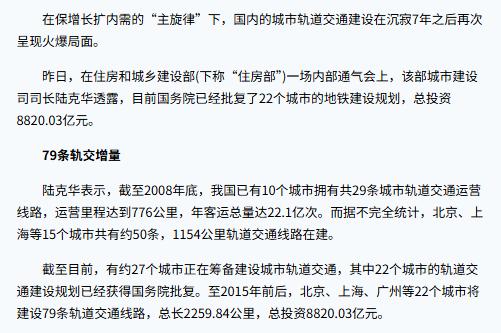
Since then, 22 cities including Beijing, Shanghai and Guangzhou have begun to prepare for the construction or expansion of subway networks. By 2015, a total of 79 rail transit lines with a total length of 2259.84 kilometers and a total investment of 882.003 billion yuan will be constructed across the country.
(Source: Xinhua News Agency)
Urban infrastructure construction is in full swing, but the most core shield machine in the era of large-scale infrastructure is still controlled by others.
"Looking back at the beginning of this century, China's shield machine market was almost completely monopolized by international giants such as Herrenknecht from Germany and Kawasaki Heavy Industries from Japan." Recalling that difficult period, Li Fengyuan, Chief Engineer of the State Key Laboratory of Tunnel Boring Machine and Intelligent Operation and Maintenance of China Railway Tunnel Bureau, said with deep distress that shield machines had blocked the main artery of China's infrastructure development.
How serious was the "neck bottleneck"? In 2002, in order to build Metro Line 2, Guangzhou imported a shield machine from abroad at a price as high as 150 million yuan. It should be noted that the total budget of Line 2 was only 9.5 billion yuan when the project was approved, and the equipment cost of one shield machine accounted for 1.6% of the total construction cost.
In addition, there are maintenance and other expenses. The maintenance service fee of foreign engineers coming to China is as high as 5,000 yuan per hour, and the service time is calculated from the moment the overseas engineers board the plane bound for China.
At that time, the average monthly salary of employees in Guangzhou was just over 2,000 yuan. Almost everyone could see that relying on the technological monopoly of shield machines, overseas shield machine manufacturers were simply charging exorbitant prices.
On the one hand, there was the equipment demand for large-scale infrastructure construction, on the other hand, there was no domestically produced shield machine that could meet the requirements. For people in the infrastructure industry and engineering equipment industry in that era, this was not only a humiliation, but also an era opportunity to work hard and fight back from a desperate situation.
In view of the lessons of Guangzhou Metro Line 2, in October 2002, China Railway Tunnel Group joined more than 20 scientific research institutions including the Chinese Academy of Sciences and Tsinghua University to form a scientific research team — to overcome the technical difficulties of shield machines.
[2] Seize the opportunity, domestic shield machines take off
For enterprises and universities such as China Railway, Tsinghua University and the Chinese Academy of Sciences at that time, shield machines were as difficult as lithography machines are today.
For example, the main bearing, known as the "heart" of the shield machine, can hardly be replaced once damaged during tunneling, so its machining accuracy is required to reach the micron level; the cutterhead and cutters, which are related to tunneling efficiency and service life, require continuous testing of materials and layouts...
It can be said that for enterprises, scientific research institutions and universities at that time, everything started from scratch.
Hard work pays off. After 6 years of R&D, in April 2008, the first domestic composite shield machine with completely independent intellectual property rights, "China Railway No.1", rolled off the production line in Xinxiang factory. Some people call it "a milestone for Chinese shield machines to move from the laboratory to the market".
(Source: Official website of China Railway Engineering Equipment Group Co., Ltd.)
But this does not mean that China's infrastructure industry has ushered in a turning point of independent and controllable development.
The reason is very simple. For projects worth billions or even tens of billions of yuan such as subways and tunnels, no one dares to take the risk of using domestic shield machines, so "China Railway No.1", which was placed with high hopes by countless infrastructure practitioners, could only lie in the workshop gathering dust.
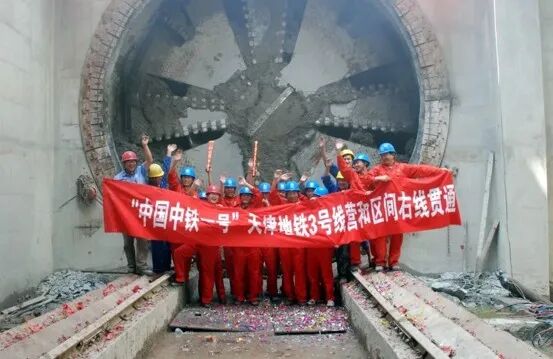
Just like in many martial arts stories where the protagonist appears in the most unexpected way, the turning point of the fate of domestic shield machines came from the 1500-meter tunneling task of Tianjin Metro Line 3 between Yingkou Road to Heping Road and Heping Road to Jiefang North Road.
Since the project involves Tianjin's most prosperous Golden Street commercial district and ancient buildings such as the former residence of Zhang Xueliang, in order to protect the ground buildings, the construction party launched a global bidding. In the competition with Herrenknecht from Germany and Kawasaki from Japan, "China Railway No.1" proved its strength with its performance;
In terms of settlement control, "China Railway No.1" controlled the surface settlement within 3 mm, while Japanese and German enterprises could only achieve 30 mm; in terms of construction speed, the average monthly advance reached 327 meters, far exceeding similar products from Japan and Germany...
In the end, this short 1500-meter project dispelled the doubts of domestic infrastructure construction parties about the technical level of domestic shield machines. Domestic shield machines not only broke the "neck bottleneck" predicament, but also took off in the global market.
In 2010, the output of domestic shield machines was more than 30 units, but five years later in 2015, the production capacity of domestic shield machines reached 231 units, accounting for 21% of the total global production capacity. In 2020, there were 655 domestic full-face tunnel boring machines, occupying two-thirds of the global market.
[3] Dual factors make China's shield machine rank first in the world
"The localization rate of domestic shield machines is as high as 95%, and the number of owned units, annual output units and construction mileage all rank first in the world", said Yang Huayong, member of the National Committee of the Chinese People's Political Consultative Conference and academician of the Chinese Academy of Engineering. After achieving technological breakthroughs in shield machines in 2008, Chinese shield machines have swept the global market in all aspects such as production capacity and technology.
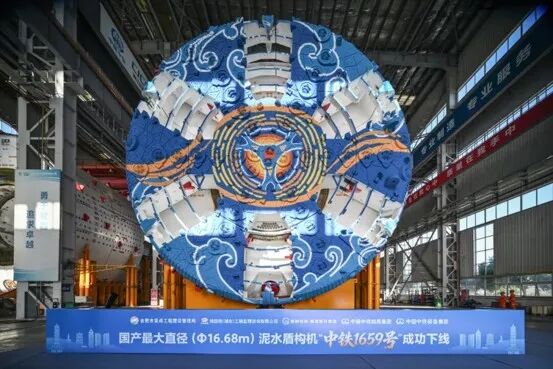
In terms of market share, domestic shield machines account for 70% of the global market share, and their products are exported to more than 50 countries and regions; in terms of technology, the diameter of domestic shield machines was only 6 meters in 2009, but now the diameter has directly reached 16 meters;
(Source: Official website of China Railway Engineering Equipment Group Co., Ltd.)
In terms of product innovation, there are horseshoe-shaped shield machines that can solve the problem of special-shaped tunnels, shield machines with a minimum turning radius of 30 meters... At present, the types of shield machines owned by China have increased from 2 to 15.
It can be said that domestic shield machines have taken the lead globally. So why has China been able to transform from a victim of the "neck bottleneck" to a leader who can master export rules in the field of shield machines in just 20 years?
In the author's opinion, there are two reasons:
First, during the era of large-scale infrastructure construction, the domestic market had huge demand for shield machines, and the exorbitant prices charged by overseas manufacturers brought market opportunities to domestic manufacturers, which is why the order volume of domestic shield machines surged after the short 1500-meter tunneling project of Tianjin Metro Line 3 in 2009.
Second, China has advantages in the manufacturing industry. As a core heavy equipment for infrastructure, a shield machine is composed of tens of thousands of parts and components such as cutters, bearings, motors and gears. Relying on the advantages of China's manufacturing industry, shield machine enterprises such as China Railway Equipment can purchase corresponding spare parts across the country.
For example, cutters and main bearings are mainly produced in Henan, motors are mainly produced in Shanxi, gears are mainly distributed in the Yangtze River Delta and Chongqing... For China Railway Equipment alone, there are more than 1,200 upstream spare parts enterprises, which have realized rapid product iteration.
"Chinese shield machines have completed the path that developed countries took 200 years to cover in 30 years, behind which is the symphony of multiple forces," said Li Jianbin, senior expert of China Railway Engineering. The economic take-off has brought a wave of super projects, and shield machines are the "hard demand" of major national projects. "Without the world's top manufacturing system, there would be no today's Chinese shield machine industry."
In fact, looking back at the development history of domestic shield machines, we will find that this is a typical path for China's manufacturing industry to reach the peak of science and technology — the domestic market has huge demand, foreign technological blockade and "neck bottleneck" force domestic enterprises to conduct independent R&D, and finally domestic enterprises achieve counterattack in the overseas market.
From shield machines in the era of large-scale infrastructure construction, to 3C products in the following period, to today's lithography machines, AI training chips and other industries, history is advancing in a similar rhythm. This also provides ideas for industries that are currently stuck by the "neck bottleneck" such as lithography machines and AI training chips — under the background of huge domestic market demand and advantageous manufacturing industry, for those so-called core heavy equipment that are controlled by others, what we need is nothing but time and waiting.
This article is from the WeChat Official Account "Siku Finance", written by Qing Fu, edited by Jia Jia, and published with authorization from 36Kr.