When AI Stops Being All Talk: Decision-Making Models Go Viral, the Physical World Requires Edge-Side "Quick Judgment"
In mid-September, a startup named TypeSafeAI released a model called Jev. It does not generate articles, does not engage in chat conversations, and does not even output a complete sentence. It does only one thing: classify the input into preset options, and return a yes/no result, a score, and a probability. Such a model that "cannot speak" has exceeded one million users just weeks after its launch, with roughly one-third of Fortune 500 enterprises starting to use it, and its valuation skyrocketed from about 200 million US dollars to 7.5 billion US dollars within 24 days.
It has brought to the industry a new category name that quickly reached a broad consensus: decision-making model. OpenAI followed up with the Decisions API within two weeks, AWS, Microsoft, and Cloudflare entered the market one after another, and more than a dozen similar products emerged in less than a month. The rapid rise of decision-making models reflects an important change taking place in the artificial intelligence industry: the value evaluation of models is gradually extending from the quality of content generation to the accuracy of decision-making, response speed and execution cost.
Zhao Tiancheng, CEO and Chief Scientist of OmAI, pointed out that many scenarios do not require boastful content generation, but a series of continuous, fast, and measurable decisions. "Large language models can actually make many decisions too, but decision-making models are fast models that focus all their capabilities and energy on measurable and verifiable decisions. What decision-making models target is exactly another type of scenario: what is needed here is not a generated piece of content, but a directly usable judgment — fast, low-cost, and end-side readable."
"The quality and cost of decision-making" is exactly the starting point of the industrial logic of decision-making models.
Decision-Making Models: The "Fast Thinking" Complement as AI Enters the Deep Water Zone
In fact, the narrative of enterprise AI has changed significantly in the past year: in the previous two years, everyone competed on "whether the model can write and answer", and now cloud vendors, SaaS vendors and office platforms have successively embedded AI Agents, intelligent entities, and intelligent decision-making into CRM, ERP, supply chain and office processes. The industrial signals are highly consistent: AI is evolving from a content generation tool to a "decision-making infrastructure" that can enter business processes and directly produce operating results.
The output of Jev's path is not text, but typed values: yes or no, option number, calibrated probability score, which can be directly used by applications without intermediate parsing. The trade-off is that it "cannot speak", but the benefit is that the end-to-end latency is compressed to 70 to 500 milliseconds, 20 to 200 times faster than similar large language models; in Microsoft's demonstration, for the same classification routing request, the decision-making model returns a result in 182 milliseconds, while the large language model takes 6.4 seconds. This is not "slightly faster", but pulls decision-making from "counted in seconds" back to "counted in milliseconds", lowering the latency threshold of high-frequency continuous decision-making chains, making it easier to integrate into actual business processes.
The value of decision-making models lies in promoting AI models to form a clearer division of capabilities. General large models continue to be responsible for complex reasoning, content generation and tasks requiring open-ended answers; decision-making models are responsible for judgment nodes in Agent workflows that have limited answer spaces, large call volumes, and must be fast and stable. Decision-making models will not replace large models, but they separate "decision-making" from the category of "generation", so that the decision quality, response speed and call cost of such models can be more independently and clearly evaluated and optimized around specific tasks.
"In practical intelligent applications, different decisions have different levels of difficulty and cannot be treated equally. Just like solving Goldbach's conjecture and doing daily customer service classification problems, the mental power consumed in theory is completely different," Zhao Tiancheng said, "but now when large language models perform inference, the cost overhead is the same."
This also explains why the adoption speed on the enterprise side is so fast. In the past two years, a large number of enterprise scenarios have been wrapped in a generative shell, but essentially they are doing decision-making work: work order routing, risk classification, process approval, inventory judgment, and Agent action selection. Generation is only a means, and decision-making is the end. When the cost and latency of the means far exceed what the end itself requires, the market will sooner or later demand that the means and ends be re-aligned. What decision-making models are doing is exactly this: let the model focus on what it should focus on, make fast decisions and fast responses, instead of using the most expensive way to produce the least needed content.
"When the decision-making model came out, the entire company team's first reaction was very excited," Zhao Tiancheng said. In the past five years, much of the work OmAI has done is essentially what decision-making models do, except that before TypeSafe AI proposed the concept of decision-making models, there was no overarching term to categorize them as decision-making models.
When an industry begins to define a model category with "fast" and "measurable" instead of measuring everything by "how human-like the writing is", it means that it has finally entered the deep water zone. In the deep water zone, what users want is not empty talk, but a series of continuous, timely, and affordable judgments. Decision-making models exactly target this silent and huge demand. However, when these judgments are integrated into physical devices such as robots and drones, being fast and low-cost is not enough.
Decision-Making in the Physical World Requires End-Native Streaming Multimodal Capabilities
The common demand of the two types of scenarios is to quickly make executable judgments under clear tasks and constraints; the difference is that digital workflows mainly complete judgments and operations based on existing information, while the physical world requires models to continuously perceive dynamic environments, and adjust decisions in real time in combination with task objectives, spatial status and execution feedback. As a result, decision-making has evolved from a one-time output of results to a continuous intelligent activity that runs through the whole process of perception, understanding and action, putting forward higher requirements for response speed, judgment accuracy and execution reliability. The judgment window may be compressed from the second level to the hundred-millisecond level, and the cost of errors has risen from simple result deviation to real physical world risks.
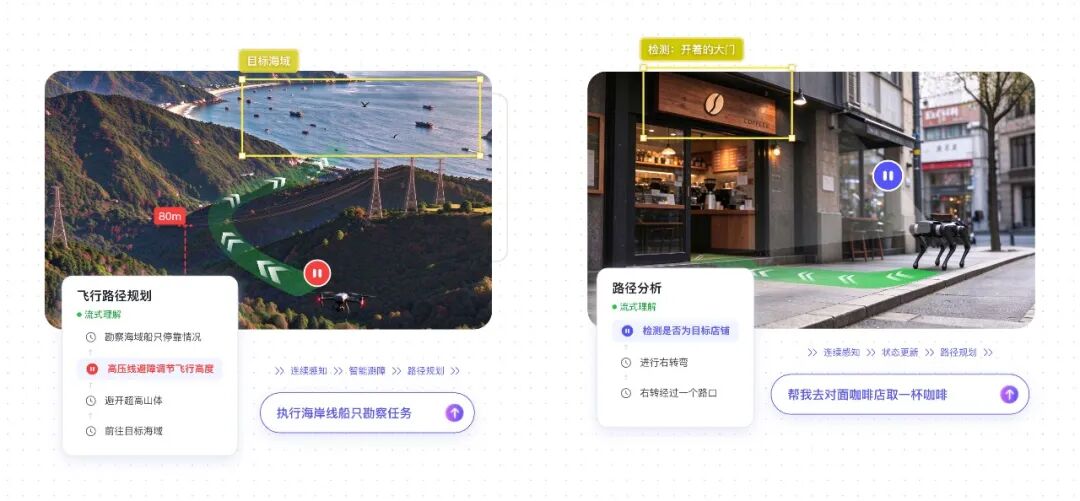
Specifically, the first threshold in the physical world: the input has changed.
In software workflows, the input of the decision-making model is a user comment, a form, or a work order — essentially still a text window. But the inputs in the physical world are: three real-time camera video streams, robot body posture parameters, and natural language instructions pouring in at the same time, dynamically, in streaming form, with multimodal signals intertwined.
The second threshold: the cost of errors has changed.
If you make a wrong decision in the digital space, you can correct it and start over; if a robot makes a wrong decision, it may crush the egg, or cause the drone to crash. It is a difference between life and death, not just a wrong answer. The severity of the cost forces out the third requirement: prediction capability. Current decision-making models make single-step judgments: whether this round is correct or not. But the physical world requires thinking two or three steps ahead: the brake must be pressed in advance, and it will be too late to make a decision when you see the wall.
These changes point to the same conclusion: the decision-making model for the physical world will inevitably follow the path of "end-native streaming multimodal". And "end-native streaming multimodal" was first proposed by OmAI in the industry in the first half of this year. This concept pursues end-native deployment, streaming perception and fast decision-making.
Most scenarios in the physical world are centered on end-side multimodal models, facing high-concurrency, real-time, streaming, and active scenarios, which inevitably require a fast response mechanism. Zhao Tiancheng pointed out, "This is exactly the typical problem encountered when some purely cloud-based large language models are deployed to the physical world. The end-side deployment, lightweight model architecture and streaming architecture model products launched by OmAI are all solving such problems."
From Flow to Go: End-Side Multimodal Moves Toward Specialized Decision-Making Models
If the first two parts answer "why decision-making models are popular" and "what kind of decision-making models the physical world needs", then OmAI's answer is not in concepts, but in its already deployed VLX matrix. At the same time, the VLX matrix provides a sample more worthy of industrial observation: it is not a single-point model, but a systematic capability system built around real-time decision-making in the physical world.
Looking back on OmAI's development in recent years, as early as 2021, it launched one of the earlier vision-language large models in China, and obtained the first multimodal model certification (OmModel No. 001) issued by the Ministry of Industry and Information Technology. This means that when most people still regarded multimodality as a concept, OmAI had already entered the official certification system for model capabilities.
In February 2025, OmAI open-sourced VLM-R1, the world's first framework that migrated the GRPO reinforcement learning method from the pure text field to the vision-language field. The key to this step is that it made the engineering path of "reinforcement learning + vision-language" public to the community, indicating that OmAI's accumulation on vision-language models is not a closed demonstration, but an output of methodology that can be applied to the entire ecosystem.
By the first half of 2026, OmAI proposed the concept of "end-native streaming multimodal" for the first time in the industry. At present, the VLX matrix has formed four layers of capabilities: VLX-Flow is responsible for continuous perception, answering what is happening in the video stream and whether attention is needed; VLX-Seek is responsible for precise positioning, answering where the target is, and which item or area is the one to find; VLX-VR is responsible for video reasoning, answering when the event occurs, what the cause and effect are, and what the video evidence is; VLX-Go is responsible for action navigation, answering where to go next, what to pay attention to, and what task target to execute.
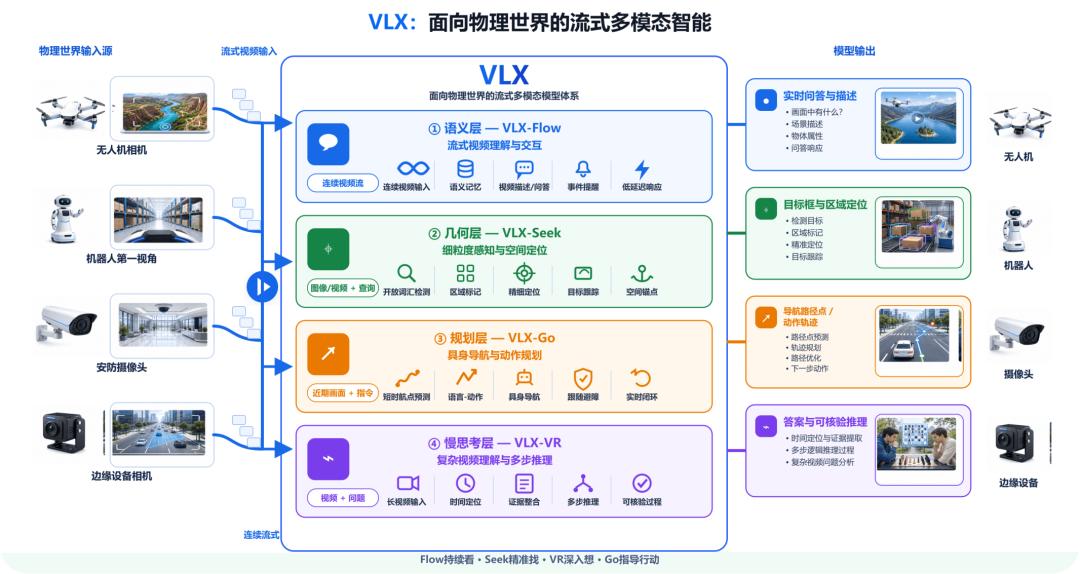
The four layers are not four isolated models, but capability layers that share the base model, unify the data format, and connect the inference link on the same video stream. It is a set of end-side product system that is connected for physical AI. In fact, the existing VLX models already have different levels of judgment and decision-making capabilities in the above capabilities. The upcoming decision-making model is not adding an isolated module outside the original system, but further optimizing environmental state understanding, task judgment, decision output and response efficiency for the high-frequency, continuous and real-time decision-making needs of the physical world, so as to promote the model to form a closer intelligent closed loop from perception, understanding to decision-making and action.
It is worth noting that whether the technical route is established ultimately depends on whether it has entered real devices, real scenarios and real workflows. OmAI's answer is not a single-point Demo, but a set of already deployed commercial landing points.
In low-altitude scenarios, the OttoPlex low-altitude embodied intelligent platform uses the VLX-Seek 0.6B end-side version to provide target and area positioning capabilities based on natural language descriptions for low-altitude inspection tasks; the positioning results do not stay in the model output, but can be further processed by pilots, upper-level task systems or subsequent workflows.
On the drone side, low-altitude scenarios such as public security, maritime affairs, natural resources, industrial parks, emergency response and rescue have been commercially deployed; on the robot side, devices of leading embodied enterprises such as DeepMotion and Unitree have been deployed; on the security side, commercial service access for millions of cameras has been completed; on the wearable side, the Homa APP is the world's first AI vision-assistance platform serving nearly 100,000 visually impaired people.

Looking further at the underlying layer, adaptation to domestic chips such as Huawei Ascend, Axera, and RK3588 has been completed, and end-side access for the four major AI PC brands of Apple, Lenovo, HP, and NVIDIA has been realized. These cross-scenario, cross-chip, and cross-terminal commercial practices not only verify the engineering deployment and scenario adaptation capabilities of OmAI's models, but also provide a real application foundation for its further development of real-time decision-making models for the physical world.
This evolution also means that OmAI's technical system is moving from perception, reasoning and action capabilities for specific tasks to specialized real-time decision-making capabilities for the physical world.
According to OmAI's calculations, the end side can achieve a 0.1-second-level response, while the cloud side usually takes more than 5 seconds, a gap of about 50 times. At the same time, end-side models can directly process real-time visual information, reducing latency and information loss caused by data transmission and information conversion. Coupled with privacy and availability — in some security, industrial, low-altitude and emergency tasks, local data processing and offline availability are important deployment requirements. In terms of cost, end-side deployment costs can be reduced by an order of magnitude, real-time performance is improved several times, and it can run on domestic chips, which makes it possible for the inflection point of embodied intelligence to move from the "Demo stage" to the "mass production stage" to arrive earlier.
But the end side does not mean abandoning the cloud side. Zhao Tiancheng's judgment on the final state is hierarchical: "I think the future will be end-cloud collaboration. The slow thinking part runs on the cloud, and all fast thinking and all fast decision-making run entirely on the end side. We use this method in many products, and the result is better than pure end-side or pure cloud-side solutions. We have verified this path."
For physical AI, the value of decision-making models ultimately needs to be verified in real devices and actual tasks: whether it can make reliable judgments within a limited time, and effectively connect continuous perception, spatial understanding and action execution. As artificial intelligence moves from content generation to autonomous decision-making and actual task execution, the accuracy of decision-making, response speed and operating cost are becoming important criteria for measuring the practical application value of models.
What really deserves attention is no longer just what kind of answers the model can generate, but whether it can make judgments faster, more accurately and at lower cost in the continuously changing real environment. OmAI's long-term accumulated end-native streaming multimodal technology, as well as its commercial practices in scenarios such as drones and robots, have laid a foundation for it to further expand the real-time decision-making capabilities of physical AI.
From continuous perception and spatial understanding to action planning, OmAI has established a multimodal capability system for the physical world. How will the upcoming specialized decision-making model further open up the intelligent closed loop between perception, judgment and action, and what kind of capability upgrade will it bring to dynamic intelligent terminals such as drones and robots?
As the November release date approaches, what kind of breakthrough will OmAI's upcoming end-side multimodal decision-making model bring to real-time decision-making in the physical world? The answer is worth looking forward to.