In the era of large models, the computing power supremacy doctrine for intelligent driving chips has become invalid.
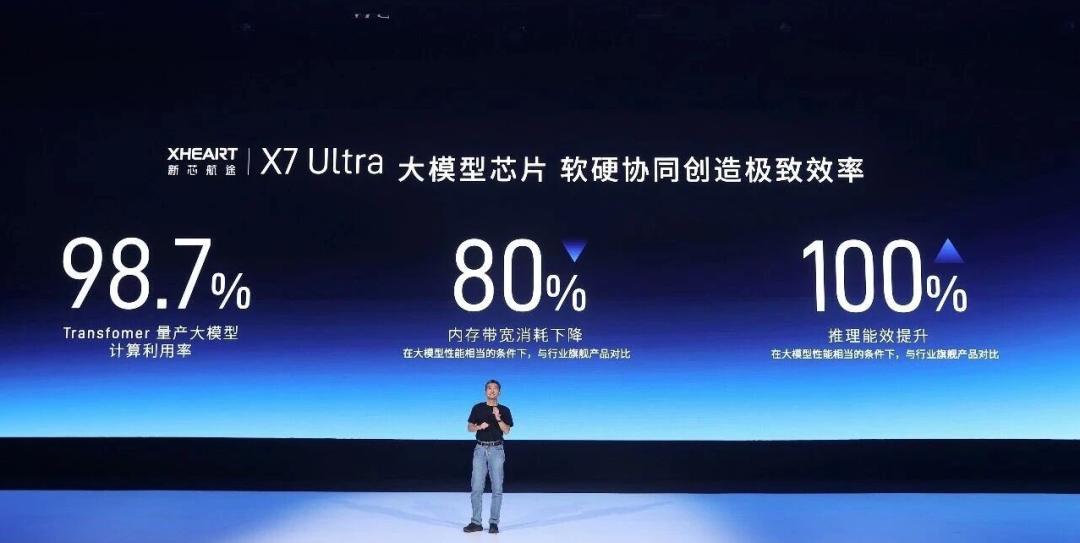
On October 29, XHEART launched its intelligent driving chip X7 Ultra in Suzhou. Li Zonglin, CEO of XHEART, revealed that X7 Ultra delivers 700 TOPS of large model computing power, while the next-generation X9 is set to hit 3000 TOPS.
As the company's first large-model-defined chip, in real-world tests on mass-produced intelligent driving models, X7 Ultra achieved an NPU computing utilization rate of 98.7%, an 80% reduction in memory bandwidth consumption, and a 100% improvement in inference energy efficiency. Media reports show that the test model is exactly Momenta's R7 World Model.
The day after XHEART's launch event, Yu Kai, founder of Horizon Robotics, posted on Weibo, pointing fingers at the equivalent computing power conversion standard in the industry:
"Now our industry has even broken through the cosmic scale, with the nominal computing power being exaggerated to 6-7 times the dense computing power, which is claimed as equivalent computing power."
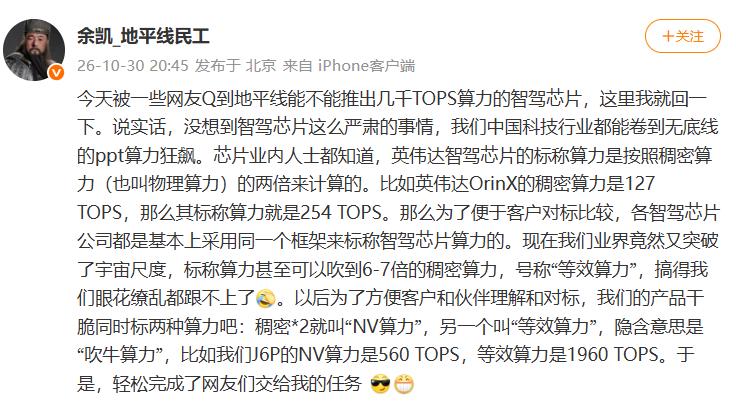
Yu Kai took the company's own Journey 6P as an example. It has 560 TOPS under the NV computing power standard, and if the so-called equivalent computing power algorithm is used, the same chip can be marked as 1960 TOPS.
The disagreement between the two sides lies in the statistical standard. Yu Kai called for a unified conversion method to put an end to inflated data, while Li Zonglin advocated real-world tests on mass-produced models and emphasized actual utilization rates. The two sides have different priorities, but they reach a consensus on one thing: the TOPS-only theory is not advisable.
The broader industry backdrop is that algorithms and hardware are converging. Large models have changed the main computing tasks on vehicle ends. Algorithms are shifting from a large number of manual rules to data-driven approaches, and the core focus of chips is moving from peak computing power to energy efficiency under real models.
Just six days ago, Qianli Technology also launched a millimeter-wave radar customized for large AI models. The team added a 10 TOPS NPU to the radar, which can not only complete target recognition on the radar side, but also transmit raw detection data to the central computing platform, transforming the radar positioning from a collection sensor to a perception unit with independent judgment capability.
Both sides embed algorithms into hardware design in advance to reduce passive adaptation to standard hardware. Qianli hopes to decide which signals the radar retains on its own, while XHEART hopes to let the model determine where the chip's computing power is allocated.
For intelligent driving enterprises, the boundary between pure software suppliers and pure chip suppliers is disappearing. Moving model requirements forward to the hardware definition stage is more in line with the industry trend.
However, this path has a physical ceiling. Embedding algorithms into hardware cannot get rid of the limitations of the physical upper limit of hardware. The XHEART chip customized based on Momenta obtains higher computing power efficiency with narrower adaptability, but at the same time loses broader openness and compatibility.
Customized optimization for models
General-purpose chips have low computing power utilization, which is already a consensus in the industry.
NVIDIA Orin's nominal 254 TOPS computing power comes with a prerequisite. It is the maximum value under INT8 precision (low-precision integer operation), of which 87 TOPS comes from the deep learning accelerator DLA. As long as a segment of the model's operation cannot be handed over to the DLA, the full 254 TOPS of computing power cannot be invoked.
He Xiaopeng once criticized that the computing power utilization rate of general-purpose GPU chips is only 30% to 40%, and even under more optimistic estimates, it is only 70% to 80%.
Three sets of actual test data disclosed by Liu Xianming, head of XPeng General Intelligence Center, at CVPR 2026 show that when an open-source model is paired with a general-purpose chip, the computing utilization rate is 22.8% and the inference time is 800 milliseconds; when the open-source model is replaced with XPeng's own Turing chip, the utilization rate rises to 35.1% and the time is reduced to 300 milliseconds; when the Turing chip is further paired with XPeng's self-developed second-generation VLA model, the figures become 82.5% and 80 milliseconds respectively.
Li Auto took another path. Zhan Kun, former senior algorithm expert of Li Auto's autonomous driving team, revealed that in 2024, in order to deploy large models on Orin, the team collaborated with NVIDIA to rewrite the PTX underlying instructions and develop a self-developed engine, finally reducing the inference latency by an order of magnitude.
XHEART goes a step further based on Li Auto's practice.
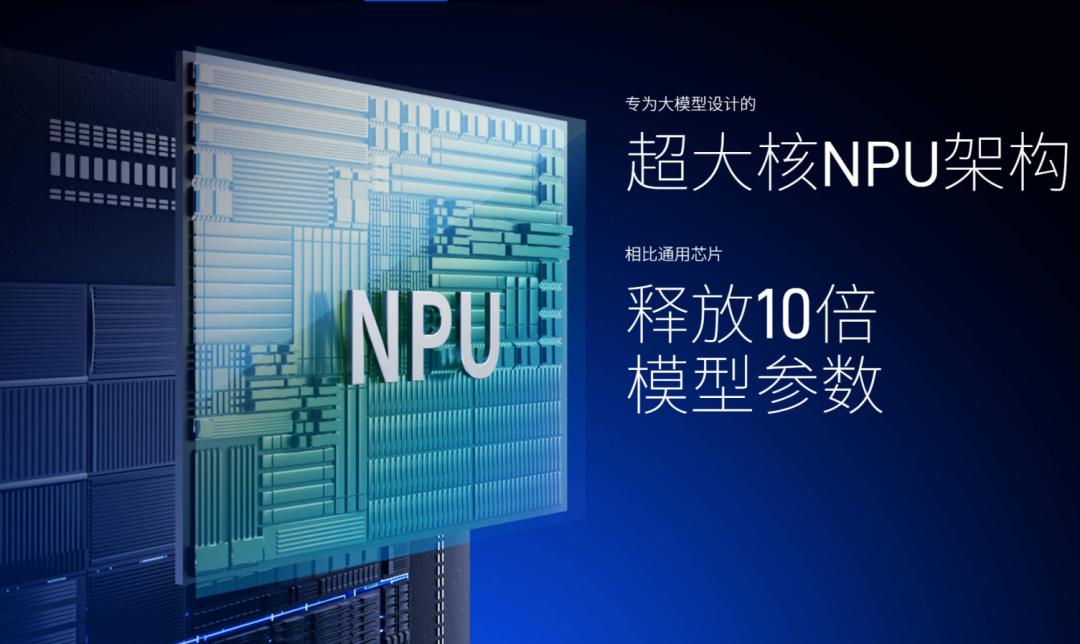
Momenta got involved in the development from the chip definition stage, splitting the small cores of traditional NPUs into ultra-large cores, and configuring dedicated acceleration engines for high-frequency low-volume tasks. The hardware-matched compilation tool can view the entire network, arrange which steps are executed continuously, and determine which results are worth retaining on the chip.
XHEART's confidence comes from Momenta. XHEART was spun off from Momenta's chip project. The two are separated from the same origin, have no direct equity relationship, and maintain deep business ties. Li Jun, the current chairman of XHEART, is the former head of Momenta's chip team, and Cao Xudong, CEO of Momenta, indirectly holds shares in XHEART through its controlling shareholder.
According to the data disclosed by Cao Xudong at the end of October, Momenta's intelligent driving installation scale has reached about 1.4 million vehicles, and the cumulative total driving distance of relevant vehicles has exceeded 20 billion kilometers. This allows XHEART to obtain long-tail scenario data in advance and figure out how much redundancy the chip should reserve. For intelligent driving chips that require heavy asset investment and cannot be modified after the architecture is finalized, this greatly reduces the trial and error cost.
However, X7 Ultra also faces a problem, that is, the time difference between models and chips.
It takes years for a chip to go from architecture design to mass production, while a model may iterate once every few months, making it difficult to quantify how much space should be reserved for the future.
For example, Qianli Technology's AI millimeter-wave radar extends its effective service life by changing the radar from a fixed specification mode to an OTA-upgradable mode. The end-side model can be continuously updated via OTA. If the next-generation model only requires better target classification and trajectory prediction, OTA can extend the radar's service cycle; but when it comes to improvements in hardware dimensions such as sampling rate and input bandwidth, OTA can do nothing.
For XHEART, the area reserved for cache on X7 Ultra can hardly be adjusted again. During the next round of financing window, it is crucial for X7 Ultra to withstand the test of at least one model iteration.
Momenta breaks away from the price war with a hardware-software integrated system
"Momenta's move to bind chips is essentially a convergence of technical routes. There is no need to place bets on multiple parties anymore, and it can make heavy investments on its own business." An industry insider in the intelligent driving sector told *Digital Intelligence Rush*.
As an intelligent driving algorithm enterprise, Momenta was also on the cooperation list when IM Motors developed the mass-produced intelligent driving solution based on Thor. For SAIC Volkswagen ID. ERA 9X, the debut model of Momenta's R7 World Model is equipped with XHEART X7.
Early-stage hardware design requires clear models and scenarios, chips require real vehicle data for verification, and vehicle regulation certification requires stable mass production projects. The entire chain requires continuous backflow of data and cash flow, at which point the cross-platform adaptation "Android-style" model delivers relatively good results.
This is Momenta's advantage over Horizon Robotics. It does not need to bet on any single chip, and can run its models without being affected by changes in the hardware landscape. At the stage when the technical route is uncertain, spreading bets on various chip platforms leads to lower risks.
However, the price war among car companies is pushing down the per-vehicle software licensing fee, leaving less bargaining room for software suppliers. At the 2026 half-year results meeting, Momenta mentioned that the price war is impacting the selling price of per-vehicle software licenses, but the company will not cut prices without a bottom line.
Cao Xudong made a clear timeline for placing his chip bets on his own side.
In 2023, Momenta brought the two-stage end-to-end solution into mass production, and at the same time confirmed the judgment of large-model-defined chips and started to promote chip collaboration; in 2024, it completed the one-stage end-to-end technology based on imitation learning; in 2025, it launched R6 and elevated the role of reinforcement learning; by 2026, the R7 World Model made its mass production debut, and the technical route shifted from the segmented end-to-end solution to the one-stage end-to-end driving model plus the world model.
Now Cao Xudong clearly stated at the launch event that the end-to-end large model and the world model have become the confirmed main technical line for intelligent driving, and intelligent driving is shifting from rule-driven to data-driven. Along this path, the hardware computing requirements for the model can already be handed over to the chip team for discussion.
Momenta has not given up the cross-platform business. In addition to NVIDIA Orin and Thor, its announced cooperation with Qualcomm spans multiple computing platforms of Snapdragon Ride. X7 Ultra only gives Momenta an extra set of options for native design, and the model itself still retains cross-platform capability as a fallback.
In other words, Momenta's algorithm is shifting from full openness to layered openness: the bottom layer provides adaptation for cross-brand chips; the top layer provides the X7 Ultra + R7 combination with optimal performance and the best experience consistency.
According to Li Zonglin, X7 Ultra will be sold separately, with no exclusive relationship with Momenta's algorithms. Car companies can purchase the two separately, and he cited IM LS6 which is equipped with self-developed IM AD system as a counterexample. For this model, the intelligent driving algorithm is deeply bound to Momenta, but the system uses IM Motors' own IM AD brand, and the chip chooses NVIDIA Orin X.
Compared with Horizon Robotics' model, the enterprise is extending from the chip side to algorithms and complete intelligent driving solutions.
From Journey 2 to Journey 5, it provides customers with chips, algorithm authorization and hardware reference design. For Journey 6P, it further developed the full set of HSD software. The subsequently launched HSD Together allows partners to obtain base model authorization and algorithm adaptation services, so that car companies and suppliers can complete vehicle model adaptation, function customization and system integration on their own.
Both companies are talking about openness and seeking a balance in the integration of software and hardware. The difference is that Yu Kai uses a set of proven software to lower the threshold for customers to choose Journey chips, while Cao Xudong uses a chip that he participated in designing in advance to reduce the difficulty of deploying his own models on vehicles.
Is it a chip department or a unicorn
To challenge NVIDIA, XHEART is not only facing Orin.
Li Auto's engineers rewrote PTX instructions on Orin, which proved the optimization blank of general-purpose chips, but also proved the ecological advantage of Orin.
Engineers can write their own computing programs with CUDA, TensorRT is responsible for optimizing inference execution, and DRIVE OS provides the vehicle-end software foundation. If an operator is not suitable for the dedicated accelerator, developers can evaluate whether to transfer it to the GPU, and then evaluate the additional overhead incurred.
This method may be time-consuming and power-consuming, but it gives engineers the opportunity to deliver new functions on the original chip. Car companies still purchase Orin even though they know there is a lot of waste in its computing power, which is to ensure that intelligent driving algorithms can be implemented faster and with lower uncertainty.
When car companies need to reserve space for future OTA function upgrades, redundant computing power becomes a way to hedge against uncertainty.
Currently, intelligent driving functions are iterating extremely fast, and being left behind by competitors if the new functions are not deployed on vehicles for several months. The general-purpose GPU architecture can maximize the adaptability to different algorithms. The CUDA ecosystem has completed tool binding and developer accumulation, which can ensure the steady progress of the algorithm team's training process, and this is the key point for car companies to make their choices.
Part of the redundant computing power cannot be fully explained as waste. To maintain general-purpose computing capability for all tasks, GPUs have to reserve a large number of scheduling and redundant logics, which itself consumes resources in the intelligent driving scenario. Other margins are reserved to ensure that the slowest few frames are still completed on time when multiple cameras send data at the same time, and parking tasks compete for resources with obstacle detection.
At the same time, the system needs to reserve resources for fault detection, redundant computing and degraded takeover. These normally idle resources constitute the safety redundancy of the intelligent driving system.
This is the real problem for X7 Ultra. No matter how efficient the dedicated chip is, if it takes time to adapt and rewrite the toolchain after deployment, the saved computing power will soon be eaten up by engineering costs.
For X7 Ultra, it needs to convert the in-depth optimization of a single model into transferable capability across multiple models, open the compiler, operator library and SDK to reduce the adaptation cost for third-party algorithm teams, and publish data on latency, power consumption, model coverage and continuous operation under the same conditions, to prove that the architecture can be reused across models.
XHEART has now entered the mass production rhythm. The company disclosed that the X7 series has been in mass production for eight months, with cumulative shipments of more than 200,000 chips, which have been installed in 10 mass-produced vehicle models, and has obtained orders for more than 40 vehicle models.
The entry of industrial investors such as Renault, Chery and CXMT, as well as the presence of TSMC and SAIC at the launch event, indicate that XHEART's industrial position has been initially stabilized. Whether it can take this step will determine whether XHEART remains Momenta's internal chip department, or becomes a truly independent chip enterprise.
This article is from WeChat Official Account "Digital Intelligence Rush", written by Bai Ji, and authorized for release by 36Kr.