After the output speed is increased by 100 times, why is the middle management the first to be eliminated in Silicon Valley?
Shen Translation is a translation team under 36Kr, focusing on technology, business, workplace, life and other fields, with a focus on introducing new technologies, new perspectives and new trends from abroad.
Editor's Note: AI has driven the cost of doing things to almost zero, yet collaboration has become the biggest bottleneck holding back progress. The most valuable resource in the future will not be productivity, but people who can help teams reach consensus. This article is translated from foreign sources.
A seemingly crazy rumor is spreading: AI will make managers redundant. With AI, enterprises can deliberately keep their teams small, where agents and humans work side by side to take on substantial work, and a single person can deliver results that used to require an entire department to complete.
At the end of 2024, Gartner predicted that by the end of 2026, one in five organizations will use AI to flatten their organizational structure and cut more than half of their middle management positions.
This is not just a rumor. AI-native enterprises such as Block, Cognizant, Lovable and Every have already put these ideas into practice and seen positive results. We should all pay close attention to their practices.
This is just like the first batch of factories after electrification. Most factory owners only replaced the steam engine with a large electric motor, kept the workshop layout completely unchanged, and as a result, productivity did not improve for decades. The real winners installed small motors on every machine and redesigned the workshop layout around the actual work process. They did not just introduce new technology and force it into existing workflows, but redesigned everything around the new technology.
A close look at these companies makes it easier to understand why they are reaping benefits from AI, while other companies have put their entire AI projects on hold. These companies obviously have not figured everything out yet — no one can come up with a clean and perfect solution on the first try. But some interesting patterns have already emerged.
The best description of where all this is heading comes from cutting-edge tech companies. Block CEO Jack Dorsey and Roelof Botha co-wrote a widely circulated article *From Hierarchy to Intelligence* about how they rebuilt Block around AI. Later, Elena Verna, a well-known growth operator working at Lovable, published her field notes after working for a year at a truly AI-native company. Finally, Every CEO Dan Shipper described in *After Automation* how the company operates after automating everything that can be automated.
To complete this transformation, we must first change the existing assumptions about "how a company should be managed": the assumption that a company is nothing more than an organizational chart, that managers are responsible for keeping their subordinates aligned, that innovation takes place in specially designed laboratories, and that meetings are primarily for transmitting information.
The hardest problems to solve are systemic problems. In a systemic problem, as long as you are inside the system, you are part of the problem. Your biggest blind spot is yourself.
— Dave Gray, author of *Liminal Thinking*
This article is my attempt to clarify what these new beliefs mean for everyone else. The hard part of reading this article is not understanding new perspectives, but letting go of the old views that you thought were already self-evident.
This article will discuss the following topics in order:
1. What changes are taking place at the individual level
2. Which links start to malfunction as the system transforms
3. Where the bottleneck of the system is shifting to
4. What new roles have emerged after agents join the team
5. What management infrastructure is still missing to make all this work
First, what changes are taking place at the individual level
Let's first look at how this transformation affects employees. At the individual level, seven shifts are taking place, and the seventh one is the most important.
The boundaries between job titles are blurring. At Every, operations and customer service staff are doing work that used to require engineers, and all engineers also communicate directly with customers. At Lovable, senior people who used to have dozens of direct reports are now happy to get their hands dirty and build things themselves. Traditional functional titles are no longer that important. This impact is also supported by measured data: in a randomized trial conducted by P&G on 791 professionals, people without AI stuck to their own areas — R&D staff proposed technical solutions, and business staff proposed business solutions; after getting access to AI, people from both sides came up with solutions that took into account both technology and business, and the quality of work also improved.
Everyone can "ask" the company to retrieve everything it knows. Jack Dorsey calls it the "World Model", and Lovable calls it the "Company Brain". Both are centralized systems that draw every useful data point from various decentralized systems of the company — every Slack message, every document, every meeting record, every KPI — to build a continuously updated digital twin of the organization. These highly relevant contextual information is open to everyone at any time, so everyone works based on the same basic information.
Agents take on substantial work, and everyone becomes a manager of agents. At Every, when you @ a colleague on Slack, there is a 50% chance that the other party is a real human, and 50% chance that it is an AI. At Lovable, each agent has a designated real person responsible for its output, a knowledgeable "agent parent". Directing, reviewing and correcting agents has become part of daily work.
People take on larger goals that they dared not try before. The upper limit of what an individual can attempt has been raised, and work that was too costly to launch in the past has become feasible.
Approval checkpoints are reduced, and everyone becomes a founder. When an experiment only costs a few tokens and takes one day, no one needs a committee to approve it. Control has not disappeared, it has only shifted position. As Alex Lieberman described, this means that a non-technical employee can push an idea to launch with built-in governance mechanisms. This used to be called intrapreneurship, which only belonged to a designated few people, but that is no longer the case now. A tool built by someone for themselves can become an agent for the team, then become a shared practice, and eventually become an internal product.
It also feels good. In a survey of tech practitioners conducted by Lenny Rachitsky and Noam Segal this summer, 82% of respondents said AI has effectively improved their efficiency, and 49% said they have been "amplified" (able to do more and do better). The P&G experiment also measured the emotional dimension, and found that people collaborating with AI are more excited, energetic and passionate, with less anxiety, frustration and distress, and people who use AI in teams have the greatest improvement. The emotional boost brought by collaborating with AI alone is no less than, and even exceeds, having a real human teammate.
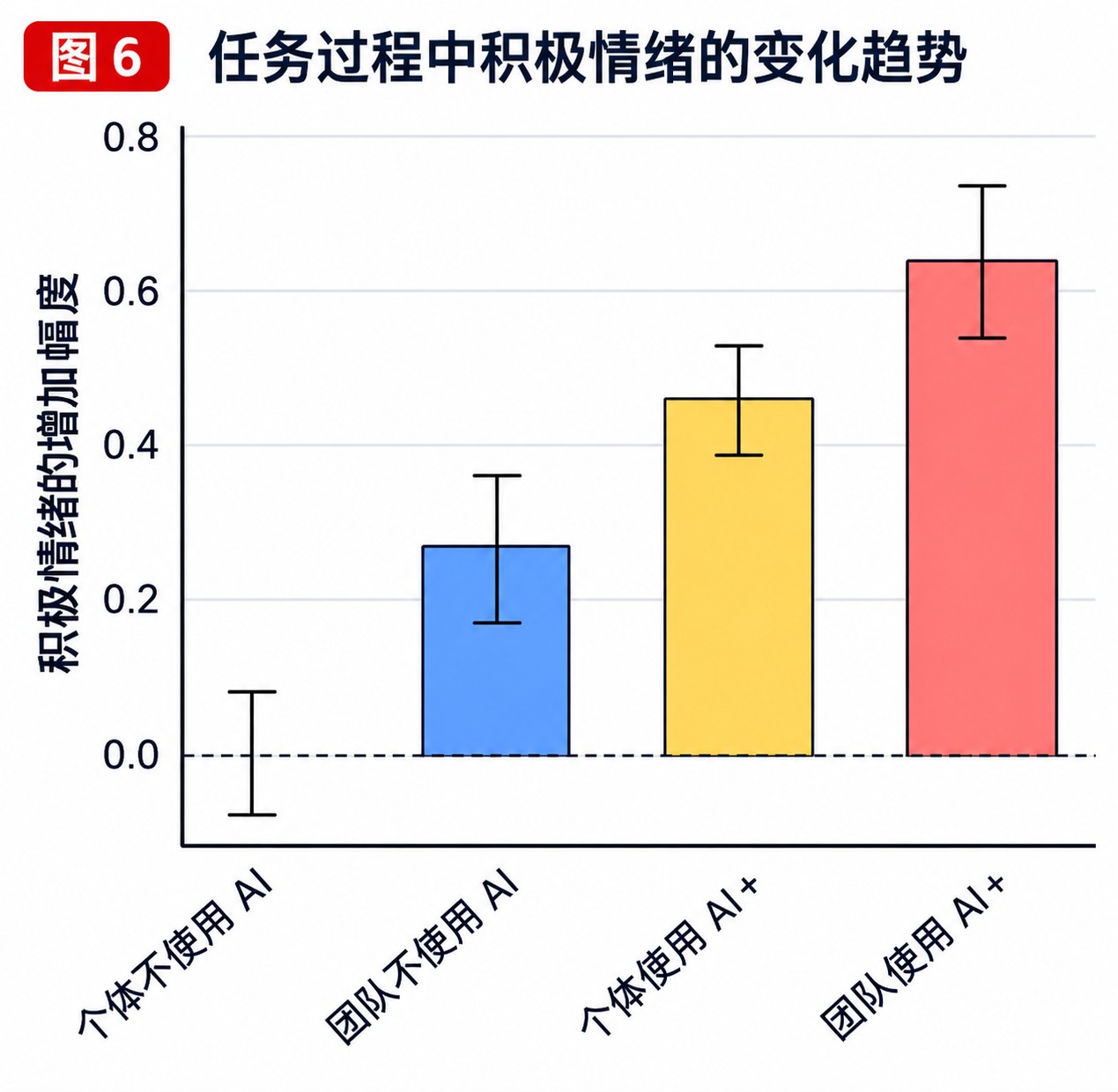
The Cybernetic Teammate, *Organization Science*, 2026
The seventh shift: the unique advantage of human beings
For individuals, the biggest transformation is that their value has been "disassembled". As AI agents take on more and more production work, people are discovering where their truly unique value lies — judgment, taste and intention.
To understand what "human judgment" is, we first need to figure out what category of knowledge judgment belongs to.
Cognitive scientist John Vervaeke divides knowledge into four categories:
Propositional knowledge: knowing "what it is";
Procedural knowledge: knowing "how to do it";
Perspectival knowledge: knowing what the situation looks like from where you stand;
Participatory knowledge: knowing what it feels like to play your own role in it.
AI has absorbed the first two types of knowledge, while real human judgment exists in the latter two.
A diagram in Dan Shipper's *After Automation* best illustrates why judgment will become a unique advantage in the AI era.
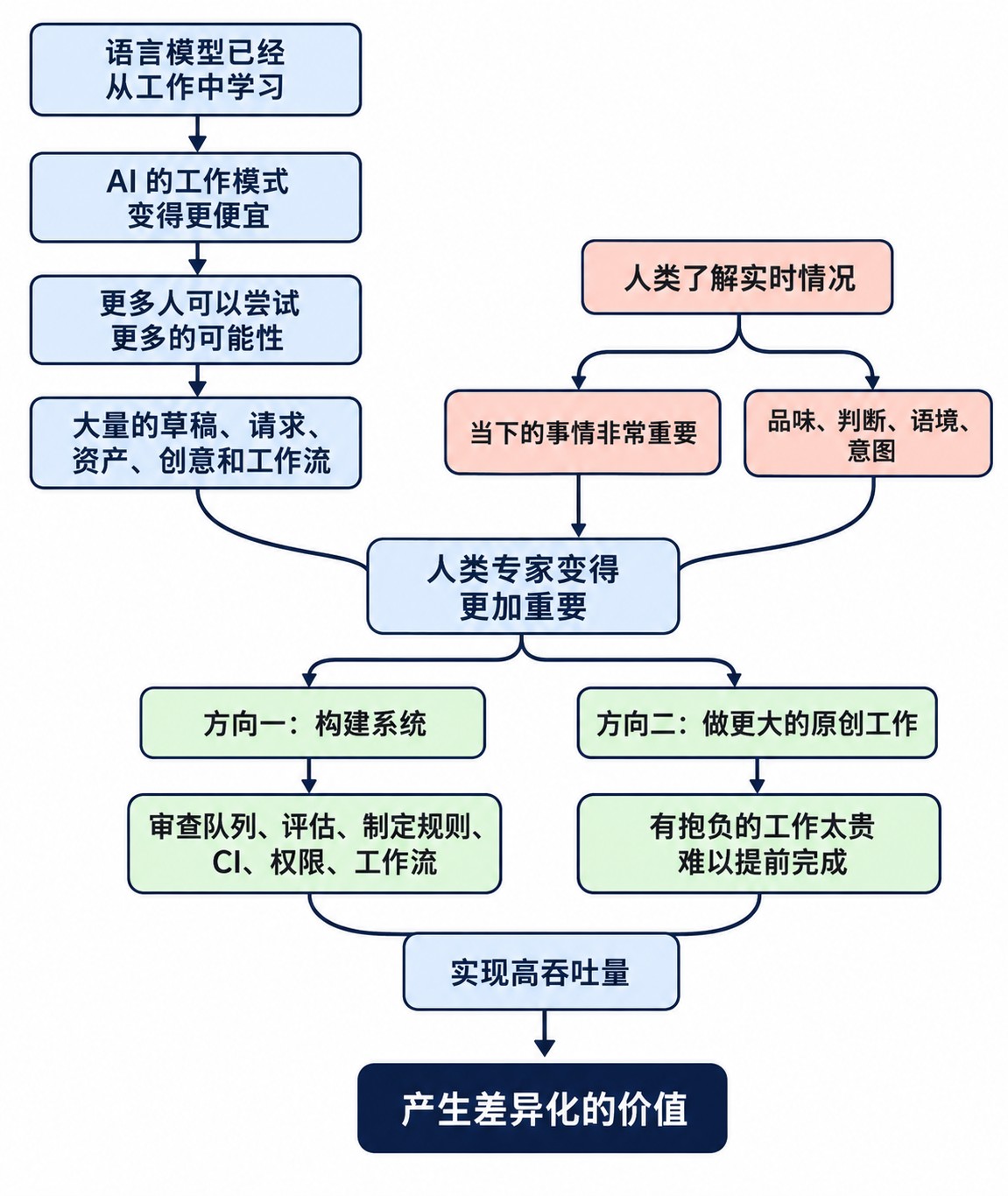
Dan Shipper, *After Automation* (Every, May 2026).
In short, two realities are converging. On the left, large language models learn from work that has already been completed, which allows everyone — regardless of title, experience or function — to freely try all kinds of things and call on an increasingly intelligent knowledge base of propositional and procedural knowledge.
On the right are people who understand the real-time situation, who can see the situation clearly from their own position, know what is most important at the moment, and are in the middle of it rather than just observing. This is judgment formed by perspectival and participatory knowledge, which AI can never achieve.
Jack Dorsey made a similar statement in his article. People are on the edge of the company, where intuition, trust and "feeling the room" really play a role. Elena Verna added that before people choose a path, they will ask themselves: "But is this Lovable enough?"
The strange paradox is that the more AI takes away the mechanical parts of work, the more companies seem to rely on human judgment. When information is ubiquitous, execution costs are low, and everyone has amazing leverage, it becomes extremely important to know what to do, when to intervene, what the standard of goodness is, and when a thing is truly completed.
— Elena Verna, Head of Growth at Lovable
Secondly, which links start to malfunction
Everything described above sounds exciting, but these companies have also produced some unwanted by-products in the transformation process. We are still in the early stage, and correlation does not equal causation, but the leading companies have already seen where costs are accumulating. Here are some of them:
There is more output, but it is becoming more and more homogeneous. When everyone can generate a decent first draft for anything with the help of a tool designed to output "the average of all past results", people with real professional competence are still needed to review, improve or discard it directly. Otherwise, we will move towards homogeneity, and homogeneous things are just generic commodities. Execution has become cheap, and bad judgment has become more expensive instead.
Slop is the visible homogeneity, repeated endlessly.
— Dan Shipper, CEO of Every
Work collides with each other, causing people great stress. Since the cost of starting a task is very low, people will try to do everything. They don't wait to be assigned, nor do they ask anyone first. As a result, two people take on the same problem from different angles and don't find out about each other until they finish. Collision is a major source of uncertainty for people, and the increase of uncertainty is one of the main causes of burnout.
There are indeed times when "high agency" is just a nice way to describe duplicated work, unclear rights and responsibilities, or someone stepping on other people's toes. Sometimes chaos leads to better results, and sometimes it is just chaos.
— Elena Verna, Head of Growth at Lovable
Managers can no longer hear voices. A survey by TNG found that 60% of respondents at least once a week take questions that they would have asked their managers to AI instead. When people bring their questions to AI, managers lose a main channel to find out where things are unclear.
Becoming an efficient manager has become harder. Even before the advent of AI, this was a difficult job. In a 2025 survey of tech practitioners, only 26.6% of respondents thought their managers were very efficient, and 42.3% thought they were ineffective. AI has made this even harder: managers have less information to rely on, because the questions that would have told them where things are unclear now all flow to AI; there are more things that need to be coordinated, because work progresses faster and collisions happen more frequently; they are also squeezed from above — in the TNG survey, front-line managers are the group most worried that senior management has too high expectations for AI, accounting for 36%, compared with 23% for senior management. This is important because efficient managers are of great value: people with good managers have a 63% higher sense of belonging and 31% less burnout.
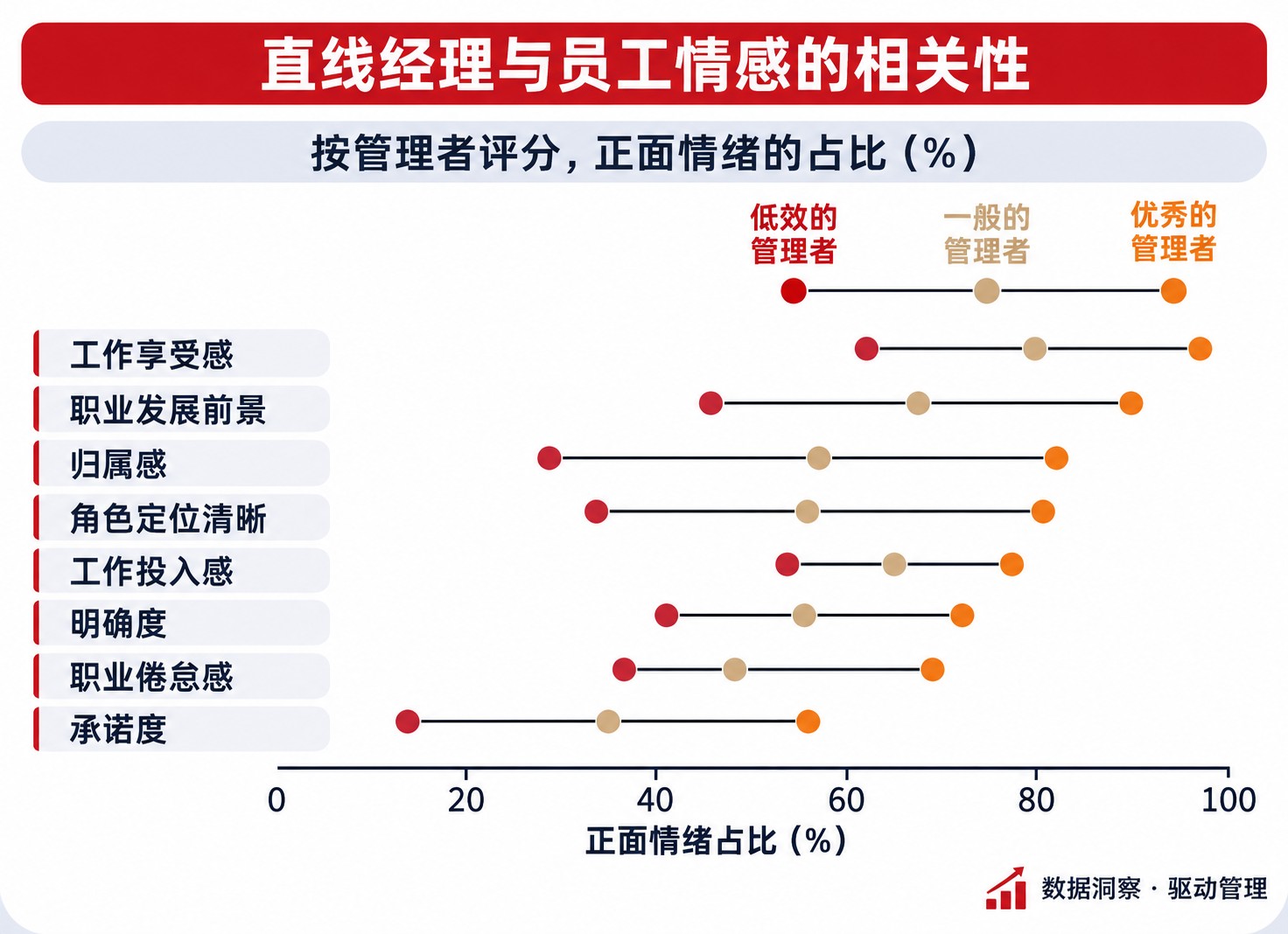
Lenny Rachitsky and Noam Segal. 2025
People run faster, but feel worse. In this survey of tech practitioners, the burnout rate rose from 44.7% to 55.7% within a year. People are worried about being asked to do more with the same pay (51%), the unsustainable pace (46%) and the declining quality of work (41%). The same concerns have emerged in Sweden: in the TNG survey, the top concerns are wrong decisions caused by incorrect data (51%), and human judgment being sidelined (50%).
The judgment paradox
There is a paradox worth stopping to think about here: if human value is shifting to judgment, why are 50% of respondents afraid of losing exactly that?
Part of the answer is that we are not talking about the same thing. At Lovable, people are consciously automating themselves:
If you think the next sentence is "... then we won't need you anymore", then "automate your own work" sounds scary. But here, it's more like "... so that you can figure out what your work should become next".
— Elena Verna, Head of Growth at Lovable
What people at Lovable automate are tasks that rely on propositional and procedural knowledge (that is, the "what it is" and "how to do it" tasks). What they will not voluntarily give up is the judgment that determines whether the work result is good or not. Evaluating AI's output mainly means finding errors, questioning assumptions, and rejecting substandard quality.
Unfortunately, almost no one's performance evaluation is linked to this. KPIs usually focus on speed, quantity and output, and no one gets rewarded for slowing down because they think something is not good enough. Coupled with the pressure to do more in less time, the rational choice is to hand over more judgment to AI, even when it should not be done.
The second reason is more dangerous. AI separates "the ability to make something" from "the ability to judge whether it is good or bad". Many of the things we try now are outside our own area of expertise. So we send the draft to someone we really trust in this matter, someone who has real domain knowledge. The cost of judgment falls on the person who did not initiate the attempt in the first place. As shown in the figure above, experts are now overwhelmed by a large number of things that require their judgment. Then who can blame them when they outsource part of that judgment to AI? Since there is almost no incentive to find errors, why would you risk burnout to pick out mistakes in other people's work?
The failed form of lazy work today is not insufficient output, but excess output... We are all throwing slop grenades at each other.
— Tobias Lütke, CEO of Shopify
Finally, there may be something more sinister going on. After Meta started installing software on employees' computers to collect mouse movements, clicks and keyboard inputs to train its own AI models, I guess many experts have started to think