State-owned capital takes stake, Zhentai Intelligence secures tens of millions of yuan in Series B financing, its brain-computer rehabilitation products have entered more than 500 hospitals | 36Kr Exclusive
Text by Hu Xiangyun
Edited by Hai Ruojing
36Kr has learned that Xi'an Zhentai Intelligent Technology Co., Ltd. (hereinafter referred to as "Zhentai Intelligence") has recently completed a Series B financing of tens of millions of RMB. This round of financing is jointly invested by Zhangjiang Sci-Tech Investment and Cinda Future Industry Fund, which is also the first introduction of state-owned capital since the company was founded. The raised funds will be used for the registration of three categories of innovative brain-computer interface medical devices, R&D of underlying core technologies, and the large-scale implementation of the national three-level "hospital-community-home" rehabilitation network.
Previously, the company has received investments from institutions such as Lenovo Capital and Incubator Group, MiraclePlus, and Suzhou Populus Euphratica Capital.
Wang Haochong, founder of Zhentai Intelligence, holds a master's degree in mechanical engineering and an on-the-job doctorate in biomedical engineering from Xi'an Jiaotong University. He introduced that the company was incubated and established relying on the "863 Program" project of Xi'an Jiaotong University, with the core research direction of brain-computer interface rehabilitation robots. In 2017, during his postgraduate study, he deeply participated in brain-computer rehabilitation clinical trials in project partner hospitals.
At that time, traditional rehabilitation equipment was dominated by passive, mechanized training, with low patient participation and difficult to guarantee the compliance of repeated training. On the demand side, the number of groups with stroke and postoperative motor/cognitive impairment is very large, and patients in grassroots and rural areas often lack continuous rehabilitation services, making it difficult to make effective use of the golden rehabilitation period. Under this background, Wang Haochong hoped to industrialize the technical achievements of his subject research to serve a larger group of people.
In August 2018, Wang Haochong officially founded Zhentai Intelligence, applying non-invasive brain-computer interface technology to the field of medical rehabilitation, and providing "integrated intelligent brain-computer rehabilitation solutions" for hospitals and rehabilitation institutions. Up to now, it has obtained 4 national Class II medical device registration certificates, its products have entered more than 500 hospitals and community institutions across the country, and have served hundreds of thousands of patients in total.
The problem of traditional passive rehabilitation is that passive training only relies on equipment to drive limb movement, and the cortical area of the patient's brain responsible for active motor intention is not fully activated, so it is difficult to drive the core mechanism of neuroplasticity, that is, "remodeling of neural synaptic connections". The consensus in the field of neuroscience is that the brain has neuroplasticity, and training with active motor intention can effectively drive the remodeling of bypass motor neural synaptic connections, which is the core scientific basis for neurorehabilitation.
Based on this principle, the product technical route of Zhentai Intelligence can be summarized as the "BCI+VR+Robot" solution: the brain-computer interface collects EEG signals and recognizes motor intention as proof of the patient's active participation; VR provides visual, auditory and tactile feedback through immersive scenarios, which is linked with the recognition results of the brain-computer interface in real time to strengthen the generation and maintenance of the patient's active motor intention; finally, the rehabilitation robot converts the intention into real limb movement, thus forming a closed loop among the three.
At the same time, under the framework of neuroplasticity, the team further put forward three core technical requirements of "active, real-time, two-way closed loop". "We believe that the equipment needs to respond to the patient's motor imagery intention within 1 second. If it exceeds 3 seconds, the patient's active intention response will be delayed, the training cannot effectively trigger neural feedback, and the effect will drop significantly." Wang Haochong said.
However, when the team tried to implement this route into products that can be widely used in hospitals, they once "faced a completely blank situation". At the beginning of Zhentai Intelligence's entrepreneurship, the domestic brain-computer interface industry was still in a very early stage, lacking mature wearable brain-computer interface hardware platforms and special algorithm datasets for patients.
"Therefore, we put forward the concept of 'General Brain-Computer Interface (GBCI)', and set three verifiable indicators: recognition accuracy greater than 90%, single imagery response time less than 1 second, and individual applicability greater than 90%." Under this indicator standard, the team began to deduce the required technical capabilities, and decided to self-develop electrodes, chip modules and algorithms.
In terms of electrodes, conventional clinical wet electrodes need to be coated with conductive paste, the training window for a single patient is only 20 minutes, and the paste coating and wearing process takes 5 to 10 minutes. Therefore, the team turned to saline electrode and dry electrode solutions, added an active amplification module behind each electrode unit to solve the problem of high impedance, and adopted a flexible structure to meet the anti-interference acquisition requirements under motion state.
At the algorithm level, Wang Haochong explained that traditional laboratory data often comes from healthy people, and the accuracy will drop significantly when migrated to patient groups. Zhentai Intelligence chose to start from scratch, and continuously carried out clinical cooperation with medical institutions to label stroke patients with different injury degrees and different rehabilitation stages in layers, so as to accumulate clinically differentiated samples.
For example, the company has jointly established a "brain-computer interface motor imagery dataset" with many top tertiary hospitals including Xuanwu Hospital, Air Force General Hospital and Renji Hospital, which includes continuous grasping of left and right hands, lower limb leg lifting, walking and other movements, increasing the average recognition accuracy from the conventional 50%-60% to 86.41%, and more than 90% for some patients.
The return of these clinical data has laid a foundation for model iteration. According to information provided by Zhentai Intelligence, at present, the daily usage of more than 500 partner hospitals reaches thousands of person-times, accumulating hundreds of thousands of patient records throughout the year. "We hope to verify the safety and effectiveness of products relying on large-scale real-world clinical data. In the next stage, we will focus on building a brain-computer interface neural data base model, and strive to achieve more personalized and accurate rehabilitation treatment and prediction."
In terms of products, based on existing technical capabilities, Zhentai Intelligence has obtained 4 national Class II medical device registration certificates, which are respectively for EEG collection and evaluation, upper and lower limb rehabilitation, hand function rehabilitation, and speech cognitive training, covering dimensions from function evaluation to PT (physical therapy)/OT (occupational therapy)/ST (speech therapy) training. The number of product channels covers 8-128 channels, of which 32 channels are the conventional clinical configuration, and higher-density wireless wearable EEG products are also under continuous R&D.
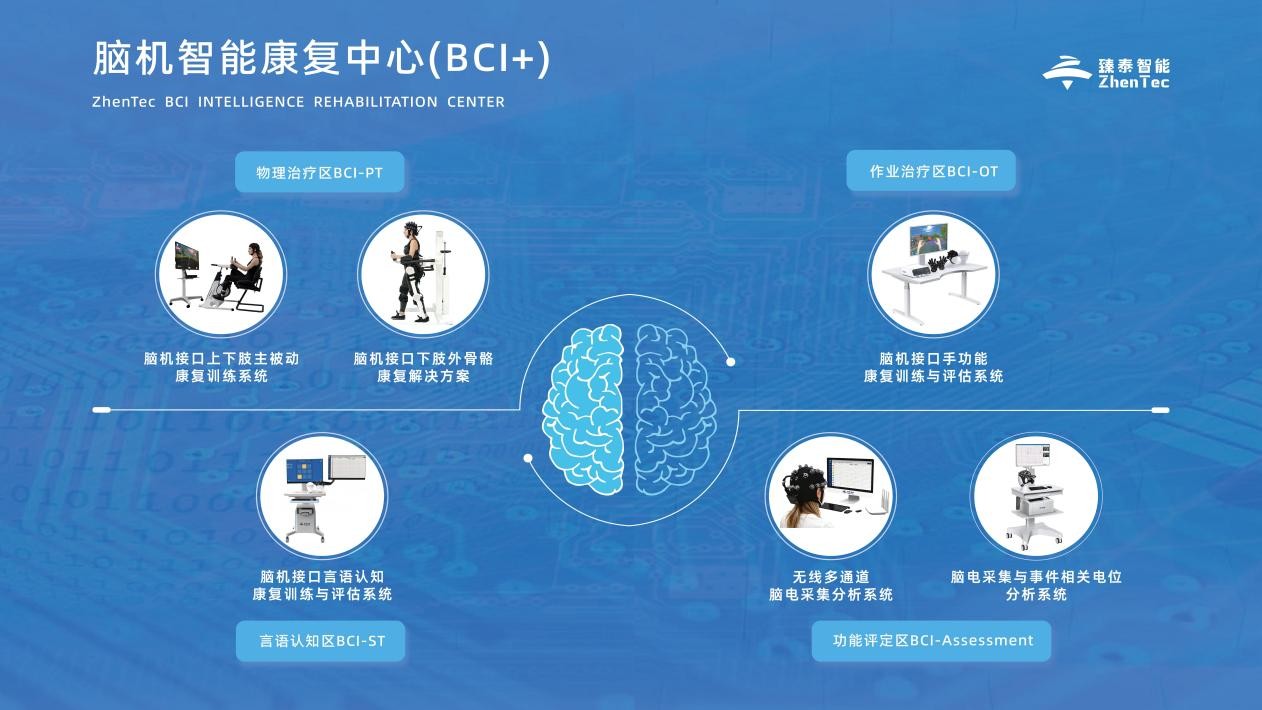
Image source: Zhentai Intelligence
A large-sample controlled clinical trial of the company shows that after adopting the active closed-loop brain-computer rehabilitation route, the rehabilitation efficacy is about 30% higher than that of traditional passive training, and the treatment time is shortened by nearly 1/3. Specifically, patients using brain-controlled rehabilitation have a 22.49% improvement in LOTCA (Loewenstein Occupational Therapy Cognitive Assessment) cognitive function, 22.30% improvement in FMA-LB (Fugl-Meyer lower limb motor function score), 30.62% improvement in FMA-B (Fugl-Meyer balance function score), and 36.50% improvement in MBI (Modified Barthel Index of Activities of Daily Living).
According to Wang Haochong, in September this year, the company established a wholly-owned subsidiary in Zhangjiang, Shanghai, and the innovative brain-computer interface product with AI algorithm as the core has launched the registration application for Class III medical devices. In addition, the company plans to expand to the fields of cognitive and emotional disorders, and build new product and technology bases for Alzheimer's disease, depression and anxiety. "We hope to realize the transformation of brain-computer interface technology from rehabilitation-oriented to treatment-oriented, complete the layout of the three major fields of 'motor-cognition-emotion', and serve more patients."
In terms of people's livelihood demonstration and scenario implementation, Zhentai Intelligence has built a brain-computer rehabilitation product experience center in Xi'an High-tech Zone, and signed a strategic cooperation agreement on science and technology assisting the disabled with Xi'an Disabled Persons' Federation; in addition, the company has implemented a brain-computer interface cognitive rehabilitation demonstration station in Shanghai Little Blue Flower Citizen Center, focusing on elderly cognitive screening, non-pharmacological intervention and home rehabilitation.
Investor Views:
Zhangjiang Sci-Tech Investment said: Brain-computer interface is a representative direction of the national future industry, and neurorehabilitation is a relatively mature track with high clinical value at present. Zhentai Intelligence has the advantages of independent R&D of underlying technologies and the support of national-level project platforms, and at the same time deeply cultivates the people's livelihood scenario of science and technology assisting the disabled, with both industrial value and social value. We will rely on the Zhangjiang science and innovation ecosystem to help enterprises accelerate the industrialization process.
Cinda Future Industry Fund said: The application of brain-computer rehabilitation technology has entered the industrial explosion window. Zhentai Intelligence has been deeply engaged in this field for many years, and has formed all-round leading advantages in multiple dimensions such as technology, standards, clinical practice, scenario implementation and social influence, with a clear commercialization path and strong growth certainty. After this round of investment, we will deeply empower enterprises in resource integration and national expansion, and help the inclusive implementation of brain-computer technology.
Wang Haochong, founder and CEO of Zhentai Intelligence, said: The ultimate value of medical application of brain-computer interface is to serve clinical practice and benefit the people. The successful completion of this Series B financing is a high recognition from the capital market for Zhentai Intelligence's brain-computer rehabilitation industrialization implementation route, which is also the direction that the company has firmly developed since its inception. In the future, we will accelerate the registration and layout of a number of innovative brain-computer interface products in the three major fields of motor, cognition and emotion, continue to deeply cultivate the underlying core technologies, accelerate the full-scenario coverage of hospitals, communities and homes, always take "technology serves life" as the development mission, continuously solve the diagnosis and treatment pain points of major brain diseases through technological innovation, and make cutting-edge technology benefit more patients and families at an early date.