Yang Zhilin went to Hong Kong.
"It feels like half of the people in the venture capital circle are in Hong Kong."
This week, Hong Kong is hosting the FinTech Week, and the 5th consecutive International Financial Leaders Investment Summit has also kicked off. As one of the most high-profile annual financial events in the Asia-Pacific region, people from all walks of life gather in Hong Kong.
Pedaily witnessed a rare scene on site: Neil Shen, Founding and Executive Partner of HSG, Yang Zhilin, Founder of Moonshot AI Kimi, and Xiong Yan, Co-President of Agibot Innovation, held a closed-door discussion.
This is also a rare public appearance of Yang Zhilin recently. At a time when rumors about his company's Hong Kong listing are growing increasingly intense, such a scene is quite meaningful.
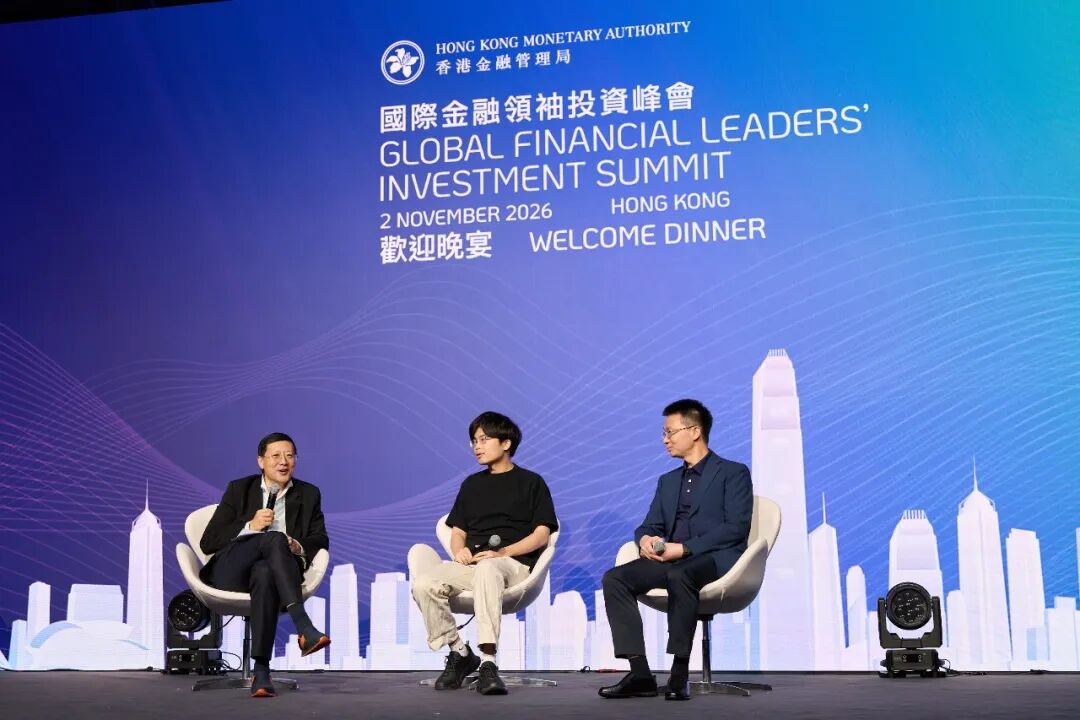
Yang Zhilin Makes Rare Appearance , in Conversation with Neil Shen
Yang Zhilin still travels light: wearing a black top and beige trousers, which seems to have become his iconic outfit, showing a typical style of a tech entrepreneur.
This time, he appeared at the welcome dinner of the International Financial Leaders Investment Summit on November 2, and had a dialogue themed "Technology for Good" with Neil Shen, Founding and Executive Partner of HSG, and Xiong Yan, Co-President of Agibot Innovation, discussing how artificial intelligence and robotics can reshape work patterns, create new business opportunities and improve people's lives.
It is worth mentioning that HSG is an early investor of Moonshot AI and has continued to increase its investment in subsequent rounds of financing. During the conversation, Yang Zhilin responded to the current heated debate between open-source and closed-source models. Benefiting from the large-scale application of recursive self-improvement in the next-generation models, he is confident in the ability of large models to generalize to the physical world in the future.
As far as we can recall, this is one of the few public appearances of Yang Zhilin recently. In the past two years, the founder, who was born in Shantou, Guangdong in 1992, has been particularly low-key. The last time he appeared intensively in the public eye was all about models.
In July this year, Kimi K3 released by Moonshot AI shocked the industry with its open-source weights of 2.8 trillion parameters. The company said that its overall capability is second only to Claude Fable 5 from Anthropic and GPT 5.6 from OpenAI. Not long ago, Kimi K3.1 Pro was also launched: the API price is about 33% lower than that of the previous K3, and the Highspeed version with 2 to 3 times faster speed is launched simultaneously.
External reports said that Kimi disclosed to investors in August that its annual recurring revenue (ARR) has exceeded 1 billion US dollars. Back in June this year, this figure was 300 million US dollars, and its ARR is expected to exceed 2 billion US dollars by the end of this year.
With model iteration and commercialization accelerating in tandem, Kimi has become one of the most powerful players in the global large model arena, and its financing pace is also aggressive. According to Bloomberg, Kimi has completed the last round of financing before listing, with a valuation of about 500 billion US dollars (over 3.5 trillion RMB).
Earlier, Pedaily exclusively learned that Kimi has notified investors to adjust the company structure to prepare for its Hong Kong IPO, and is expected to be listed on the Hong Kong Stock Exchange as soon as the first quarter of next year. Under such circumstances, Yang Zhilin's presence in Hong Kong inevitably leads to associations - the pace of IPO seems to be getting closer.
Hong Kong is Competing for New Money
At this moment, Hong Kong is full of bustling crowds.
Not long ago, Hong Kong just introduced the 7th batch of key enterprises, and 18 enterprises officially settled in Hong Kong or expanded their businesses in Hong Kong. "Half of them are from the Chinese mainland, and the other half are from all over the world." Familiar names such as Agibot, Paradigm Intelligence, 51Vision, Chery Automobile, and Yum China appear on the list.
The other protagonist in this dialogue, Xiong Yan, comes from Agibot. Agibot has deep ties with Hong Kong: it has not only opened its Hong Kong office located in Times Square, Causeway Bay, and plans to invest tens of millions of yuan in Hong Kong, but also will hold campus recruitment seminars at the Chinese University of Hong Kong, the Hong Kong University of Science and Technology, and the University of Hong Kong, and gradually expand its local Hong Kong team along with the advancement of R&D and business.
Such a scene is also a true portrayal of Hong Kong's vigorous efforts to develop science and innovation.
John Lee Ka-chiu, Chief Executive of the Hong Kong Special Administrative Region, mentioned in his opening speech at the FinTech Week that Hong Kong currently has more than 1400 fintech companies, covering mobile payment, cross-border wealth management, artificial intelligence, blockchain and cybersecurity. At the same time, Hong Kong is building a complete sci-tech innovation industrial chain, connecting talents, scientific research, commercialization and industrialization, to further link capital and the global market.
More and more entrepreneurs and investors are flocking to Hong Kong. In the first 9 months of this year, the InvestHK of the Hong Kong Special Administrative Region Government assisted more than 550 overseas and mainland enterprises to set up or expand their businesses in Hong Kong, a year-on-year increase of 14%, involving about 9 billion US dollars of foreign direct investment, and creating about 11100 jobs in the first year.
"They come to invest in Hong Kong for the opportunities that Hong Kong offers. In the coming decades, many important opportunities will come from our Northern Metropolis," said John Lee. The construction of the Northern Metropolis in Hong Kong will create a new dual-engine pattern of "finance in the south, sci-tech innovation in the north" for Hong Kong, which will eventually accommodate about 2.5 million people and provide more than 500000 new jobs.
Connecting the booming tech wave from the Chinese mainland on one end, and the long-term capital from all over the world on the other, the tide of "competing for talents and enterprises" in Hong Kong is sweeping in.
Once upon a time, there was a popular saying in Hong Kong's industrial sector: "High Tech loses money, Low Tech makes big money". It means that doing high-tech business in Hong Kong tends to lose money, while doing low-tech business can make huge profits. Though it is a joke, it vividly reflects the epitome of Hong Kong's past industry.
Times have changed. As more and more cutting-edge tech companies are willing to set up their laboratories, overseas businesses and capital operations in Hong Kong, the industrial background of Hong Kong is being rewritten little by little.
Under the Lion Rock, the waves keep surging. Old Money is fading away, and New Money is rising.
This article is from the WeChat Official Account "Pedaily" (ID: pedaily2012), written by Zhou Jiali, authorized for release by 36Kr.